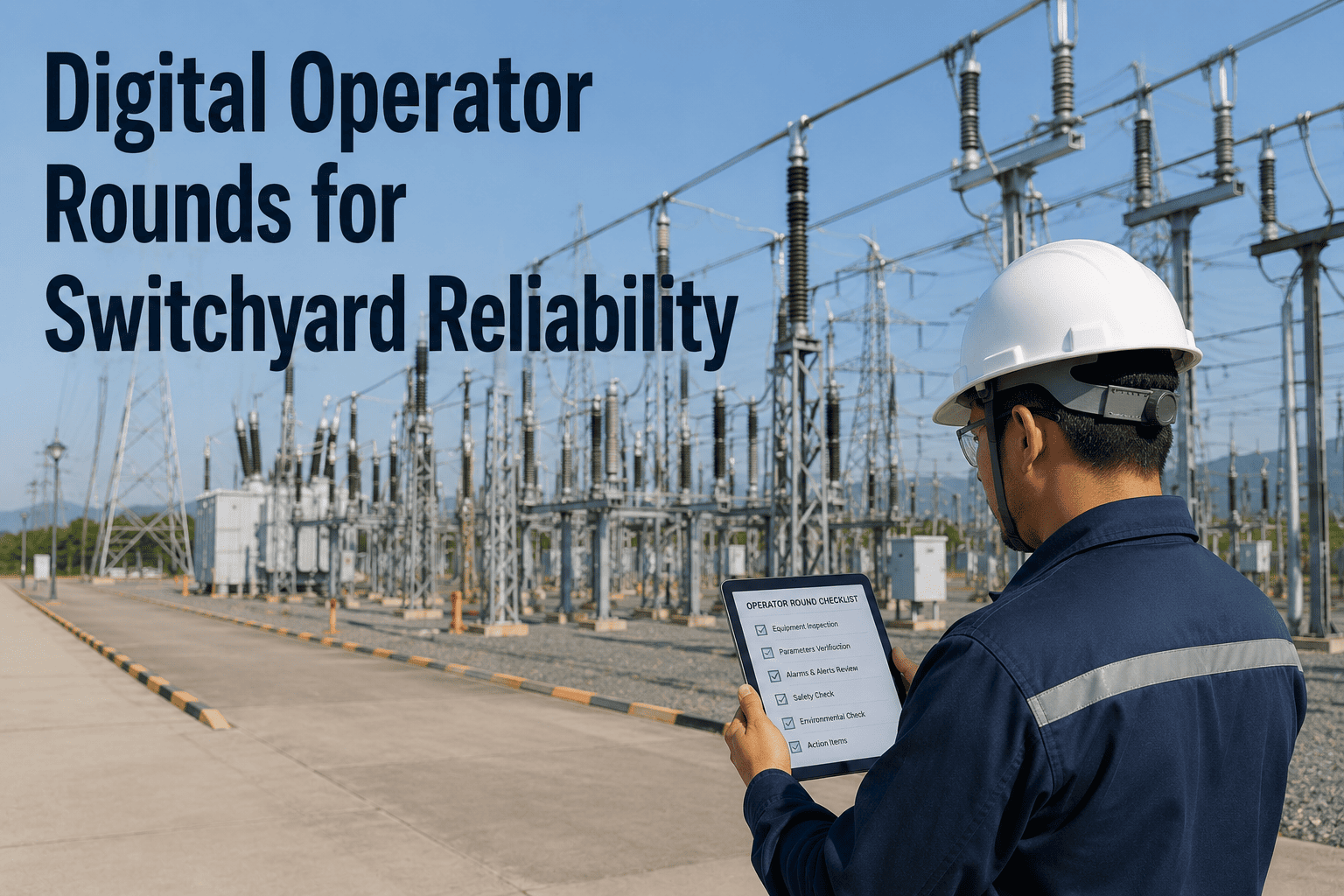
Switchyard equipment failures cause the most severe and longest-duration outages in any power generation or transmission operation — and the majority of them are preceded by warning signs that a structured operator round would have caught first. Breaker timing anomalies, transformer thermal drift, corroded disconnect contacts, and failing surge arresters all give advance notice to an operator who knows what to look for and has a consistent inspection routine to follow. Paper-based switchyard rounds create a compliance illusion: a filled-in form proves someone walked the yard, but does not prove they checked the right things, recorded accurate data, or flagged anomalies to the maintenance team. Digital operator rounds with QR asset scanning, timestamped photo capture, and automated corrective work order generation replace that illusion with a verifiable inspection record. This guide covers the complete digital round structure for switchyard reliability — from breaker condition checks and thermal photography to anomaly reporting workflows and corrective action tracking. Run every switchyard round digitally on OxMaint's inspection management platform and convert every finding into a prioritized work order before the operator leaves the yard.
Substation Maintenance · Digital Inspections · Corrective Work Orders
Digital Operator Rounds for Switchyard Reliability
QR asset scans to thermal photos. Breaker checks to anomaly reports. A complete digital round structure replacing paper switchyard forms — built for generation and transmission switchyards of any voltage class.
QR Asset Scanning
Thermal Photo Capture
Instant Work Orders
Audit-Ready Records
Paper vs Digital
Why Paper Rounds Are Failing Your Switchyard
Paper-based inspection forms have three structural weaknesses that digital rounds eliminate entirely.
Paper Rounds
No verification that the operator actually scanned each asset
Handwritten readings are illegible, estimated, or fabricated
Anomalies noted on paper reach maintenance the next day — or never
No photo evidence of deteriorating equipment condition
Trend analysis requires manual data entry from paper forms
Audit preparation means locating and scanning physical binders
Digital Rounds — OxMaint
QR scan at each asset proves physical presence and correct sequence
Numeric fields with range validation catch out-of-range readings immediately
Anomaly flagged in the app generates a work order in real time
Photo attached to asset record with timestamp and GPS location
Automatic trending on all numeric readings across every round
Audit export from CMMS in minutes — no physical document search
65%
Of switchyard anomalies are first detected during structured operator rounds — not remote monitoring
4.2x
Faster defect-to-work-order conversion with digital rounds vs paper-based reporting
$180K
Average avoided repair cost when a breaker defect is caught on rounds vs in service failure
Replace your paper switchyard forms today. QR-scanned rounds, real-time anomaly alerts, photo-documented findings, and instant corrective work orders — all accessible from a mobile device in the field.
Round Checklist
Six Asset Categories. Every Round.
Structure every digital round around these six asset categories. Each QR scan at the asset locks in the operator's position and timestamps the data entry against that specific piece of equipment.
Oil temperature gauge reading recorded — top oil and winding temperatures
Record both gauges at each round. Trending temperature rise without corresponding load increase indicates cooling system degradation or incipient fault development.
Oil level in conservator tank confirmed within normal range
Log oil level against a defined scale. A dropping oil level may indicate a slow leak or diaphragm failure in the conservator. Capture a photo at each round for trend comparison.
Buchholz relay gas collection indicator checked — no gas accumulation
Gas accumulation in the Buchholz relay is an early indicator of an internal fault. Any gas present requires sampling and analysis before the next scheduled maintenance window.
Thermal image of HV and LV bushing terminations captured (if thermography route)
Bushing terminal hot spots precede catastrophic bushing failures. A thermal photograph at each thermography round creates a progressive temperature history for each termination point.
No oil leaks visible at radiators, valves, gaskets, or cable boxes
Photograph any new oil stain at the base of radiators or gasket lines. Log the location and size as a baseline. Expanding stains require work order escalation and oil level monitoring.
SF6 gas pressure gauge reading logged — no red-zone indication
SF6 pressure below the minimum alarm level means the breaker may not interrupt fault current. Log the pressure reading at every round and trend for slow leak detection.
Spring charge indicator confirmed — mechanism charged for next operation
A discharged operating spring means the breaker cannot trip or close on demand. Verify the spring charged indicator at every inspection round. An uncharged mechanism is an immediate report.
Operation counter reading recorded — compare to last round
An unexpected counter increment since the last round means the breaker operated without a known reason — either a protection trip or control system anomaly. Investigate immediately.
Control cubicle heater operational — no moisture on internal surfaces
Moisture inside the breaker control cubicle causes relay maloperation and contact corrosion. Verify the anti-condensation heater is running and the cubicle is dry at every round.
Disconnect contact alignment visually confirmed — no misalignment or partial engagement
A partially engaged disconnect contact runs hot under load. A thermal photo of a hot contact is the most reliable early detection method. Compare to previous thermography rounds.
Bus insulator condition inspected — no cracks, tracking, or contamination bands
Contaminated insulators flashover at lower voltages than clean ones. Note any bird fouling, industrial contamination, or surface tracking visible on post insulators or strain insulator strings.
Thermal image of disconnect contacts captured — compare to previous round
A 10°C rise in contact temperature between rounds with no change in load current indicates increasing contact resistance. Trending in the digital record triggers maintenance before a hot-spot failure.
Oil level visible in oil-filled CT and VT — no sign of leakage at base or gaskets
A leaking CT or VT can fail catastrophically, causing a phase-to-ground fault and potential explosion. Any oil stain around the base requires immediate tagging and work order escalation.
No unusual noise — no hum, buzzing, or corona discharge sound at CT and VT
An unusual hum from a VT can indicate incipient ferroresonance. Corona discharge audible at ground level suggests insulation degradation at a level that requires engineering review.
Porcelain and composite housing inspected — no cracks or chips in shed profile
A crack in CT or VT housing admitted moisture can cause a tank failure under fault conditions. Log any cracks photographically and escalate to the outage maintenance planning queue.
Surge arrester leakage current monitor reading recorded (if fitted)
A rising leakage current trend indicates zinc oxide disc degradation inside the arrester. Trending the reading at every round gives advance warning before the arrester fails short-circuit or open.
No visible cracks, tracking, or discoloration on arrester housing
Surface tracking or discoloration on the arrester housing indicates high leakage current history or direct discharge damage. A damaged housing arrester should be replaced at the next planned outage.
Ground lead connections inspected — no corrosion, loose bonding, or open ground
An arrester with an open ground lead provides zero protection during a lightning or switching surge event. Verify the ground connection visually and photograph any corroded or loose bonding at each round.
Security fence condition and gate locks verified — no unauthorized access signs
An open or damaged fence around an energized switchyard is an immediate safety and security incident. Log any breach with a photo and raise a work order for same-day repair.
Gravel surface condition adequate — no standing water or muddy pools near equipment
Standing water in a switchyard reduces step and touch potential safety margins. Log puddle locations and flag drainage issues for maintenance before the next heavy rainfall event.
Vegetation growth within clearance zones — no encroachment on live equipment
Tree and shrub growth into minimum clearance distances is a flashover risk. Log encroaching vegetation with a photo and GPS tag. Clearance trimming should be scheduled before the next storm season.
Digital Round Workflow
From QR Scan to Closed Work Order
A digital round in OxMaint follows a defined sequence that creates an unbroken evidence chain from inspection start to corrective action close-out.
1
Operator Starts Round
Logs into OxMaint app, selects the scheduled switchyard round. Round checklist loads with all assets in the correct walk-around sequence.
2
QR Scan at Each Asset
Operator scans the QR tag at each piece of equipment. Scan is timestamped and GPS-logged — proving physical presence at the asset at that moment.
3
Data Entry and Photo Capture
Operator enters readings, selects condition status, and attaches photos directly to the asset record. Out-of-range readings are flagged in real time.
4
Anomaly Flagged — Work Order Auto-Created
Any anomaly selected by the operator automatically generates a corrective work order, notifies the maintenance supervisor, and attaches the supporting photo evidence.
5
Round Completed and Submitted
Operator submits the completed round. Record is locked with a digital signature. All readings, photos, and anomalies are stored and searchable in the asset history.
Round Frequency
Switchyard Round Cadence
Round frequency varies by asset criticality and voltage class. Use this matrix to define your round schedule and assign the correct check depth for each interval.
| Asset |
Daily Round |
Weekly |
Monthly |
Thermography Route |
| Power transformers |
Temperature, oil level, leaks |
Buchholz, noise, gaskets |
Silica gel, PRD, fans |
All HV terminations |
| Circuit breakers |
SF6 pressure, spring charge |
Operation counter, heater |
Cubicle condition, alarms |
Contact and bushing ends |
| Disconnect switches |
Visual alignment check |
Insulator condition |
Drive mechanism, lubrication |
Contact zones at rated load |
| CT and VT |
Oil level, leakage |
Noise, housing cracks |
Ground connection, wiring |
Terminal connections |
| Surge arresters |
Visual condition |
Leakage current reading |
Ground lead inspection |
All arrester bodies |
| Yard infrastructure |
Security fence, access |
Drainage, gravel |
Vegetation clearance |
Cable tray runs |
FAQs
Frequently Asked Questions
Why is QR scanning better than just completing a checklist on paper?
QR scanning at each asset proves the operator physically visited that specific piece of equipment at a documented time. Paper checklists can be completed remotely or guessed. For an audit or incident investigation, a QR-verified round is irrefutable evidence of inspection — a paper form is not.
OxMaint provides QR tags and full scanning verification built into the round workflow.
What thermal camera equipment is needed for switchyard thermography rounds?
Entry-level FLIR or Fluke handheld thermal cameras in the 160×120 to 320×240 resolution range are sufficient for switchyard contact and termination surveys. For long-range measurements at EHV switchyards, a higher-resolution camera with a telephoto lens is recommended. Most CMMS platforms including
OxMaint accept standard JPEG thermal images for attachment to asset records.
How often should a complete switchyard thermography survey be conducted?
Industry practice for energized switchyard thermography is quarterly for critical EHV and HV equipment, with an annual comprehensive survey covering every termination and contact point. Surveys should be conducted at maximum loading conditions — typically late afternoon in summer — when thermal anomalies are most visible.
What should happen immediately when an operator finds an anomaly during a round?
The operator should photograph the anomaly, log the finding in the digital round with an accurate condition description, and flag it as a defect. In OxMaint, this automatically creates a work order and sends an alert to the maintenance supervisor. The operator should not delay reporting to finish the rest of the round — critical anomalies may require immediate action.
Book a demo to see the anomaly-to-work-order workflow.
Can digital rounds be used for gas-insulated switchgear (GIS) as well as open-air yards?
Yes. GIS inspection rounds focus on gas compartment pressure monitoring, partial discharge detection, and drive mechanism checks rather than visual contact inspection. OxMaint supports fully customizable round templates for GIS, open-air AIS, and mixed-technology switchyards, with asset-specific check items and reading fields for each equipment type.
Replace Paper Rounds With Verifiable Digital Inspections
QR-verified asset scans, photo-documented findings, real-time anomaly alerts, and instant corrective work orders — purpose-built for switchyard reliability teams that need a complete audit trail for every round.