A condenser operating at 2.5 in Hg absolute instead of 1.0 in Hg absolute is not a minor operating deviation — it is a 4–7% heat rate penalty that compounds every hour the vacuum remains degraded, costing $18,000 to $45,000 per day in incremental fuel at a 500 MW coal or gas unit. Condenser vacuum loss has exactly four root cause categories: air in-leakage, cooling water fouling, steam bypass or tube leak, and vacuum system equipment failure — and each leaves a distinct diagnostic fingerprint that separates it from the others. The failure in most thermal plants is not that the root cause is hard to find; it is that no structured troubleshooting workflow exists to guide shift operators from the first vacuum deviation through root cause confirmation to a completed corrective work order. Mobile CMMS work orders that deliver the right diagnostic sequence to the right technician within minutes of a vacuum alarm are the operational difference between a 4-hour recovery and a 3-day forced outage investigation. Start building condenser vacuum workflows in Oxmaint free and deploy the troubleshooting sequence to your team's mobile devices today.
Thermal Plant Maintenance
Mobile CMMS
Condenser Reliability
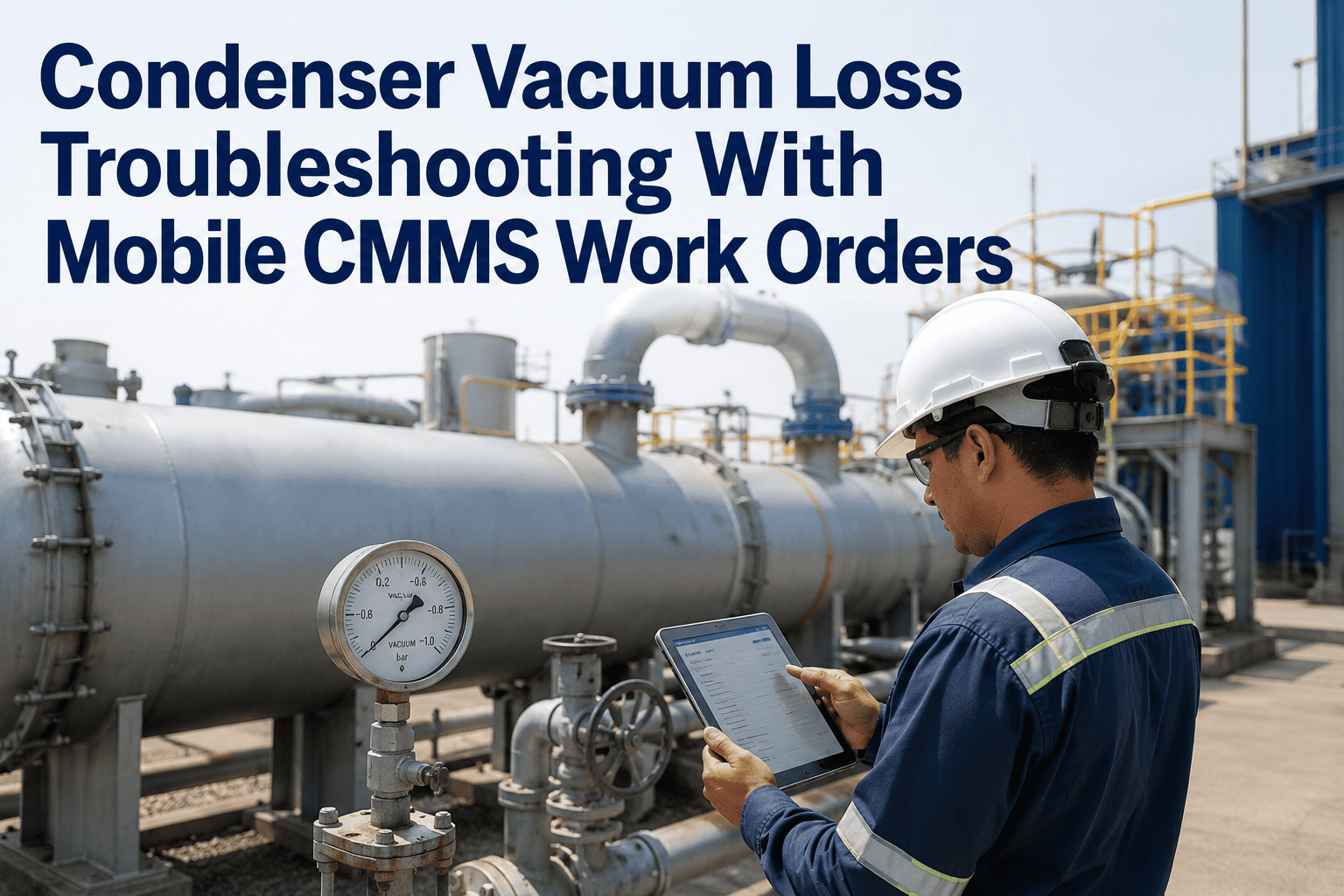
Condenser Vacuum Loss Troubleshooting With Mobile CMMS Work Orders
The four-root-cause diagnostic workflow delivered to mobile — from first vacuum alarm to closed corrective work order in under 4 hours.
4–7%
Heat rate penalty per 1.5 in Hg vacuum degradation
$45K/day
Incremental fuel cost from sustained vacuum loss at a 500 MW unit
4 hrs
Median recovery time with structured mobile work order vs. 3 days without
4
Root cause categories — all distinguishable without unit shutdown
Root Cause Map
The Four Root Causes of Condenser Vacuum Loss — and How to Tell Them Apart
Every condenser vacuum loss event falls into one of four categories. The diagnostic fingerprints below let a technician narrow the root cause within 30 minutes of receiving the mobile work order — without waiting for lab results, specialist analysis, or unit shutdown.
RC 1
Air In-Leakage
Most common: 55–65% of vacuum loss events
Diagnostic fingerprint
Vacuum deteriorates gradually over days to weeks
Ejector/vacuum pump air extraction rate increasing above baseline
Dissolved oxygen in hotwell rising — air dissolving into condensate
Condenser pressure rises when ejector capacity is intentionally reduced
Mobile work order action: ultrasonic leak detection survey of expansion joints, flange connections, valve packing glands, and instrumentation taps below operating pressure
RC 2
Cooling Water Fouling or Flow Restriction
Second most common: 20–25% of vacuum loss events
Diagnostic fingerprint
Terminal temperature difference (TTD) rising — hotwell temp approaching CW outlet temp
Condenser pressure rises with higher ambient/CW inlet temperature
CW flow rate below design — pressure differential across waterbox reduced
Gradual degradation pattern, correlates with time since last tube cleaning
Mobile work order action: CW flow verification, waterbox inspection, tube bundle fouling assessment, and cleaning schedule confirmation against last service date in Oxmaint history
RC 3
Vacuum System Equipment Failure
Equipment-driven: 10–15% of vacuum loss events
Diagnostic fingerprint
Sudden vacuum loss — hours not days — independent of operating conditions
Steam jet ejector motive steam pressure deviating — pressure regulator failure
Liquid ring vacuum pump seal water temperature elevated or flow lost
Vacuum loss recovered partially when standby vacuum equipment started
Mobile work order action: ejector performance test vs. design curve, seal water flow and temperature check, pump mechanical inspection — with Oxmaint BOM pull for seal water cooler components
RC 4
Tube Leak or Steam Bypass
Least common but highest consequence: 5–10% of events
Diagnostic fingerprint
Conductivity spikes in hotwell condensate — CW chemistry entering steam side
Hotwell level rising unexpectedly — waterbox pressure driving flow through tube defect
Localized condenser shell temperature anomaly above single tube bundle pass
Makeup water demand increasing — condensate contamination requiring disposal
Mobile work order action: hotwell conductivity trending, eddy current tube inspection work order generation, isolation procedure for affected tube bundle per Oxmaint equipment hierarchy
Mobile Workflow
From Vacuum Alarm to Closed Work Order — The Mobile CMMS Sequence
Oxmaint's mobile CMMS delivers a structured, branching diagnostic sequence to the shift technician's device within minutes of a vacuum alarm — guiding from symptom to root cause to corrective action without any knowledge of who the right person is or where the procedure document lives.
Step 1
Vacuum Alarm Received — Auto Work Order Generated
When condenser pressure exceeds the alert threshold (configurable — typically 1.5 in Hg above design), Oxmaint auto-generates a mobile work order assigned to the on-call instrument/mechanical technician. Work order includes: current pressure reading, trend over last 4 hours, last maintenance date for all four vacuum system components, and link to diagnostic decision tree.
Step 2
Mobile Diagnostic Decision Tree — Rate of Onset
The technician answers two screening questions on their device: (1) Gradual over days or sudden onset? (2) Dissolved oxygen in hotwell elevated? These two answers route the work order to the correct root cause investigation branch — air leakage, fouling, equipment failure, or tube leak — with the full diagnostic checklist for that branch pre-loaded.
Step 3
Root Cause Confirmation — Data Recorded in Field
The technician records all diagnostic readings directly into the mobile work order: ejector extraction rate, TTD calculation, seal water temperature, hotwell conductivity. Oxmaint compares readings against the asset's historical baseline — not just a generic limit — and confirms or rejects each root cause hypothesis with a confidence indicator.
Step 4
Corrective Work Order — Parts Reserved, Crew Scheduled
Root cause confirmed triggers a corrective work order pre-populated with the repair procedure, required parts pulled from the condenser BOM in Oxmaint, and priority routing based on vacuum impact severity. If tube cleaning is required, Oxmaint checks contractor availability and generates an outage window recommendation based on the degradation trend.
Step 5
Post-Repair Verification — Performance Recovery Confirmed
After repair completion, a verification checklist confirms vacuum has recovered to within design tolerance. Performance delta before and after is automatically recorded to the condenser's asset history — building the data set that prevents the same failure recurring without detection.
Deploy the 4-root-cause diagnostic workflow to your team's mobile devices
Oxmaint delivers the complete condenser vacuum troubleshooting sequence — alarm to closed work order — on any mobile device, with the asset history and parts inventory already loaded.
Performance Recovery
What Gets Tracked After Every Vacuum Loss Event — and Why It Matters
Each condenser vacuum loss event is a data point. Plants that capture structured post-event data in their CMMS build a diagnostic library that accelerates every future event. Oxmaint captures five data points per event automatically.
Root Cause Confirmed
Logged against the specific asset — builds a root cause frequency distribution for each condenser unit so the most common causes get proactive PM attention.
Time to Diagnose
Response time from alarm to root cause confirmation tracked per event — identifies where workflow gaps are slowing recovery and where additional training or tooling is needed.
Vacuum Recovery Delta
Pressure improvement from pre-repair to post-repair baseline recorded — confirms repair effectiveness and flags partial recoveries that indicate a secondary contributing cause.
Heat Rate Impact (MWh)
Fuel cost impact of the vacuum degradation period calculated automatically from pressure deviation and unit output — makes the business case for proactive maintenance visible to plant management.
FAQ
Frequently Asked Questions
How quickly can air in-leakage be located using mobile CMMS-guided ultrasonic detection?
With a structured inspection route pre-loaded in the mobile work order, most air leaks on a 500 MW condenser are located within 2–4 hours of starting the ultrasonic survey. The Oxmaint work order delivers the inspection sequence in priority order — expansion joints, flange connections, valve stems — so technicians cover the highest-probability locations first.
Oxmaint's mobile inspection module supports photo capture and location tagging for every leak identified.
What is Terminal Temperature Difference (TTD) and why is it the key fouling indicator?
TTD is the difference between the saturation temperature of the steam at condenser pressure and the cooling water outlet temperature. In a clean condenser, TTD is typically 2–5°F. As tube fouling increases, heat transfer degrades and TTD rises — a TTD above 10°F usually indicates significant fouling that is causing measurable vacuum deterioration.
Book a demo to see how Oxmaint trends TTD automatically against your condenser's design specification.
Can mobile CMMS work orders integrate with plant DCS alarms to trigger automatically?
Yes. Oxmaint integrates with plant DCS and historian systems via OPC-UA and REST API. A condenser pressure threshold breach in the DCS triggers an Oxmaint work order automatically — with the current reading, 4-hour trend, and relevant asset history included in the work order before the technician opens it. No manual alarm acknowledgement or work order creation step is required.
Does a tube leak always require a unit shutdown to repair?
Not always. Single tube plugging can be performed during a short planned outage window, restoring vacuum without a full unit shutdown. Oxmaint's condenser tube tracking module maintains a plugged tube count and calculates the remaining heat transfer area — flagging when the cumulative plugging percentage reaches the threshold requiring a tube replacement outage. This converts an emergency shutdown into a planned event.
How does Oxmaint mobile work well in field conditions — poor connectivity, outdoor environments?
Oxmaint's mobile CMMS supports full offline operation. The work order, checklist, and asset data sync to the device before the technician enters the field — all data entry and photo capture functions work without connectivity and sync automatically when signal is restored.
Start free to deploy the mobile app to your team today.
Root cause confirmed. Work order closed. Vacuum restored. — in under 4 hours.
Oxmaint delivers the structured condenser vacuum troubleshooting workflow to any mobile device — from the first alarm through diagnosis, parts, and repair verification — with every step logged to the asset's permanent history.