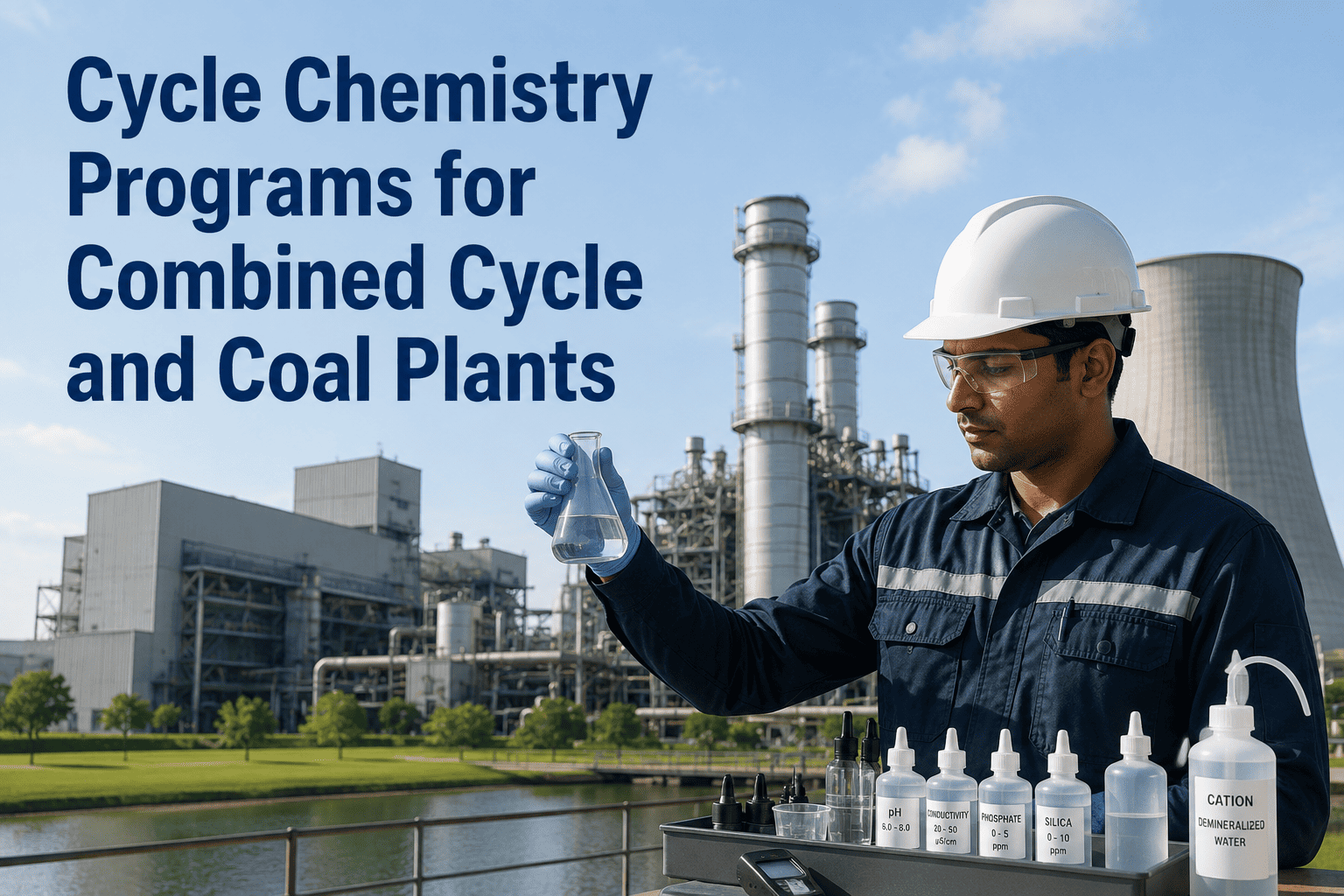
The water-steam cycle is the circulatory system of any thermal power plant — and cycle chemistry is what keeps it clean, protective, and free of the corrosion and deposition mechanisms that shorten tube life, foul turbine blades, and eventually force chemical cleaning shutdowns worth millions in lost generation. Whether your plant runs all-volatile treatment oxidizing (AVT-O), oxygenated treatment (OT), phosphate treatment, or a combined approach, the difference between a program that protects pressure parts and one that quietly degrades them comes down to sampling frequency, action level discipline, and documented corrective response. OxMaint's CMMS platform gives power plant chemistry teams the PM scheduling, threshold-triggered work orders, and multi-cycle sampling records to run EPRI-aligned cycle chemistry programs with full audit documentation — not just a lab notebook that gets lost between outages. Book a free demo to see how cycle chemistry monitoring is structured in OxMaint for combined cycle and coal plants.
Combined Cycle · Coal Plant · Cycle Chemistry · CMMS · OxMaint
Cycle Chemistry Programs for Combined Cycle and Coal Plants
Poor cycle chemistry is one of the leading causes of boiler tube failures, turbine blade deposition, and condenser tube corrosion in thermal power plants — and most of the damage accumulates invisibly, over months, before any visible symptom appears. A structured cycle chemistry program aligned to EPRI guidelines, tracked in a CMMS, and backed by corrective action discipline is the operational foundation that protects pressure parts across every outage cycle.
9.2–9.6
Target pH range for all-ferrous AVT(O) feedwater systems — deviations outside this band accelerate FAC and magnetite transport
<0.2 µS/cm
EPRI cation conductivity target for AVT(O) feedwater — exceedances signal acid anion contamination requiring immediate investigation
≤10 ppb
Dissolved oxygen limit for AVT(O) feedwater — controlled air ingress at the condenser establishes the protective FeOOH passivation layer
1 ppb
Feedwater iron concentration achievable with OT on once-through units — the benchmark for a fully optimised chemistry program
Treatment Selection
The Four EPRI-Recognised Cycle Chemistry Treatments — And When Each Applies
EPRI's Comprehensive Cycle Chemistry Guidelines for Combined Cycle/HRSG plants recognise four feedwater and boilerwater treatment regimes. Selecting the right treatment for your plant design and operating profile is the first decision — structuring it as a monitored, documented program is what makes it work in practice.
Most Common — All-Ferrous Systems
AVT(O) — All-Volatile Treatment Oxidising
Ammonia or neutralising amine injection raises feedwater pH to 9.2–9.6. Controlled air ingress from the condenser provides dissolved oxygen (≤10 ppb) to establish a protective ferric oxide hydrate (FeOOH) passivation layer on carbon steel surfaces. No reducing agents added. Recommended for all-ferrous combined cycle and HRSG systems with clean condensate and low air in-leakage.
pH: 9.2–9.6
DO: ≤10 ppb
Cation conductivity: <0.2 µS/cm
Copper-Alloy Systems
AVT(R) — All-Volatile Treatment Reducing
Ammonia or amine injection with pH limited to ≤9.1 to minimise copper transport. An oxygen scavenger (hydrazine or carbohydrazide) maintains a reducing environment, protecting copper-based alloys in condensers, feedwater heaters, and heat exchangers. Required where copper alloys remain in the steam cycle — less common in newer combined cycle designs.
pH: 8.8–9.1
DO: controlled reducing
Oxygen scavenger: required
Baseloaded Once-Through Units
OT — Oxygenated Treatment
Deliberate oxygen injection (up to 150 ppb) into highly pure feedwater (cation conductivity ≤0.15 µS/cm) forms a dense, protective FeOOH layer that virtually eliminates single-phase FAC and reduces feedwater iron to ≤1 ppb. OT is the preferred treatment for most once-through utility steam generators and can achieve superior corrosion protection — but requires strict condensate purity control and is not suitable for cycling plants or units with copper alloys.
pH: 8.0–8.5
DO: 30–150 ppb injected
Cation conductivity: <0.15 µS/cm
Drum-Type Boilers
PT / CT — Phosphate or Caustic Treatment
Phosphate treatment (tri-sodium phosphate) or caustic treatment (NaOH) controls boilerwater pH in drum-type units, preventing hide-out corrosion and scale formation. Phosphate treatment has a 70-year history in fossil boiler drums and is the most widely used drum treatment globally. Applicable to drum-style HRSG pressure circuits and conventional coal plant boiler drums — not applicable to once-through designs.
pH: controlled by dosing
PO₄ or NaOH: per EPRI guidelines
Drum only — not feedwater
Monitoring Framework
The Six Parameters Every Cycle Chemistry Program Must Measure and Record
Cycle chemistry monitoring is not a single measurement — it is a coordinated set of parameters, each providing a different window into cycle health. Missing any one of them creates a blind spot that allows a damaging chemistry excursion to develop undetected. OxMaint structures all six as scheduled PM work orders with defined sampling points, action levels, and corrective work order triggers.
01
pH
Feedwater · Drum · Condensate
The most fundamental cycle chemistry parameter. pH controls magnetite stability, FAC susceptibility, and ammonia/amine film formation. Deviations below 8.5 accelerate carbon steel corrosion; deviations above 9.6 (AVT) increase silica solubility and turbine blade silica deposition risk. pH must be monitored and recorded at multiple points in the cycle — not just the feedwater header.
Alert: ±0.3 from target · Action: ±0.5 from target
02
Cation Conductivity
Feedwater · Steam · Condensate
Cation conductivity after ion exchange measures total acid anion contamination — chlorides, sulfates, and organic acid decomposition products — with excellent sensitivity. The EPRI AVT(O) normal limit of 0.2 µS/cm provides a low-background baseline against which any condenser in-leakage, air ingress, or treatment chemical decomposition is immediately detectable. Continuous on-line measurement is the EPRI-recommended standard.
Normal: <0.2 µS/cm · Action: >0.5 µS/cm
03
Dissolved Oxygen
Feedwater · Condensate
In AVT(O), dissolved oxygen is the passive corrosion protector — controlled at ≤10 ppb to support FeOOH formation without oxidising conditions that could damage copper alloys. In OT, deliberately injected at 30–150 ppb in pre-qualified condensate. In AVT(R), suppressed below detection with scavenger. The treatment regime determines whether high DO is a problem or a programme requirement — which is why DO monitoring must always be interpreted in context of the active treatment.
AVT(O): ≤10 ppb · OT: 30–150 ppb
04
Specific Conductivity
Makeup Water · Condensate · Steam
Specific (non-cation) conductivity of makeup water effluent should be maintained at or below 0.1 µS/cm from a well-designed demineraliser. Completely pure water has a conductivity of 0.055 µS/cm — so a well-functioning makeup system produces effluent close to this theoretical minimum. Rising specific conductivity in makeup or condensate streams is the first indication of demineraliser breakthrough or condenser in-leakage, well before cation conductivity crosses action levels.
Makeup target: ≤0.1 µS/cm · Condensate: per EPRI limits
05
Sodium
HP / IP / LP Drum · Steam · Condensate
Sodium is the most sensitive on-line indicator of condenser tube in-leakage — detectable at ppb levels that precede visible contamination by weeks. A rising sodium reading in drum water or condensate triggers an investigation for condenser tube integrity before chloride and sulfate contamination reaches stress corrosion cracking thresholds in austenitic superheater components. Sodium monitoring is especially critical in coastal or recirculating cooling water plants where condenser leakage has high chloride potential.
Action level: typically >10 ppb — plant-specific
06
Iron and Copper Transport
Feedwater · Condensate
Dissolved and suspended iron in feedwater is the direct measure of corrosion product transport — the material that deposits in boiler tubes, causing under-deposit corrosion, overheating, and tube failures. Iron targets under OT (≤1 ppb) are dramatically lower than under AVT(R) programs, demonstrating the superior passivation of the OT regime. Copper transport monitoring is required in any system with copper alloy components — copper deposits in high-pressure boiler zones cause severe under-deposit corrosion.
OT target: ≤1 ppb Fe · AVT(O): ≤2 ppb Fe
Running cycle chemistry sampling from paper logs with no corrective action linkage or multi-year trend records?
OxMaint structures cycle chemistry sampling as scheduled PM work orders — with threshold-triggered corrective work order generation, action level documentation, and full sampling history stored against each HRSG or boiler asset. Free to start.
Chemistry and FAC
How Cycle Chemistry Directly Controls FAC Rate — And Why pH Alone Is Not Enough
Flow-accelerated corrosion (FAC) is the most dangerous long-term consequence of sub-optimal cycle chemistry in combined cycle and coal plants. FAC wall thinning progresses invisibly until pipe rupture — and three chemistry parameters together determine whether your plant is running in the safe operating window or accelerating toward failure.
pH
Peak FAC Rate at pH 8.5
FAC rate reaches its maximum at approximately pH 8.5 in carbon steel systems. Moving to pH 9.2–9.6 (AVT(O)) dramatically reduces the magnetite dissolution rate that drives FAC wall thinning. Every 0.3 pH unit below the AVT(O) target at a susceptible FAC location represents a measurable increase in wall thinning rate — which is why pH monitoring at the right sampling points is non-negotiable, not optional.
Dissolved Oxygen
OT Essentially Eliminates Single-Phase FAC
Oxygenated treatment creates a dense ferric oxide hydrate layer that is substantially more protective than the magnetite formed under AVT conditions. Plants that have switched from AVT(R) to OT report reductions in feedwater iron from 5–10 ppb to ≤1 ppb — a direct measure of how much less metal is dissolving from feedwater piping per operating hour. The trade-off is that OT requires cation conductivity ≤0.15 µS/cm and is not compatible with copper alloys or frequent cycling.
Temperature
Peak FAC Susceptibility at ~150°C
FAC rate in carbon steel is strongly temperature-dependent, peaking at approximately 130–160°C (roughly corresponding to LP evaporator and economizer conditions in most combined cycle HRSGs). This is why LP economizer and evaporator circuits in HRSGs are consistently among the highest-priority FAC inspection locations — the combination of peak FAC temperature, two-phase flow, and carbon steel construction creates the maximum thinning rate environment.
Program in OxMaint
What a Structured Cycle Chemistry Program Looks Like in OxMaint
Chemistry programs fail in the gap between measurement and corrective action. A reading that exceeds the action level but generates no work order, no documented response, and no escalation does not protect pressure parts — it just creates a paper trail that shows the exceedance was seen and ignored. OxMaint closes this gap with four connected program elements.
Scheduled Sampling PM Work Orders
Each sampling point — feedwater pH, drum cation conductivity, HP sodium, condensate DO — is a scheduled PM work order in OxMaint with defined frequency, responsible crew, and required sampling steps. Technicians complete the PM on mobile, recording readings directly against the sampling point asset. No readings are lost to paper logs or individual shift notebooks.
Three-Level Action System
OxMaint's threshold configuration mirrors EPRI's normal / alert / action level structure. A normal reading closes the PM. An alert-level reading generates a documented note and flags for supervisor review. An action-level exceedance automatically creates a corrective work order — assigned, prioritised, and tracked to closure. No exceedance goes unactioned because of shift handover or verbal-only communication.
Multi-Year Trend Records by Sampling Point
Every reading stored in OxMaint is timestamped and retained against the specific sampling point — not a general plant record. This builds the multi-year trend data that makes seasonal excursions, gradual drift, and correlations between chemistry exceedances and subsequent tube damage visible. When an outage inspection finds pitting or deposit buildup, the chemistry record shows exactly what was happening in the months before.
Outage Chemistry Package
At the outage planning stage, OxMaint surfaces all chemistry-driven corrective work orders — chemical cleaning requirements, deposits identified from iron transport trends, condenser tube repairs flagged by sodium monitoring — into the outage work package register, pre-staged with materials and contractor assignments before shutdown. Chemistry findings become planned outage scope, not day-of discoveries.
Program Comparison
Before and After: What Changes When Cycle Chemistry Moves Into a CMMS
| Chemistry Program Area |
Without CMMS |
With OxMaint |
Outcome |
| Sampling compliance |
Dependent on individual chemist or operator memory — gaps during shift changes, outages, and holidays |
Scheduled PM work orders — sampling frequency enforced by the system, compliance visible to management |
Consistent sampling across all shifts and seasons |
| Action level response |
Verbal or paper-only — no documented corrective action, no escalation, no closure verification |
Auto-generated corrective work order at action level crossing — assigned, tracked, closed with documented resolution |
Zero unactioned exceedances |
| Multi-year trending |
Readings in annual report spreadsheets — different format each year, data gaps, no correlation to equipment condition |
All readings stored by asset and sampling point — trend visible across any date range, correlated with maintenance events |
Chemistry-to-damage correlation visible |
| Outage chemistry input |
Chemistry team produces a verbal recommendation pre-outage — may or may not influence work package scope |
Chemistry corrective work orders automatically elevated into outage work package register with full finding history |
Every chemistry finding becomes planned outage scope |
| Audit and compliance documentation |
Reconstructed from paper logs, often incomplete, manual compilation for each audit or insurance review |
Complete sampling and corrective action record available on demand from OxMaint — no reconstruction required |
Audit-ready at any point |
Common Questions
What Plant Chemistry Teams Ask About Cycle Chemistry Program Management in OxMaint
How do we choose between AVT(O) and OT for a combined cycle plant?
The EPRI selection matrix considers two primary factors: the presence of copper alloys in the system (copper rules out OT) and plant operating profile (frequent cycling makes OT harder to sustain as the chemistry upsets during start-stop can cause temporary exceedances). Most combined cycle plants with all-ferrous systems and baseload operation are OT-eligible. Most cycling units default to AVT(O) as the safer and more manageable program.
Book a demo to see how OxMaint structures both treatment programs with their respective action level systems.
What sampling frequency does OxMaint support for cycle chemistry PMs?
OxMaint supports any sampling frequency — continuous on-line reading recording via historian integration, daily grab samples, weekly composite samples, or any combination. EPRI recommends continuous on-line monitoring for cation conductivity, pH, and dissolved oxygen at core points — OxMaint can receive these as automated readings or as manual entries from technician sampling rounds.
Set up your sampling PM structure in OxMaint with the exact frequencies specified in your EPRI-aligned chemistry plan.
Can OxMaint correlate chemistry exceedances with subsequent tube damage found at outage?
Yes — because both chemistry sampling records and outage inspection findings are stored against the same asset in OxMaint, it is straightforward to display chemistry readings from the operating period alongside the corrosion or deposit observations recorded during the subsequent outage inspection. This correlation is exactly what supports root cause analysis for boiler tube failures and justifies chemistry program modifications.
Sign up free and explore the asset-linked record structure.
How does the cycle chemistry PM structure integrate with chemical cleaning work orders?
Chemical cleaning decisions are typically triggered by a combination of iron transport trending, deposit weight density data from tube samples, and operating hours since the last cleaning. In OxMaint, when iron transport trends or deposit analysis results indicate cleaning is required, a corrective work order is raised and — if timing aligns with the next planned outage — automatically elevated into the outage work package register with required vendor, chemical type, and duration specified.
Book a technical call to walk through the chemical cleaning work order workflow.
Cycle Chemistry · AVT · OT · FAC · pH · Conductivity · CMMS
Chemistry Exceedances That Generate No Corrective Action Don't Protect Your Pressure Parts. They Just Document the Damage.
OxMaint gives power plant chemistry teams the PM scheduling, action level enforcement, and multi-year trend records to run a cycle chemistry program that actually protects boiler tubes, turbine blades, and pressure boundaries — not just satisfies a sampling frequency requirement on a compliance checklist.