A cooling tower gearbox at a 660 MW thermal unit seized without warning during peak summer load, taking the fan offline and forcing the unit to derate by 45 MW for nine days while a replacement gearbox was sourced and installed. Post-failure teardown showed advanced gear tooth pitting and a bearing that had been running hot for at least six weeks — signals that existed in vibration and oil data the whole time, just nobody was watching the trend. Sign up for OxMaint to catch gearbox degradation while it is still a maintenance task, not an emergency derate.
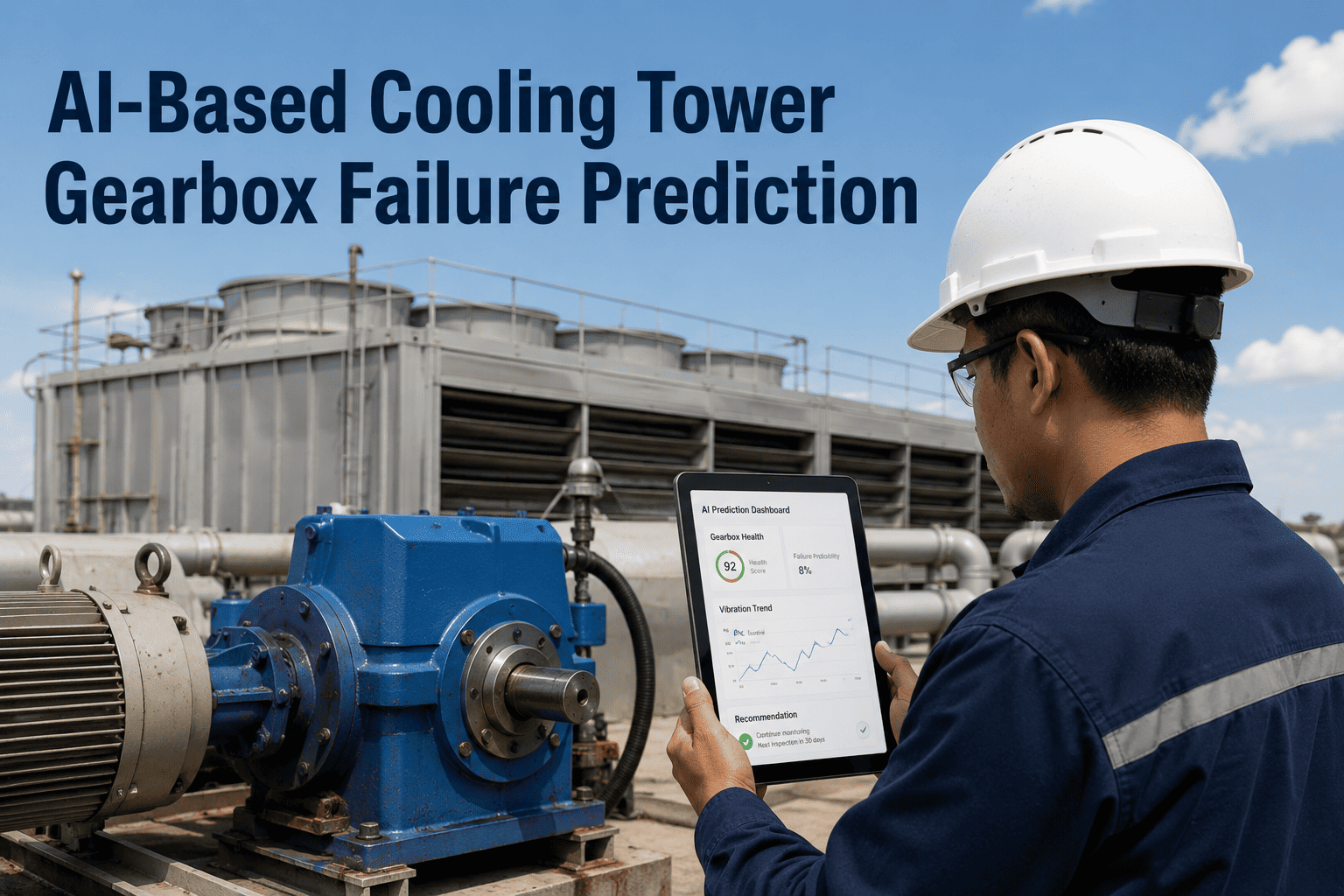
AI-Based Cooling Tower Gearbox Failure Prediction
Combine vibration monitoring, oil analysis, and AI-driven trend detection to catch cooling tower gearbox degradation weeks before bearing seizure or gear tooth failure forces an emergency fan outage during peak load.
Four Signals That Predict Gearbox Failure — Weeks Before It Happens
Cooling tower gearboxes rarely fail without warning. The signals are usually present in vibration spectra and oil condition data for weeks, sometimes months, before mechanical failure. The problem is not absence of data — it is absence of someone correlating it consistently.
Sidebands appearing around the gear mesh frequency in vibration spectra indicate developing tooth wear or misalignment, typically visible 4 to 8 weeks before any audible or tactile symptom appears.
A steady rise in amplitude at the bearing's specific defect frequencies — inner race, outer race, or ball pass — signals progressive bearing wear well ahead of the temperature rise that operators would notice by hand.
Increasing iron and copper content in oil analysis, paired with rising particle counts, confirms active wear surfaces inside the gearbox — often the clearest corroborating evidence alongside vibration trends.
A gearbox running progressively hotter at the same fan speed and ambient condition, with no change in cooling water flow, points to increasing internal friction from developing wear.
From Raw Sensor Data to a Maintenance Decision — the AI Prediction Pipeline
Vibration sensors, temperature probes, and periodic oil samples feed readings into OxMaint automatically, alongside manually logged inspection rounds for gearboxes without permanent sensors.
Each gearbox gets its own healthy-condition baseline, accounting for its specific fan size, duty cycle, and ambient operating range, rather than a generic industry threshold.
OxMaint's prediction model correlates vibration, temperature, and oil trend data across the gearbox population, identifying degradation patterns that match historical pre-failure signatures.
A risk score and estimated remaining useful life are generated per gearbox, giving maintenance planners a ranked list instead of a binary alarm with no context.
A high-risk gearbox automatically generates a CMMS work order with the supporting data attached, so the planner can schedule the repair into the next planned outage window instead of an emergency callout.
Turn Vibration and Oil Data Into Decisions You Can Act On Before Failure
OxMaint connects to your existing vibration sensors and oil lab reports, building a per-asset prediction model around your actual cooling tower fleet — typically configured within two to three weeks of onboarding.
What an Unplanned Gearbox Failure Actually Costs Versus a Planned Replacement
What Happens After a Gearbox Is Flagged — the Full Maintenance Response
Prediction only has value if it connects to a clear maintenance response. OxMaint links every risk flag to a structured decision path so planners know exactly what action level the data justifies.
No deviation from baseline detected. Gearbox remains on its existing inspection and oil sampling schedule with no additional action required.
Early-stage deviation detected in one data stream. Vibration or oil sampling frequency is increased to confirm whether the trend is developing or was a measurement anomaly.
Multiple data streams confirm progressive degradation. A work order is generated to schedule a detailed inspection or component repair within the next available planned window.
Failure indicators suggest near-term breakdown risk. Supervisor and reliability engineer are notified immediately to evaluate fan derate or shutdown ahead of an uncontrolled failure.
What a Thorough Cooling Tower Gearbox Inspection Should Actually Cover
Visual check for water contamination, discoloration, and correct fill level against the sight glass marking.
Handheld vibration reading at standard measurement points, compared against the asset's individual baseline trend.
Check for grease leakage or moisture ingress at the input shaft seal, a common early indicator of seal wear.
Verify mounting bolts remain at specified torque, since loosening accelerates misalignment-driven vibration.
Confirm motor-to-gearbox coupling alignment remains within tolerance, since misalignment is a leading cause of premature bearing wear.
Gearbox Failure Prediction on OxMaint — Common Questions
Permanent sensors give the highest prediction accuracy, but OxMaint also supports periodic handheld vibration readings and oil samples logged through the mobile app for gearboxes without installed sensors. Many plants start with handheld monitoring on critical units and expand sensor coverage gradually based on the value seen. Sign up to discuss the right monitoring mix for your cooling tower fleet.
Prediction lead time depends on the failure mode and data quality, but bearing and gear tooth degradation are typically detectable 4 to 12 weeks before mechanical failure when vibration and oil trend data are both available. The model improves over time as it learns the specific degradation patterns of your equipment population. Book a demo to see prediction accuracy on sample data.
Yes. OxMaint integrates with existing vibration monitoring platforms and oil analysis lab reports, pulling readings into the asset's combined health record rather than requiring a separate parallel system. This avoids duplicate sensor investment and gives a single trend view per gearbox. Sign up to discuss your existing monitoring integration.
A high-risk flag automatically generates a CMMS work order with the supporting vibration spectra, oil trend, and risk score attached, routed to the planning team for scheduling into the next available outage window. The recommendation includes estimated remaining useful life so planners can balance urgency against outage scheduling constraints. Book a demo to see the full alert-to-work-order flow.
Yes. Each gearbox gets its own individual baseline and prediction model based on its specific operating history, regardless of manufacturer, age, or fan size. Older or mixed-fleet cooling towers benefit particularly from this, since manufacturer-published thresholds often do not account for years of accumulated wear patterns specific to that unit. Sign up to build individual baselines for your full fleet.
Catch Gearbox Degradation Before It Becomes a Forced Outage
OxMaint correlates vibration, oil, and temperature data across your cooling tower fleet to flag developing gearbox failures weeks ahead — giving your team a planned repair window instead of an emergency one.