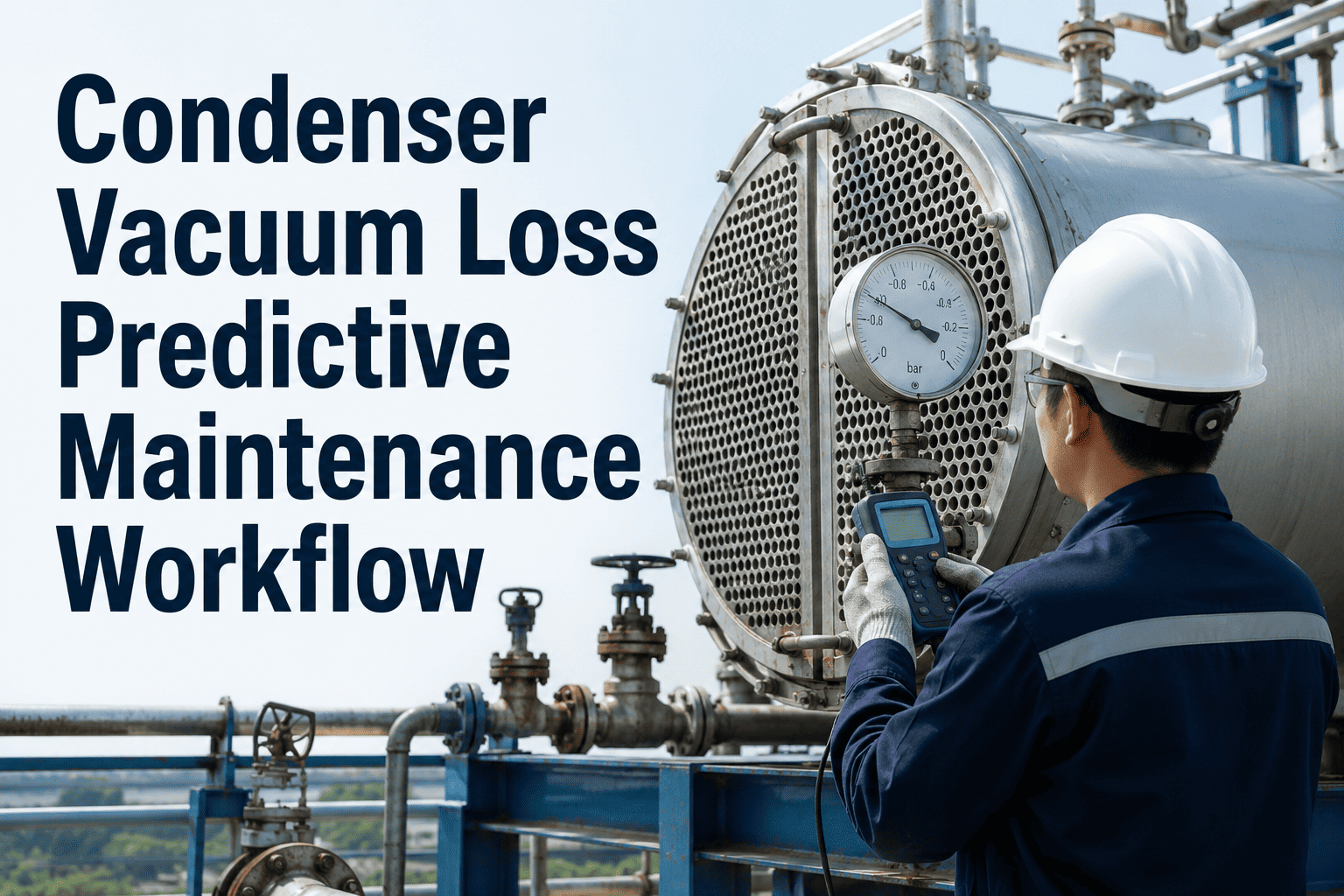
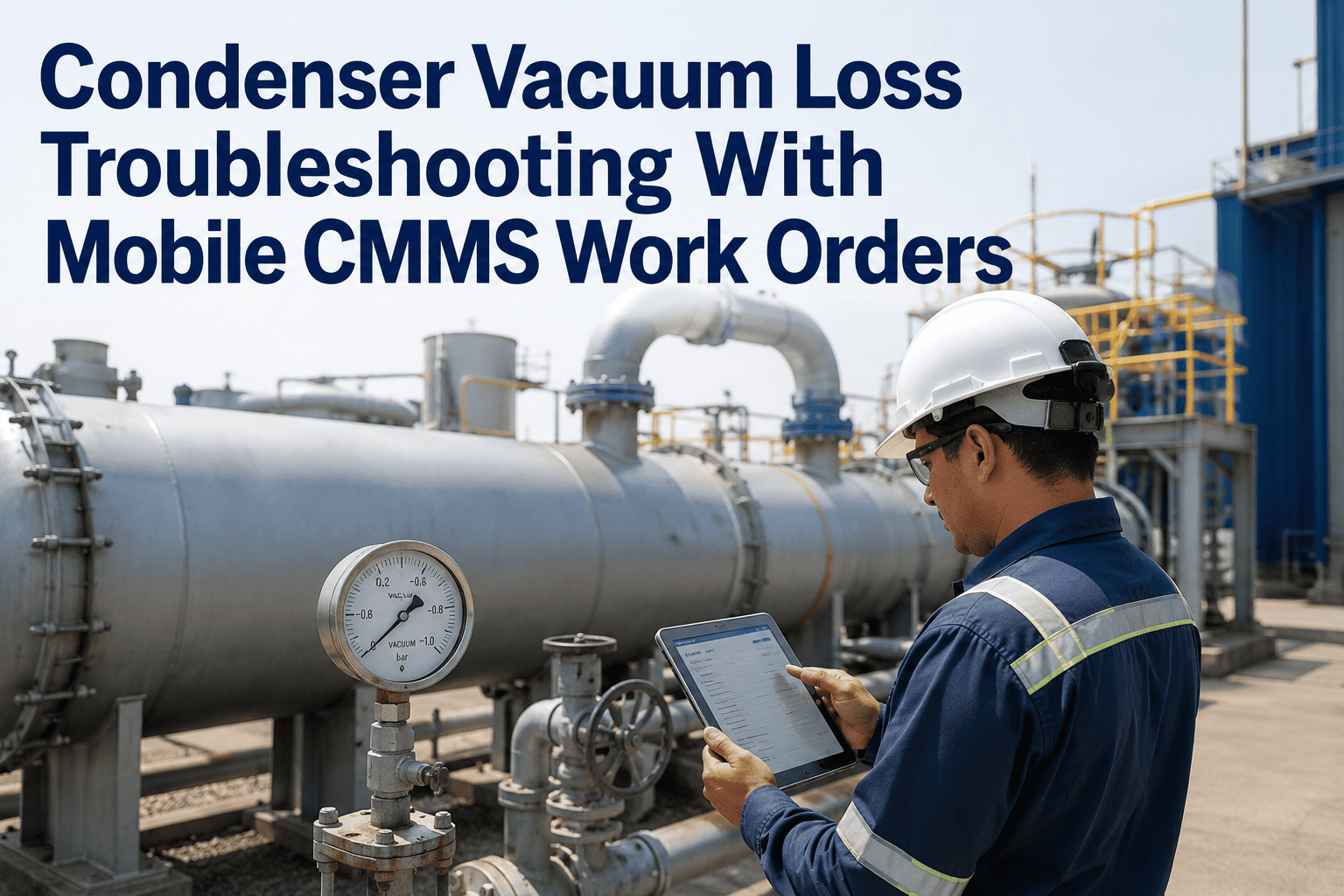
Condenser Vacuum Loss Predictive Maintenance Workflow
By Johnson on June 18, 2026
A one-inch Hg drop in condenser vacuum can cost a mid-size power plant thousands of dollars a day in lost turbine efficiency — and most plants don't notice until the heat rate report comes out a week later. Vacuum loss rarely happens suddenly; it builds from air in-leakage, tube fouling, or a failing air removal system days or weeks before the efficiency hit becomes obvious. This workflow shows exactly which readings predict vacuum loss early, how to diagnose the root cause fast, and how a connected CMMS turns a slow leak into a same-day work order instead of a quarter of lost heat rate. To put this workflow on your condensers, start a free trial or book a 30-minute walkthrough with a thermal performance specialist.
Predictive Maintenance · Thermal Efficiency
Condenser Vacuum Loss Predictive Maintenance Workflow
Every 1" Hg of lost vacuum costs roughly 1-1.5% in turbine heat rate. Catching the cause in days instead of weeks is the difference between a planned cleaning and a quarter of avoidable fuel cost.
Vacuum loss almost always traces back to one of three mechanisms — and each one has a distinct early-warning signature.
45%
Air In-Leakage
Worn expansion joints, valve packing, or flange gaskets let air into the steam space. Rising air removal system runtime and dissolved oxygen readings are the earliest indicators.
35%
Tube Fouling
Scale, biological growth, or debris on condenser tubes reduces heat transfer. Climbing cooling water differential temperature across the condenser is the leading signal.
20%
Air Removal System Degradation
Worn vacuum pump seals or steam jet air ejector nozzle erosion reduce extraction capacity. Falling discharge pressure ratio on the ejector is the tell.
1-1.5%
Heat rate penalty per inch Hg of vacuum lost
5-10 days
Typical lead time from first signal to measurable vacuum drop
2-4 hrs
Planned tube cleaning duration vs days for a forced outage
Diagnostic Flow — From Symptom to Work Order
A connected workflow narrows the cause in minutes instead of requiring a manual walkdown across three separate systems.
1
Vacuum trend dips below threshold. Condenser back pressure sensor flags a sustained drop below the configured setpoint.
→
2
System checks dissolved oxygen and CW ΔT. Rising oxygen points to air in-leakage; rising ΔT points to fouling.
→
3
Work order auto-routes to the right crew. Mechanical for gasket/joint inspection, or chemistry/cleaning crew for tube fouling.
→
4
Fix logged against asset history. Recurrence pattern becomes visible, so repeat offenders get flagged for a permanent fix.
Catch Vacuum Loss Before It Hits Your Heat Rate Report
OxMaint trends condenser vacuum, dissolved oxygen, and CW differential temperature against each asset and routes the work order to the right crew automatically.
Vacuum loss is one of the most underdiagnosed efficiency drains in a power plant because the symptom — a slightly worse heat rate — shows up far away from the actual cause, which is usually a small leak or a few fouled tube bundles. The fix is rarely expensive. The expensive part is the weeks it takes to even notice, which is exactly the gap a connected monitoring workflow closes.
Frequently Asked Questions
How much does condenser vacuum loss actually cost in fuel terms?
Each inch of Hg lost from design vacuum typically raises turbine heat rate by 1 to 1.5%, which translates directly into higher fuel consumption for the same output. On a mid-size unit this can add up to a meaningful daily cost if the loss runs for weeks before being caught. OxMaint trends vacuum continuously so the loss gets flagged early.
How do I tell if vacuum loss is from air in-leakage or tube fouling?
Rising dissolved oxygen in the condensate points to air in-leakage through joints, valves, or gaskets. A widening cooling water differential temperature across the condenser points to fouled tubes restricting heat transfer. Tracking both together narrows the cause within hours.
Can OxMaint route the work order automatically based on which signal triggers?
Yes. OxMaint correlates vacuum, dissolved oxygen, and CW ΔT readings and routes the resulting work order to the mechanical team for leak inspection or the cleaning crew for tube fouling, based on which signal crossed threshold first. Book a demo to see this configured for your condenser.
How often should condenser vacuum and air removal system performance be checked?
Continuous logging of vacuum, dissolved oxygen, and air ejector or vacuum pump discharge pressure is the standard for critical units. Where continuous sensors aren't installed, a daily manual reading is the practical minimum to catch the typical 5 to 10 day warning window.
Stop Losing Heat Rate to a Leak You Could Have Caught Early
Connect vacuum, oxygen, and temperature readings to your work order system and let OxMaint flag the cause before it shows up in your fuel bill.