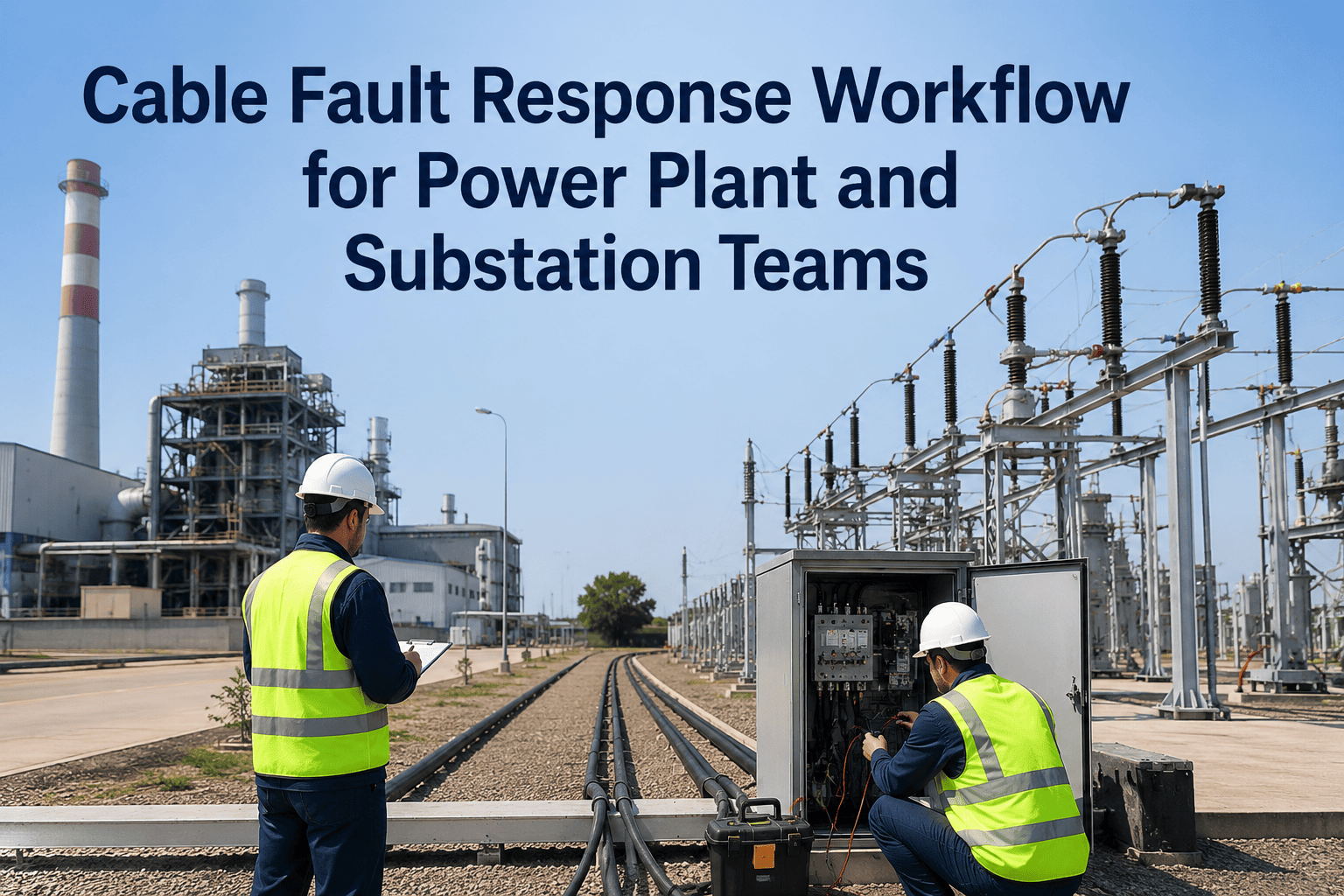
Cable faults in power plants and substations are not scheduled events — they strike mid-shift, under load, and without warning. The difference between a 20-minute outage and a 20-hour production crisis often comes down to one variable: how fast your team mobilizes, isolates, and documents the fault sequence. OxMaint's work order management platform gives power plant and substation maintenance teams a structured, mobile-first fault response workflow — from first alarm to verified restoration — with every step timestamped, assigned, and audit-ready. Book a demo to see how substation teams are cutting fault response times by more than 40 percent.
EMERGENCY MAINTENANCE · POWER PLANT · SUBSTATION
Cable Fault Response Workflow
For Power Plant and Substation Teams
From fault alarm to verified restoration: a step-by-step emergency maintenance workflow with CMMS-enforced documentation at every stage.
40%
faster fault isolation with structured response workflows
8 hr+
avg US customer outage duration without clear fault protocols
80°C
cable termination hotspot threshold requiring immediate action
THE 6-PHASE RESPONSE WORKFLOW
01
Fault Detection and Initial Alarm
Protection relay trip, thermal alarm, or physical observation triggers the response. Every second of delay here compounds downstream restoration time.
Record exact alarm timestamp and protection relay ID in CMMS
Confirm fault type: overcurrent, earth fault, thermal overload, or insulation failure
Identify affected cable circuit, feeder, or bay designation
Notify shift supervisor and safety officer immediately
02
Isolation and Safety Establishment
No fault investigation begins until the affected circuit is de-energized and LOTO is complete. This phase is the highest-risk point in the workflow.
Open relevant circuit breakers and disconnect switches per switching schedule
Apply LOTO — lock, tag, and verify absence of voltage on all phases
Verify ground resistance readings if fault involved earth path
Confirm isolation on CMMS work order before any physical approach
03
Fault Location and Diagnostics
Pinpointing the fault location before repair attempts eliminates guesswork and repeated outages. Infrared, VLF, and insulation resistance tests each serve different fault modes.
Perform insulation resistance test (megger) on all phases to ground
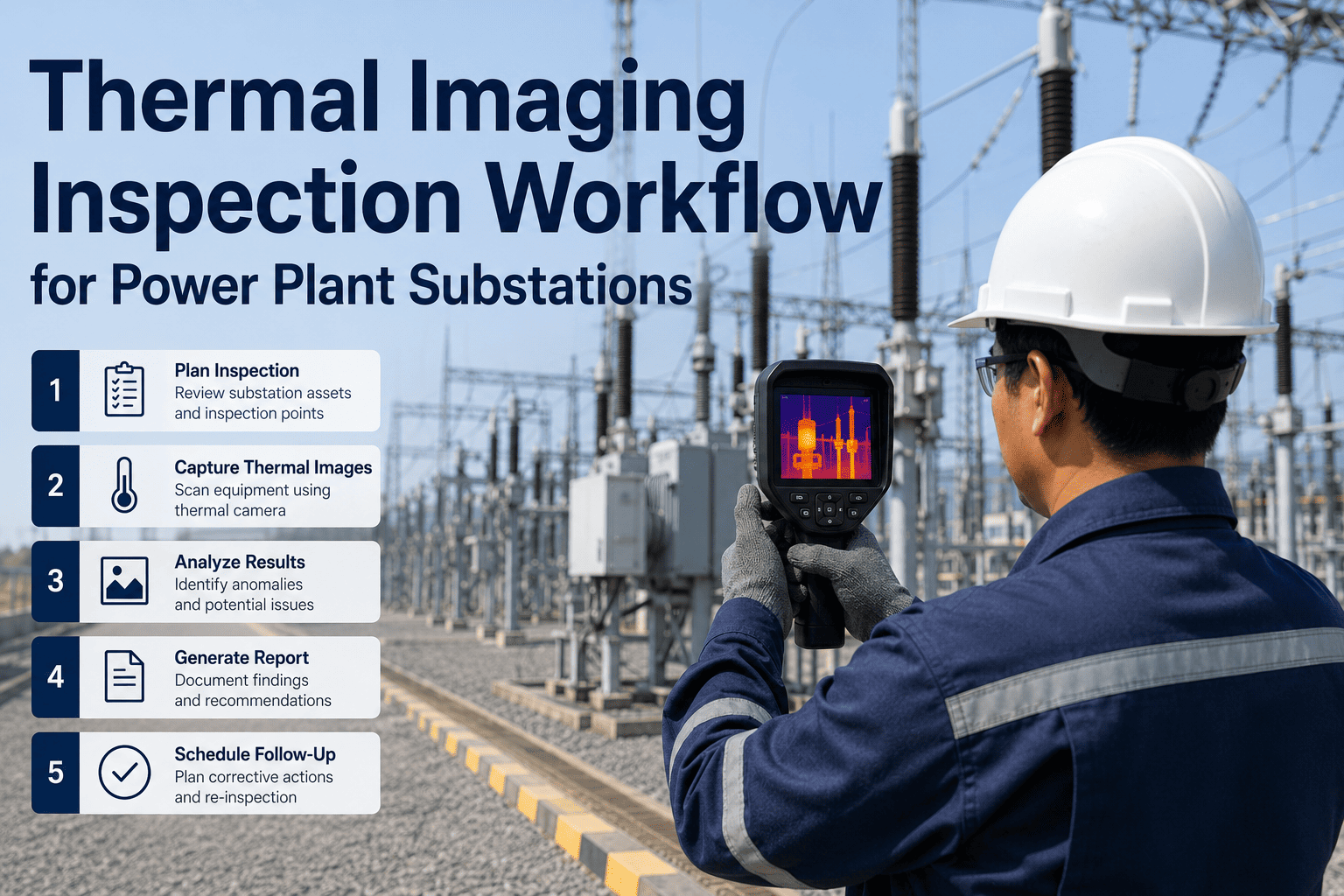
Deploy infrared thermography on terminations, joints, and splice boxes
Use TDR (time-domain reflectometry) or VLF testing for buried cable faults
Photograph and log all findings in CMMS work order with GPS-tagged location
04
Repair Authorization and Parts Mobilization
Authorized repair scope and confirmed spares availability prevent mid-repair delays — the most common cause of extended fault outages in substation environments.
Issue repair work order with scope, assigned technician, and time estimate
Pull spares from storeroom: cable joints, termination kits, heat-shrink materials
Verify spare cable section matches the failed cable specification (voltage rating, cross-section)
Get written authorization from shift supervisor before repair start
05
Repair Execution and Documentation
Every repair action must be documented in real time — not reconstructed from memory hours later. Mobile CMMS capture at the asset creates the traceability audit trail.
Document repair method, parts used, and technician name per work order
Record pre-repair and post-repair insulation resistance readings
Photograph completed repair, especially termination and joint quality
Log repair duration and any deviation from authorized scope
06
Restoration and Return to Service
Energization after repair is a structured procedure, not a single switch flip. Pre-energization checks and post-restoration monitoring confirm the fault is fully resolved.
Remove LOTO per permit and confirm all personnel clear of the circuit
Perform pre-energization continuity and phase rotation checks
Energize in stages — check voltage, current, and relay status at each step
Close work order in CMMS with total fault duration, root cause, and corrective action
Every Cable Fault Generates a Paper Trail. Make Yours Digital.
OxMaint auto-creates a timestamped work order from the moment a fault alarm is logged — so your team focuses on the repair, not the paperwork. Every phase is captured, every part is tracked, and every restoration is documented for NERC, insurance, and root-cause review.
FAULT TYPE QUICK REFERENCE
Common Cable Fault Modes and First Response Actions
| Fault Type |
Primary Symptom |
First Diagnostic Test |
Typical Root Cause |
| Insulation Breakdown |
Earth fault relay trip, phase-to-ground current |
Megger insulation resistance test |
Aging insulation, moisture ingress, mechanical damage |
| Termination Failure |
Thermal alarm, visible arcing or burning smell |
Infrared thermography at termination point |
Loose connection, contamination, improper torque |
| Joint Failure |
Overcurrent trip, cable sheath damage at joint location |
TDR or VLF testing to locate joint position |
Poor joint installation, ground movement, thermal cycling |
| Overload Fault |
Thermal overload relay trip, elevated cable surface temperature |
Load current measurement, thermal scan |
Circuit overloading, blocked cable trays, ambient temperature rise |
| Partial Discharge |
No immediate trip, but recurring low-level alarms |
Partial discharge (PD) test — VLF method |
Void in insulation, degraded joint compound, moisture tracking |
CMMS REQUIREMENTS FOR CABLE FAULT RESPONSE
What Your Work Order System Must Capture at Each Phase
Detection Phase
Fault alarm timestamp (auto or manual)
Asset ID and circuit reference
First responder name and arrival time
Isolation Phase
LOTO permit number linked to work order
Breaker and switch positions confirmed
Voltage-absent verification record
Diagnostics Phase
Test results with pre/post values
Fault location with photo evidence
Test instrument ID and calibration status
Restoration Phase
Total outage duration (start to restore)
Root cause classification
Corrective action and follow-up work orders
FREQUENTLY ASKED
Cable Fault Response — Common Questions
How quickly should a cable fault work order be opened after alarm?
Within 5 minutes of alarm confirmation. Any delay between fault detection and work order creation creates a documentation gap that complicates root cause analysis and NERC compliance reporting. OxMaint allows mobile work order creation from the alarm notification itself, so the clock starts when the fault starts — not when the office opens.
Sign up free to configure alarm-linked work order templates for your circuits.
What tests are required before re-energizing after a cable fault repair?
At minimum: insulation resistance (megger) test on all phases to ground, phase rotation check, and continuity verification. High-voltage cable circuits typically require a post-repair high-potential (hipot) or VLF withstand test before return to service. All test values should be recorded in the work order closure, with pre-repair values as the baseline comparison.
Book a demo to see how OxMaint enforces mandatory test fields before a work order can be closed.
How do we track recurring cable faults on the same circuit?
Link every cable fault work order to the specific asset ID. Over time, repeat faults on the same circuit surface in OxMaint's failure pattern reports — showing frequency, fault type, and repair history. Three faults on the same asset within 24 months typically triggers a cable replacement recommendation rather than continued patch repairs.
What is the most common cause of extended cable fault outages?
Spares unavailability and unclear repair authorization. Most fault repairs that exceed 8 hours are not delayed by technical complexity — they stall waiting for a matching cable joint kit or for someone with authority to approve the repair scope. A CMMS with integrated spares inventory and mobile approval workflows closes both gaps before the next fault occurs.
Does OxMaint support LOTO permit integration with work orders?
Yes. OxMaint links LOTO permit numbers directly to work orders, so isolation status is visible on the same mobile screen as the repair checklist. Technicians cannot close a work order without LOTO removal confirmation, eliminating the risk of returning a circuit to service while safety controls are still applied.
OXMAINT · WORK ORDER MANAGEMENT · POWER PLANT CMMS
Structure Every Fault Response Before the Next One Happens
OxMaint gives power plant and substation teams a proven 6-phase cable fault workflow — with mobile work orders, LOTO tracking, diagnostic data capture, and root cause documentation built in from the first alarm.