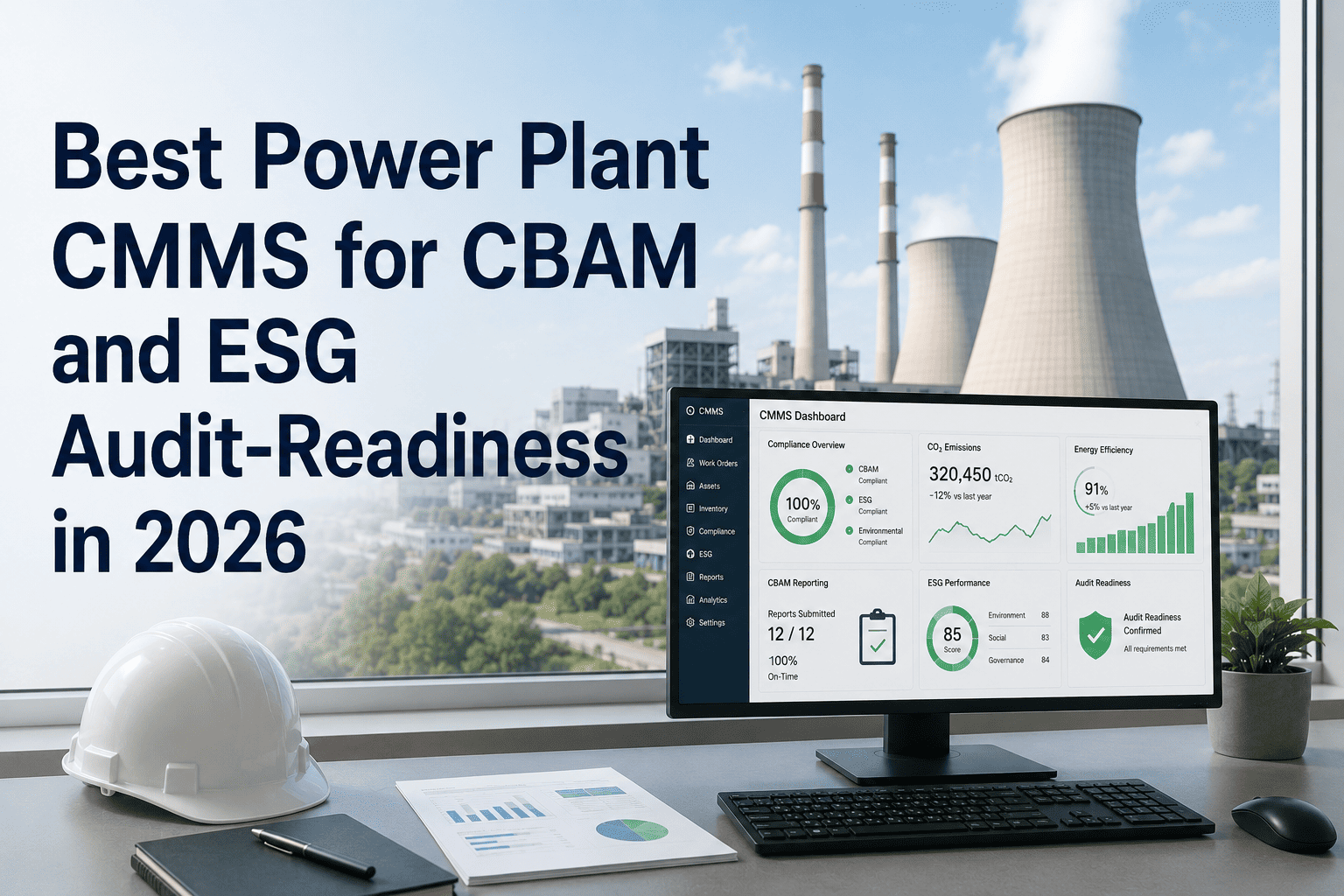
The carbon accountability landscape changed structurally on January 1, 2026 — the EU's Carbon Border Adjustment Mechanism entered its definitive phase, and ESG reporting moved from voluntary disclosure to assured, machine-readable obligation. CBAM penalties now hit €100 per tonne of CO₂e not covered (with total non-compliance cost reaching roughly €170 per tonne after surrender obligations are factored in), default-value usage adds a 10% surcharge in 2026 rising to 30% by 2028, and CSRD assurance requirements impose third-party verification on detailed ESG disclosures. For power plants — whose embedded emissions flow downstream into every CBAM-covered import calculation and whose Scope 1 and Scope 2 numbers anchor every utility ESG filing — the right CMMS is no longer just maintenance software. It is the system of record for the data your auditors, regulators, and trading partners now demand. To see how OxMaint structures CBAM-grade emissions data and ESG-ready evidence in one platform, you can start a free trial or book a 30-minute audit-readiness walkthrough with a power plant specialist.
Best Power Plant CMMS · CBAM & ESG Edition · 2026
The Best Power Plant CMMS for CBAM and ESG Audit-Readiness in 2026
CBAM's definitive phase, CSRD assurance, ISSB-absorbed SASB and TCFD metrics, GRI 305 emissions disclosures — all of it depends on traceable, asset-level operational data. Here is the CMMS that turns your maintenance system into your carbon evidence platform.
€100/t
CBAM penalty per tonne CO₂e not covered
€170/t
Total non-compliance cost incl. surrender obligation
+30%
Surcharge on default-value emissions from 2028
~50,000
Companies now in CSRD scope vs ~11,000 under NFRD
The Carbon Accountability Stack — Why Your CMMS Sits at the Bottom
Every CBAM declaration, ESG disclosure, and assurance review traces back to the same foundation: asset-level operational data. The platform that owns that data is the platform that owns your compliance.
Layer 1
External Reporting & Penalty Surface
CBAM annual declarations · CSRD sustainability statements · SEC climate disclosures · California SB 253/261 filings
Layer 2
ESG Frameworks & Standards
ISSB S1 / S2 (absorbed TCFD & SASB) · GRI 305 Emissions · ESRS E1 Climate · CDP disclosures
Layer 3
GHG Accounting & Calculations
Scope 1 direct emissions · Scope 2 electricity · Embedded emissions per CN code · Specific Embedded Emissions (SEE)
Layer 4
Operational Data Foundation — The CMMS Layer
Asset-level fuel use · work order completion · energy meter reads · CEMS data · maintenance history · evidence trail
Layer 4 is where OxMaint operates. Every layer above it depends on the structured, asset-linked, time-stamped data that only a proper CMMS produces.
The CBAM 2026 Critical Timeline
The definitive phase is already running. Here are the deadlines that anchor 2026–2028 carbon compliance for any power asset whose output touches EU-bound goods.
Jan 1, 2026
CBAM Definitive Phase Begins
Transitional reporting phase ended Dec 31, 2025. Certificate obligations now apply.
Mar 31, 2026
Authorised Declarant Deadline
All importers above thresholds must hold CBAM declarant status to keep importing.
Feb 1, 2027
Certificate Sales Open
Common central platform launches. Default values now incur 10% surcharge.
Sep 30, 2027
First CBAM Surrender Deadline
Annual declaration for 2026 emissions. First financial settlement.
2028 & Beyond
Default Value Surcharge Rises to 30%
Verified emissions data becomes essential for cost competitiveness.
Important
Actual verified emissions data almost always produces a lower certificate obligation than default values for plants running modern, efficient technology. Investing in asset-level monitoring and CMMS-tracked maintenance evidence has a measurable financial case in 2026 — and becomes essential post-2028.
ESG Framework Coverage — What Each Standard Needs From Your CMMS
The frameworks have consolidated, but the data demands have intensified. Here is what each major framework expects to see in your assurance package.
EU Carbon Border Adjustment Mechanism
Specific Embedded Emissions (SEE) per installation
Direct and indirect emissions per CN code
Verified production data & energy consumption
Third-party verification documents
GRI 305 Emissions Standard
Scope 1, 2, and 3 GHG emissions disclosures
Emissions intensity per output unit
NOx, SOx, and other significant air emissions
Methodology and emission factor documentation
ISSB IFRS S2 (absorbed SASB & TCFD)
Industry-specific material climate metrics
Governance, strategy, risk & metrics (TCFD pillars)
Scenario analysis & transition plan evidence
Asset-level climate-related financial data
CSRD & ESRS E1 Climate Change
Double materiality assessment evidence
Detailed Scope 1/2/3 with assurance trail
Digital, machine-readable disclosure format
Independent third-party assurance documentation
OxMaint Feeds All Four Frameworks From One Operational Dataset
Asset-linked emissions tagging, fuel-consumption logging per work order, energy meter integration, immutable audit trails, and one-click exports formatted for CBAM declarants, GRI authors, ISSB reporters, and ESRS assurance teams.
The Evidence Pyramid — From Plant Floor to Assurance Report
Auditors and verifiers do not accept summary numbers without traceability. The pyramid below shows how OxMaint structures evidence so every disclosed metric traces back to a time-stamped operational record.
Tier 1 · Assurance Output
Annual CBAM declaration · CSRD sustainability statement · 10-K climate section
Tier 2 · Aggregated KPIs
Scope 1/2 totals · emissions intensity · SEE per output · annual energy consumption
Tier 3 · Asset-Level Data
Per-unit fuel use · per-asset kWh · CEMS records · maintenance work order outcomes
Tier 4 · Source Records (CMMS)
Time-stamped readings · photos · technician sign-off · immutable audit trail · part replacement logs
The 6 CMMS Capabilities That Make a Platform CBAM & ESG Audit-Ready
Use this scorecard to evaluate any CMMS on your shortlist. Platforms missing any of these create assurance gaps that auditors will flag.
01
Asset-Level Emissions Tagging
Every asset carries its own GHG emission factor, fuel type, and energy source — not a plant-wide average. Required for Specific Embedded Emissions accuracy.
02
Fuel & Energy Consumption Logging
Per-work-order fuel use, per-asset energy meter integration, and direct ingestion from CEMS and historian platforms. No spreadsheet handoffs.
03
Immutable Audit Trail
Every change to a work order, reading, or asset record logged with user, timestamp, and prior value. Auditors specifically check for tampering risk.
04
Framework-Tagged Exports
Pre-formatted export bundles for CBAM declarations, GRI 305 disclosures, ISSB S2 metrics, and ESRS E1 assurance packages — generated on demand.
05
Verification Document Management
Storage and version control for third-party verification reports, emission factor sources, and methodology documentation tied to specific reporting periods.
06
Role-Based Assurance Workflows
Separation of duties between operations, sustainability, and finance teams with electronic sign-off — supporting CSRD's third-party assurance obligations.
The Cost of Non-Compliance in 2026
Carbon and ESG penalties have moved from theoretical to operational. The table below shows what happens when documentation gaps meet verified obligations.
| Regime |
Violation Type |
Penalty Mechanism |
2026 Cost |
| CBAM |
Insufficient certificate surrender |
Per tonne CO₂e not covered + ongoing obligation |
€100/t + procurement cost (~€170/t total) |
| CBAM |
Using default emission values |
Surcharge on declared emissions |
+10% in 2026, +30% from 2028 |
| CBAM |
Missed Authorised Declarant deadline |
Loss of import authorisation |
Inability to import after Mar 31, 2026 |
| CSRD |
Failed third-party assurance |
Required re-statement & re-audit |
Material weakness disclosure |
| SEC / California |
Inaccurate climate disclosure |
Civil penalties + restatement |
Variable, plus reputational exposure |
| ISSB / Investor |
Material data gaps in S2 filings |
Investor & lender scrutiny |
Cost of capital impact |
Plants on CMMS platforms without framework-tagged exports typically spend 200–400 hours per assurance cycle assembling evidence. Book a demo to see how OxMaint cuts that to a fraction.
How OxMaint Maps to Each Reporting Standard
Direct framework-to-feature mapping. Every standard's expected evidence is produced from operational data OxMaint already captures.
CBAM
Definitive Phase Evidence
Asset-level fuel consumption logs
Production volume per CN code period
Energy source & emission factor records
Maintenance evidence supporting actual data
Exportable in EU-required formats
GRI 305
Emissions Disclosure
Scope 1 fuel-by-asset tracking
Scope 2 purchased electricity logs
NOx, SOx CEMS integration
Emissions intensity calculation
Methodology documentation per asset
ISSB S2
Climate-Related Disclosure
Industry-specific SASB metrics
Risk management asset tagging
Strategy & transition plan evidence
Climate-related financial data feed
TCFD pillar alignment built-in
CSRD / ESRS E1
Assured Sustainability Statement
Double materiality evidence support
Assured Scope 1/2/3 data lineage
Machine-readable XBRL export prep
Independent verifier workflow access
Digital signature & sign-off trail
Frequently Asked Questions
Why does a power plant CMMS matter for CBAM compliance?
CBAM requires verified emissions data at the production installation level — and the cheapest way to fall into the default-value penalty zone is to lack asset-level operational records. A CMMS owns the fuel use, energy meter reads, and CEMS integration that anchor every Specific Embedded Emissions calculation. Actual verified data almost always produces a lower certificate obligation than default values for modern plants, and the default-value surcharge rises from 10% in 2026 to 30% by 2028.
Start a free trial to map your CBAM evidence chain.
Which ESG frameworks are most relevant for power plants in 2026?
The four that matter most: ISSB S1 and S2 (which has absorbed SASB and TCFD) for investor-focused disclosure, GRI 305 for emissions transparency, CSRD with ESRS E1 for EU-regulated assured reporting, and CBAM for any output linked to EU-bound goods. CSRD in particular is now in scope for roughly 50,000 companies versus 11,000 under NFRD, with mandatory third-party assurance and machine-readable formats. The frameworks share underlying data needs — a CMMS that captures asset-level emissions and energy data feeds all four.
What is the financial penalty for missing CBAM obligations?
The penalty for insufficient certificate surrender is €100 per tonne of CO₂e not covered, plus the ongoing obligation to procure the missing certificates — taking total non-compliance cost to approximately €170 per tonne. Default-value usage adds a 10% surcharge in 2026 rising to 30% from 2028. Missing the March 31, 2026 Authorised Declarant deadline means losing the ability to import CBAM-covered goods entirely.
How does OxMaint support CSRD third-party assurance?
CSRD requires independent assurance of sustainability statements, which means auditors must trace every disclosed metric back to source operational data. OxMaint maintains an immutable audit trail on every work order, reading, and asset record — with user, timestamp, and prior value logged. Role-based access supports separation of duties between operations, sustainability, and finance teams, and one-click exports produce the data lineage assurance providers expect.
Book a demo to walk through the assurance workflow.
Did TCFD disband, and what does that mean for power plant reporting?
TCFD fulfilled its mandate and disbanded in 2023, but its four-pillar framework — governance, strategy, risk management, and metrics — was fully absorbed into ISSB IFRS S2. Power plants that built TCFD-aligned climate disclosures transition seamlessly to ISSB S2. The structural shift is that climate disclosures are now embedded in mandatory investor-focused standards rather than a separate voluntary framework — making the underlying data evidence more important, not less.
Can OxMaint integrate with our existing carbon accounting and ESG platforms?
Yes. OxMaint provides REST API access and out-of-the-box connectors for major ERP and carbon accounting platforms. The most common pattern is OxMaint as the operational evidence layer feeding asset-level fuel, energy, and maintenance data to a corporate carbon accounting tool, which then formats outputs for CBAM declarants, GRI reports, and ESRS filings. The point of integration is to ensure your CMMS data becomes assurance-ready rather than getting re-keyed into multiple downstream systems.
From Maintenance System to Carbon Evidence Platform
The 2026 carbon accountability regime makes one thing clear: the platform that owns your operational data owns your compliance position. OxMaint structures asset-level emissions, fuel consumption, energy use, and maintenance evidence into a single audit-ready record — exportable in formats your CBAM declarants, ESG reporters, and third-party assurance providers expect. Deploy in days, not months, and turn your CMMS into the foundation of every carbon disclosure your plant produces.