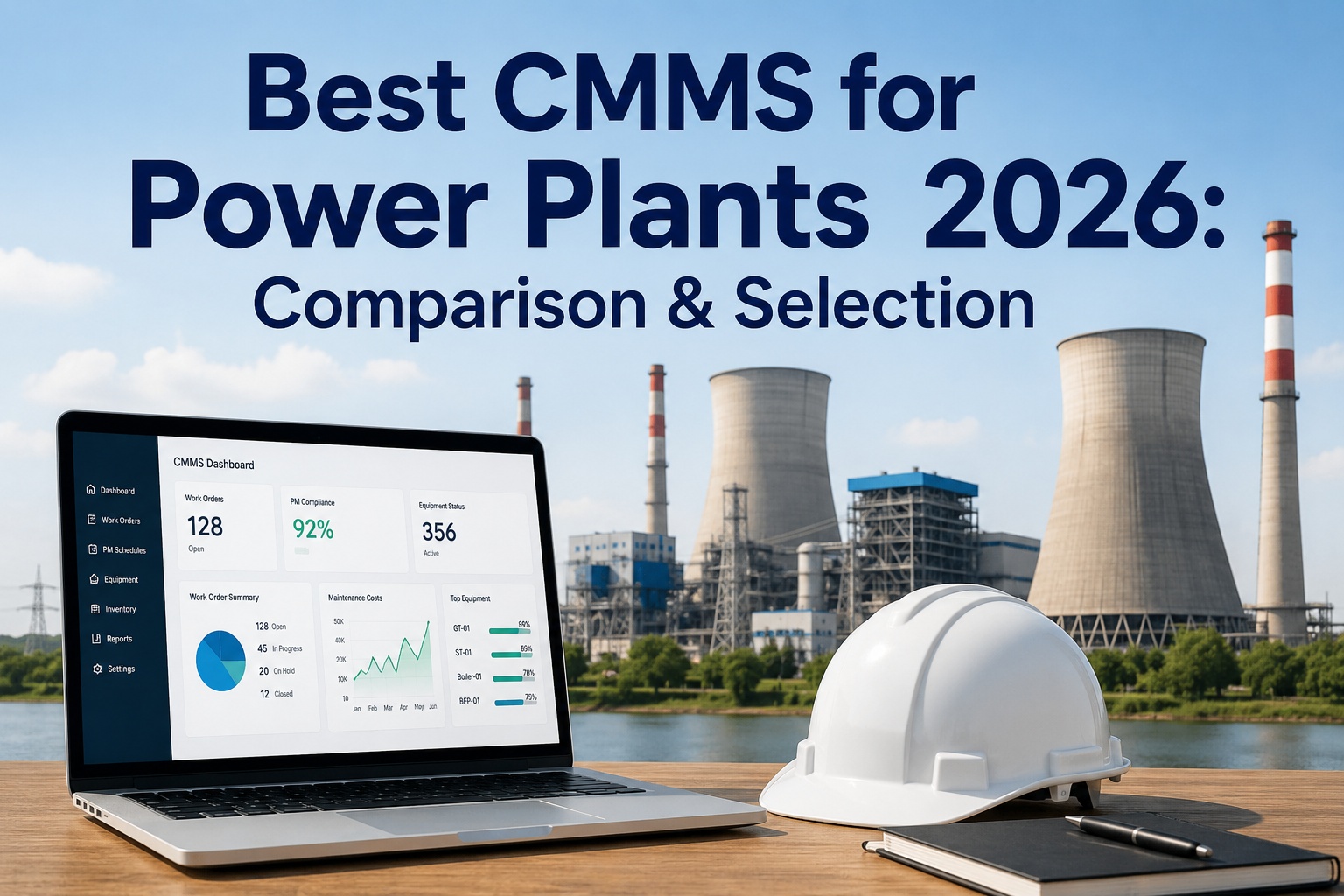
Choosing the best CMMS for a power plant in 2026 means looking past generic facilities tools and evaluating platforms on turbine health monitoring, NERC compliance recordkeeping, fired-hour triggers, and outage planning. This comparison guide breaks down the capabilities that actually matter for generation assets — from HRSG and combined-cycle support to total cost of ownership — so you can shortlist with confidence. Start a free OxMaint trial to benchmark against the checklist, or book a demo to see it scored side-by-side.
Best CMMS for Power Plants 2026: Comparison & Selection Guide
A structured evaluation framework for maintenance and reliability managers comparing CMMS platforms for generation assets — covering turbine EOH triggers, NERC PRC-005 recordkeeping, outage planning, HRSG support, and real implementation cost.
Why a Generic CMMS Falls Short in Power Generation
Facilities-maintenance platforms are built around calendar-based work orders and square-footage asset hierarchies. Power plants run on fired hours, equivalent operating hours (EOH), start-stop cycles, and API-recommended inspection intervals. A CMMS that cannot ingest turbine monitoring data, cannot auto-trigger a borescope at 24,000 EOH, and cannot produce a NERC-auditable maintenance record is a liability — not a tool.
Generic Facilities CMMS
- Calendar-only PM triggers — no fired-hour or cycle logic
- Flat asset tree; no combined-cycle train relationships
- No OEM integration (GE Mark VIe, Siemens SPPA-T3000)
- Manual NERC evidence compilation from spreadsheets
- Outage scheduling bolted on as a Gantt afterthought
Power-Generation CMMS
- EOH, fired-hour, and start-cycle trigger engine
- Asset hierarchy mapped to generation train & auxiliaries
- OPC-UA / PI System integration for condition-based triggers
- Auto-generated PRC-005 & MOD maintenance evidence packets
- Outage planning with critical-path, freeze, and resource leveling
Power-Plant CMMS Feature Checklist
Use this checklist as a vendor scorecard during demos. Every item maps to a generation-specific workflow — if a platform can't tick it, it belongs in the "generic" column.
Turbine Health Monitoring Integration
Ingests vibration, temperature, and fired-hour data from OEM control systems (GE Mark VIe, Siemens SPPA-T3000, Mitsubishi MITSUBISHI-TI) via OPC-UA or PI System.
NERC Compliance Recordkeeping
Auto-generates PRC-005-6 and MOD-025 evidence packets — maintenance dates, test results, personnel, and unavailability hours — exportable for auditors.
Fired-Hour & EOH-Based Triggers
Work orders auto-generate at 8,000 / 16,000 / 24,000 EOH thresholds for combustion turbines, with start-stop cycle counting for peakers.
Outage Planning & Scheduling
Planned-outage work-pack management with critical-path scheduling, resource leveling across crafts, and freeze-date milestone tracking.
HRSG & Combined-Cycle Asset Support
Drum-level, tube-leak, and catalyst-replacement PM templates; harmonic inspection intervals per API 560 / API 570 for HRSG pressure parts.
API & OEM Interval Library
Pre-loaded inspection intervals for API 610 (pumps), API 618 (reciprocating compressors), API 570 (piping), and OEM-recommended gas-turbine major intervals.
Condition-Based Maintenance Routing
Threshold alerts from oil analysis, vibration, and thermal imaging auto-create work orders routed to the correct reliability engineer.
Mobile Work Orders in Lockout/Tagout Zones
Offline-capable mobile app with LOTO isolation-point verification and electronic clearance sign-off for plant-floor execution.
CMMS Platform Comparison Matrix
How the leading 2026 options stack up against the generation-specific checklist. OxMaint is included as the purpose-built benchmark.
| Capability | OxMaint | Generic Enterprise CMMS | ERP-Embedded Maintenance | Point Tools + Spreadsheets |
|---|---|---|---|---|
| Turbine OEM integration (Mark VIe, SPPA-T3000) | Native OPC-UA / PI | Add-on or custom | Via middleware | Manual export |
| Fired-hour / EOH trigger engine | Native, configurable | Calendar only | Custom coding | Not available |
| NERC PRC-005 evidence auto-compile | Built-in audit packet | Report builder | Module required | Manual assembly |
| Outage planning with critical-path | Integrated scheduler | Third-party add-on | Separate module | Excel Gantt |
| HRSG / combined-cycle templates | Pre-loaded API 560/570 | Build from scratch | Build from scratch | Not available |
| Implementation timeline | 4–8 weeks | 4–9 months | 9–18 months | Ongoing |
| 5-year TCO (mid-size plant) | $85K–$140K | $220K–$400K | $500K+ | $60K + risk cost |
Outage Planning: Where Most CMMS Platforms Break
A planned combustion-turbine major outage involves 3,000–8,000 work orders, 15–30 contractor crews, and a critical-path window of 18–28 days. Most CMMS platforms treat this as "just a big schedule." It is not.
Work-Pack Assembly
Can the system bundle PMs, corrective work, and modifications into outage work-packs with linked isolation permits and BOMs — or does each craft lead rebuild the list in Excel?
Critical-Path Scheduling
Does the scheduler show the driving path through turbine open / rotor removal / blade repair / reassembly — with float and drag calculated — or just a Gantt bar chart?
Resource Leveling
Can it detect that 14 mechanical crews are double-booked on Day 6 and auto-level across available contractor slots — or does the planner catch it at 2 a.m. on shift?
Freeze-Date Control
After the scope freeze date, does the system gate new work through a change-control approval — or can anyone add a work order that blows the critical path?
Post-Outage Closeout
Does it auto-capture actual hours vs. estimates, generate the NERC evidence for work performed, and feed lessons-learned into the next cycle — or is closeout a six-week manual grind?
Spare-Parts Pre-Staging
Does it verify consumables, rotor hardware, and hot-gas-path parts are received and staged before the turbine opens — or does the crew wait three days for a bolt set?
HRSG & Combined-Cycle Asset Support
Heat-Recovery Steam Generators and their auxiliaries carry inspection intervals that don't align with calendar quarters. A power-plant CMMS must manage:
Pressure-Part Inspections
API 570 piping and NBIC vessel inspections with tube-leak detection work-order routing tied to online monitoring data.
Catalyst & Ammonia System
SCR catalyst replacement scheduling based on operating hours and NOx-reduction performance degradation curves.
Drum & Deaerator Internals
Internal inspection intervals per API 510 and OEM guidance, linked to water-chemistry excursion history.
Steam-Turbine Overhaul
HP/IP/LP casing open intervals based on equivalent operating hours and last-borescope findings, not arbitrary 4-year cycles.
Implementation & Total Cost of Ownership
The sticker price of a CMMS license is 20–30% of what you'll actually spend over five years. The rest is implementation, data migration, integration, and the hidden cost of workarounds when the system doesn't fit generation workflows.
Data Migration & Asset Hierarchy
Building a generation-train hierarchy (GT → HRSG → ST → condenser → BOP) from scratch in a generic CMMS takes 10–16 weeks. OxMaint ships with a combined-cycle template that maps to your single-line diagram in days.
OEM & Monitoring Integration
Connecting Mark VIe, SPPA-T3000, or your PI Historian to trigger work orders is either a native feature or a $60K–$120K custom middleware project. Ask the vendor to show a live fired-hour trigger in the demo.
NERC Evidence Configuration
If the vendor cannot show you a pre-built PRC-005 evidence report in the first demo, assume 200+ hours of consulting to configure it — and ongoing manual effort every audit cycle.
Outage Module Stand-Up
ERP-embedded outage tools often require a separate Primavera or MSP license plus integration. A generation CMMS includes outage planning as a core module — no second license, no sync failures.
Specialization vs. Breadth: How to Weigh It
When to Choose a Power-Generation CMMS
- Your plant runs combustion turbines, HRSGs, or steam turbines with OEM control systems
- You face NERC PRC-005, MOD-025, or MOD-026 compliance obligations
- You plan major outages on 2–4 year cycles with multi-craft coordination
- Your reliability program uses fired-hour, EOH, or condition-based triggers
- You need audit-ready evidence without a spreadsheet sidecar
When a General-Purpose CMMS May Suffice
- Your facility is a simple-cycle peaker with minimal compliance exposure
- You outsource all major maintenance and only track work-order completion
- You have no turbine monitoring system to integrate with
- Your parent company mandates an ERP-embedded module for IT consolidation
- You maintain buildings, grounds, and fleet — not generation assets
Frequently Asked Questions
What makes a CMMS "purpose-built" for power plants versus generic?
A power-plant CMMS has native fired-hour and EOH trigger logic, pre-built NERC PRC-005 evidence reporting, OEM control-system integration (Mark VIe, SPPA-T3000), and outage planning with critical-path scheduling. A generic CMMS relies on calendar triggers, flat asset trees, and manual compliance compilation — forcing generation workflows into a facilities mold.
How does OxMaint handle NERC PRC-005 recordkeeping?
OxMaint auto-tags every maintenance work order with the protection-system component it affects, captures unavailability hours, test results, and personnel signatures, and compiles them into an auditor-ready evidence packet on demand. No spreadsheet assembly, no retroactive documentation sprints before an audit.
Can OxMaint trigger work orders from turbine fired-hour data?
Yes. OxMaint ingests fired-hour and EOH data via OPC-UA or a PI System connector and auto-generates work orders at configurable thresholds — typically 8,000 (borescope), 16,000 (hot-gas-path), and 24,000 (major) EOH for gas turbines, with separate start-stop cycle counting for peaking duty.
How long does OxMaint implementation take for a combined-cycle plant?
A typical 2×1 combined-cycle plant goes live in 4–8 weeks. OxMaint ships with a combined-cycle asset hierarchy template, pre-loaded API inspection intervals, and NERC evidence configuration — eliminating the 4–9 month build typical of generic enterprise CMMS platforms.
What does OxMaint cost compared to ERP-embedded maintenance modules?
Five-year TCO for a mid-size plant runs $85K–$140K including implementation, integrations, and licensing. ERP-embedded maintenance modules typically run $500K+ over the same period once consulting, middleware, and the outage-planning add-on are included — before counting the cost of fitting generation workflows into a generic framework.
Put OxMaint Through the Checklist
Bring your turbine EOH thresholds, NERC evidence requirements, and next outage scope to a 30-minute demo. We'll score OxMaint against the feature checklist live — and show you the fired-hour trigger, the PRC-005 evidence packet, and the outage scheduler in action.