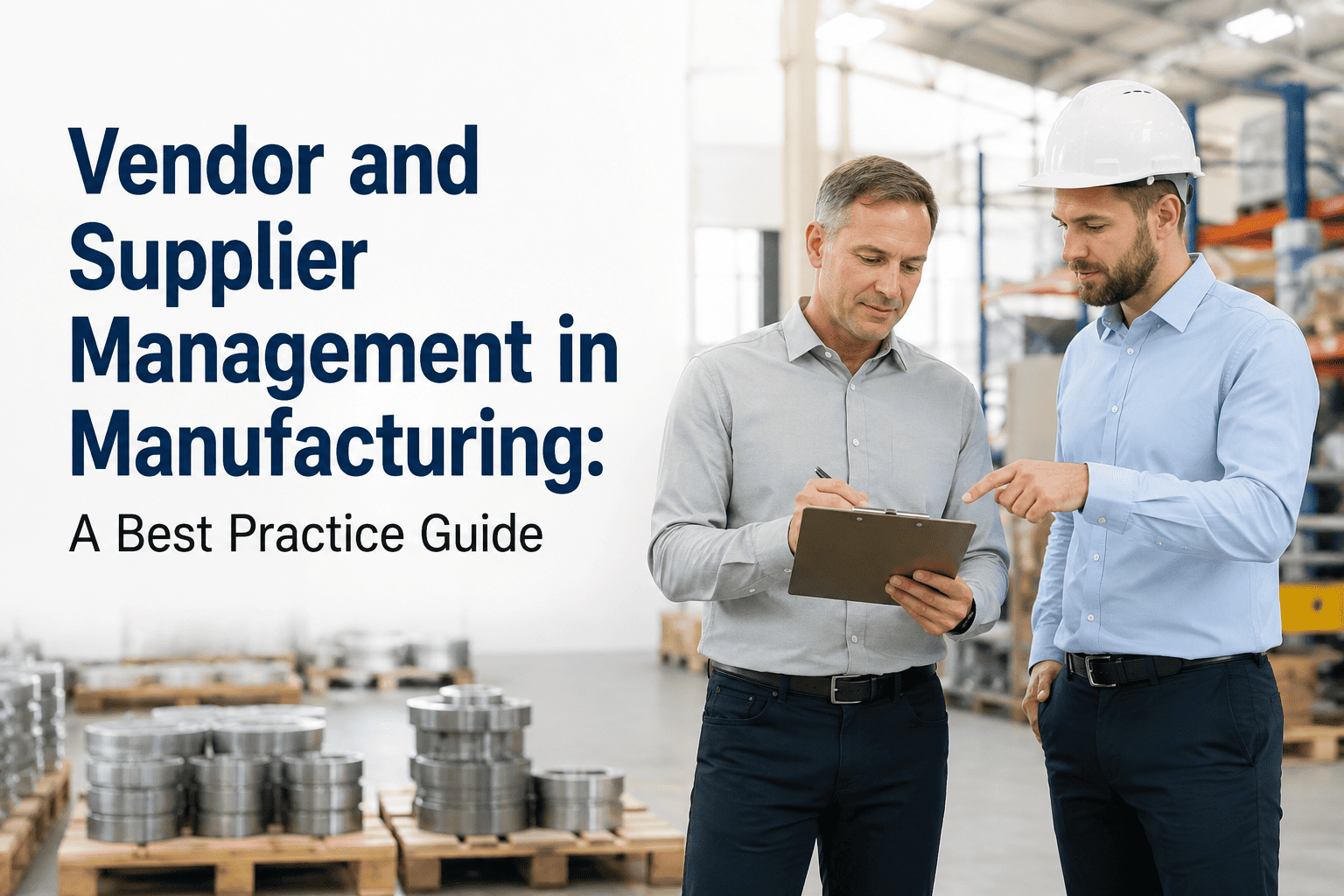
A single unapproved vendor supplying non-conforming parts can shut down an assembly line for days. A sole-source supplier going out of business can halt production for weeks. Vendor and supplier management in manufacturing is not a procurement formality — it is a production risk management function that directly determines whether maintenance schedules hold, spare parts arrive when needed, and quality standards are met consistently across every batch. This guide covers best practices that procurement teams, maintenance managers, and operations leaders use to build supplier programs that reduce supply chain risk while keeping costs and lead times under control. See how Oxmaint manages vendors and purchase orders alongside maintenance work orders and asset records in one platform.
Blog · Procurement · Supply Chain Management
Vendor and Supplier Management in Manufacturing: A Best Practice Guide
How procurement teams, maintenance managers, and operations leaders build supplier programs that reduce supply chain risk, ensure parts availability, and maintain quality standards across every vendor relationship.
Why This Matters
43%
of unplanned downtime linked to spare parts unavailability
2–3x
higher cost for emergency parts vs planned procurement
60%
of quality escapes trace back to supplier non-conformances
The Four Pillars of Vendor Management in Manufacturing
Effective vendor management is built on four interconnected functions. Weaknesses in any one pillar create risks that cascade into production, quality, and cost outcomes.
01
Supplier Qualification
Evaluating and approving vendors before they supply production-critical parts or maintenance materials. Qualification covers quality system capability, financial stability, production capacity, and delivery track record — not just price.
02
Performance Monitoring
Tracking supplier delivery, quality, and responsiveness against defined targets on a continuous basis — not just after problems occur. Scorecards with leading indicators catch declining supplier performance before it impacts production.
03
Risk Management
Identifying and mitigating supply chain risks — sole-source dependencies, geographic concentration, lead time volatility, and financial risk — through dual sourcing, safety stock strategies, and contingency planning.
04
Relationship Development
Building strategic supplier relationships that go beyond transactional purchasing — joint cost reduction programs, early supplier involvement in product development, and collaborative problem-solving when supply disruptions occur.
Supplier Qualification — What the Approved Vendor List Actually Requires
An approved vendor list (AVL) is only as reliable as the qualification process behind it. These are the minimum evaluation criteria for vendors supplying maintenance parts and production materials in a manufacturing environment.
| Qualification Area |
What to Evaluate |
Common Failure Points |
| Quality Management System |
ISO 9001 or equivalent certification; internal quality controls; non-conformance handling process |
Certificates expired or not scoped to relevant product lines |
| Delivery Capability |
Lead time commitments; on-time delivery history with references; surge capacity for emergency orders |
Lead times quoted for standard orders, not the emergency scenarios that actually matter |
| Financial Stability |
Credit rating; years in business; customer concentration risk; ownership and succession status |
Single-owner small suppliers with no succession plan — high discontinuity risk |
| Technical Capability |
In-house testing and certification; traceability documentation; material certificates and test reports |
Resellers posing as OEM-equivalent suppliers without direct manufacturer traceability |
| Compliance and Regulatory |
Export control compliance; restricted substances declarations; industry-specific certifications (ATEX, PED, etc.) |
Compliance assumed rather than verified — discovered only during audit or incident |
| Pricing and Contractual Terms |
Price stability commitments; minimum order quantities; return and warranty policy; payment terms |
No price escalation cap — suppliers exploit sole-source position after qualification |
Supplier Scorecard — KPIs That Predict Problems Before They Happen
Reactive vendor management responds to problems. Proactive vendor management uses leading indicator KPIs to identify supplier risk before delivery failures, quality escapes, or price surprises occur.
Delivery Performance
On-Time Delivery Rate
Target: 95%+
Measure against committed date — not original requested date
Lead Time Variance
Target: <10% deviation
Increasing variance is a leading indicator of supply chain stress
Emergency Order Fulfillment Rate
Track separately
Critical for maintenance suppliers — standard OTD masks emergency performance
Quality Performance
Incoming Acceptance Rate
Target: 99%+
Measure on every shipment — not just sampled lots
Non-Conformance Closure Time
Target: <5 business days
Slow NCR response predicts recurrence — disciplined suppliers close fast
Repeat Non-Conformance Rate
Target: 0
A single repeat NCR triggers formal corrective action requirement
Responsiveness
Quote Response Time
Target: <24 hrs
Slow quote response predicts slow emergency response during downtime events
Corrective Action Response
Target: 48 hrs acknowledgment
How fast suppliers respond when problems arise is a character test
Technical Support Availability
Documented SLA required
Critical for MRO and OEM parts suppliers — not all provide technical support
Oxmaint connects vendor management directly to maintenance operations — approved vendor lists, purchase orders, parts receiving, and work order parts consumption tracked in one platform with full audit history.
Purchase Order Management — Where Most Manufacturing Procurement Breaks Down
Purchase order discipline is the operational foundation of vendor management. These are the practices that separate procurement teams with reliable parts supply from those that spend maintenance time chasing orders.
Step 1
Need Identification and Approval
Parts requests from maintenance teams are validated against the asset's bill of materials and approved vendor list before a PO is raised. Uncontrolled spot purchasing from unapproved vendors — common in reactive maintenance cultures — bypasses qualification and creates quality and traceability risk.
Step 2
PO Creation with Full Specification
Purchase orders include part number, approved vendor part reference, required material certificates, delivery date, and delivery location — not just price and quantity. Incomplete POs create receiving disputes and quality gaps that are expensive to resolve after delivery.
Step 3
Acknowledgment and Confirmation
Every PO requires vendor acknowledgment with confirmed delivery date within 24 hours of issue. Unacknowledged POs create false confidence in parts availability. Maintenance planners need confirmed commitments, not assumed acceptance.
Step 4
Receiving Inspection and GRN
Parts are inspected against PO specifications on receipt — before being placed in inventory. Material certificates and packing lists are matched to the PO and stored with the goods receipt record. Parts that fail inspection are quarantined immediately, not stored pending resolution.
Step 5
Consumption Tracking Against Work Orders
Parts issued from inventory are linked to the specific work order and asset they are consumed against — creating a full procurement-to-installation chain. This data feeds vendor performance tracking (did the part perform?) and informs future PM-triggered ordering cycles.
Book a demo to see how Oxmaint closes this loop automatically.
CMMS Integration — Connecting Vendor Management to Maintenance Operations
Vendor management data sitting in a procurement system that maintenance teams cannot access creates the parts availability gaps that cause the most damaging unplanned downtime. CMMS integration closes this gap.
Without CMMS Integration
Maintenance planner calls procurement to check parts availability
Work order created without confirming parts are in stock
Technician arrives at equipment — parts not available
Emergency PO raised at 2–3x standard cost
Maintenance delayed 2–5 days waiting for emergency delivery
Asset history shows PM completed — but repair incomplete
With CMMS-Integrated Vendor Management
Work order created — parts availability checked automatically
Below-minimum stock triggers purchase request to approved vendor
PO raised and tracked within CMMS — no system switching
Technician dispatched only when parts confirmed in stock
Parts consumption logged against asset on work order closure
Inventory and vendor performance updated automatically
Frequently Asked Questions
How many vendors should be on an approved vendor list for a typical manufacturing plant?
There is no ideal number — but most well-managed plants aim for 2–3 qualified suppliers per critical parts category, and a single approved vendor for non-critical consumables where price is the primary driver. AVL size should be driven by supply risk management, not cost reduction targets alone. Overloaded AVLs with 10+ vendors per category create management overhead without proportional risk reduction.
See how Oxmaint manages approved vendor lists within your maintenance workflow.
What is the difference between vendor management and supplier management in manufacturing?
In practice the terms are used interchangeably, but some organizations distinguish them: vendor management covers transactional purchasing relationships — parts, consumables, MRO — while supplier management refers to strategic production material suppliers with closer quality system integration. The practices described in this guide apply to both, with more rigorous qualification and performance tracking applied to production-critical suppliers.
How should maintenance teams handle vendor performance issues without full procurement authority?
Maintenance teams should document quality and delivery issues at the point of receipt and work order closure — not informally. Every non-conforming delivery and every parts shortage that delays a work order is a vendor performance data point. When this data lives in the CMMS rather than in a technician's memory, procurement teams have the evidence they need to drive supplier accountability reviews.
Book a demo to see how Oxmaint captures vendor performance data from maintenance workflows.
What is the best way to manage sole-source suppliers for critical maintenance parts?
Sole-source suppliers require active risk management: negotiate formal supply agreements with delivery commitments, maintain higher safety stock levels than you would for dual-source parts, actively investigate alternative suppliers annually, and where technically feasible, develop an approved second source. A sole-source that fails during a critical equipment outage has no competitive pressure to prioritize your emergency — your only leverage is a prior contractual commitment.
Connect Vendor Management to Your Maintenance Program
Oxmaint gives maintenance teams and procurement managers a shared platform for approved vendors, purchase orders, parts inventory, and work order execution — eliminating the coordination gaps that cause costly unplanned downtime.