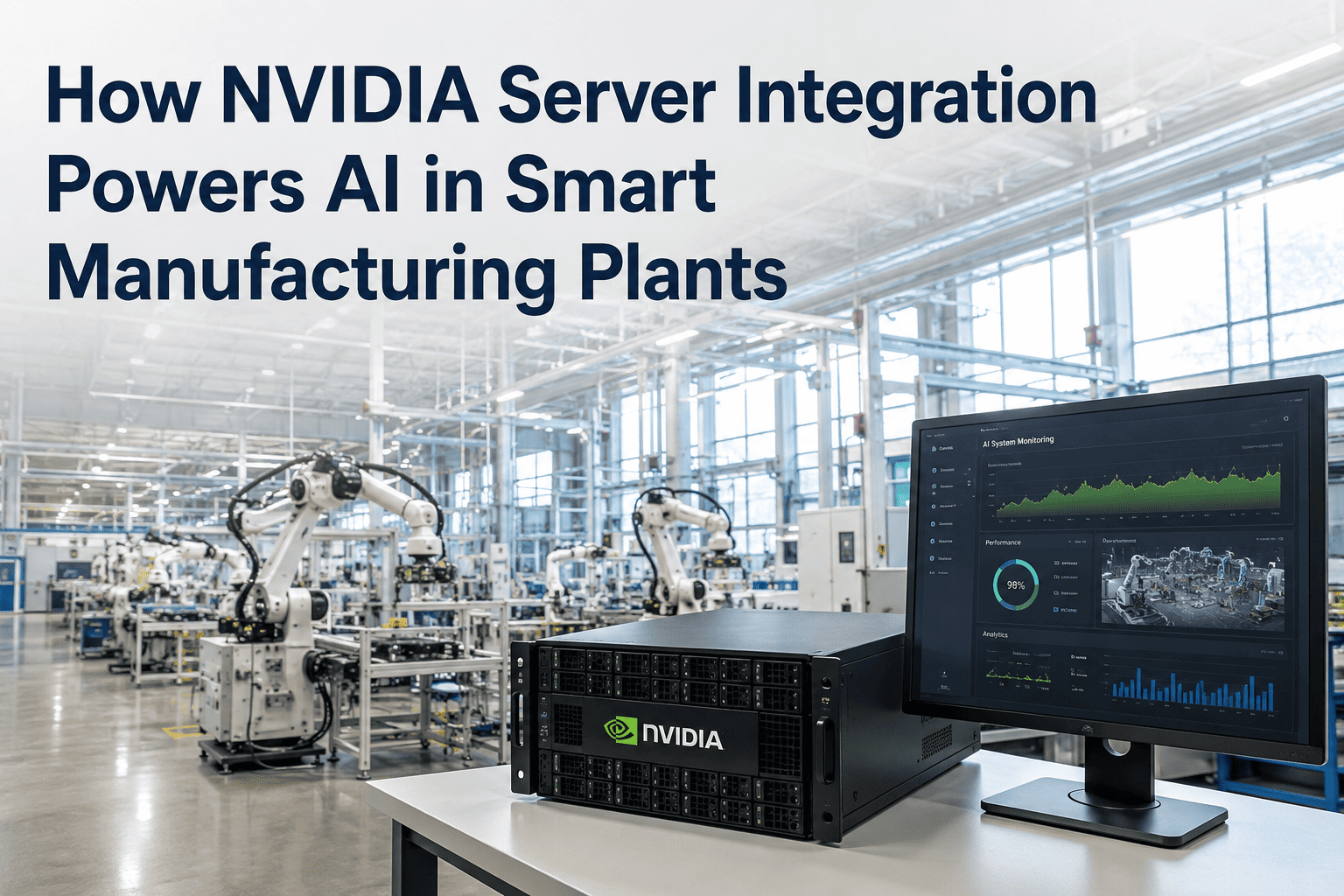
NVIDIA's GPU infrastructure has moved from data centers into factory floors, and the shift is changing what "smart manufacturing" actually means in practice. Edge AI systems built on NVIDIA Jetson, IGX, and EGX platforms are enabling real-time defect detection, predictive maintenance inference, and quality control vision at line speed — without sending data to the cloud for processing. For AI engineers and IT directors evaluating GPU-powered edge computing in industrial environments, this page covers how NVIDIA server integration works in active manufacturing facilities, where the performance gains are measurable, and what implementation actually involves. See how Oxmaint integrates with AI-enabled plant infrastructure to connect sensor data and predictive insights to maintenance work orders in real time.
Blog · AI Infrastructure · Smart Manufacturing
How NVIDIA Server Integration Powers AI in Smart Manufacturing Plants
GPU-powered edge computing is enabling real-time defect detection, predictive maintenance, and quality AI that runs at line speed — without cloud latency. Here is how it works in active manufacturing facilities.
<10ms
AI inference latency at the edge
4K
Camera streams processed per GPU node
30–50%
Defect escape reduction reported by manufacturers
What NVIDIA Server Integration Actually Means in a Manufacturing Plant
NVIDIA server integration in manufacturing is not a single product — it is an architecture that combines GPU computing hardware, software frameworks, and sensor infrastructure into a real-time AI system on the plant floor.
Layer 1 — Sensing
Machine vision cameras
Vibration sensors (IIoT)
Thermal imaging arrays
Acoustic monitors
PLC and SCADA feeds
▼
Layer 2 — NVIDIA Edge Computing
NVIDIA Jetson (device-level AI)
NVIDIA IGX (safety-critical edge)
NVIDIA EGX (plant-level GPU cluster)
DeepStream SDK (video analytics)
TAO Toolkit (model training)
▼
Layer 3 — Manufacturing Applications
Defect detection and quality control
Predictive maintenance inference
Robotic path optimization
CMMS work order integration
Production scheduling AI
NVIDIA Hardware Platforms Used in Manufacturing — A Practical Comparison
NVIDIA offers distinct hardware platforms for different points in the manufacturing AI architecture. Choosing the right platform depends on where inference runs, what latency is acceptable, and how much compute the application requires.
| Platform |
Form Factor |
Primary Manufacturing Use Case |
Typical Deployment Point |
Compute Profile |
| NVIDIA Jetson Orin |
Embedded module |
Vision AI on single machine or robot |
Machine-mounted or robot controller |
Up to 275 TOPS |
| NVIDIA IGX Orin |
Industrial PC |
Safety-certified AI near production equipment |
Cell-level enclosure |
Functional safety ready |
| NVIDIA EGX Platform |
Edge server rack |
Multi-camera quality AI across production line |
Plant floor server room |
Multi-GPU scalable |
| NVIDIA A-series GPU servers |
Data center server |
Model training on production quality data |
On-premise data center |
A100/A30 class |
| NVIDIA DGX Systems |
AI supercomputer |
Large-scale model development and fleet learning |
Central engineering or cloud |
H100 class |
Five Manufacturing AI Applications NVIDIA Infrastructure Enables
These are the applications where GPU-powered edge computing creates the most measurable impact in active manufacturing environments — validated across automotive, electronics, pharmaceutical, and heavy industry deployments.
01
Real-Time Visual Quality Inspection
GPU-accelerated vision models analyze parts at production line speed — detecting surface defects, dimensional deviations, and assembly errors that human inspectors miss at high throughput. NVIDIA DeepStream processes multiple 4K camera streams simultaneously on a single GPU node, enabling inspection at stations where quality has historically been sampled, not 100% checked.
Defect escape rates reduced 30–50% in electronics assembly deployments
02
Predictive Maintenance Inference at the Edge
Vibration, temperature, and current signature data from IIoT sensors feeds continuously into AI models running on Jetson or EGX hardware. Anomaly detection models identify early failure signatures — bearing degradation, imbalance, electrical fault patterns — and generate maintenance alerts before failure occurs, without cloud round-trips that add latency.
Unplanned downtime reduction of 20–35% reported in pump and motor maintenance applications
03
Robotic Vision and Path Optimization
Collaborative robots equipped with Jetson-powered vision can adapt grip positions, assembly paths, and force profiles in real time based on part variation — eliminating the rigid fixturing that conventional automation requires. NVIDIA Isaac ROS provides the robot operating system integration layer that connects GPU vision to robot controllers.
Part-to-part variation handling without fixture changes in flexible assembly applications
04
Digital Twin Simulation
NVIDIA Omniverse enables physics-accurate digital twin simulations of production lines, robots, and factory layouts. Manufacturers run simulation experiments — layout changes, new product introductions, throughput optimizations — without disrupting live production. GPU compute makes real-time simulation feasible at production-system scale.
Layout optimization and robot path planning validated in simulation before physical implementation
05
Process Parameter Optimization
AI models trained on historical process data — temperature curves, pressure profiles, chemical concentrations — run inference continuously and recommend real-time parameter adjustments that maximize yield. GPU inference speed allows these recommendations to update faster than traditional PID control loops respond to process drift.
Yield improvement of 3–8% reported in semiconductor and pharmaceutical process applications
Oxmaint integrates with AI-powered maintenance inference systems — connecting predictive alerts from NVIDIA edge platforms directly to CMMS work orders, so maintenance teams act on AI predictions without manual data transfer.
NVIDIA Software Stack for Manufacturing AI — Key Frameworks
Hardware is only one part of the integration. The NVIDIA software ecosystem provides the AI development, deployment, and runtime tools that make GPU-powered manufacturing applications production-ready.
NVIDIA DeepStream SDK
Video analytics pipeline framework
Processes multiple camera streams simultaneously for quality inspection and safety monitoring applications. Used extensively in automotive body shop vision systems and electronics PCB inspection lines.
NVIDIA TAO Toolkit
AI model training and fine-tuning
Enables manufacturers to fine-tune pre-trained vision models on their specific defect libraries and product types without needing large data science teams. Dramatically reduces the data and compute needed to deploy custom quality AI.
NVIDIA Isaac ROS
Robot operating system with GPU acceleration
Provides GPU-accelerated perception, navigation, and manipulation for industrial robots. Used by integrators deploying collaborative robots that need real-time vision for assembly, kitting, and bin-picking applications.
NVIDIA Omniverse
Digital twin and simulation platform
Physics-accurate simulation environment for factory layout, robot programming, and production system testing. Major automotive OEMs use Omniverse for virtual factory commissioning before physical equipment arrives on site.
NVIDIA Metropolis
Vision AI application framework
Pre-built AI pipeline components for common manufacturing vision tasks — defect detection, OCR for label verification, people and object tracking for safety compliance. Reduces custom development time for standard vision applications.
NVIDIA Triton Inference Server
Production AI model serving
Manages multiple AI model deployments simultaneously on a single GPU server — enabling a single EGX node to serve inference for quality inspection, predictive maintenance, and process optimization in parallel.
Implementation Considerations for IT Directors and AI Engineers
Deploying NVIDIA infrastructure in manufacturing environments introduces specific integration, network, and operational requirements that differ significantly from data center AI deployments.
Network Architecture
Manufacturing edge AI requires OT/IT network segmentation — GPU edge nodes on the plant floor operate in OT network zones with restricted connectivity to corporate IT infrastructure. Time-sensitive networking (TSN) is increasingly specified for AI inference systems that must synchronize with PLC control loops.
Environmental Hardening
Standard server-grade GPU hardware is not rated for plant floor environments. NVIDIA IGX and purpose-built industrial GPU servers are specified for operating temperature ranges, vibration tolerance, and ingress protection levels appropriate for manufacturing locations. Air cooling in dusty environments requires filtered enclosures.
Functional Safety
Applications where AI inference influences safety-critical decisions — robot collision avoidance, press guarding, hazardous area monitoring — require hardware and software certified to functional safety standards. NVIDIA IGX Orin has been designed with functional safety certification pathways in mind, which standard Jetson modules do not provide.
Model Lifecycle Management
Production AI models need version control, performance monitoring, and retraining workflows. Defect detection models drift as products change, tooling wears, and lighting conditions shift. MLOps infrastructure for manufacturing AI must support model updates without production line downtime — typically through blue-green deployment patterns.
CMMS and MES Integration
Predictive maintenance AI generates value only when predictions reach maintenance teams as actionable work orders. Integration between NVIDIA edge inference platforms and CMMS systems — through API connections or MQTT/OPC-UA message brokers — is a required step that many AI deployments underestimate.
Book a demo to see how Oxmaint connects to AI-generated maintenance alerts.
Frequently Asked Questions
What is the difference between NVIDIA Jetson and NVIDIA EGX for manufacturing AI?
Jetson is a device-level embedded AI module suited for single-machine or robot-mounted vision applications with modest compute requirements. EGX is a plant-level GPU edge server designed to handle multiple simultaneous AI workloads — processing many camera streams or serving inference for multiple applications in parallel. Most plants use both: Jetson for machine-level tasks and EGX for line-level analytics.
See how Oxmaint connects to edge AI outputs regardless of platform.
How does edge AI inference differ from cloud-based AI for manufacturing applications?
Edge inference runs on GPU hardware at or near the production line, delivering results in under 10 milliseconds — fast enough to make real-time quality decisions or trigger machine stops before a defective part moves to the next station. Cloud-based AI introduces round-trip latency of 50–200 milliseconds or more, which is too slow for many production control applications and creates connectivity dependency that manufacturing environments cannot accept.
What volume of training data is needed to deploy a custom quality inspection AI model?
With NVIDIA TAO Toolkit's transfer learning approach, manufacturers can fine-tune pre-trained vision models with as few as 500–1,000 labeled defect images per defect class — far less than training from scratch. The exact requirement depends on defect complexity, acceptable false-positive rate, and how visually distinct defects are from acceptable parts. Most manufacturers start with their existing inspection reject samples as the initial training dataset.
How does NVIDIA's Omniverse fit into manufacturing operations for non-OEM companies?
Omniverse is increasingly accessible for mid-size manufacturers, not just OEMs. The most practical use cases at this level are robot cell layout validation before installation, new product introduction simulation to verify assembly feasibility, and maintenance training simulations. Cloud-hosted Omniverse removes the need for on-premise high-end GPU workstations for simulation tasks.
Book a demo to discuss AI-connected maintenance programs for your plant.
Connect Your AI Infrastructure to Maintenance Execution
Predictive maintenance AI from NVIDIA edge platforms generates value only when predictions become work orders. Oxmaint closes the loop — connecting AI-generated alerts to digital work orders, technician dispatch, and maintenance history on one platform.