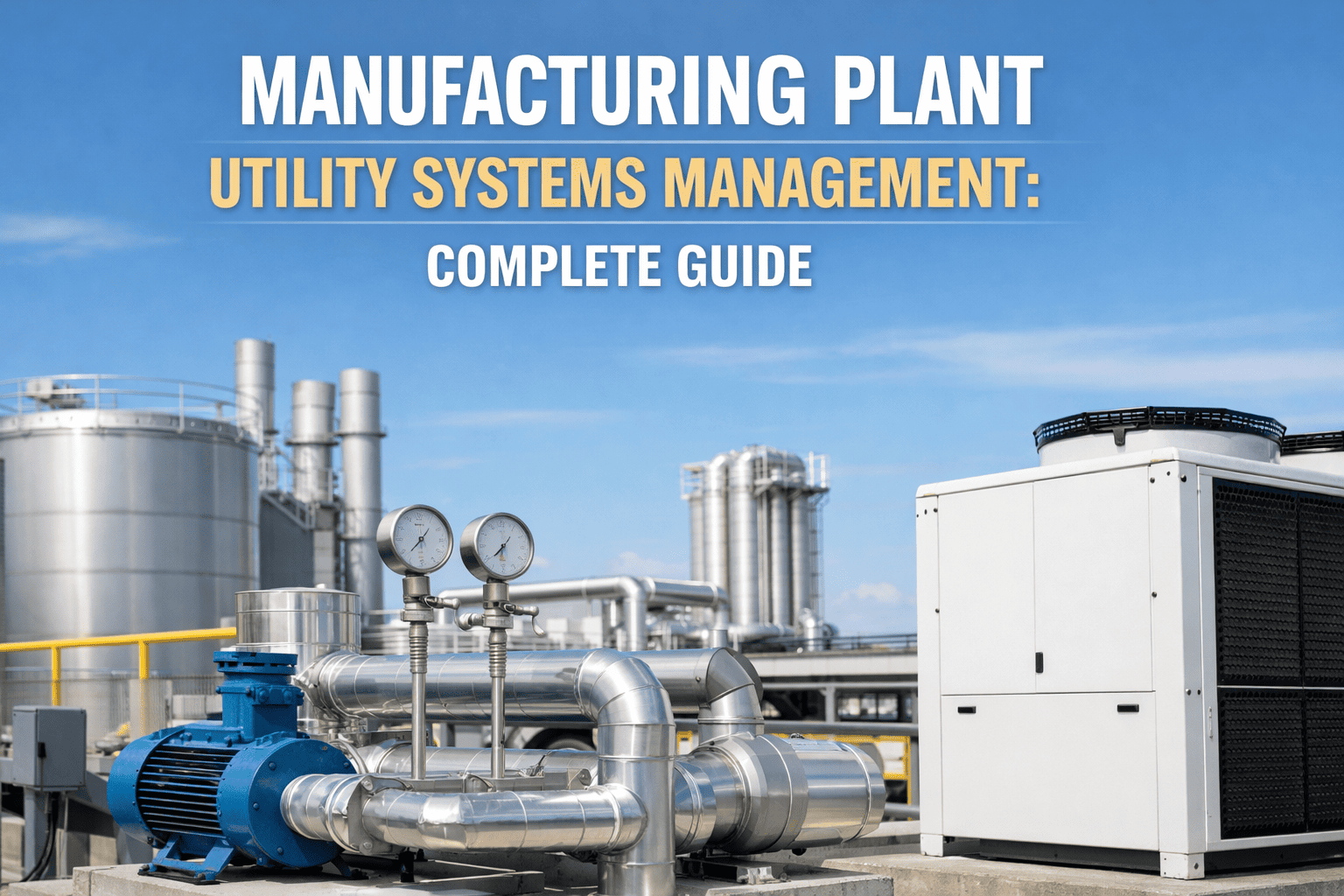
Manufacturing Plant Utility Systems Management: Complete Guide
By oxmaint on March 4, 2026
Manufacturing plants lose an average of $180,000 every year to unplanned utility failures that proper maintenance would have prevented. Compressed air leaks bleed energy 24 hours a day. Steam traps fail silently for months. Cooling towers grow scale that chokes heat exchangers. Electrical connections loosen until they arc. These utility systems operate behind the scenes, but when one fails, your entire production line stops. The difference between plants that control utility costs and those that hemorrhage money comes down to one thing: structured, proactive management of every utility asset. Schedule a free utility assessment with our team to pinpoint exactly where your plant is losing money and get a plan to fix it.
How Utility Systems Impact Your Plant's Bottom Line
Utility systems are the invisible backbone of manufacturing. They do not make products, but nothing gets made without them. Despite representing 30-40% of total operating costs in a typical plant, utility assets receive a fraction of the maintenance attention given to production equipment. That imbalance creates enormous waste.
30-40%
of total plant operating costs are driven by utility systems including compressed air, steam, electricity, and water
$50K/hr
average cost of unplanned downtime in manufacturing, often triggered by utility failures, not production equipment
70%
of energy savings in manufacturing come from low-cost maintenance improvements, not major capital projects
The financial reality is stark: a single failed boiler tube costs more in emergency repairs and lost production than an entire year of scheduled boiler maintenance. A compressed air system with unrepaired leaks can waste more electricity than your largest CNC machine consumes. These are not hypothetical scenarios. They happen in plants every week, and they are entirely preventable with the right maintenance infrastructure in place.
Stop losing money to utility failures you can prevent. Sign up for Oxmaint and get instant access to PM scheduling, work order tracking, and asset management for every compressor, boiler, and cooling tower in your plant.
The 6 Critical Utility Systems Every Plant Must Manage
A well-run manufacturing facility treats utility systems with the same rigor as production equipment. Each system has unique failure modes, maintenance requirements, and optimization opportunities. Below is what plant operations teams need to know about each one and how they interconnect to keep production running.
01
Compressed Air Systems
Compressed air is often called the fourth utility and is also the most expensive per unit of energy delivered. It powers pneumatic actuators, packaging lines, blow-off stations, and instrument controls across every manufacturing sector. The U.S. Department of Energy estimates that leaks account for 20-30% of a compressor's output in a typical plant. Beyond leaks, oversized compressors running at partial load, clogged filters, and wet air from failed dryers all drive up costs and damage downstream equipment.
Quarterly ultrasonic leak detection surveysFilter and separator element replacementsOil analysis and compressor performance trendingDryer dew point verification and drain maintenance
02
Steam Generation and Distribution
Steam remains the most widely used heat transfer medium in food processing, pharmaceutical, chemical, and paper manufacturing. Boilers, steam distribution piping, condensate return systems, and steam traps form an interconnected network where one weak link degrades the entire system. A single failed-open steam trap can waste $5,000-$15,000 in fuel annually. Scale buildup of just 1/16 inch on boiler tubes increases fuel consumption by 12%. Effective steam management combines water treatment, trap testing, insulation maintenance, and combustion tuning into a coordinated program.
Daily boiler water chemistry testing and blowdownAnnual steam trap surveys with immediate replacementInsulation integrity audits on distribution pipingCombustion tuning and flue gas analysis quarterly
03
Water and Wastewater Treatment
Manufacturing plants consume water for process cooling, cleaning, product formulation, and boiler feedwater. Each application demands specific water quality, and poor treatment leads to fouled heat exchangers, corroded piping, legionella risk in cooling towers, and regulatory violations on discharge. A cooling tower operating without proper chemical treatment loses 15-20% of its heat transfer efficiency within a single season. Wastewater discharge violations carry fines starting at $10,000 per day and can result in forced production shutdowns.
Chemical dosing calibration and tank inventory checksCooling tower basin cleaning and drift eliminator inspectionpH, conductivity, and turbidity monitoring schedulesDischarge sampling and regulatory compliance documentation
04
Electrical Distribution and Power Quality
Switchgear, transformers, motor control centers, and power factor correction equipment distribute electricity safely across the plant. Electrical failures are among the most dangerous in any facility, with arc flash events capable of causing fatalities and destroying equipment worth hundreds of thousands of dollars. Loose connections generate heat that accelerates insulation degradation. Power quality issues such as harmonics and voltage sags cause premature motor failures and erratic equipment behavior. Infrared thermography and power quality monitoring are essential preventive measures.
Annual infrared thermographic surveys of all panelsBreaker testing and connection torque verificationPower factor monitoring and capacitor bank inspectionGround fault protection testing and arc flash analysis
05
HVAC and Environmental Controls
Manufacturing HVAC is not office air conditioning. Clean rooms in semiconductor and pharmaceutical plants demand HEPA filtration and precise humidity control. Food plants require temperature-controlled environments to prevent contamination. Paint booths need carefully balanced airflow for finish quality. When HVAC fails in these environments, entire production batches can be lost. A single temperature excursion in a pharmaceutical plant can destroy product worth more than the HVAC system itself. Preventive maintenance including filter changes, coil cleaning, and damper calibration is non-negotiable.
Monthly filter inspection and replacement schedulesCoil cleaning and refrigerant charge verificationTemperature and humidity calibration checksDamper actuator testing and ductwork inspection
06
Industrial Gas and Specialty Systems
Nitrogen, oxygen, argon, and specialty gases serve welding, inerting, packaging, and process applications across metals, food, electronics, and chemical manufacturing. Gas system failures pose both operational and safety risks. Leaking nitrogen lines waste expensive gas and can create oxygen-depleted atmospheres in enclosed spaces. Pressure regulator failures can damage sensitive downstream equipment. Safety valve testing and leak detection are critical maintenance priorities that protect both people and production. Create your free Oxmaint account to schedule gas system safety checks alongside compressed air, steam, and all other utility maintenance in one place.
Pressure regulator calibration and relief valve testingGas line leak detection with scheduled survey routesManifold and changeover panel inspectionVentilation verification for enclosed gas storage areas
Managing six utility systems with spreadsheets is a recipe for missed PMs. Book a demo and we will show you how Oxmaint automates compressed air, steam, electrical, and water system maintenance schedules with technician notifications and full audit trails.
Reactive vs. Preventive: What Poor Utility Management Really Costs
Most plants understand that reactive maintenance is expensive. But when it comes to utility systems, the gap between reactive and preventive approaches is even wider than for production equipment because utility failures cascade across the entire facility.
Reactive Utility Management
XRun-to-failure on compressors, boilers, and pumps
XNo scheduled leak detection or trap testing
XWater treatment only after scale or corrosion appears
XElectrical panels inspected only after tripping
XEmergency contractors at 2x-3x standard rates
40-60% Higher
annual utility operating costs versus proactively managed plants
Proactive CMMS-Driven Management
+Automated PM schedules aligned to OEM specs
+Quarterly leak surveys and trap testing programs
+Continuous water chemistry monitoring and dosing
+Annual thermographic surveys with trend tracking
+Planned downtime during low-production windows
25%+ Savings
on utility costs with structured maintenance and energy optimization
How to Build a Preventive Maintenance Program for Plant Utilities
Effective utility maintenance is not about doing more work. It is about doing the right work at the right time. The table below maps the critical maintenance tasks for each utility system, the intervals that industry best practices recommend, and the consequences of skipping them. Sign up free for Oxmaint to turn this checklist into automated PM workflows that your team executes consistently without manual tracking.
Utility Preventive Maintenance Matrix
System
Priority PM Tasks
Interval
What Happens If You Skip It
Compressed Air
Ultrasonic leak survey, filter and separator changes, oil sampling, belt and coupling inspection
Weekly to quarterly
20-30% energy waste, moisture damage to pneumatic tools, contaminated products
Temperature excursions destroying product batches, indoor air quality violations
Not sure which utility PMs to prioritize first? Book a demo and our maintenance specialists will review your utility systems, recommend the highest-impact tasks, and show you how to set up automated schedules in Oxmaint.
Energy Optimization Tactics That Deliver 25% Utility Savings
Maintenance alone keeps systems running. Optimization makes them run efficiently. The strategies below are ranked by speed of payback and ease of implementation, starting with the quickest wins.
Tactic 1
Compressed Air Leak Elimination
A plant with 500 CFM of leaks at typical energy rates wastes over $100,000 annually. Ultrasonic leak detection surveys take 1-2 days and repair costs are minimal. This is consistently the single fastest payback project in any plant. Most facilities recover 15-25% of compressor capacity through systematic leak repair, often eliminating the need for additional compressor purchases.
Payback: 1-3 months | Savings: $10K-$100K+/year
Tactic 2
Steam Trap Testing and Replacement
Industry studies consistently show that 15-30% of steam traps in any facility have failed. Failed-open traps dump live steam directly into condensate lines, wasting fuel and causing water hammer damage. A systematic annual survey with immediate replacement of failed traps typically saves 10-15% of total boiler fuel costs with a payback period under 6 months.
Payback: 3-6 months | Savings: $15K-$80K/year
Tactic 3
Variable Frequency Drives on Utility Motors
Cooling tower fans, pump motors, and compressors frequently run at full speed even when demand is low. VFDs match motor speed to actual load, and because energy consumption drops by the cube of speed reduction, even modest speed decreases yield dramatic savings. Prioritize motors above 25 HP with variable-load duty cycles for the fastest returns.
Payback: 12-18 months | Savings: 20-50% per motor
Tactic 4
Boiler Combustion Tuning
Excess air in the combustion process wastes fuel by heating air that does not contribute to steam production. A professional combustion analysis and burner tune-up every 6-12 months keeps excess air levels optimized, typically improving boiler efficiency by 2-5%. On a boiler consuming $500,000 in annual fuel, that represents $10,000-$25,000 in direct savings.
Payback: 2-4 months | Savings: 2-5% of fuel costs
Tactic 5
Waste Heat Recovery
Compressors convert 96% of input energy into heat. Boiler flue gases carry significant thermal energy up the stack. Recovering this waste heat to preheat boiler feedwater, warm facilities, or supplement process heating can offset 5-15% of total plant energy costs. Heat recovery systems require minimal ongoing maintenance once installed. Start a free Oxmaint account to track heat recovery performance and schedule maintenance for every energy-saving system in your plant.
Payback: 12-24 months | Savings: 5-15% of energy costs
Why Top Plants Use CMMS for Utility Asset Tracking
A CMMS transforms utility management from scattered spreadsheets and tribal knowledge into a centralized, automated system that ensures nothing falls through the cracks. Here is how a platform like Oxmaint addresses the specific challenges of managing utility infrastructure across your facility.
Automated Preventive Maintenance Scheduling
Set up calendar-based, meter-based, or condition-triggered PMs for every utility asset. Oxmaint sends technician notifications automatically and escalates overdue tasks so critical inspections like boiler safety valve tests and electrical thermographic surveys never get missed.
Complete Utility Asset Registry
Every compressor, boiler, cooling tower, transformer, and water treatment unit gets a digital record with maintenance history, nameplate data, warranty dates, and linked spare parts. Technicians scan QR codes to pull up full asset details from the field.
Mobile Work Order Management
Technicians receive, update, and close work orders from their phones while standing next to the equipment. Photo attachments, digital checklists, and time logging capture the detail you need for compliance audits and performance analysis.
Spare Parts Inventory Linked to Assets
Know exactly which filters, belts, gaskets, and elements are needed for each utility asset. Automated reorder alerts prevent the stockouts that turn a 2-hour PM into a 2-week delay while emergency parts ship.
Compliance Audit Trails
Boiler inspections, water discharge testing, electrical safety checks, and environmental compliance tasks generate tamper-proof records automatically. Pull audit-ready reports in seconds instead of digging through filing cabinets.
Documented Results: Utility Management ROI
Facilities that transition from reactive to proactive utility management consistently report measurable improvements across energy costs, equipment uptime, and maintenance efficiency. These benchmarks reflect typical outcomes from plants using CMMS-driven utility programs.
25%
reduction in total utility energy costs through leak repair, optimization, and scheduled maintenance
70%
fewer unplanned utility breakdowns with structured preventive maintenance programs
3x
longer average utility equipment lifespan with regular maintenance and performance trending
45%
less time spent coordinating emergency utility repairs and expediting parts
Start seeing these results at your plant within 30 days. Sign up for a free Oxmaint account now and begin registering utility assets, scheduling preventive maintenance, and tracking energy cost improvements from day one.
Your 8-Week Utility Management Implementation Plan
You do not need a million-dollar project to get utility management right. The roadmap below follows the same phased approach that successful plants use to go from spreadsheets to structured CMMS-driven operations in under two months.
Week 1-2
Utility Asset Audit
Walk every utility room, mechanical space, and distribution path. Catalog every compressor, boiler, pump, panel, cooling tower, and treatment system. Record nameplate data, current condition, and any known issues. Enter all assets into Oxmaint with photos and locations.
Week 3-4
PM Schedules and Workflows
Build preventive maintenance schedules for every utility asset using OEM recommendations as the baseline. Create digital checklists for each task type. Assign technicians, set notification triggers, and establish escalation rules for overdue work orders.
Week 5-6
Quick Win Projects
Execute your first compressed air leak survey and fix every leak found. Test all steam traps and replace failures. Conduct infrared scans of electrical panels. These quick wins generate immediate savings that build organizational support for the full program.
Week 7-8+
Optimize and Expand
Analyze work order data to refine PM frequencies. Identify energy optimization projects based on maintenance findings. Set up KPI dashboards for utility uptime, energy costs, and PM completion rates. Expand the program to cover every auxiliary system in the plant.
Common Utility Management Mistakes and How to Fix Them
Even experienced maintenance teams fall into patterns that undermine utility system performance. Recognizing these common pitfalls and applying proven fixes accelerates your path to reliable, cost-efficient utility operations.
Challenge Resolution Guide
Common Mistake
What It Costs You
The Fix
Utility assets not tracked in any system
No maintenance history, repeated failures, no data for replacement decisions
Register every utility asset in a CMMS with nameplate data, PM schedules, and linked spare parts
Treating compressed air leaks as normal
$10K-$100K+ in annual energy waste depending on system size
Establish quarterly ultrasonic leak surveys with tagged repairs tracked through work orders
Ignoring steam trap failures
15-30% of traps failed at any time, each wasting $5K-$15K/year in fuel
Annual trap surveys with immediate replacement; track trap inventory and failure rates in CMMS
Skipping electrical thermography
Undetected hot spots lead to arc flash incidents, equipment damage, and fires
Annual thermographic surveys on all panels and switchgear with findings logged for trending
No water treatment program
Fouled heat exchangers, corroded pipes, cooling capacity loss, compliance fines
Automated chemical dosing with daily testing schedules and compliance documentation in CMMS
Take Control of Every Utility System in Your Plant
Your compressed air leaks, failed steam traps, and neglected electrical panels are silently draining your budget every hour of every day. Oxmaint gives your maintenance team the scheduling, tracking, and reporting tools to manage every utility asset with the same discipline you apply to production equipment. Start with a free account, see results within weeks.
What utility systems can be managed with Oxmaint CMMS?
Oxmaint handles all plant utility systems including compressed air compressors and dryers, steam boilers and distribution networks, cooling towers and chillers, electrical switchgear and transformers, water and wastewater treatment, HVAC systems, and industrial gas delivery. Each asset gets its own maintenance schedule, history log, and linked spare parts inventory. Sign up free and explore the platform to see how Oxmaint organizes utility assets with built-in PM schedules.
How quickly can we expect results from better utility management?
Most plants see measurable improvements within 30-60 days. Quick wins like compressed air leak repairs and steam trap replacements deliver immediate energy savings with minimal investment. Within 3-6 months, structured PM programs significantly reduce unplanned downtime and emergency repair costs across all utility systems.
Do we need IoT sensors or special hardware to get started?
No. Most plants begin with PM scheduling and work order management in Oxmaint, which requires zero additional hardware. As your program matures, you can add sensors and sub-metering to unlock predictive capabilities. The foundation is always structured maintenance processes first, technology layering second. Book a free demo call to discuss the right starting point for your facility and see how other plants got started without sensors.
How does Oxmaint help with regulatory compliance for utility systems?
Oxmaint automates scheduling for compliance tasks including boiler inspections, emissions testing, water discharge sampling, and electrical safety checks. Digital checklists capture required data, photos, and technician sign-offs with timestamps. Audit-ready reports can be generated instantly for any regulatory inspection.
What is the biggest utility management mistake plants make?
Not tracking utility assets in any system. When compressors, boilers, and cooling towers exist only in someone's memory, maintenance becomes random instead of systematic. The single most impactful step any plant can take is registering every utility asset in a CMMS with PM schedules attached. Everything else builds on that foundation. Schedule a free walkthrough and our team will help you build your utility asset registry and first set of PM schedules.