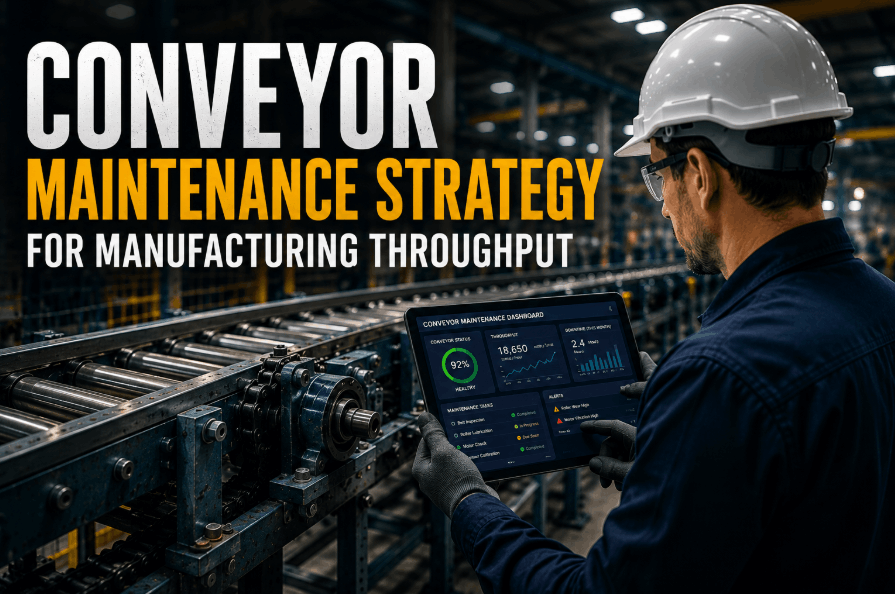
Conveyor systems are the circulatory system of modern manufacturing — when they stop, throughput stops. In 2026, plant managers and reliability engineers are under increasing pressure to keep conveyor uptime above 95% while managing aging equipment and shrinking maintenance windows. A structured conveyor maintenance strategy is no longer optional; it is a production continuity requirement. Sign Up Free to start building asset-specific conveyor PM schedules and work order workflows that reduce unplanned failures before they reach the production floor. The gap between facilities that meet throughput targets and those that miss them is almost always traced back to maintenance planning discipline, not equipment quality.
Reduce Conveyor Downtime with OxMaint
OxMaint gives maintenance teams the PM scheduling, mobile work orders, and real-time KPI dashboards to manage conveyor reliability from a single platform — built for manufacturing throughput in 2026.
Why Conveyor Maintenance Strategy Determines Manufacturing Throughput
Conveyor belt failures, idler seizures, drive motor faults, and tensioner misalignment are all predictable failure modes — yet most plants still respond to them reactively. Book a Demo to see how OxMaint's asset management module helps maintenance teams build conveyor-specific failure mode libraries, schedule condition-based inspections, and close the loop between technician observations and PM interval refinement. Facilities that treat conveyor maintenance as a scheduled, data-driven program rather than a breakdown response function consistently achieve higher OEE, lower parts spend, and more predictable production scheduling. The business case for structured conveyor maintenance is not theoretical — it is measurable in line throughput per shift.
Core Components of a High-Performance Conveyor Maintenance Strategy
Asset-Based PM Scheduling
Build preventive maintenance schedules around actual conveyor asset data — belt type, load profile, operating hours, and historical failure frequency — rather than generic vendor intervals. CMMS-driven PM triggers ensure no inspection window is missed.
Condition Monitoring Integration
Track belt tension, idler bearing temperature, motor current draw, and belt tracking data as leading indicators. Condition-based maintenance triggers eliminate unnecessary scheduled downtime while catching real degradation before failure.
Work Order Root Cause Documentation
Every conveyor repair work order must close with a documented root cause — not just task status. Root cause data drives PM interval refinement, parts stocking decisions, and failure pattern identification across asset groups.
Lubrication and Inspection Checklists
Standardize conveyor inspection routes with digital checklists that capture idler condition, belt splice integrity, drive chain wear, and take-up tension readings. Digital compliance records replace paper logs and support OSHA audit readiness.
Spare Parts Inventory Alignment
Align critical spare parts — belting, idler sets, drive sprockets, bearings — to each conveyor asset in the CMMS. Parts availability at the point of failure is the difference between a 20-minute repair and a 4-hour production outage.
MTBF and Reliability Trend Tracking
Monitor Mean Time Between Failures per conveyor segment to identify deteriorating assets before they become production bottlenecks. MTBF trends inform capital replacement planning and justify predictive maintenance investment decisions.
Conveyor Maintenance KPIs: What to Track in 2026
Maintenance managers who track conveyor-specific KPIs make faster, better decisions on parts procurement, technician deployment, and capital investment. Sign Up Free to access OxMaint's real-time KPI dashboard preconfigured for conveyor and rotating equipment reliability — no spreadsheet formulas required.
| KPI | What It Measures | Target Benchmark | Risk If Ignored |
|---|---|---|---|
| Conveyor Uptime % | Operating hours vs. scheduled production hours | ≥ 95% | Missed throughput targets |
| PM Compliance Rate | % of scheduled conveyor PMs completed on time | ≥ 85% | Rising reactive failure rate |
| MTBF (per conveyor) | Average operating time between failures | Trending up YoY | Undetected degradation |
| MTTR | Average repair time per conveyor failure event | Asset-specific baseline | Hidden labor efficiency loss |
| Planned vs. Reactive Ratio | Scheduled vs. emergency conveyor work orders | 70/30 or better | Chronic firefighting culture |
| Backlog (weeks) | Open conveyor work orders vs. team capacity | 2–4 weeks | Deferred maintenance compounding |
| Cost per Repair Event | Total parts + labor per conveyor failure | Trending down YoY | Budget justification weakness |
Building a Conveyor Preventive Maintenance Program: Phase-by-Phase
Asset Registry and Failure Mode Mapping
Enter every conveyor asset into the CMMS with segment ID, installation date, belt type, drive specifications, and known failure history. Map the top 3 failure modes per asset to build a targeted PM scope.
PM Schedule Build and Work Order Activation
Configure CMMS-triggered PM work orders by operating hours or calendar interval. Assign digital inspection checklists covering lubrication points, belt tracking, idler condition, and drive chain wear. Enforce zero-paper compliance from day one.
KPI Review and Interval Refinement
After 90 days of structured PM execution, review MTBF trends and failure pattern data to adjust PM intervals. Eliminate tasks that generate no findings; increase frequency on components showing early wear. Book a Demo to see how OxMaint's analytics module supports data-driven PM refinement at scale.
Conveyor Maintenance Strategy vs. Reactive Repair: Cost and Throughput Impact
Manage Every Conveyor Asset from One Maintenance Platform
OxMaint gives plant maintenance teams mobile work orders, automated PM scheduling, asset health tracking, and real-time KPI dashboards — purpose-built for high-throughput manufacturing environments.
Conveyor Maintenance Inspection Checklist: Daily, Weekly, and Monthly
A standardized inspection checklist is the foundation of every high-performance conveyor maintenance program. Digital checklists captured in a CMMS create audit-ready compliance records and feed failure trend data back into PM interval refinement — eliminating the blind spots that paper-based routines miss.
-
Belt tracking alignmentVisually confirm belt runs centered on all idlers — misalignment visible at head and tail pulley areas
-
Drive motor temperatureTouch or IR check on motor housing — elevated temp indicates overload or cooling blockage
-
Unusual noise or vibrationListen for idler chirp, belt slap, or drive chain rattle during startup and steady-state operation
-
Emergency stop functionTest pull-cord or e-stop actuation — verify conveyor stops within rated response time
-
Material spillage and buildupCheck skirting, transfer points, and return belt for carryback material that adds load and wear
-
Idler roll conditionWalk the full conveyor length — identify seized, wobbling, or missing idler rolls for immediate replacement
-
Belt splice integrityInspect mechanical fasteners or vulcanized splice for cracking, separation, or raised edges
-
Take-up tensioner positionVerify gravity or screw take-up is within travel range — approaching limit indicates belt stretch
-
Drive chain lubricationApply chain lube per interval spec — dry chain is the single fastest path to drive sprocket failure
-
Guard and safety cover conditionConfirm all nip-point guards, head pulley covers, and tail pulley enclosures are fully secured
-
Head and tail pulley lagging wearMeasure lagging thickness — worn lagging reduces drive traction and accelerates belt slip under load
-
Gearbox oil level and conditionCheck sight glass and sample oil color — milky or metallic oil signals moisture ingress or internal wear
-
Belt thickness measurementUltrasonic or caliper check at three points along belt length — track wear rate against replacement threshold
-
Structural frame and support inspectionCheck walkway grating, stringer bolts, and support legs for corrosion, cracks, or loose fasteners
-
CMMS work order and PM compliance reviewReview open work orders, overdue PMs, and repeat failure codes — adjust intervals based on 30-day findings
Frequently Asked Questions: Conveyor Maintenance Strategy
What is a conveyor maintenance strategy in manufacturing?
A conveyor maintenance strategy is a structured program of scheduled inspections, condition monitoring, PM work orders, and failure mode management designed to sustain conveyor uptime and protect manufacturing throughput against unplanned stoppages.
What are the most common conveyor failure modes in industrial plants?
Belt misalignment, idler bearing failure, drive chain wear, belt splice failure, and take-up tensioner drift account for the majority of conveyor downtime events in manufacturing and process industries.
How does a CMMS improve conveyor maintenance?
A CMMS automates PM work order triggering, stores asset failure history, tracks spare parts linked to each conveyor, and generates compliance records — converting reactive conveyor maintenance into a structured, data-driven program.
What KPIs should I track for conveyor reliability?
Track conveyor uptime percentage, MTBF per segment, PM compliance rate, planned-to-reactive ratio, and cost per repair event. These five metrics give maintenance managers full visibility into conveyor health and program effectiveness.
How quickly can a structured conveyor PM program reduce reactive failures?
Most manufacturing facilities see a measurable shift in planned-to-reactive ratio within 60–90 days of structured CMMS-driven conveyor PM implementation, with reactive failure rates declining further as PM interval data matures. Sign Up Free to start building your conveyor PM program today.
What is the ROI of predictive conveyor maintenance?
Facilities that shift from reactive to predictive conveyor maintenance typically reduce repair costs by 25–40% and recover 2–5% of total production capacity through elimination of unplanned downtime. Full program ROI payback periods of under 6 months are common.
Ready to Build a Conveyor Maintenance Strategy That Protects Throughput?
OxMaint gives maintenance managers the tools to plan, execute, and measure conveyor reliability — PM scheduling, mobile work orders, KPI dashboards, and asset health tracking built for manufacturing plants in 2026.