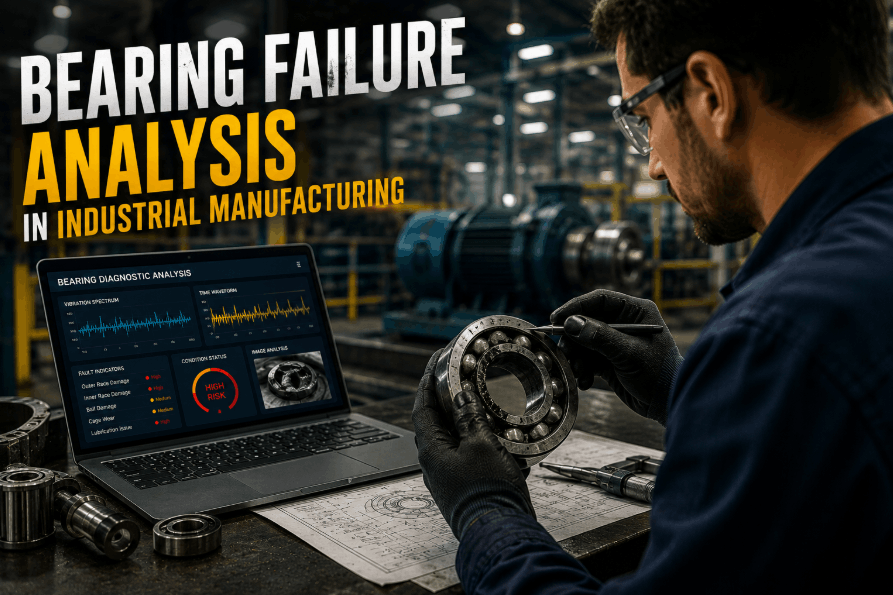
Bearing failures account for nearly 40% of rotating equipment breakdowns in industrial manufacturing — and most are preventable. In 2026, reliability engineers and maintenance managers are expected to move beyond reactive replacement cycles and implement structured bearing failure analysis programs that identify root causes, inform PM intervals, and reduce repeat breakdowns across pumps, motors, conveyors, and compressors. Sign Up Free to start capturing bearing failure data in a CMMS that connects root cause findings to PM schedules and asset reliability trends. Plants that treat every bearing failure as a diagnostic event — not just a parts swap — consistently achieve longer equipment service life and lower total maintenance cost per asset. Book a Demo to see how OxMaint's work order and asset management modules support structured bearing failure analysis workflows at scale.
Reduce Bearing-Related Downtime with OxMaint
OxMaint gives reliability teams the CMMS infrastructure to capture bearing failure root causes, trigger condition-based PM work orders, and track rotating equipment MTBF — all from a single mobile-accessible platform.
Why Bearing Failure Analysis Is Critical to Industrial Reliability
Replacing a failed bearing without understanding why it failed is the maintenance equivalent of treating symptoms rather than disease. Recurring bearing failures on the same asset — same location, same failure mode, often within months of each other — are a diagnostic signal, not bad luck. Sign Up Free to configure OxMaint's work order closure workflow to capture bearing failure mode, lubrication condition, contamination evidence, and installation notes as structured data on every repair — building the failure history database that drives PM interval refinement and parts procurement planning. Structured bearing failure analysis is one of the highest-ROI reliability investments a maintenance department can make because the data is already available at every repair event; it simply needs to be captured systematically.
The 6 Primary Bearing Failure Modes in Industrial Manufacturing
Lubrication Failure
Insufficient grease quantity, wrong lubricant viscosity, or lubrication interval drift causes metal-to-metal contact and rapid raceway wear. Lubrication failures account for an estimated 36% of premature bearing failures — the single largest preventable failure category.
Contamination
Dust, metal particles, process fluids, and moisture ingress accelerate abrasive wear on rolling elements and raceways. Evidence includes pitting, scoring, and discoloration on bearing surfaces. Contamination failures signal seal integrity problems that must be addressed at the asset level.
Overloading and Misalignment
Radial or axial overloading, shaft misalignment, and belt overtension generate uneven load distribution that produces flaking fatigue on raceway contact zones. Misalignment is a leading root cause in drive train and conveyor tail pulley bearing failures.
Installation Damage
Improper press-fit force, hammer installation, or incorrect interference fit causes brinelling — false or true — that creates stress concentrations on raceways before the bearing has turned a single revolution. Installation quality is a direct function of technician training and tooling.
Electrical Fluting
Stray electrical currents passing through bearing assemblies on VFD-driven motors create pitting patterns — electrical discharge machining marks — across raceway surfaces. Fluting failures are increasing in frequency as variable frequency drives proliferate in manufacturing environments.
Normal Fatigue Failure
Subsurface fatigue at the theoretical end of bearing service life produces spalling that begins at stress initiation points within the raceway. True fatigue failures indicate the bearing was operated within design parameters — and that PM replacement intervals are correctly calibrated.
Bearing Failure Analysis Methods: A Reliability Engineer's Toolkit
Effective bearing failure analysis combines visual inspection evidence with operational data and asset history. Book a Demo to see how OxMaint structures work order closure workflows to capture the failure analysis data that reliability engineers need — without adding administrative burden to technicians in the field.
| Analysis Method | What It Detects | Application | CMMS Integration Point |
|---|---|---|---|
| Visual Inspection | Spalling, pitting, discoloration, contamination | Post-failure examination | Work order closure notes + photos |
| Vibration Analysis | Early bearing defect frequencies (BPFO, BPFI, BSF) | Condition monitoring routes | Predictive PM trigger on threshold breach |
| Oil/Grease Analysis | Metallic particle count, water content, viscosity | Lubricated bearing health | Inspection checklist field in work order |
| Infrared Thermography | Elevated bearing housing temperature pre-failure | Walk-around condition survey | Predictive PM generation from observation |
| Acoustic Emission | Subsurface crack propagation in early stages | Low-speed bearing monitoring | Asset health alert linked to work order |
| Root Cause Code Analysis | Failure mode patterns across asset population | Historical CMMS failure data review | PM interval and lubrication schedule update |
Building a Bearing Failure Prevention Program with CMMS
Failure Mode Taxonomy and Asset Registry
Define a standardized bearing failure root cause code library in OxMaint — lubrication, contamination, overload, installation, electrical, fatigue — and link it to every rotating equipment asset. Consistent coding turns repair records into reliability intelligence.
Condition-Based PM Triggers
Configure CMMS PM schedules using vibration analysis thresholds, lubrication intervals, and operating hour triggers specific to each bearing application. Condition-based triggers replace calendar-driven replacement cycles with evidence-driven interventions.
Failure Pattern Review and PM Refinement
At 90-day intervals, review CMMS bearing failure data by asset type, failure mode, and location to identify systemic issues — chronic lubrication intervals, contamination hot spots, or installation quality gaps. Refine PM schedules and technician procedures accordingly. Book a Demo to see OxMaint's failure analytics module in action.
Bearing Failure Analysis KPIs: Measuring Rotating Equipment Reliability
Turn Every Bearing Failure into Reliability Intelligence
OxMaint's CMMS captures bearing failure root causes, tracks rotating equipment MTBF, and triggers condition-based PM work orders — giving reliability engineers the data to prevent repeat failures across their entire asset population.
Bearing Failure Warning Signs: Early Detection Guide for Maintenance Teams
Recognizing bearing failure warning signs before catastrophic breakdown is the practical skill that separates reactive maintenance teams from reliability-focused ones. Every failure mode produces detectable symptoms — audible, thermal, or vibrational — that appear well before the bearing reaches end of life. Knowing what to look for and how to respond is the first step toward condition-based maintenance execution.
Subtle Noise Changes
Faint high-frequency whine or hiss audible only at close range during steady-state operation
Elevated Temperature
Bearing housing temperature 15–25°C above baseline; detectable by IR thermometer or thermal camera
Audible Rumble or Knock
Low-frequency rumble, intermittent knock, or cyclic grinding audible without instruments during operation
Increased Vibration Amplitude
Vibration analysis shows rising overall velocity or acceleration at bearing defect frequencies (BPFO, BPFI)
Discolored or Contaminated Grease
Grease sample shows dark color, metallic particles, water emulsification, or hardened consistency on purge
Fluting Pattern on Raceway
Washboard-pattern corrugation visible on raceway surface during post-failure inspection on VFD-driven equipment
Frequently Asked Questions: Bearing Failure Analysis
What is bearing failure analysis in industrial manufacturing?
Bearing failure analysis is the systematic examination of failed bearings to identify root cause — lubrication, contamination, overload, installation damage, or fatigue — and use that finding to prevent recurrence through PM interval or procedure adjustment.
What are the most common causes of bearing failure in plants?
Lubrication failure, contamination ingress, shaft misalignment, and installation errors account for roughly 80% of premature bearing failures in manufacturing. These are all preventable with structured inspection and PM programs.
How does vibration analysis help detect bearing failures early?
Vibration analysis detects bearing defect frequencies — BPFO, BPFI, BSF, FTF — weeks or months before audible failure, allowing condition-based replacement during planned downtime windows rather than emergency reactive events.
How does a CMMS support bearing failure analysis?
A CMMS standardizes failure root cause capture on every repair work order, builds an asset failure history database, links findings to PM schedule updates, and tracks MTBF trends — converting individual repair events into systematic reliability improvements.
What is the difference between predictive and preventive bearing maintenance?
Preventive maintenance replaces bearings on a fixed schedule. Predictive maintenance uses vibration analysis, thermography, or oil analysis to replace bearings based on actual condition — extending service life on healthy bearings and catching failures before they cause damage.
How quickly can I reduce repeat bearing failures with OxMaint?
Most facilities see measurable reductions in repeat bearing failures within 90 days of implementing structured root cause capture and PM refinement workflows in OxMaint. Sign Up Free to start building your rotating equipment reliability database today.
Ready to Build a Bearing Reliability Program That Prevents Repeat Failures?
OxMaint gives maintenance and reliability teams the CMMS tools to capture bearing failure root causes, schedule condition-based PMs, and track rotating equipment reliability — purpose-built for industrial manufacturing in 2026.