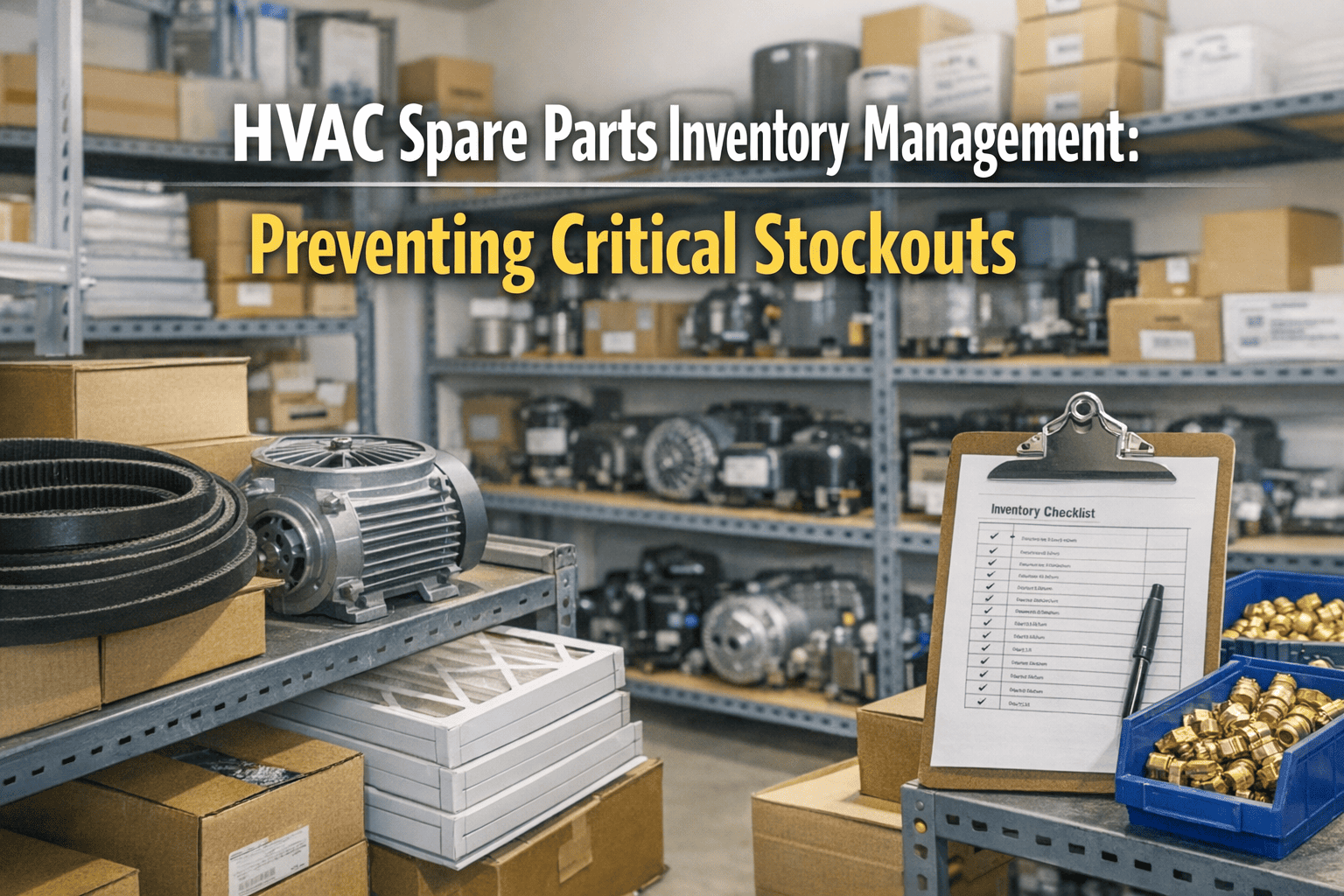
Spare parts control is the difference between a technician finishing a job in one visit and driving back to the warehouse for a part that should have been on the van. A regional service warehouse network supporting field technicians had a parts catalog and a storeroom, but reorder points were set from memory and OEM defaults rather than actual usage, leaving high-turnover parts out of stock while slow movers piled up as dead inventory. Sign Up Free to connect your parts catalog to real consumption data — or Book a Demo to see spare parts control for service warehouses applied to your own storeroom.
Spare Parts Inventory · Automated Reorder Points · ABC Analysis
Stop Stocking Parts From Memory and OEM Guesswork
Asset-linked parts catalogs, automated reorder points calculated from real work order consumption, dead stock review, and vendor lead-time tracking — Oxmaint helps service warehouses keep the right part on the shelf without overstocking the wrong one.
Facility Profile
The Operation: A Storeroom Running on Memory Instead of Consumption Data
Facility Overview
IndustryField service — regional service warehouse network supporting HVAC, appliance, and equipment repair technicians
Prior ApproachReorder points set manually from OEM recommendations and storeroom staff memory, not from actual parts consumption
Core Pain PointSimultaneous stockouts on common parts and dead stock accumulation on slow movers, with no shared visibility between warehouses
Oxmaint ModulesSpare Parts Inventory · Automated Reorder Points · ABC Analysis · Asset-Linked Parts Catalog · Vendor Lead-Time Tracking
Baseline Pressure Points
0
Storerooms calculating reorder points from actual work order consumption history before this engagement, all relying on OEM defaults or guesswork instead
Trips
Extra van trips back to the warehouse logged whenever a technician arrived on site without the part the job actually needed
Annual
Frequency of the only physical inventory count performed, leaving dead stock and shrinkage undetected for months at a time
Root Cause Analysis
Why Stockouts and Dead Stock Kept Happening at the Same Time
A review of storeroom records found that parts data lived apart from the work orders that actually consumed those parts, so reorder decisions were never grounded in real usage. Sign Up Free to see your own consumption history calculated into live reorder points — or Book a Demo to walk through ABC analysis on your current parts catalog.
01
Reorder Points Set From Guesswork, Not Usage
Minimum and maximum stock levels were based on OEM suggested spares lists or whatever a previous technician remembered ordering, with no link back to how fast a part actually moved.
02
Parts Were Not Linked to the Assets They Served
A bearing or seal kit sat in the catalog as a generic line item rather than tied to a specific equipment model, so technicians sometimes pulled the wrong part for the job.
03
Dead Stock Was Never Systematically Reviewed
Slow-moving and obsolete parts accumulated quietly across storerooms, tying up budget that could have funded the high-turnover parts that were actually running out.
04
Vendor Lead Times Were Never Tracked
Safety stock buffers were set once and never revisited, even as supplier delivery performance drifted, leaving some reorder points too tight and others unnecessarily padded.
The Solution
How Oxmaint Connected Parts, Assets, and Work Orders Into One Storeroom Workflow
The warehouse network linked its parts catalog directly to its asset registry and work order history in Oxmaint, replacing manual min/max settings with reorder points calculated from real consumption data. Sign Up Free to connect your own parts catalog to live consumption data — or Book a Demo to see automated reorder points applied to your storeroom.
01
Reorder Points Calculated From Work Order Consumption
Every part issued against a closed work order feeds a rolling consumption history, and Oxmaint recalculates the reorder point automatically against a configurable safety stock policy.
02
Every Part Linked to the Asset It Serves
Technicians opening a work order see the exact part specification for that asset, removing the guesswork that led to wrong-part pulls and repeat trips.
03
ABC Analysis Surfaces Dead Stock Automatically
Parts are classified by consumption value, flagging slow movers for review and freeing budget that had been sitting in obsolete inventory.
04
Vendor Lead-Time Scorecards Refine Safety Stock
Promised delivery dates are compared against actual receipt for every purchase order, so reorder points reflect real supplier performance instead of a one-time estimate.
Results
What Spare Parts Control Looked Like After Automated Reorder Points
Results are illustrative, based on Oxmaint's published outcomes across its spare parts inventory customer base; figures for your warehouse will depend on SKU count, starting data quality, and order volume. Book a Demo to see how these outcomes would map to your own storeroom network.
40%
Typical reduction in stockouts once reorder points are calculated from real consumption instead of guesswork
20–30%
Typical reduction in total inventory carrying costs within the first year of automated reorder points and dead stock cleanup
Up to 85%
Reduction in wrong-part pulls once every part is linked directly to the asset record it serves
73%
Typical drop in emergency procurement spend once min/max automation replaces gut-feel reordering
<5%
Obsolete stock share achieved by storerooms running structured ABC review on a regular cycle
Days
Typical time to connect a parts catalog to the asset registry and work order system and start calculating live reorder points
| Metric |
Before Automated Reorder Points |
With Oxmaint Spare Parts Control |
Typical Change |
| Reorder point logic |
Manual / OEM default |
Calculated from consumption |
Continuous |
| Stockouts |
Baseline |
Reduced via real usage data |
-40% typical |
| Carrying costs |
Baseline |
Dead stock identified and cleared |
-20% to -30% |
| Wrong-part pulls |
Baseline |
Parts linked to asset record |
Up to -85% |
| Emergency procurement spend |
Baseline |
Min/max automation |
-73% typical |
Spare Parts Inventory
See Where Your Storeroom Budget Is Actually Going
Connect your parts catalog to real consumption data and see your own stockout, dead stock, and reorder picture in one dashboard.
Key Business Impact
What Spare Parts Control Means for the Service Team
01
Technicians Finish More Jobs in One Visit
With the right part linked to the asset before the van leaves the warehouse, repeat trips for a missing part become the exception rather than routine.
02
Working Capital Stops Sitting on a Shelf
Clearing dead stock and tightening reorder points frees budget that was previously locked in parts nobody was using.
03
Storerooms Stay Aligned Across Locations
Shared visibility into consumption and stock levels lets warehouses balance inventory across locations instead of each one reordering in isolation.
FAQ
How does Oxmaint calculate reorder points for spare parts?
Oxmaint builds a rolling consumption history from every part issued against a closed work order, then calculates the reorder point per SKU using a configurable safety stock policy instead of a one-time OEM estimate.
What is the difference between spare parts inventory and general MRO inventory?
Spare parts inventory covers the specific replacement components used in repair work, such as motors and seals, while MRO inventory is broader and includes consumables and supplies not tied to a single repair.
How does linking parts to assets reduce wrong-part orders?
When a part record is tied to the exact equipment model it serves, technicians see the correct specification on the work order itself, removing the guesswork that leads to ordering the wrong component.
Can Oxmaint track vendor lead time and delivery performance?
Yes. Every purchase order logs promised versus actual delivery, building a vendor scorecard that helps refine safety stock and identify suppliers whose lead times are not reliable.
Spare Parts Inventory
Stop Guessing at Reorder Points — Calculate Them From Real Usage
Oxmaint links every part to the asset it serves, recalculates reorder points from actual work order consumption, and flags dead stock before it ties up another budget cycle.