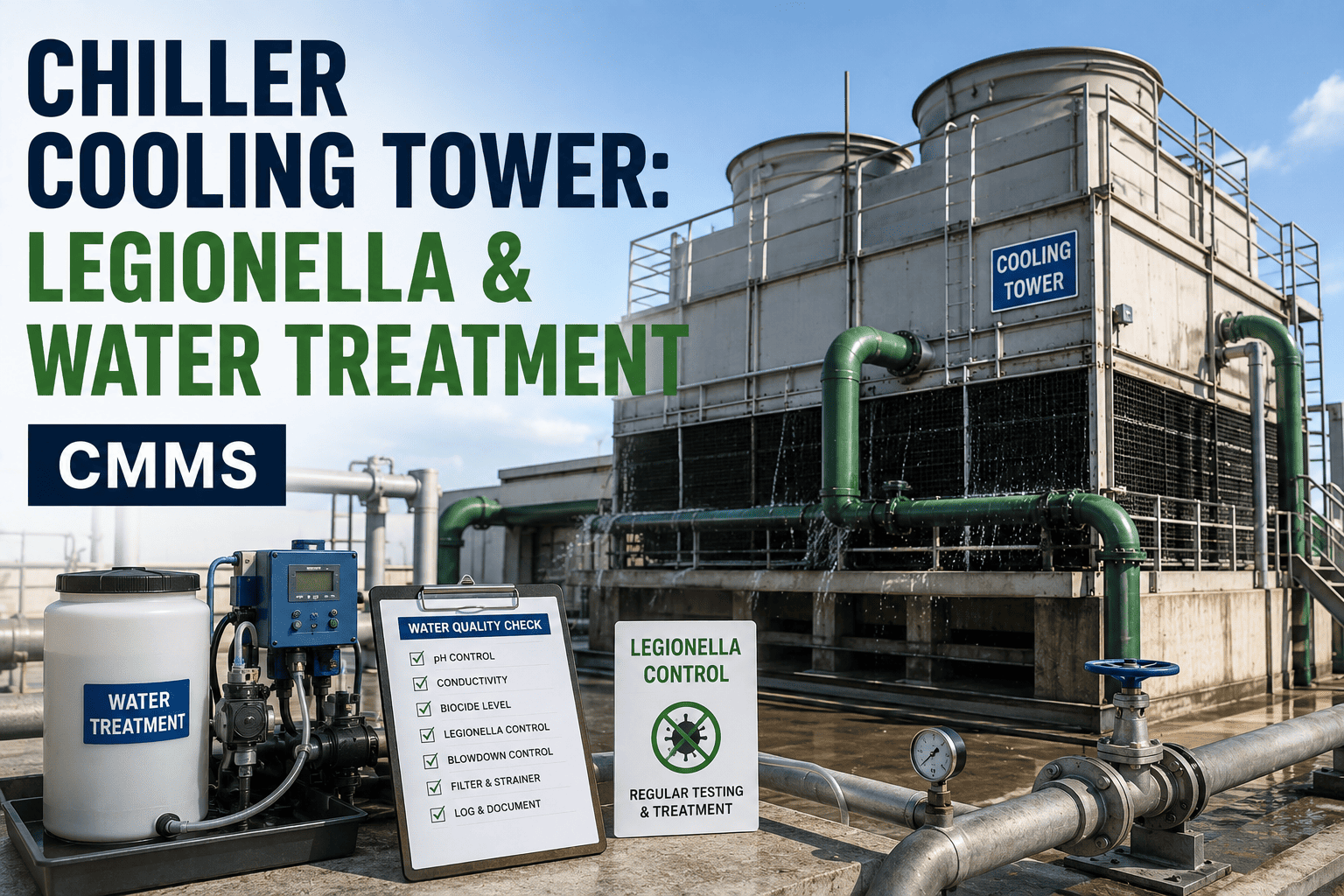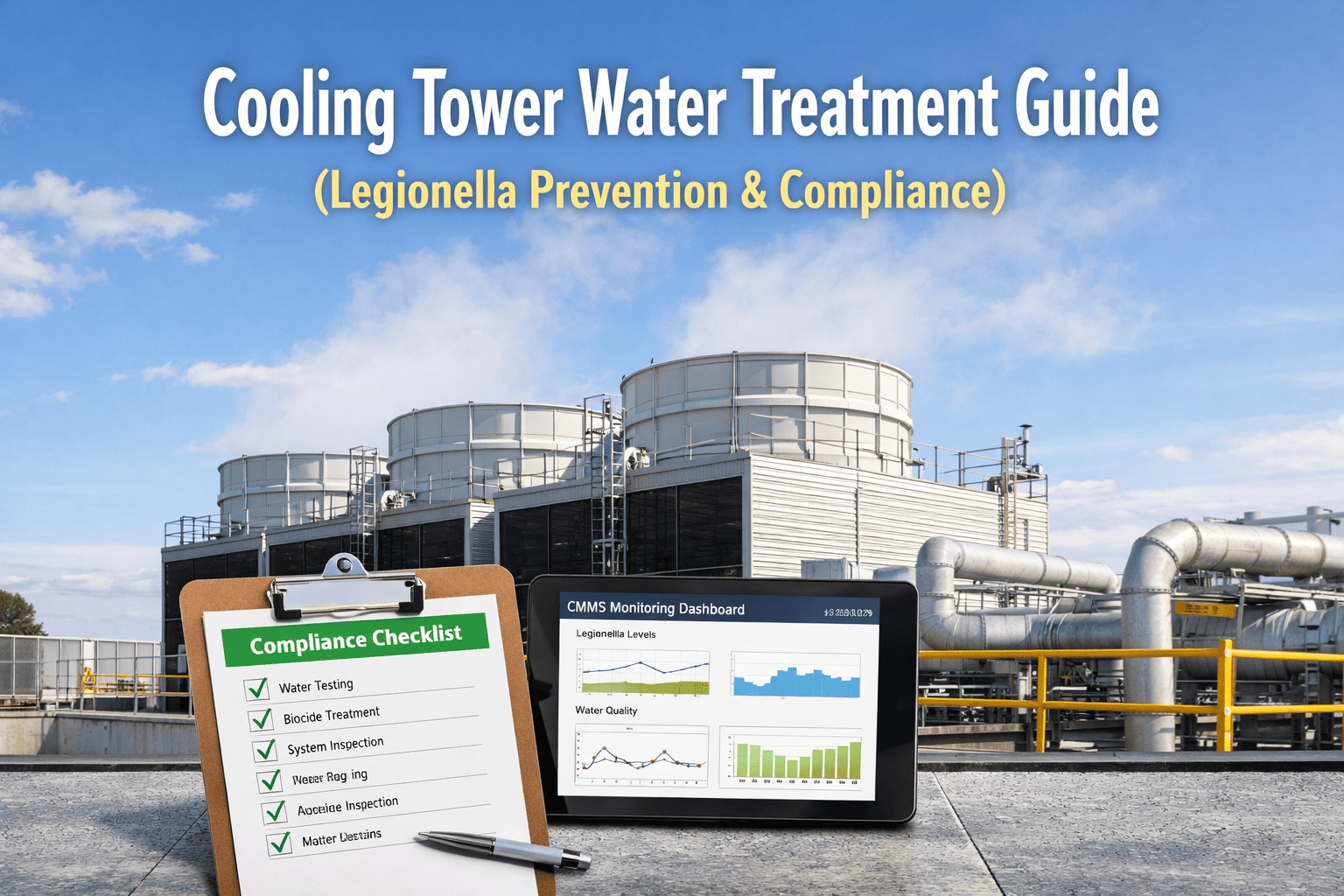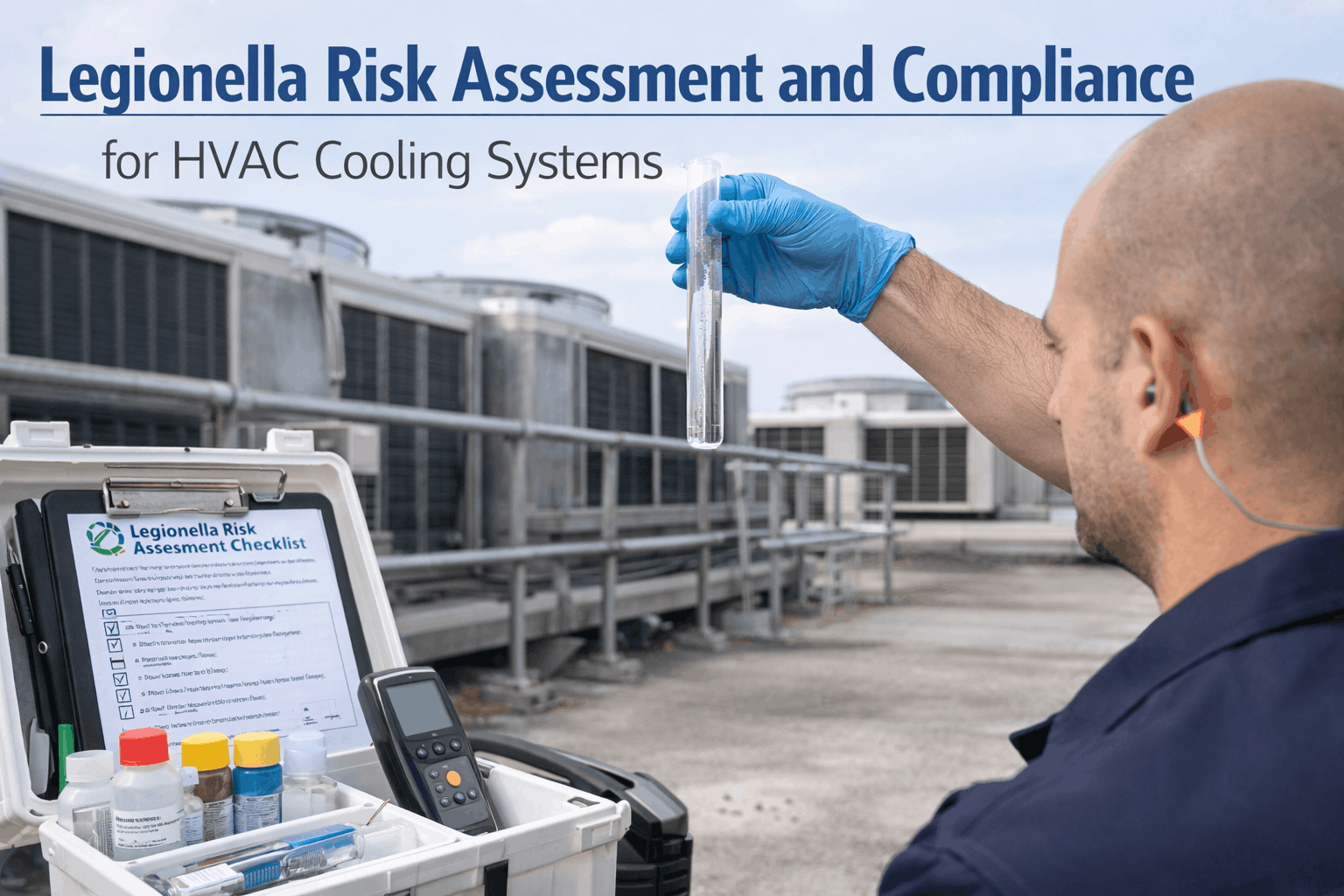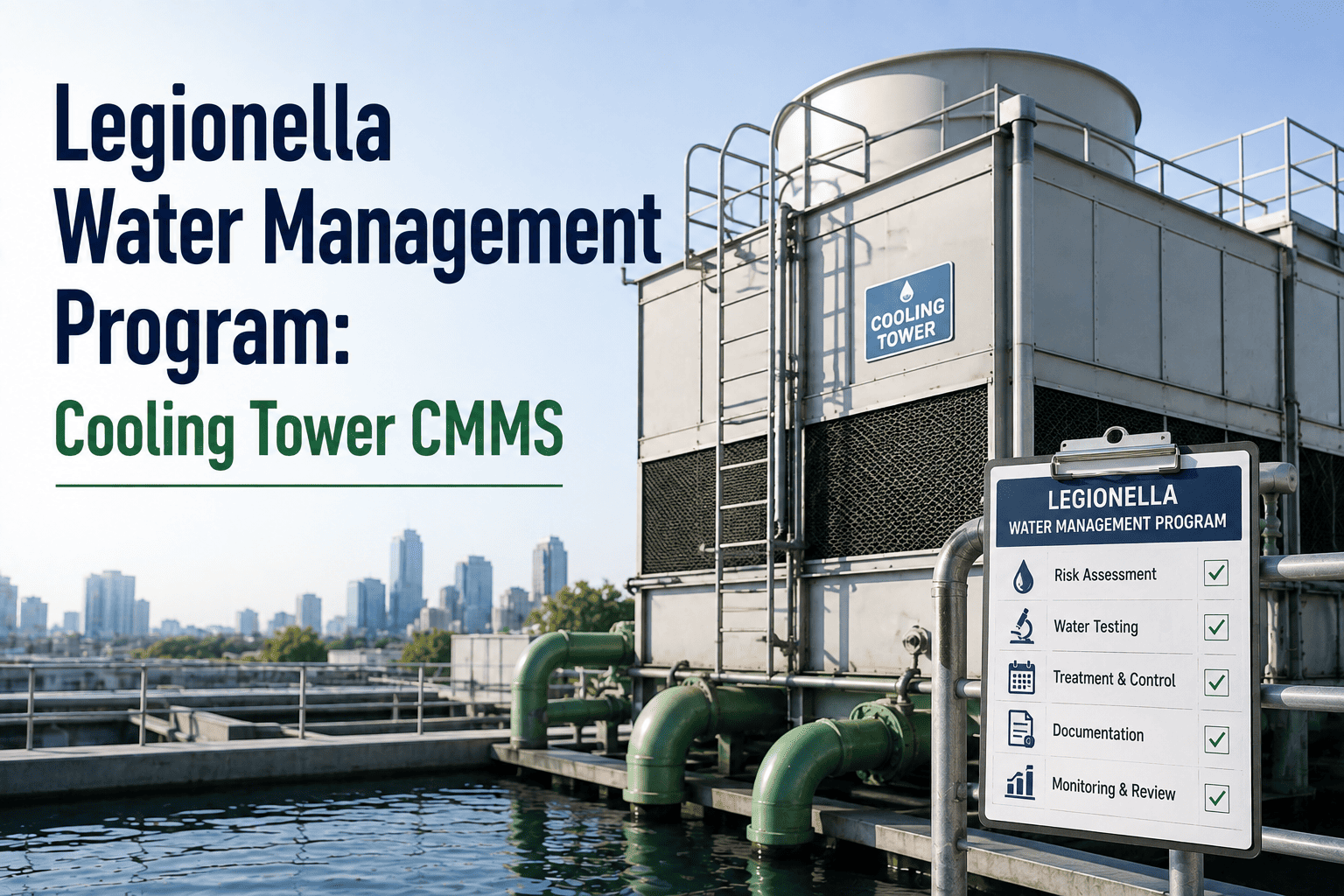
A Legionella water management program is a documented, risk-based plan that controls Legionella bacteria growth in building water systems — and for HVAC teams operating cooling towers, ASHRAE 188 compliance is now the baseline, not a stretch goal. Legionella cooling tower outbreaks are linked to an estimated 8,000–18,000 hospitalized cases of Legionnaires' disease each year in the U.S. alone, and the cost of a single outbreak — in remediation, lawsuits, downtime and brand damage — routinely exceeds $200K, with fatalities triggering criminal liability. A well-structured Legionella CMMS transforms your water management compliance from paper binders and calendar reminders into automated, audit-ready workflows: scheduled water testing, chlorination logs, drift-eliminator inspections, and risk-assessment documentation all triggered, tracked and timestamped. Whether you manage 10 cooling towers or 500, the right Legionella program guide paired with purpose-built maintenance software is what separates a defensible compliance posture from a reactive scramble. Start your Start Free Trial of OxMaint and operationalize your ASHRAE 188 plan in days, not months.
Can your team prove Legionella compliance in 60 seconds?
A documented Legionella water management program is mandatory under ASHRAE 188 for cooling towers, evaporative condensers and complex water systems. If your last inspection, water test or drift-eliminator check lives in a spreadsheet — or worse, a binder — you're one audit or outbreak away from six-figure liability. OxMaint digitizes every control measure, test result and corrective action into a single, audit-ready trail.
Legionella Risk Assessment for HVAC Cooling Towers: What ASHRAE 188 Requires
Under ASHRAE 188, every building with a cooling tower, evaporative condenser, humidifier or aerosol-generating device must have a written water management program (WMP) developed by a qualified team — and re-validated at least annually or after any major system change.
Identify Hazardous Conditions
Map every water system where Legionella can amplify: cooling towers, condensers, storage tanks, dead legs, and low-flow branches. Document water temperature zones (77–108°F is the prime growth range), biofilm risk, and aerosol exposure pathways to occupants and the public.
Define Control Measures & Limits
Set measurable control limits for each hazard: residual chlorine (0.2–1.0 ppm), conductivity cycles, pH (7.0–8.5), and biological counts. Assign a control point owner and establish corrective-action triggers when any limit drifts outside the defined range.
Verify, Validate & Document
Verification confirms control measures are operating as designed; validation confirms the WMP is actually reducing Legionella risk. Every inspection, water test, chlorination event and corrective action must be time-stamped, signed, and retrievable for a minimum of 3 years.
The real-world cost gap
A 320-bed hospital operating 4 cooling towers without a digitized WMP spends an average of 11 hours per month manually compiling compliance records for internal audits and health-department requests. After a positive Legionella test, that same facility typically incurs $45K–$120K in emergency remediation, superchlorination, and operational downtime within the first 72 hours — before any litigation. OxMaint clients cut documentation time by 80% and eliminate missed test intervals entirely.
Legionella Cooling Tower Compliance Checklist for 2026
Use this 12-point checklist to benchmark your current Legionella prevention HVAC program. Each item maps to an ASHRAE 188 requirement and becomes an automated task template inside OxMaint.
| Control Measure | Frequency | ASHRAE 188 Ref. | Acceptable Limit |
|---|---|---|---|
| Visual inspection of cooling tower basin, fill & drift eliminators | Weekly | §6.1 | No biofilm, scale or debris |
| Residual chlorine / biocide level measurement | 2–3× per week | §6.2 | 0.2–1.0 ppm free chlorine |
| Cooling water pH test | Weekly | §6.2 | 7.0–8.5 |
| Conductivity / TDS blowdown check | Weekly | §6.2 | Per manufacturer cycles |
| Legionella culture sampling (ISO 11731) | Quarterly | §6.3 | <10 CFU/mL (action: >100) |
| Heterotrophic plate count (HPC) | Monthly | §6.3 | <10,000 CFU/mL |
| Drift eliminator integrity & cleaning | Quarterly | §6.1 | No visible damage / bypass |
| Basin descaling & disinfection (superchlorination) | Quarterly or per risk | §6.4 | 5–10 ppm for 4–6 hrs |
| Dead-leg & low-flow branch identification | Bi-annually | §5.2 | None identified / remediated |
| WMP team review & validation re-assessment | Annually | §7 | Documented sign-off |
| Corrective action log review & trend analysis | Monthly | §6.5 | All actions closed |
| Contractor service report digitization & filing | Per service visit | §6.6 | Stored ≥3 years |
A 12-Month Legionella Water Testing & Maintenance Schedule
Legionella compliance HVAC programs fail most often not from missing a single test — but from ad-hoc scheduling that leaves gaps. Here's a validated annual cadre that OxMaint automates end-to-end.
Q1: Baseline & Deep Clean
Annual WMP re-validation. Full basin drain, descale, and superchlorination (10 ppm, 6 hrs). First quarterly Legionella culture sample. Drift eliminator inspection and replacement if efficiency <99%. Log all results in OxMaint with photo attachments.
Q2: Load Ramp & Monitoring
Cooling load increases — biocide feed rates must be verified against demand. Weekly HPC trending, second Legionella culture. Conductivity blowdown automation check. Dead-leg walk-down of all connected piping.
Q3: Peak Risk Season
Highest ambient temperatures = peak Legionella amplification. Increase biocide residual checks to 3× weekly. Third Legionella culture. Review all corrective actions from Q1–Q2 for trend patterns. Drift eliminator re-inspection after storm events.
Q4: Validation & Documentation
Fourth and final Legionella culture. Full WMP documentation audit — verify all 12 control measures have complete records. Trend analysis of HPC, biocide, and Legionella data for the year. Schedule next-year deep clean and budget for component replacement.
How OxMaint Digitizes Your Legionella Water Management Program
Spreadsheets and wall calendars don't trigger corrective work orders when a chlorine reading comes back low. OxMaint's AI-powered CMMS closes the loop between testing, action, and documentation — turning ASHRAE 188 from a liability into a routine.
Automated PM Triggers for Every Control Measure
Pre-built ASHRAE 188 task templates auto-generate weekly, monthly and quarterly work orders for water testing, biocide checks, drift eliminator inspections and basin descaling. Eliminates 95% of missed test intervals.
Digital Test Logs with Pass/Fail Automation
Technicians log chlorine, pH, conductivity and culture results on mobile devices in the field. Out-of-range values instantly trigger a corrective work order with escalation to the WMP team. Cuts documentation time by 80%.
Audit-Ready Compliance Dashboard
Every inspection, test result, corrective action and contractor report is timestamped and searchable. Generate a complete ASHRAE 188 compliance packet in under 60 seconds for any health-department or internal audit request. Zero-gap audit trail.
Predictive Trend Analytics
AI-driven analytics on HPC counts, biocide consumption and water chemistry trends identify drift toward risk thresholds weeks before a positive Legionella test. Catch amplification 3–6 weeks earlier.
A commercial real estate portfolio with 28 cooling towers across 6 properties was spending $62K/year on third-party compliance consultants plus 140 internal labor-hours monthly just to maintain paper logs. After deploying OxMaint, automated PM scheduling eliminated all manual tracking, mobile test logging cut documentation time by 82%, and the compliance dashboard reduced audit preparation from 3 weeks to 2 days. Net result: $54K annual savings, zero missed tests, and a passing health-department audit on first inspection — all within 90 days of go-live.
See OxMaint on your cooling towers — book a 30-minute demo
We'll load your ASHRAE 188 control measures, test frequencies and asset list into a live workspace so you can see exactly how automated Legionella compliance works on your systems.
Legionella Water Management Program — Frequently Asked Questions
What is ASHRAE 188 and who must comply?
ASHRAE Standard 188-2018 is the industry consensus standard for minimizing Legionella risk in building water systems. Compliance is required for any building with a cooling tower, evaporative condenser, hot water system, humidifier, or aerosol-generating device — and it's effectively mandatory because it's referenced by OSHA, CDC, and most state and local health codes. Many insurance carriers now require documented ASHRAE 188 compliance as a condition of coverage.
How often should Legionella water testing be performed on cooling towers?
Legionella culture sampling (ISO 11731) should be performed at least quarterly under a baseline WMP, with heterotrophic plate counts (HPC) done monthly. During peak risk months (June–September) or after any system modification, increase sampling frequency to monthly. Residual biocide and pH measurements should be logged 2–3 times weekly. OxMaint auto-schedules each test interval and escalates any missed or out-of-spec result — Start Free Trial to automate the full cadence.
What Legionella CFU level triggers corrective action?
Per CDC and ASHRAE guidance, detectable Legionella at <10 CFU/mL requires review of control measures but no immediate remediation. Levels of 10–100 CFU/mL require prompt review and adjustment of biocide treatment. Anything above 100 CFU/mL requires immediate corrective action including superchlorination, resampling within 2–4 weeks, and a documented root-cause investigation. OxMaint's digital test logs auto-trigger the correct work-order template based on the CFU value entered.
Can a CMMS really improve Legionella compliance?
Yes — the primary cause of Legionella compliance failures isn't lack of knowledge; it's missed tests, undocumented corrective actions, and untraceable records. A Legionella CMMS like OxMaint eliminates all three by auto-generating scheduled work orders, enforcing mobile field data entry with pass/fail logic, and maintaining a timestamped, searchable audit trail. Facilities using CMMS for WMP compliance report 80%+ reductions in documentation time and near-zero missed test intervals.
How long does it take to implement OxMaint for Legionella compliance?
Most teams are live within 1–2 weeks. OxMaint ships with pre-built ASHRAE 188 task templates covering all 12 standard control measures, so you import your asset list, assign WMP team members, and set your test frequency — the system handles the rest. Book a 30-minute demo and we'll show you a live workspace configured for cooling tower compliance on the call.
Stop relying on binders and spreadsheets for Legionella compliance
Join the maintenance & reliability teams using OxMaint to automate ASHRAE 188 control measures, digitize every water test, and generate audit-ready compliance reports in seconds — not weeks.
Free 14-day trial · No credit card