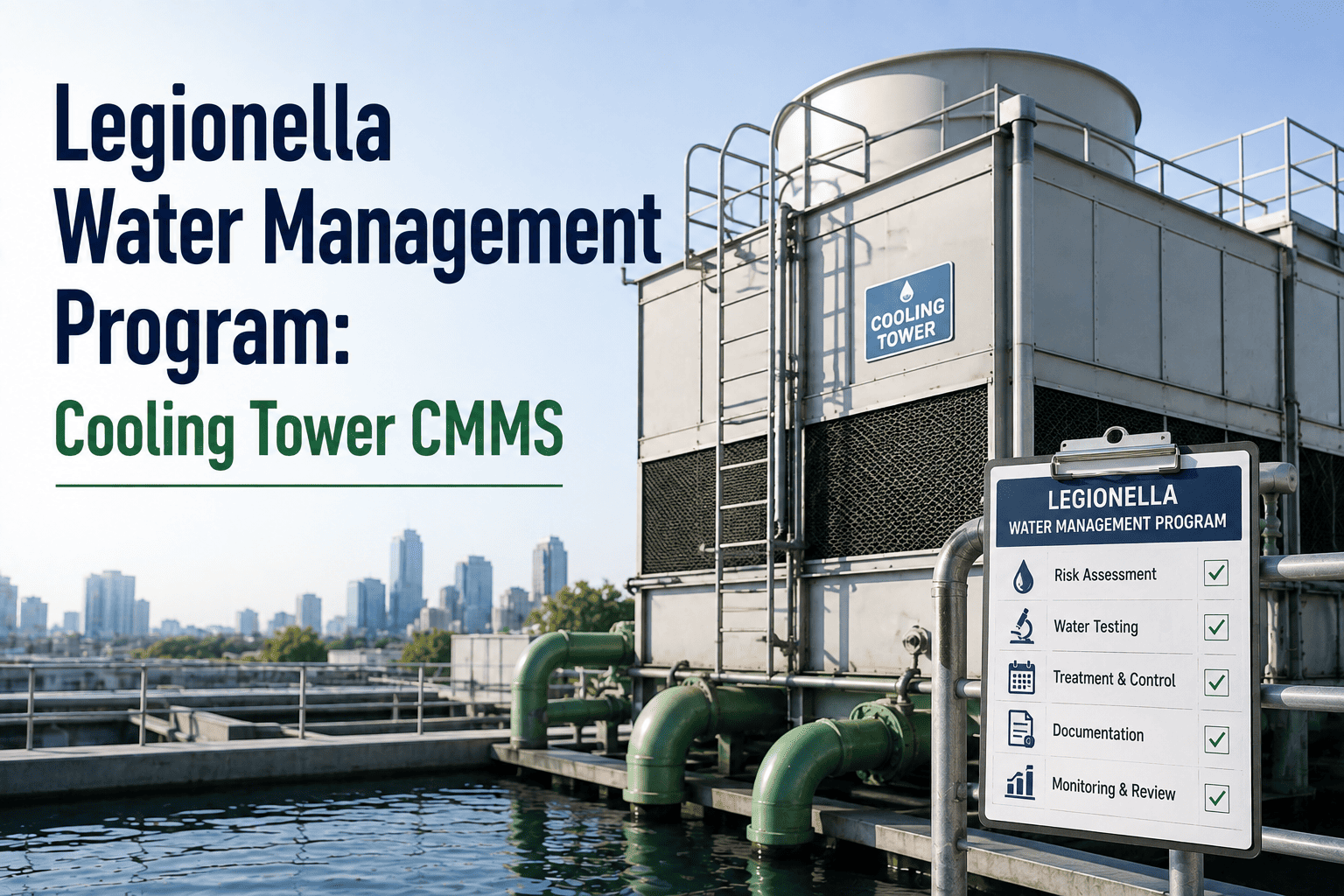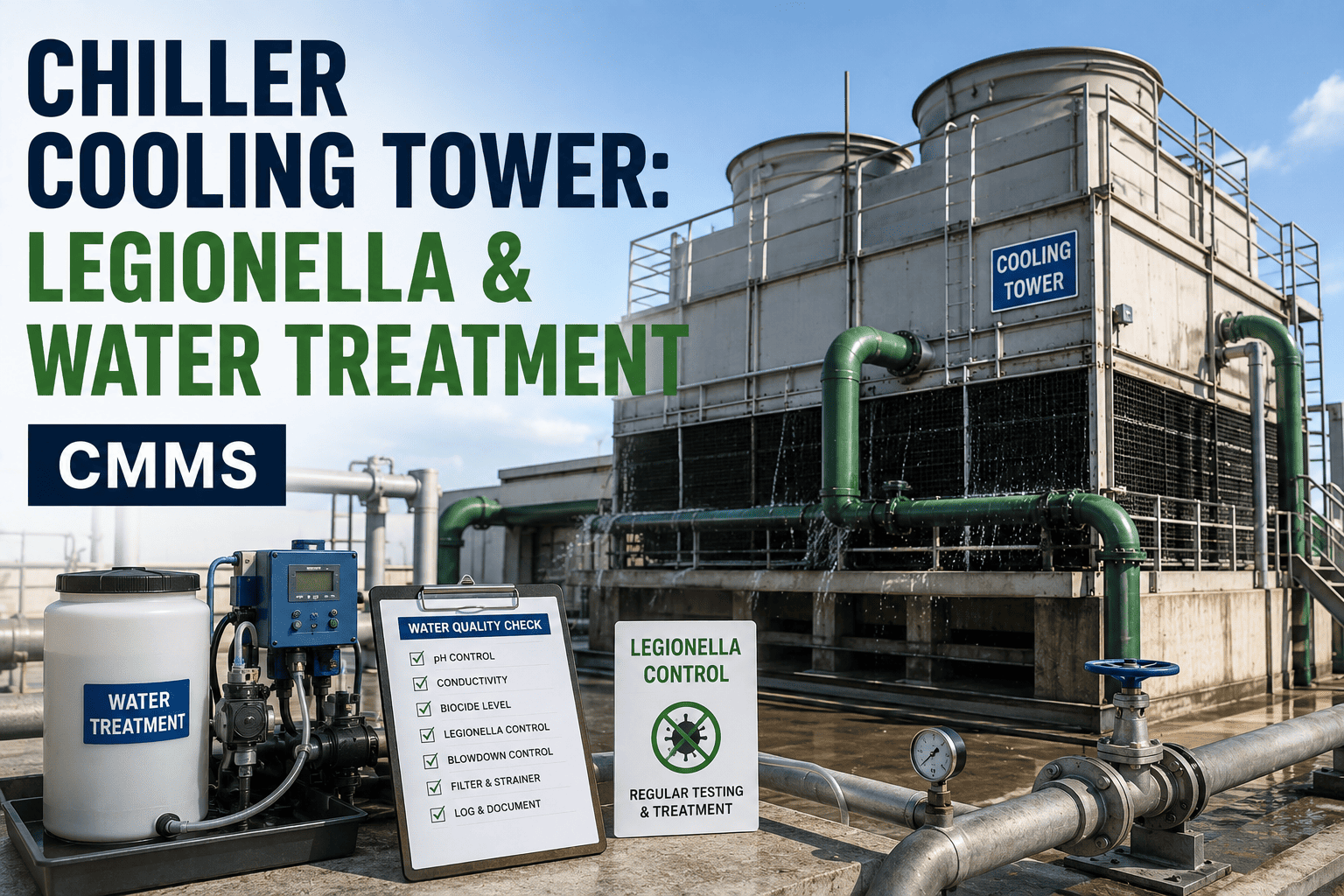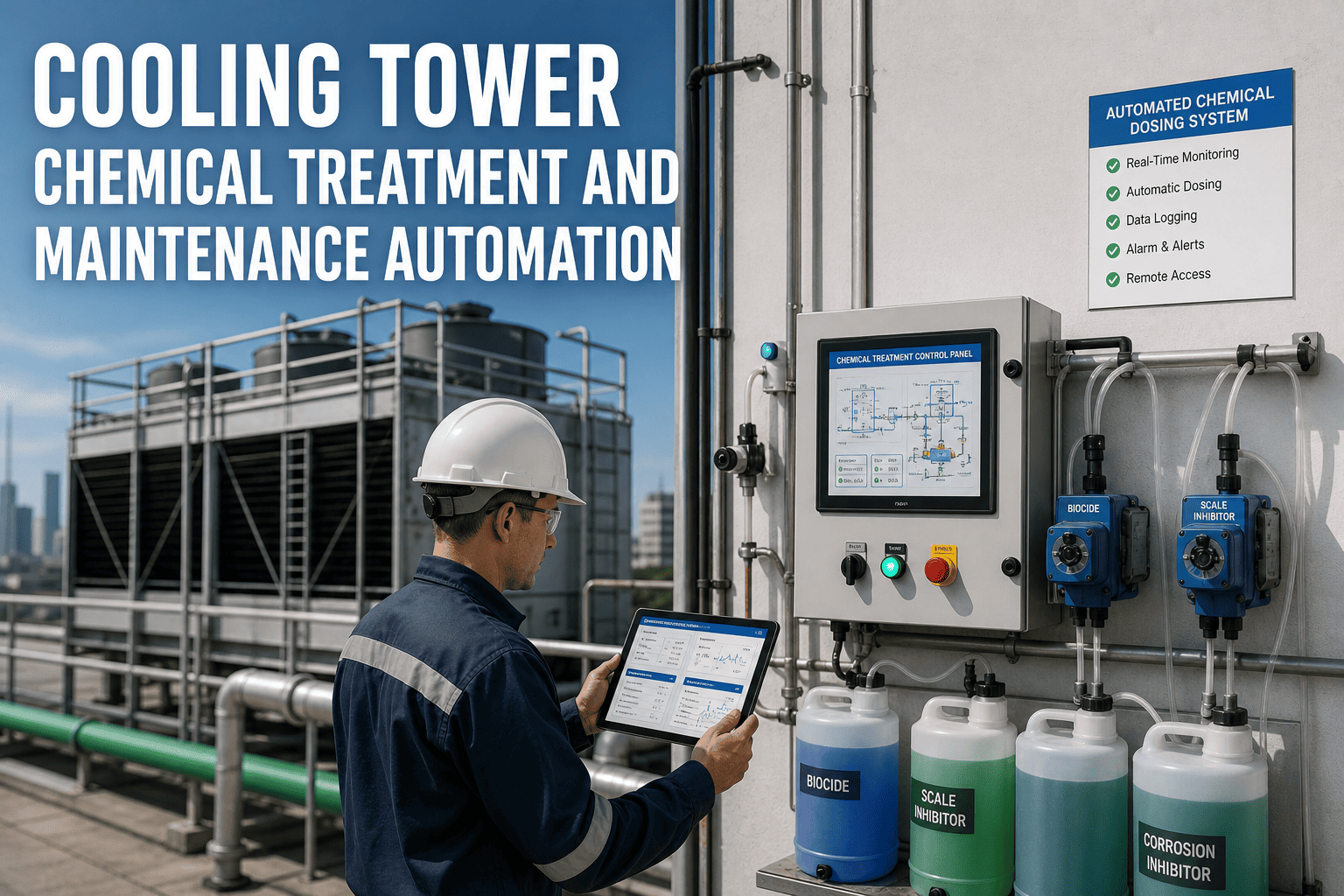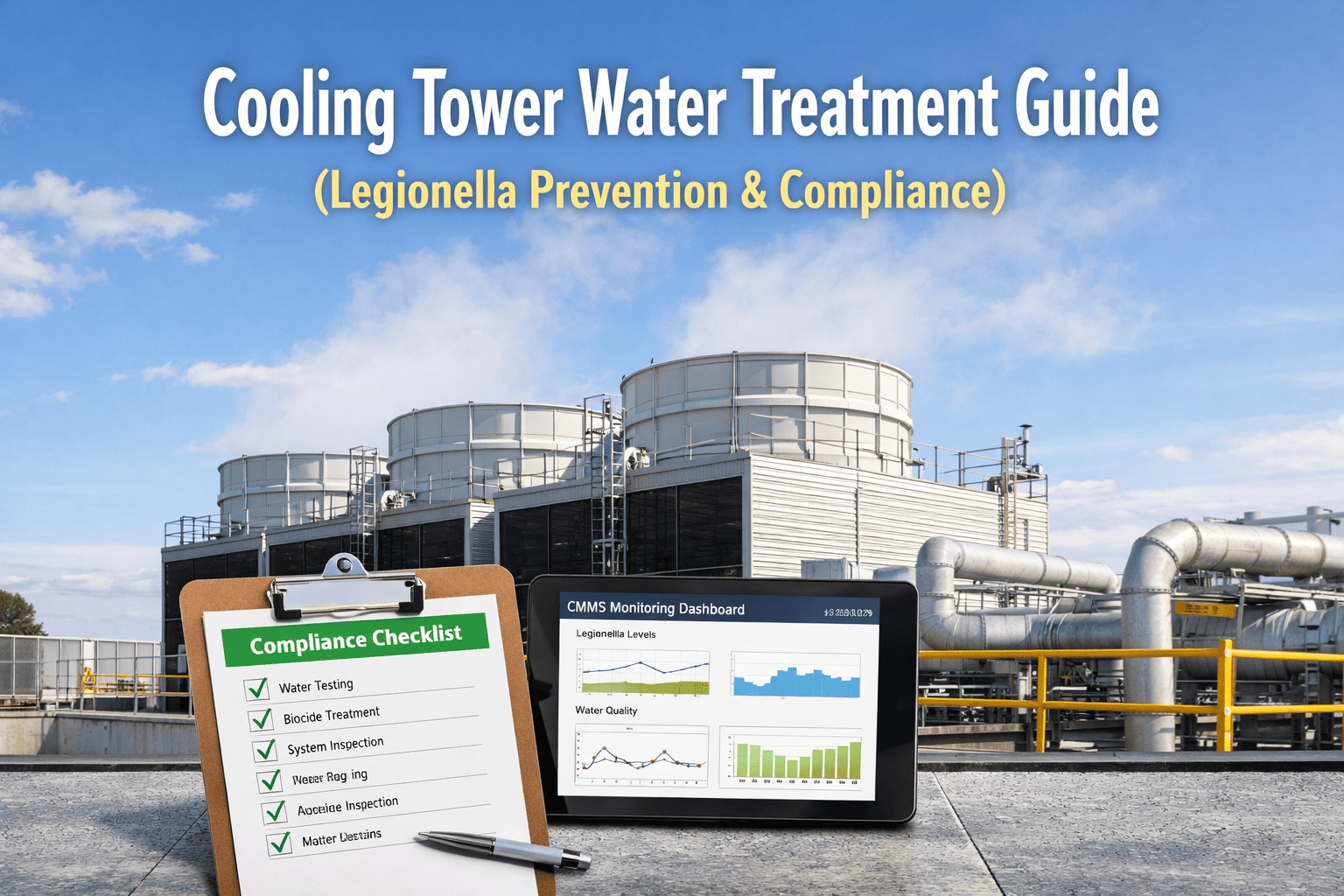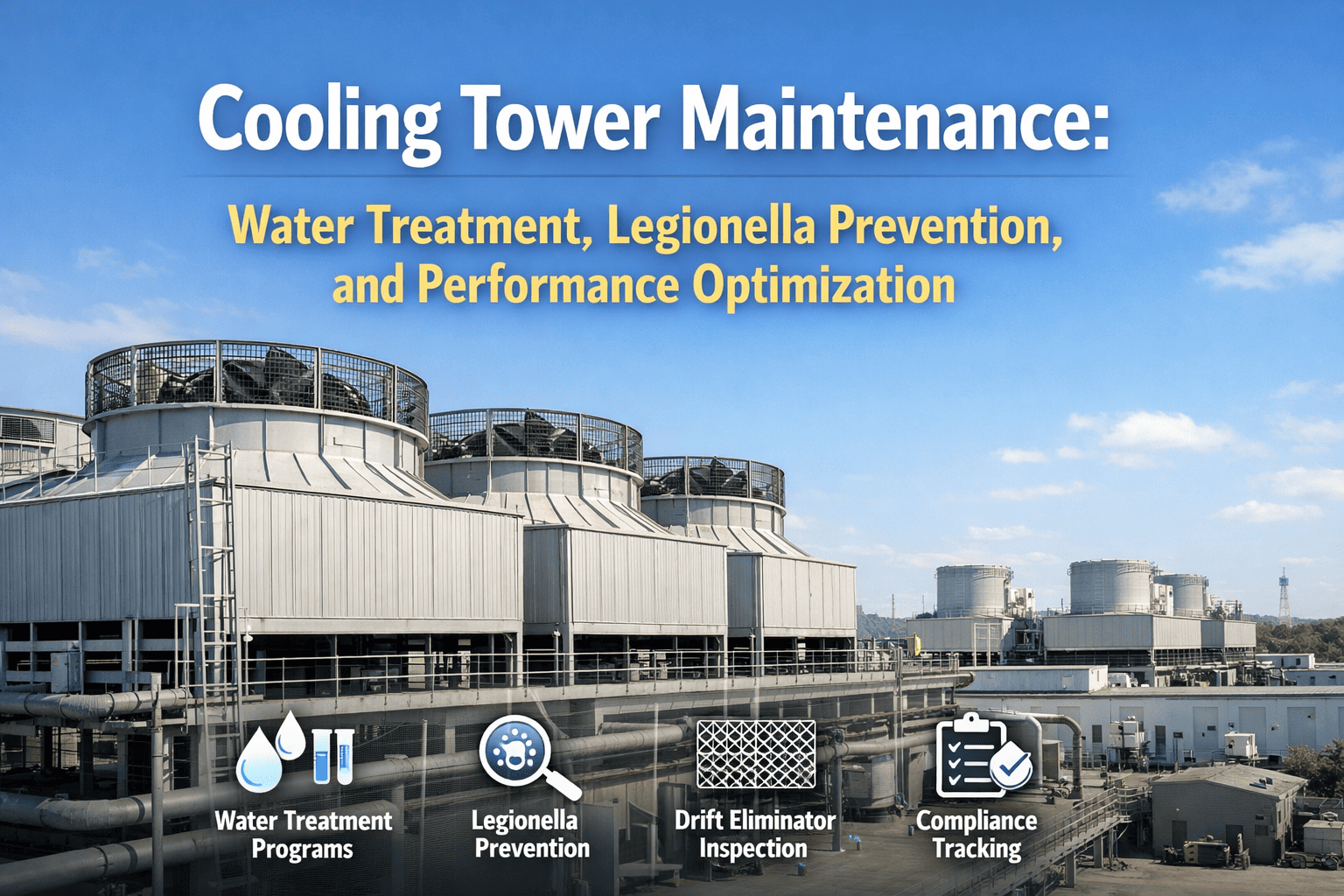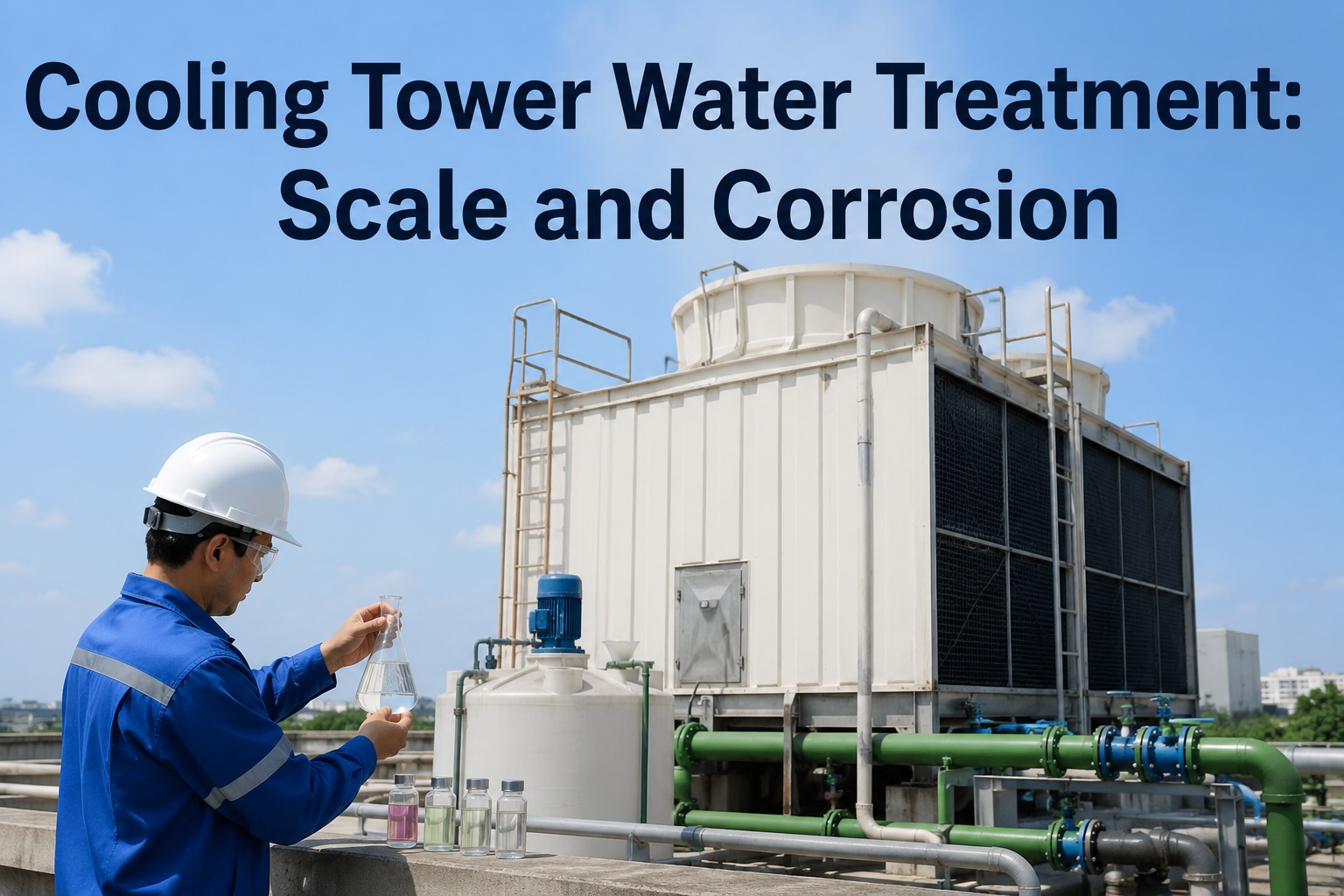
A cooling tower is an open system that evaporates pure water and leaves everything else behind, so every mineral, gas and microbe in the makeup water concentrates over time until the water side either scales up, corrodes through, or grows a biofilm. Water chemistry is what stands between a chiller plant that hits design efficiency and one quietly losing capacity to a film of scale you can't see. This guide covers cooling tower water treatment for scale, corrosion and biological control: how the program is built, how cycles of concentration and blowdown are managed, and how corrosion coupons and biocide residuals prove it's actually working. Start free or book a demo.
Cooling Tower Water Treatment: Scale & Corrosion Control
The three failure modes on the water side — scale, corrosion, biological fouling — the chemistry that holds them off, and the monitoring that proves the program is working across seasons of changing water.
Why the Water Side Turns on Itself
A cooling tower rejects heat by evaporating water. The water vapor leaves clean; the calcium, magnesium, silica, chloride and dissolved gases it carried stay in the loop and concentrate with every pass. That concentration is the root of all three water-side problems — and left alone, they compound each other. Sign up free and OxMaint tracks each tower's test parameters and treatment tasks per asset, so drift shows up on a trend line instead of in a failed heat exchanger.
The Central Dial: Cycles of Concentration
Every water treatment program turns on one number. Cycles of concentration (COC) is the ratio of dissolved solids in the recirculating water to the makeup water — run at 3 cycles and the loop is 3× as concentrated as what's coming in. Push cycles up and you save water and chemicals; push too far and minerals cross their solubility limit and precipitate as scale. The whole job is finding the highest cycles the water can hold without scaling, then holding the line there. Book a demo to see conductivity and cycles trended per tower with alerts when they drift out of band.
Cycles are held by blowdown — deliberately dumping a portion of concentrated water and letting fresh makeup dilute the loop. A conductivity controller does this automatically: when conductivity climbs past the setpoint (commonly around 1,500–2,500 µS/cm depending on makeup quality), the blowdown valve opens until the loop drops back into band. Get the setpoint and the controller right and cycles hold themselves; neglect the controller and the tower either scales from runaway cycles or bleeds money from over-blowdown.
The Chemistry Was Degrading the System for Years — Because Nobody Was Tracking It.
In one documented case, a large medical facility found corrosion rates running at 12.7 MPY and heat-exchanger approach temperatures drifted 8°F above design. The treatment chemistry wasn't exotic — it simply wasn't being tested at the frequency or precision the system required. Once the program was tracked properly, corrosion dropped to 0.3 MPY and approach returned toward 2°F. OxMaint turns every test parameter, coupon pull and biocide check into a scheduled, logged, trended task per tower — so the invisible drift becomes a number someone sees.
Proving It Works: Coupons, Residuals and Counts
A treatment program isn't judged by what you dose — it's judged by what the metal and the water report back. Water chemistry can read perfectly while corrosion runs under a deposit in a dead leg, which is why the coupon matters: a water test measures what's in the water, a corrosion coupon measures what that water is doing to your equipment. These are the readings that verify the program. Sign up free and log each of them against the tower with its target band, so an out-of-range result becomes a work order instead of a line in a binder.
Water Doesn't Stay Still: The Seasonal Problem
The reason a "set it and forget it" program fails is that the water itself never holds constant. Makeup chemistry shifts with the season and the source, load swings between winter and a peak-summer afternoon, and temperature changes what scales and what corrodes. A program tuned in April is wrong by July. This is exactly where paper tracking loses the thread and structured scheduling earns its place. Book a demo to see season-driven treatment tasks scheduled per tower automatically.
Binder-and-Clipboard vs. Water Treatment Tracked in OxMaint
Most towers are treated on a service provider's visit log, a clipboard of hand-written readings, and a controller nobody checks between visits. That works until a reading drifts for six weeks before anyone connects it to the approach temperature climbing. Here's what changes when the program lives in a CMMS. Start free and put your first tower's chemistry on a schedule this week.
What OxMaint's Maintenance Software Does for Water Treatment
A water treatment program is a recurring schedule of tests, dosing checks, coupon pulls and compliance tasks whose whole value depends on nothing being skipped and every reading being trended. That's precisely what a CMMS is for. Here's the concrete mapping. Book a demo to see it against your tower list.
OxMaint doesn't replace your water treatment chemist or dose chemical — it's the system that makes sure the program they designed is executed on schedule, verified by readings, and defensible on record. Sign up free and build your first tower's program this week, or book a demo to walk it against your plant.
We run six towers across two campuses and our whole water program lived on the treatment vendor's monthly visit reports plus a clipboard the operators filled in when they remembered. We had a heat exchanger lose noticeable capacity before anyone connected it to a conductivity reading that had been drifting high for over a month. We moved every tower's test round, coupon schedule and Legionella tasks into OxMaint with target bands on each reading. Now an out-of-range conductivity or a rising corrosion rate creates a work order the same shift, the coupon reports live on the asset, and our ASHRAE 188 evidence is one export instead of a scramble. The drift that used to hide is now the thing we catch first.
Frequently Asked Questions
Stop Letting Water Chemistry Drift Until It's a Failed Heat Exchanger.
OxMaint schedules every test round, coupon pull and Legionella task per tower, trends each reading against its target band, fires work orders on out-of-range results, and keeps ASHRAE 188 evidence on record — so scale, corrosion and biofouling get caught on a trend line, not in the equipment. Start free — no credit card, unlimited users, forever. Or book a demo for a plant-specific walkthrough.