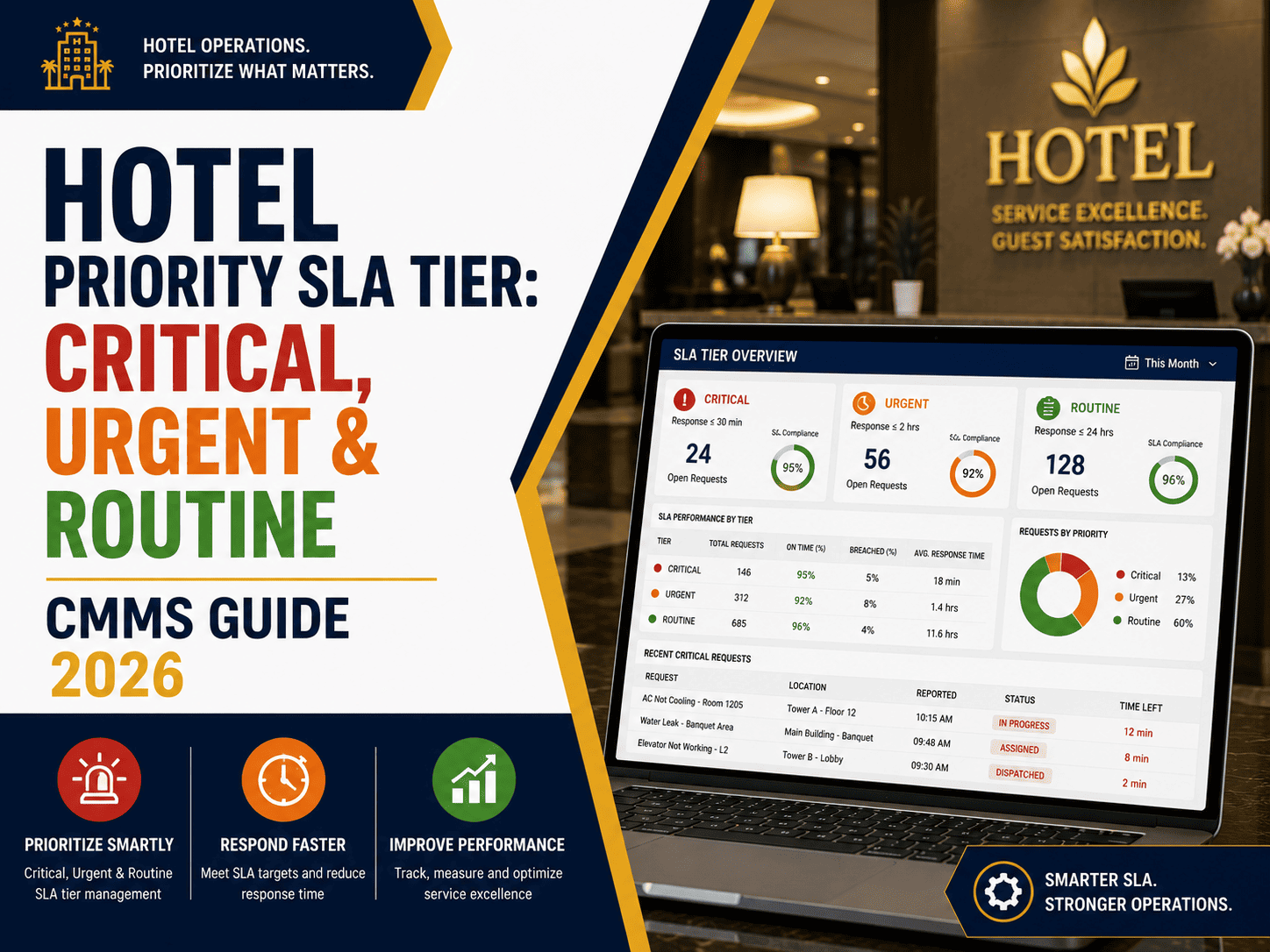
A hotel priority SLA tier system divides every maintenance work order into critical, urgent, or routine categories so life-safety issues get immediate attention while cosmetic requests wait their turn. By implementing a priority SLA guide through a modern CMMS, hotels can automatically route guest complaints and preventive maintenance tasks based on severity, drastically reducing response times for critical equipment failures. This guide breaks down the CMMS hotel priority tier structure, showing you exactly how to set response time expectations and automatic escalation rules. Ready to stop treating every work order like an emergency? Start Free Trial and configure your tiers today.
Priority SLA Guide 2026
Is a routine burnt light bulb keeping your maintenance team from a critical life-safety failure?
When every guest request is treated as an emergency, actual emergencies get delayed. A structured CMMS hotel critical urgent routine system ensures life safety SLA hotel protocols trigger instant response, while cosmetic work waits its turn.
Tier Definitions
What defines a critical, urgent, or routine CMMS hotel priority tier?
A hotel tier guide must start with clear definitions. Without strict boundaries, front desk staff and maintenance managers will inevitably over-prioritize, flooding technicians with false alarms. Here is how to classify your CMMS priority tier hotel framework.
Life Safety & Operational Failure
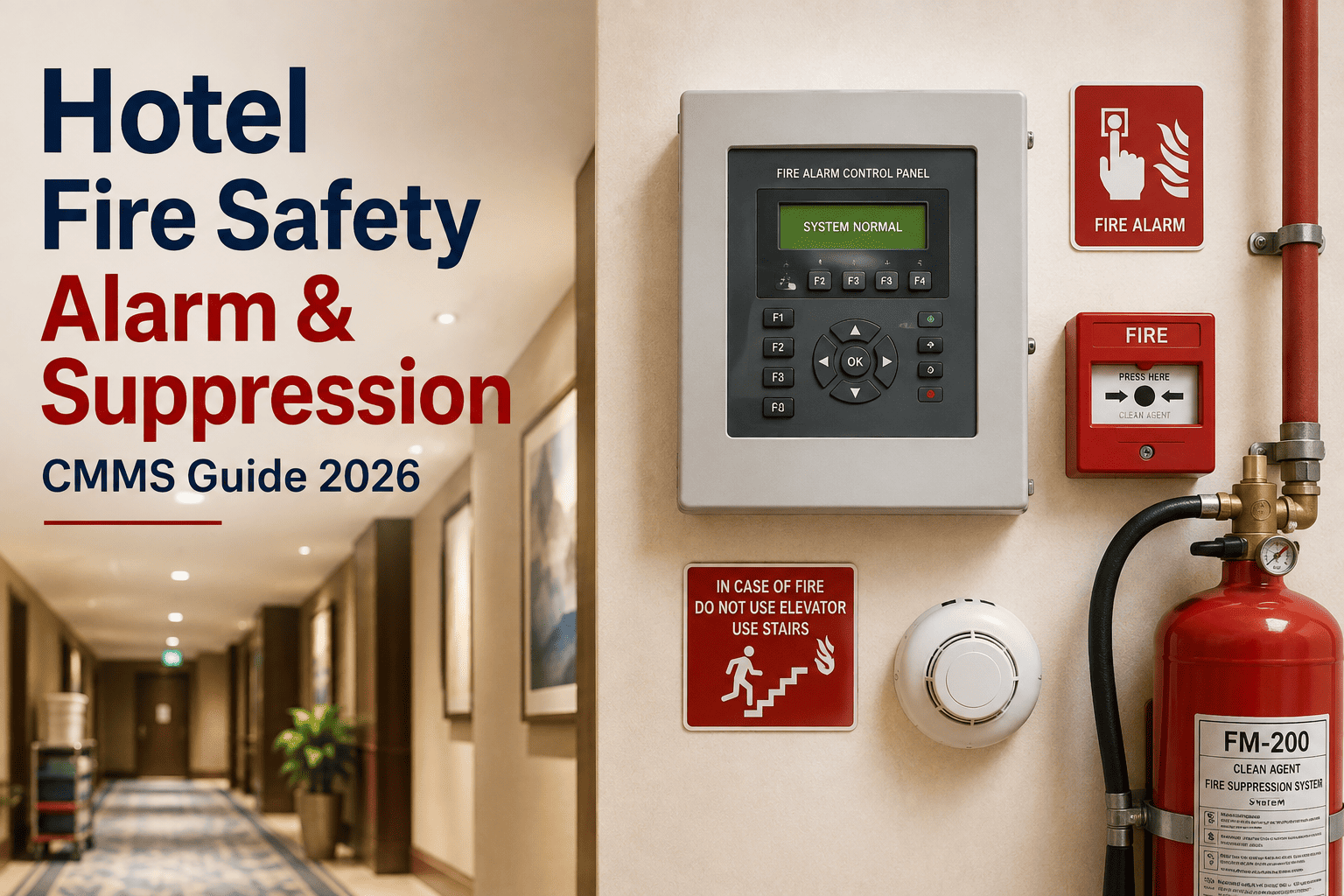
Issues that threaten guest safety, cause injury, or trigger total system outages. Fire alarms, elevator entrapments, gas leaks, and main power failures fall under life safety SLA hotel protocols.
Guest Comfort & Core Amenities
Failures that severely impact the guest experience but pose no immediate danger. HVAC outages in extreme weather, lack of hot water, or broken toilets require a swift guest comfort SLA hotel response.
Cosmetic & Preventive
Minor aesthetic defects, scheduled preventive maintenance, and general wear-and-tear. Burnt bulbs, squeaky doors, and paint touch-ups fall under the CMMS hotel routine SLA category.
Response Time Framework
CMMS hotel critical urgent routine response time benchmarks
Setting response and resolution times is the core of a functional SLA tier CMMS guide. If you fail to define resolution windows, guest satisfaction scores drop and operational costs rise. Use these benchmarks to configure your CMMS hotel SLA tier settings.
| SLA Tier | Example Scenario | Response Time | Resolution Time | Escalation Rule |
|---|---|---|---|---|
| Critical | Elevator stuck between floors | 15 minutes | 2 hours | Notify GM & Director of Ops at 20 min |
| Critical | Fire suppression system fault | 10 minutes | 1 hour | Auto-call 3rd party life safety vendor |
| Urgent | AC failure in 90°F weather | 30 minutes | 4 hours | Reassign tech & notify Front Desk at 45 min |
| Urgent | Plumbing leak damaging drywall | 1 hour | 8 hours | Notify Chief Engineer at 90 min |
| Routine | Scuff marks on hallway baseboards | Next shift | 72 hours | Bump to Urgent if guest complains twice |
Real-World Scenario
The cost of misclassified priority in a 200-room property
Consider a 200-room boutique hotel running on spreadsheets and paper logs. A guest reports a flickering bathroom light (Routine). Simultaneously, a housekeeper notices a pool pump making grinding noises (Urgent). Because the hotel lacks a CMMS priority tier 2026 framework, the maintenance engineer handles the flickering light first—it was reported first on the log.
Two hours later, the pool pump seizes entirely, cracking the motor housing and draining the pool. The property faces $4,800 in emergency pump replacement costs, $2,000 in lost pool-side revenue, and 14 negative guest reviews mentioning the closed pool. A proper CMMS hotel priority tier system would have flagged the pool pump noise as urgent, routing the technician there immediately while the light bulb waited its turn.
Software Setup
How OxMaint enforces your priority SLA tier automatically
Setting priorities is useless without the software to enforce them. OxMaint is an AI-powered CMMS and Enterprise Asset Management platform that takes your hotel tier guide and turns it into automated workflows, ensuring critical issues never wait behind routine work.
AI-Driven Priority Routing
OxMaint analyzes keywords in guest requests and staff notes, automatically assigning the correct CMMS hotel critical urgent routine tag to eliminate human error and ensure instant dispatch.
Automated SLA Timers & Escalation
Every work order starts a countdown. If a life safety SLA hotel response breaches its target, OxMaint auto-escalates via SMS and email to the Chief Engineer and General Manager.
Mobile-First Dispatch
Technicians receive push notifications sorted by priority tier. A critical alert overrides routine tasks on their mobile dashboard, guiding them to the highest-impact asset immediately.
Audit-Ready Compliance Logs
OxMaint time-stamps every priority change, response, and resolution. If a life safety incident is reviewed, you have an ironclad digital trail proving your priority SLA CMMS guide was followed.
Stop letting routine tasks delay critical guest safety
See how OxMaint configures a custom CMMS hotel SLA tier for your property in under 30 minutes. Book a demo today and let our team map your exact critical, urgent, and routine workflows.
Implementation Steps
How to set up a priority SLA CMMS guide in 5 steps
Transitioning from a chaotic reactive model to a tiered SLA structure requires methodical setup. Follow this timeline to deploy your hotel priority SLA tier system without disrupting daily operations.
Audit Existing Assets & Requests
Pull 90 days of historical work orders. Categorize them retroactively into critical, urgent, and routine to establish your property's baseline volume and identify which assets generate the most urgent requests.
Define Tier Thresholds
Lock in your life safety SLA hotel response times. Work with your GM and Head of Security to agree that critical means 15 minutes, urgent means 2 hours, and routine means 48 hours.
Configure OxMaint Automations
Input your tiers into the CMMS. Set up keyword triggers so that when the front desk logs "no AC," the system automatically tags it as urgent and starts the 30-minute countdown timer.
Train Front Line Staff
Train front desk and housekeeping on how to input requests. They do not choose the priority; the system does. This removes emotional bias from the dispatch process.
Review & Refine Quarterly
Use OxMaint analytics to review SLA breach rates. If 90% of critical tickets are resolved in 10 minutes, tighten the timer. If urgent tickets constantly breach, add staff or adjust the definition.
Frequently Asked Questions
Hotel priority SLA tier questions answered
What is a hotel priority SLA tier system?
A hotel priority SLA tier system is a structured framework that categorizes maintenance work orders into critical, urgent, and routine levels. It defines exact response and resolution times for each category, ensuring life-safety issues are addressed before cosmetic guest requests, typically managed through a CMMS.
How are critical, urgent, and routine maintenance defined in a hotel?
Critical maintenance involves life safety and total operational failure (elevators, fire systems). Urgent maintenance severely impacts guest comfort but lacks immediate danger (HVAC outages, plumbing backups). Routine maintenance covers cosmetic defects and preventive tasks (paint, light bulbs). You can map these definitions directly into OxMaint when you Start Free Trial.
What is the standard response time for a critical hotel maintenance issue?
The industry standard response time for a critical, life-safety hotel maintenance issue is under 15 minutes. Resolution is typically expected within 1 to 2 hours. A CMMS hotel critical urgent routine setup ensures these timers are automatically tracked and escalated if breached.
How does a CMMS handle automatic SLA escalation?
A CMMS like OxMaint uses automated timers attached to each priority tier. If a work order approaches its target resolution time, the system sends alerts. If it breaches the SLA, the CMMS automatically notifies the next manager in the chain of command via push notification, email, or SMS. To see this live, Book a Demo today.
Why should hotels switch from paper logs to a CMMS priority tier system?
Hotels should switch because paper logs rely on manual prioritization, leading to human error and delayed emergency responses. A CMMS priority tier system removes guesswork, automatically routes work based on severity, provides audit-ready compliance logs, and prevents routine tasks from blocking urgent guest comfort needs.
Ready to master your hotel maintenance priorities?
Join properties using OxMaint to automate their critical, urgent, and routine work orders. Eliminate misclassified priorities, protect guest safety, and cut maintenance delays by up to 40%.
Free 14-day trial · No credit card