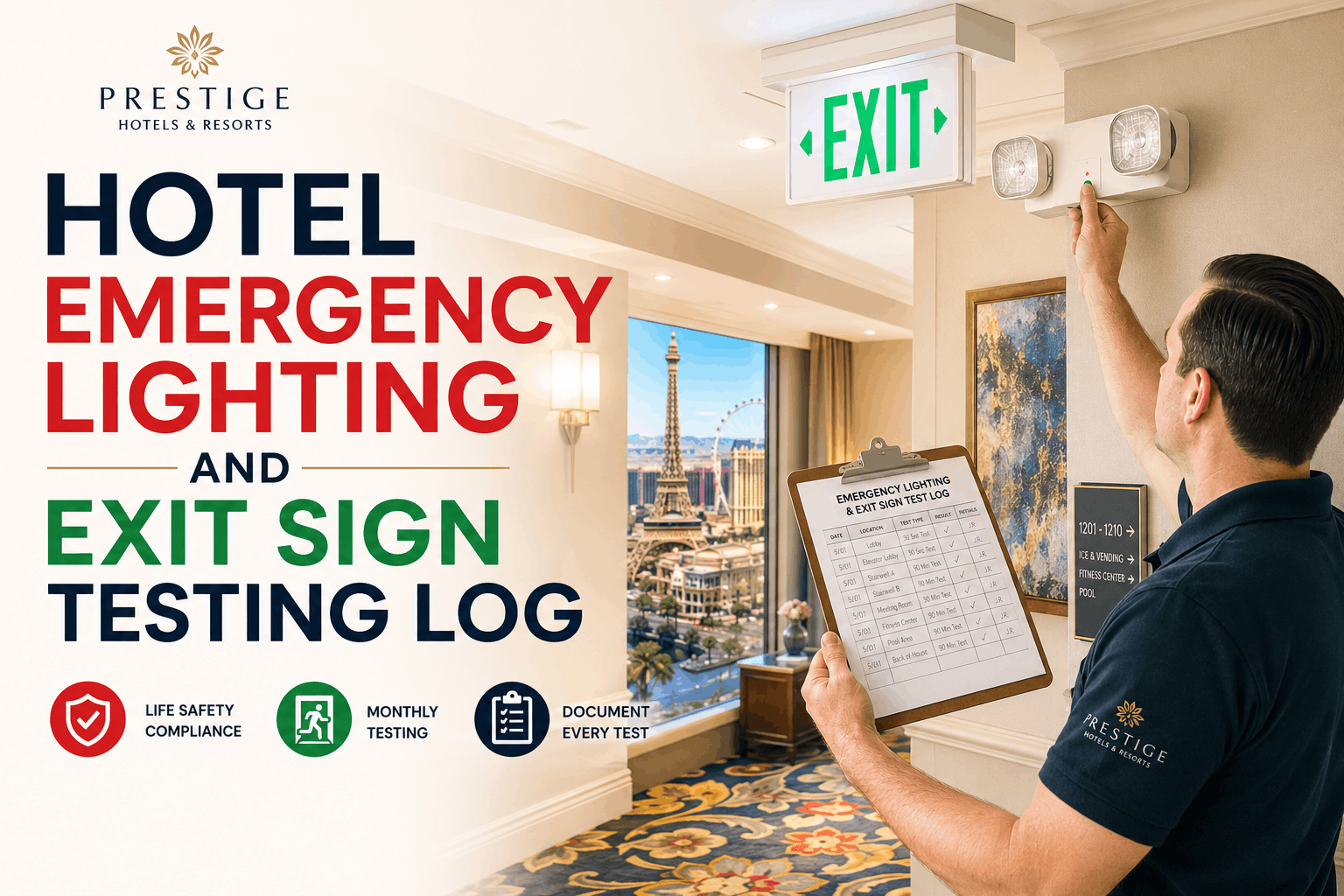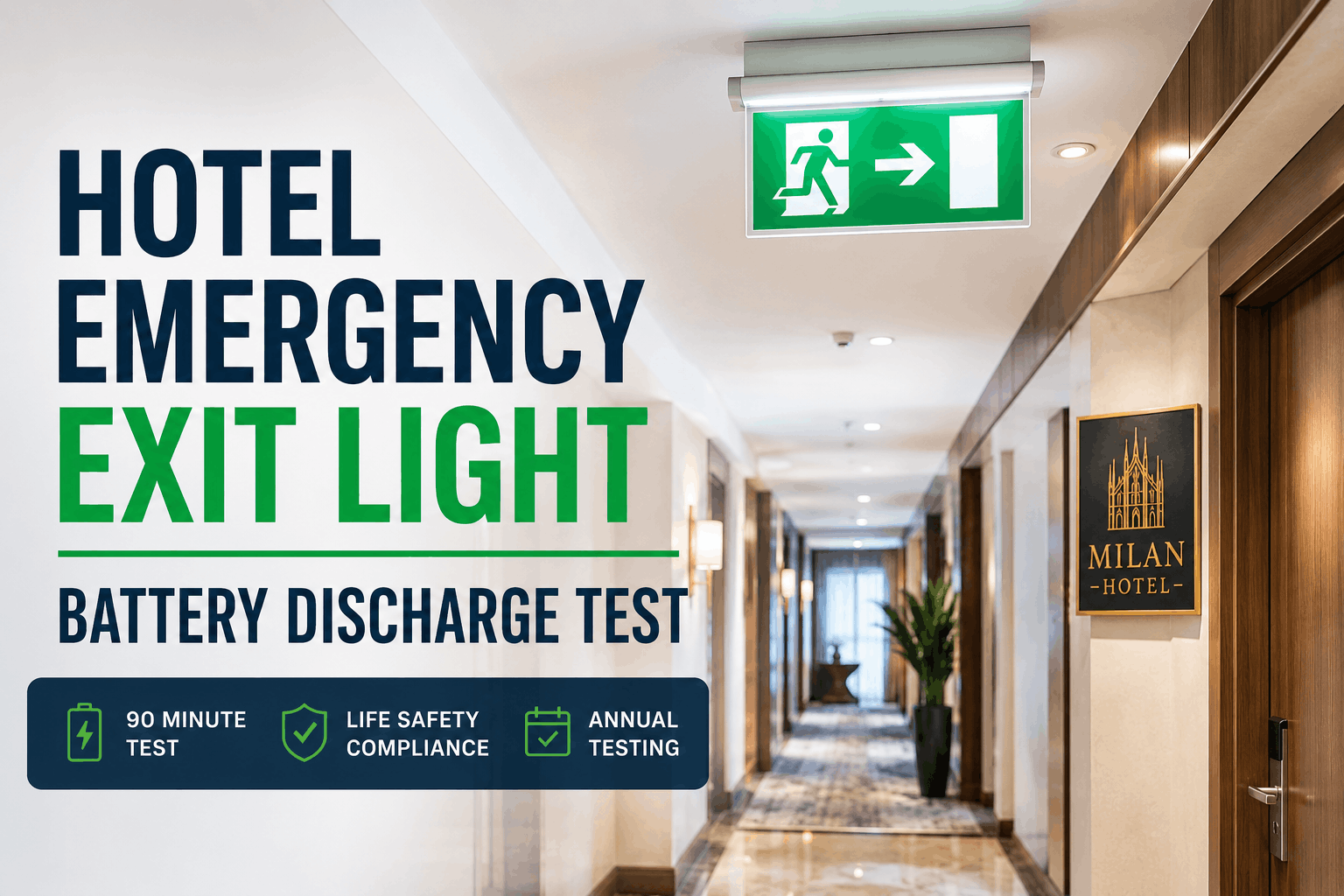
Emergency exit lighting is a life safety requirement in every hotel—it must illuminate all paths of egress (stairs, corridors, exits) automatically in case of power failure to guide occupants safely out of the building in darkness. NFPA 101 Life Safety Code mandates that battery-powered emergency lights maintain illumination for a minimum of 90 minutes during a power outage, providing sufficient time for full building evacuation. However, batteries degrade silently over time. A unit that passes a quick 30-second monthly test might fail after 45 minutes of continuous operation—exactly when occupants depend on it most. NFPA 101 Section 7.9.3 requires monthly functional testing (30 seconds minimum) to verify lights activate on battery power, and critically, an annual full 90-minute battery discharge test to ensure the system operates for the complete evacuation duration. Hotels that skip annual 90-minute testing or maintain fragmentary records face fire code violations, insurance coverage gaps, and potential liability if occupants cannot locate exits during a power loss. Oxmaint automates annual 90-minute test scheduling, logs discharge duration and illumination levels per light, and generates compliance reports that satisfy fire marshal audits and insurance carrier requirements.
NFPA 101 Emergency Lighting Requirements: 90-Minute Battery Duration, Illumination Standards, and Testing Obligations
Emergency exit lighting in hotel properties serves a single critical purpose: guide occupants to safety in complete darkness during a power failure. The NFPA 101 Life Safety Code (Section 7.9) specifies that emergency lighting must automatically activate when normal lighting power is lost, and must maintain minimum illumination levels for at least 90 minutes. The initial illumination must average 1 footcandle (about the brightness of a dimly lit hallway) along the path of egress, with no point dropping below 0.1 footcandles (barely visible). After 90 minutes, illumination may decline to an average of 0.6 footcandles, but no point can fall below 0.06 footcandles. This 90-minute window is calculated to provide ample time for building occupants—including elderly, disabled, and mobility-impaired guests—to locate and traverse emergency exits, descend stairs, and reach a safe assembly area outside. Without the 90-minute requirement, poorly maintained emergency lights could leave guests in complete darkness after an hour of evacuation attempt, creating catastrophic safety risk. Hotels that implement annual 90-minute battery discharge tests validate that their emergency lighting systems will actually perform under real emergency conditions, not just pass a "push-to-test" button check.
Why Monthly 30-Second Tests Miss Battery Failures: The Critical Importance of Annual 90-Minute Discharge Testing
Many hotel managers assume that monthly functional testing ("push-to-test" button for 30 seconds) proves emergency lights are ready. This assumption is dangerously incomplete. A monthly test verifies that the light powers up on battery—a gross pass/fail check. It does NOT verify that the battery has enough capacity to sustain illumination for 90 continuous minutes. Batteries degrade gradually: a unit that easily sustains 90 minutes in year 1 may run out of power at the 45-minute mark by year 5. A 30-second test provides no visibility into battery endurance. Only a full 90-minute discharge test under load reveals whether a battery can actually perform its life-safety function. NFPA 101 Section 7.9.3 explicitly mandates this annual 90-minute test precisely because experience shows that undetected battery failures are a leading cause of emergency egress darkness in real fire incidents. Hotels that skip annual 90-minute testing are rolling the dice on guest safety and exposing themselves to severe liability if an incident occurs.
Batteries lose 5-10% capacity annually from chemical degradation, higher in hot climates. A battery passing 30-second test in year 6 might fail 90-minute discharge—but without annual testing, failure is undiscovered until an actual power outage.
Monthly "push-to-test" gives false sense of security. Lights activating quickly on battery backup does not mean they'll stay on for 90 minutes. Utilities and fire marshals consistently find failed 90-minute tests in facilities with "perfect" monthly test records.
Emergency lights installed in uninsulated attics, mechanical closets, or outdoor locations experience extreme temperature swings that accelerate battery degradation. A unit in a 50°F winter storage area ages differently than one in a 95°F attic.
Even if the battery has capacity, the internal charging/discharging circuit and LED can fail independently. A unit with a failed circuit board won't draw power from the battery even though the battery itself is fine. Full discharge test reveals these combined failures.
Fire marshals reviewing compliance records look specifically for annual 90-minute discharge test logs. Absence of these records triggers violation citations regardless of whether monthly tests show pass status.
A 90-minute test requires turning off building normal lighting and running on battery backup only—a significant operational disruption. Many hotels skip or delay annual tests due to scheduling difficulty, making CMMS automation essential.
Annual 90-Minute Battery Discharge Test Procedure: Setup, Monitoring, Documentation, and Pass/Fail Criteria
The annual 90-minute battery discharge test is a controlled, time-intensive procedure that must be executed with discipline and complete documentation. The test replicates a complete power loss scenario by disabling normal AC power to all emergency lights and forcing operation on battery backup for the full 90-minute minimum duration. Illumination levels are measured at baseline (0 minutes) and at regular intervals (every 15 minutes typical) to verify the light sustains minimum brightness throughout the test. Lights that maintain minimum illumination (1.0 footcandle average, 0.1 minimum at any point) throughout pass the test. Lights that fail (drop below minimum before 90 minutes) are flagged for battery replacement and retested. Most hotels conduct these tests during low-occupancy periods (off-season or late-night hours) and schedule all stairwell, corridor, and exit lights as a single coordinated test event to minimize operational disruption.
| Test Phase | Equipment & Safety | Procedure Steps | Monitoring & Logging | Pass Criteria |
|---|---|---|---|---|
| Pre-Test Planning | NFPA 101-compliant footcandle meter (0.1-10.0 fc range), backup lighting plan (flashlights for stairwells), occupancy confirmation (low-occupancy period selected), building control system access to isolate circuits | Schedule test during lowest occupancy window (e.g., midnight-2 AM or off-season date). Notify building occupants (staff, any guests) that test will disable normal lighting for 90 minutes. Deploy staff with flashlights in stairwells for safety. Pre-identify all emergency light locations requiring testing (typically 40-200 units depending on building size). | Test schedule published 2 weeks prior, occupancy verification logged, staff assignments documented, emergency contact procedures briefed | Clear low-occupancy window confirmed, safety plan in place, all required fixtures identified and accessible for monitoring |
| AC Power Isolation | Electrical lockout/tagout equipment, circuit breaker diagrams, certified electrician or building systems technician to perform isolation | At facility electrical panel, isolate AC circuits feeding normal lighting. This forces all emergency lights to operate on battery backup. Do not isolate other building systems (HVAC, elevators, etc.)—only normal lighting circuits. Verify isolation by checking that wall outlets and ceiling lights are no longer powered; emergency lights should activate immediately (they should be illuminated already if properly maintained). | Circuits isolated at time stamp, baseline illumination levels recorded at 0 minutes using footcandle meter, test start time recorded in CMMS | All emergency lights activate on battery backup within 10 seconds of AC isolation. No lights fail to activate. |
| Illumination Monitoring (0–90 minutes) | Calibrated footcandle meter (accuracy ±10%), measurement chart with location grid (map of each emergency light location), measuring tape, clipboard with data sheet | At 15-minute intervals (0, 15, 30, 45, 60, 75, 90 minutes), visit each emergency light location and measure illumination at floor level (approximately 12 inches from wall, pointing downward from fixture toward floor). Record footcandle reading at each location on chart. If any light drops below 0.1 fc, note time of failure. If light completely extinguishes, note failure time and reason if identifiable (failed LED, circuit board malfunction, or battery depletion). | Footcandle readings recorded at each interval per location, light failures with failure times noted, ambient conditions (temperature, building activity) documented, technician name and observer sign-offs | Average illumination across all fixtures ≥ 1.0 fc initially (0-30 min), no location dropping below 0.1 fc before 90 minutes. All fixtures operating at 90-minute mark. If any fixture fails before 90 min, test fails and replacement battery required. |
| Failure Response & Remediation | Replacement emergency light batteries (correct model for each fixture type), battery installation tools, test rig to verify replacement unit performance before reinstalling | If any unit fails discharge test (illumination drops below minimum before 90 minutes), remove failed unit and replace battery immediately. Do not attempt field repair on-site; replace battery per manufacturer procedure using correct model/capacity. After replacement, retest with smoke generator or perform secondary 30-minute discharge to verify new battery sustains load. Document reason for failure (battery aged out, circuit board failed, LED failed) and mark unit for follow-up inspection. | Failed unit model/location, failure time and illumination level at failure, replacement battery model/serial, post-replacement test result, labor hours for replacement documented | Replacement battery performs for full 90-minute discharge test without illumination degradation. All initially failed units verified compliant before restoring building to normal operation. |
| AC Power Restoration | Circuit breaker controls, electrical lockout/tagout removal tools, facility lighting verification | After all fixtures reach 90-minute mark, restore AC power to normal lighting circuits. Verify wall outlets and ceiling lights re-activate. Emergency lights will continue operating on battery but will begin recharging. Within 1-2 hours, all lights should be fully recharged (status indicators showing "fully charged" or green LED if equipped). Restore building occupancy procedures. | AC power restoration time logged, normal lighting restoration verified, emergency light recharge status confirmed (all units charging within 2 hours) | Normal lighting operational, emergency lights charging (visual or electronic indicators showing charge status), building operations resuming normally with no unexpected failures |
| CMMS Documentation & Compliance Closure | Oxmaint mobile work order or testing report form, supervisor sign-off, compliance manager review | In Oxmaint, create test record with: test date, start/end times, AC isolation method, list of all fixtures tested with locations and illumination readings at each interval, any fixtures that failed (with failure time and remediation action), replacement batteries installed (model, serial, location), post-remediation retest results. Attach photos of test setup and illumination meter readings if possible. Route to supervisor and compliance manager for approval. Schedule any failed units' post-replacement verification testing. | Complete test record with all required metrics, remediation actions with evidence, supervisor approval, compliance manager sign-off, chain of custody maintained, test report archived | All fixtures passed full 90-minute test or failed units remediated and reverified. Test documentation complete and audit-ready. Next annual test scheduled and notified to technician. |
Implementing an Annual 90-Minute Testing Program: Scheduling Strategy, Resource Planning, and Compliance Documentation
Hotels that achieve compliance with annual 90-minute testing integrate the test into their capital and maintenance planning process, not as an ad-hoc emergency response. Many large properties conduct testing in phases: test half the building one month, other half the following month, to spread operational impact. Others conduct a single coordinated test during a planned slow period (e.g., off-season or holiday shutdown when most guest rooms are unoccupied and staff can coordinate safely). Oxmaint automates scheduling, tracks completion status, flags overdue tests, and generates reports that demonstrate compliance to fire marshals and insurance auditors—eliminating manual calendar management and ensuring accountability.
- Walk entire hotel and identify all emergency lights: exit signs, stairwell fixtures, corridor fixtures, loading dock, kitchen, mechanical areas—document location, model, battery type, age
- Obtain emergency lighting design drawings and control system documentation from building owner or fire alarm contractor
- In Oxmaint, register all emergency lights as named assets with location coordinates, model, installation date, battery model/capacity
- Determine optimal test window: select low-occupancy period (off-season, holiday, late night); identify staffing required (electrician, technician, observers)
- Obtain NFPA 101-compliant footcandle meter (range 0.1-10.0 fc, accuracy ±10%) and backup meter for redundancy
- Verify facility electrician is trained in safe AC power isolation and lockout/tagout procedures per OSHA 1910.147
- Develop safety plan: deploy flashlights in all stairwells during test, position staff near exits, establish communication procedures (radios/phones), have emergency contact numbers available
- Prepare occupant notification: if hotel is occupied during test, inform guests in advance that building normal lighting will be disabled for scheduled safety test (avoid guest panic or complaints)
- On test day, at scheduled time: disable AC power to normal lighting circuits (keep all other building systems active)
- Verify all emergency lights activate within 10 seconds of power loss
- Beginning at 0 minutes, measure illumination at each emergency light location using footcandle meter at 15-minute intervals through 90 minutes (total 7 measurements per location)
- Record all readings on measurement chart organized by location. Note any light failures with time and status.
- At 90-minute mark, restore AC power. Verify normal lighting restores and emergency lights begin recharging.
- In Oxmaint, create test record with complete illumination data. Any fixture with illumination dropping below 0.1 fc before 90 minutes or failing to illuminate is flagged as "failed"
- For each failed fixture, create remediation work order: replace battery (or LED/circuit board if those components failed), reinstall, and retest with secondary 30-minute discharge to confirm recovery
- Once all remediation is complete, generate final compliance report from Oxmaint showing all fixtures tested, pass/fail status, remediation actions, and completion date
- Archive report and furnish to fire safety department, insurance carrier, and fire marshal if requested. Schedule next annual test in CMMS (due within 12 months).
Emergency Lighting Compliance KPIs: Test Completion, Battery Health, and Occupant Safety Readiness
Hotels tracking emergency lighting KPIs connect maintenance discipline to guest safety and regulatory compliance. Oxmaint's compliance dashboard shows test completion status, battery failure trends, and remediation timeliness in real time. Start a free trial and ensure your emergency lights are ready.
Percentage of emergency light fixtures that completed full 90-minute discharge test within last 12 months. Below 95% creates compliance violation and safety gap. Oxmaint tracks each fixture individually.
Percentage of fixtures sustaining minimum illumination for full 90-minute duration on first test. Below 80% indicates systemic battery aging requiring facility-wide replacement cycle.
Count of fixtures that illuminate correctly initially but extinguish or drop to unsafe levels (below 0.1 fc) before 90 minutes. Indicates battery degradation or circuit board failures requiring replacement.
Mean age of batteries across all emergency lights at time of annual test. Trending upward signals aging population requiring bulk replacement within 12-24 months to maintain compliance margin.
Count of NFPA 101 violations issued related to emergency lighting testing or battery performance. Oxmaint documentation eliminates these violations entirely.
Time elapsed from identifying a fixture that failed 90-minute test to completion of battery replacement and reverification. Longer intervals indicate maintenance backlog creating safety risk.