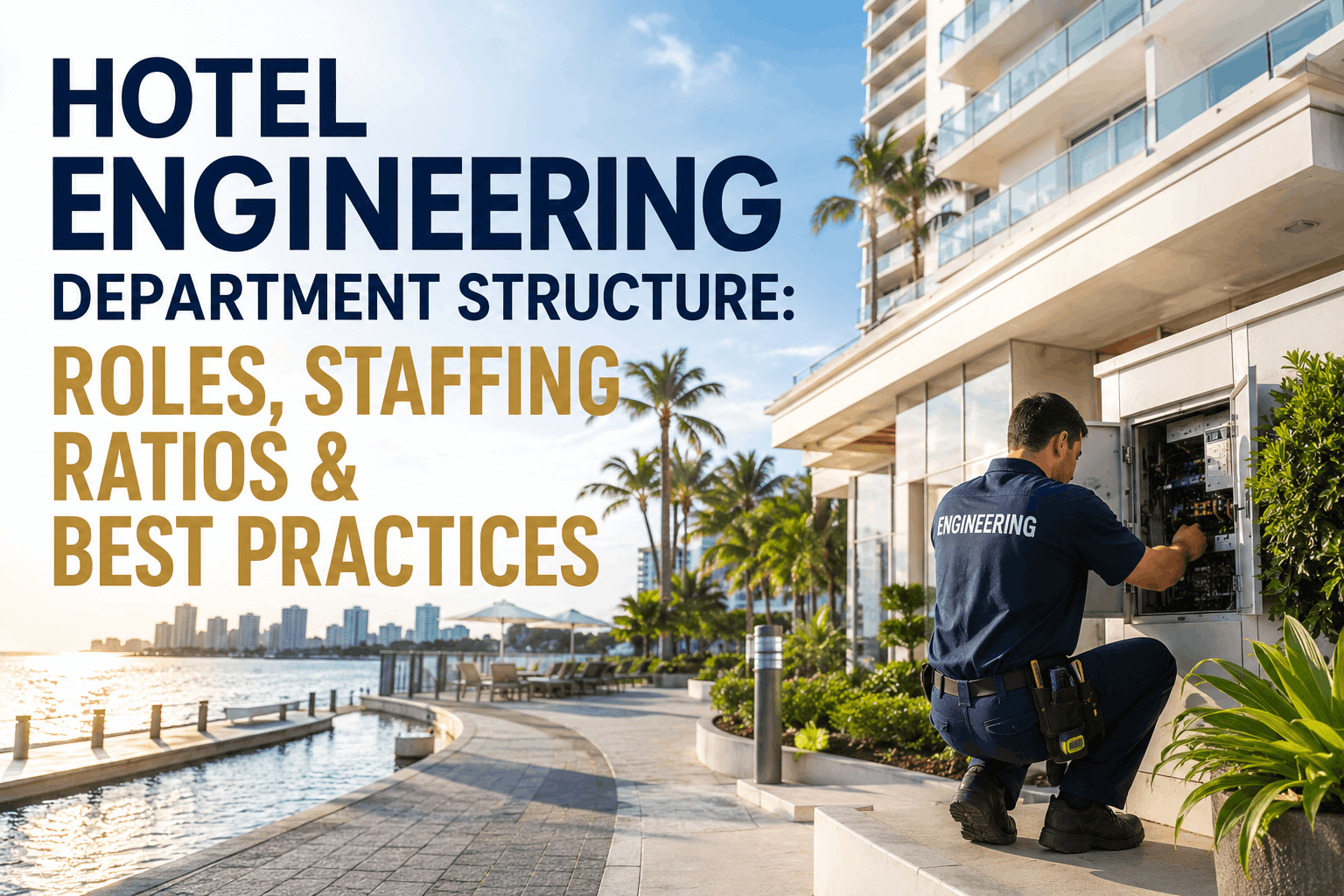
Hotel Engineering Department Structure and Staffing Ratios
By Alex Jordan on June 11, 2026
The average full-service hotel operates with 1 engineer per 40–60 rooms — but that 50% range represents a difference of 3–4 full-time positions for a 300-room property. And staffing ratios that work for a 5-year-old select-service hotel will catastrophically understaff a 40-year-old full-service property with legacy MEP systems. Most hotel engineering departments are staffed based on tradition ("we've always had 5 engineers") or budget constraint ("we can only afford 4"), not on actual workload. The result is predictable: deferred PM, emergency repair overtime, and chief engineers working 60-hour weeks just to keep the building running. OxMaint's workload analytics measure actual technician hours required to complete scheduled PM, respond to guest requests, and manage corrective repairs — providing the data needed to right-size engineering teams, justify headcount to ownership, and distribute work evenly across shifts.
HOTEL OPERATIONS · WORKFORCE PLANNING · 2026
Hotel Engineering Department Structure and Staffing Ratios by Property Type
FTE per 100 rooms, chief engineer span of control, shift scheduling models, technician skill mix, outsourcing thresholds, and the workload data required to staff engineering departments correctly.
1:40–60Engineer-to-room ratio — full-service hotel (industry standard)
1:80–120Engineer-to-room ratio — select/limited-service hotel
3–5Minimum FTE for 24/7 coverage with on-call backup
40%Of chief engineer time consumed by admin — not technical work
The 4 Engineering Department Roles — Span of Control and Core Functions
Hotel engineering departments fail when roles blur — chief engineers doing technician work, technicians making capital decisions, and no one owning preventive maintenance. The four-role framework below defines the span of control and core functions for each position. OxMaint's role-based access controls enforce these boundaries in the CMMS — technicians see work orders, chiefs see budgets, and every action is logged to the appropriate level of authority.
Chief Engineer
Department Head
Budget management, capital planning, regulatory compliance, brand standards, department KPIs, vendor contracts, fire/life safety systems, energy management. Span of control: 5–15 direct reports depending on property size.
Assistant Chief / Shift Lead
Supervisor
Daily work order dispatch, shift scheduling, PM compliance monitoring, emergency response coordination, inventory management, technician training. Span of control: 3–8 technicians per shift lead.
Skilled Technician
Technical
Preventive maintenance execution, corrective repairs, guest room service calls, equipment inspections, parts replacement. Specializations: HVAC, electrical, plumbing, kitchen equipment, building automation.
Utility / Generalist
Entry
Filter changes, light bulb replacement, grounds work, painting, furniture moving, pool chemical checks, back-up for skilled technicians. Entry-level role for career development.
Staffing Ratios by Property Type — FTEs per 100 Rooms
Staffing ratios vary dramatically by property class, age, and service level. The benchmarks below provide starting points for department sizing — but actual staffing must be adjusted for property-specific factors documented in the following section. OxMaint's workload planning module calculates required FTEs based on actual PM task volume, guest request frequency, and repair history — moving staffing decisions from "industry average" to "property-specific data."
Hotel Engineering Staffing Benchmarks — FTEs per 100 Rooms
0.9–1.3 FTEs per 100 rooms (chief engineer included)
Limited F&B (breakfast only), smaller public areas, simplified systems. 150-room select-service: 1–2 FTEs total. Chief engineer typically performs hands-on work.
Extended-Stay
0.8–1.1 FTEs per 100 rooms (chief engineer included)
Higher guest room PM load (in-room kitchens), lower public area intensity. 120-room extended-stay: 1–2 FTEs total. May share chief engineer across multiple properties.
Limited-Service
0.5–0.8 FTEs per 100 rooms (chief engineer included)
No F&B, minimal public areas, simplified systems. 100-room limited-service: 0.5–1 FTE. Often shares chief engineer across 2–3 properties in a management group.
Staffing Multipliers — Property Age, Condition, and Service Level Adjustments
Base staffing ratios are only starting points. Five property-specific factors multiply required staffing upward or downward. A 40-year-old hotel requires 30–40% more engineering hours than a 5-year-old property of the same class. The multipliers below adjust base ratios to actual property conditions. OxMaint's condition assessment module tracks equipment age, deferred maintenance backlog, and repair frequency — automatically calculating the staffing adjustment required for each property.
Engineering coverage models vary by property size and guest expectations. The table below shows three common shift models and their FTE requirements. OxMaint's shift scheduling module assigns work orders to on-duty technicians automatically, tracks overtime, and alerts when a shift is understaffed for the current workload.
Engineering Shift Models — Coverage by Property Size
Engineering staffed 24 hours, 7 days. Minimum 2 technicians per shift (overlap during shift changes). Supervisor on-site during peak hours, on-call overnight. Minimum FTE: 8–12.
Skill Mix — Generalists vs. Specialists
The right skill mix depends on property size and equipment complexity. Small properties need generalists who can handle multiple trades. Large properties benefit from specialists in high-complexity areas. The table below shows recommended skill distribution by property size. OxMaint's skills tracking module records technician certifications and training history — ensuring work orders are assigned only to qualified staff.
Property Size (Rooms)
Generalist %
Specialist %
Specialist Roles Needed
Under 100 rooms
90–100%
0–10%
None — all technicians handle all trades with vendor support for HVAC or elevator repairs.
100–250 rooms
70–80%
20–30%
One HVAC specialist (RTU/PTAC). One plumbing specialist if property has multiple F&B outlets.
Full specialist team with sub-specialties (chiller tech, boiler tech, refrigeration tech, elevator coordinator).
Workload-Based Staffing — Moving Beyond Ratios to Actual FTE Requirements
Industry ratios are useful benchmarks — but they don't account for your property's specific PM task volume, guest request frequency, and repair history. The workload-based staffing formula below calculates required FTEs from actual CMMS data. Properties using this method report 25% fewer overtime hours and 40% lower contractor spend than properties using ratios alone. OxMaint's workload analytics dashboard performs this calculation automatically — showing required FTEs, current staffing gap, and recommended adjustments by role.
Workload-Based Staffing Formula — FTE Calculation from CMMS Data
PM
Preventive Maintenance Hours/Week
Sum of all scheduled PM task durations
+
COR
Corrective Repair Hours/Week
Guest requests + equipment failures
+
ADMIN
Admin & Planning Hours/Week
Paperwork, meetings, training, inventory
SUM
Total Weekly Engineering Hours
PM + COR + ADMIN
÷
40
Hours per FTE (Weekly)
Standard full-time work week
=
FTE
Required Full-Time Engineers
Before shift coverage multiplier
Example: 80 PM hours + 60 repair hours + 20 admin hours = 160 total weekly hours ÷ 40 = 4.0 FTE before shift coverage adjustment. 24/7 coverage requires 6–8 FTEs for same workload (shift coverage multiplier 1.5–2.0×).
"
We were running a 6-person engineering team at our 350-room full-service property, and the chief engineer kept telling ownership we needed 8. They wouldn't approve the increase without data. We pulled 12 months of work order history from OxMaint and calculated our actual workload: 95 hours/week of PM, 85 hours of corrective, 25 hours of admin — 205 total hours. 205 ÷ 40 = 5.1 FTEs for business hours, but we had 24/7 coverage requirement. The shift coverage multiplier pushed required FTEs to 7.5. We presented the data to ownership and got approval for 8 FTEs immediately. The data made the case that our chief engineer's gut feeling couldn't.
Regional Director of Engineering — Hotel management company, 8 properties, US West Coast
Outsourcing vs. In-House — When to Use Contractors
Not every engineering task requires in-house staff. Strategic outsourcing can reduce FTE requirements while maintaining service quality. The matrix below shows which tasks are typically kept in-house versus outsourced by property size. OxMaint's vendor management module tracks contractor service dates, costs, and performance — ensuring outsourced work is completed on schedule and within budget.
Task Outsourcing Matrix — By Property Size
In-house · Outsourced · Hybrid approaches
Elevator Maintenance
Outsourced (all property sizes)
Contractor-performed due to licensing requirements and specialized tools. In-house role: log completion, escort contractor, verify work.
Small properties outsource all HVAC. Large properties keep in-house HVAC specialist for routine; outsource chiller/boiler major overhauls.
Kitchen Exhaust Cleaning
Outsourced (all sizes — fire code requirement)
Professional cleaning required for fire code compliance. In-house role: weekly grease filter cleaning between professional services.
Laundry Equipment
Hybrid (most properties)
In-house: daily lint cleaning, belt changes, minor adjustments. Outsourced: bearing replacement, control board repairs, major overhauls.
Guest Room PM
In-house (all property sizes)
Filter changes, fixture checks, caulking, minor repairs — core engineering function. Outsourcing these tasks is rarely cost-effective.
Frequently Asked Questions
How many maintenance technicians does a 200-room full-service hotel need?
Base ratio: 1.4–1.8 FTEs per 100 rooms = 2.8–3.6 FTEs plus chief engineer. Actual staffing depends on property age, amenities, and condition. A 20-year-old property with pool, 2 F&B outlets, and banquet space: 4–5 FTEs + Chief. A 5-year-old property with same amenities: 3–4 FTEs + Chief. OxMaint's workload calculator provides property-specific recommendation.
What is the minimum engineering team size for 24/7 coverage?
Minimum 5–6 FTEs for true 24/7/365 coverage with no on-call. Calculation: 3 shifts × 8 hours × 7 days = 168 weekly coverage hours. 168 ÷ 40 hours per FTE = 4.2 FTEs minimum before accounting for vacation, sick leave, training, and meetings. With coverage for absences: 6–8 FTEs depending on overlap requirements (shift handover, peak hour coverage).
How do I justify additional engineering headcount to ownership?
Use workload data, not arguments. Calculate total weekly engineering hours from your CMMS (PM + corrective + admin). Divide by 40 to get required FTEs. Document current staffing gap. Calculate overtime costs — if current team works 10 hours overtime weekly, that's 0.25 FTE of paid overtime that could be converted to a new hire. Present: current workload, current staffing, overtime cost, recommended FTE count, and ROI of adding headcount vs. contractor overtime.
Should the chief engineer be a working manager or purely administrative?
Property size determines the answer. Under 150 rooms: chief engineer typically works 50–70% hands-on, 30–50% admin. 150–300 rooms: 30–50% hands-on, 50–70% admin. Over 300 rooms: 10–20% hands-on, 80–90% admin (with assistant chief managing daily dispatch). If chief engineer spends over 60% of time on hands-on work in a 300+ room property, the department is understaffed.
How does a CMMS help with engineering staffing decisions?
A CMMS provides the workload data that staffing decisions require: actual hours spent on PM vs. corrective vs. admin, work order volume trends by season, technician productivity, overtime patterns, and deferred maintenance backlog. Without this data, staffing decisions are based on ratios and assumptions. With CMMS data, staffing is based on actual required hours — defensible, measurable, and adjustable as workload changes.
Right-Size Your Engineering Department with Workload Data.
OxMaint provides the analytics to calculate required FTEs, justify headcount, and balance work across shifts — free to start.