Hotel asset criticality tagging sorts every piece of equipment — from chillers and elevator drives to guest-room exhaust fans — into Critical, High, or Standard tiers so maintenance teams can allocate preventive maintenance hours where downtime and guest impact actually matter. A 300-key property may track 3,000+ assets, yet typically fewer than 15% drive the majority of downtime cost, safety risk, and negative reviews. This guide walks through a hotel asset criticality framework, scoring methodology, and the CMMS structure that converts it into action. To apply it on your property today, Start Free Trial or read on for the full classification playbook.
Your chiller and a bathroom fan can't share the same PM schedule — so why are they?
When every asset gets equal maintenance attention, critical equipment is under-served and engineering hours are wasted on low-impact tasks. Criticality tagging fixes the allocation problem.
What is hotel asset criticality tagging and why it matters
Asset criticality tagging is the structured process of rating every asset's business impact on a scale — typically Critical, High, or Standard — using weighted factors like guest safety, operational impact, regulatory exposure, and repair lead time. ISO 55000 asset management principles call for risk-based prioritization, and in a hotel environment that means engineering effort must concentrate where failure consequences are highest.
Safety & Compliance
Life-fire systems, emergency generators, and elevators carry direct guest-safety and code-inspection obligations. Failure can mean injury, fines, or forced closures.
Operational Impact
How quickly does downtime halt revenue-generating operations? A main chiller knocks out 300 rooms; a single TV affects one guest room.
Downtime Cost
Lost room revenue, comp nights, F&B spoilage, and reputational damage. A hotel-wide HVAC outage can cost $15K–$50K+ per day in a full-service property.
Redundancy & Lead Time
If an asset fails, is there a backup? Spare-part lead time of 6 weeks on a boiler circulation pump dramatically raises its criticality score.
Critical, High, Standard: the three-tier hotel asset classification
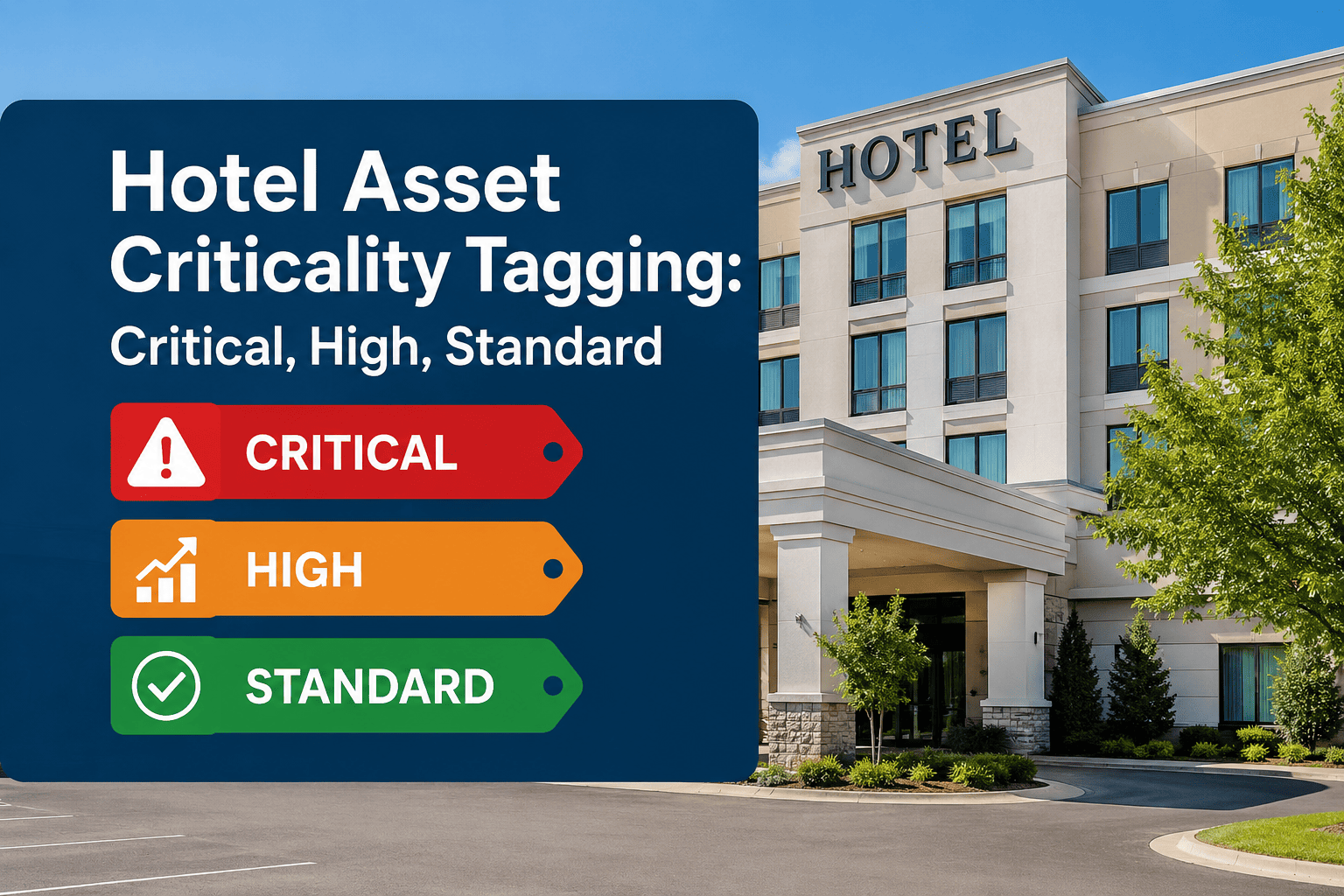
Most hotel properties find that roughly 10–15% of assets fall into the Critical tier, 25–35% into High, and 50–60% into Standard. Here's how each tier is defined and what PM cadence it demands.
Critical Assets — Life Safety & Operational Backbone
Fire alarm and suppression systems, emergency generators, main HVAC chillers/boilers, elevators, main electrical switchgear, and domestic water booster pumps. Failure risks guest safety, triggers regulatory violation, or halts hotel operations within minutes.
High Assets — Service-Critical & Revenue-Supporting
Commercial kitchen equipment (ovens, walk-in coolers, dishwashers), pool and spa filtration systems, laundry equipment, secondary HVAC (RTUs, AHUs), and BMS controllers. Failure causes significant guest dissatisfaction, revenue loss, or health-code risk but doesn't immediately endanger life.
Standard Assets — Guest-Room & Low-Impact Fixtures
Guest-room HVAC PTAC units, bathroom exhaust fans, lighting fixtures, televisions, minibars, and ice machines. Failure affects a single guest or small area; impact is contained and repair is typically straightforward with short lead times.
How to calculate an asset criticality score
A weighted scoring model removes subjectivity from the classification process. Score each asset 1–5 across four factors, multiply by the weight, and sum the results. Assets scoring 4.0+ are Critical, 2.5–3.9 are High, and below 2.5 are Standard.
| Factor | Weight | Score 1 (Low) | Score 5 (High) |
|---|---|---|---|
| Safety & Compliance Risk | 35% | No safety impact; non-code item | Life-safety system; code-mandated inspection |
| Operational Impact | 30% | Single guest room affected | Entire hotel or major service halted |
| Downtime Cost (per day) | 20% | Under $500/day impact | $10,000+/day impact |
| Redundancy & Lead Time | 15% | Full backup; parts same-day | No redundancy; 4+ week lead time |
A 180-asset boutique hotel reallocating engineering hours
A 180-key full-service hotel tracked 1,400 assets but ran identical monthly PMs across all equipment categories. After scoring: 168 assets (12%) were classified Critical, 392 (28%) High, and 840 (60%) Standard. By shifting PM hours accordingly, the property cut annual PM labor cost by 22% while increasing Critical-asset PM compliance from 78% to 97% — directly reducing unplanned downtime events by 35% over six months.
Setting up criticality tagging in your hotel CMMS
Tagging assets is only useful if the CMMS uses those tags to drive PM frequency, work-order priority, spare-part stocking levels, and dashboard alerts. Here's the step-by-step structure for translating criticality scores into CMMS automation.
Build the asset registry with criticality fields
Import every asset into OxMaint with location hierarchy (property → floor → zone → room). Add custom fields for Criticality Tier, Score, Safety Flag, and Redundancy Flag so you can filter and report instantly.
Map PM templates to each tier
Create PM templates per tier: Critical = weekly inspection + monthly full PM + predictive sensors. High = monthly walk-down + quarterly PM. Standard = quarterly visual + annual PM. Auto-generate work orders on schedule.
Set work-order priority by criticality
Configure auto-priority rules: a breakdown work order on a Critical asset triggers Priority 1 with SMS alerts to the Chief Engineer. Standard-asset break-fix tickets default to Priority 3 and route to the next-day queue.
Link spare-parts min/max to tier
Critical-asset spare parts (e.g., elevator controller boards, chiller contactors) get min-stock thresholds with auto-reorder. Standard parts are purchased on-demand, freeing 20–30% of parts-room capital.
Build criticality dashboards & KPIs
Track PM compliance by tier, MTBF by tier, and downtime cost by tier. Critical-asset PM compliance below 95% should trigger a red-flag alert to the Director of Engineering weekly.
Stop treating every asset like it matters equally — see OxMaint on your property
Book a 30-minute demo and we'll load a sample criticality model for a hotel your size, showing exactly how PM hours, spare-parts spend, and downtime shift when tiering is automated.
How OxMaint powers hotel criticality tagging end-to-end
OxMaint's AI-powered CMMS and EAM platform turns criticality scores into automated maintenance action — from PM scheduling to predictive failure alerts — so engineering teams focus where it counts.
Criticality-based PM automation
Auto-generate tiered PM schedules (weekly, monthly, quarterly) based on each asset's Critical/High/Standard tag. OxMaint customers cut PM scheduling time by 80% and lift Critical-asset compliance above 95%.
AI predictive failure alerts
OxMaint's AI analyzes vibration, temperature, and run-time data from Critical and High-tier assets to predict failures 7–21 days in advance — reducing unplanned downtime 30–50% on tagged equipment.
Tiered spare-parts optimization
Auto-reorder Critical spares at min-stock thresholds while flagging Standard parts for on-demand purchase. Properties typically free 20–30% of parts-room capital tied up in low-priority inventory.
Real-time criticality dashboards
Live KPIs by tier: PM compliance, MTBF, downtime cost, and work-order backlog. Drill from property level to a single chiller in two clicks. Export-ready for brand-compliance audits and GM reviews.
Hotel asset criticality tagging — your questions answered
What is hotel asset criticality tagging?
Hotel asset criticality tagging is the process of rating every piece of equipment — from chillers to guest-room fans — as Critical, High, or Standard based on safety risk, operational impact, downtime cost, and repair lead time. The tier determines PM frequency, work-order priority, and spare-parts stocking levels so engineering effort concentrates where failure matters most.
How often should Critical hotel assets receive preventive maintenance?
Critical hotel assets like fire alarms, emergency generators, main chillers, and elevators typically require weekly visual inspections and monthly full PMs, supplemented by predictive-maintenance sensors for vibration and temperature monitoring. Regulatory code inspections (e.g., NFPA, ASME for elevators) layer on top at their mandated intervals.
Can I implement criticality tagging in my existing CMMS?
Yes, if your CMMS supports custom asset fields, tier-based PM templates, and priority rules. OxMaint makes this seamless with built-in criticality scoring, auto-PM generation by tier, and real-time dashboards. You can Book a Demo to see a hotel criticality model set up live, or Start Free Trial to import your asset list today.
How much does it cost when hotels don't prioritize maintenance by criticality?
Properties without criticality-tiered maintenance typically overspend 20–30% on PM labor for low-impact assets while under-serving Critical equipment — leading to 30%+ higher unplanned downtime, comp-room costs averaging $150–$300 per affected guest, and potential regulatory fines for missed life-safety inspections.
What's the difference between asset criticality and asset condition?
Asset criticality measures the business and safety impact if an asset fails — it's relatively stable over time. Asset condition measures the current physical state and degradation level — it changes as the asset ages or receives maintenance. Both are needed: criticality drives PM frequency and priority, while condition drives repair-vs-replace capital decisions.
Tag your assets by criticality — and put engineering hours where they count
Join hotels using OxMaint to automate tiered PMs, predict failures on Critical equipment, and cut unplanned downtime by up to 50%. Set up your criticality model in days, not months.
Free 14-day trial · No credit card