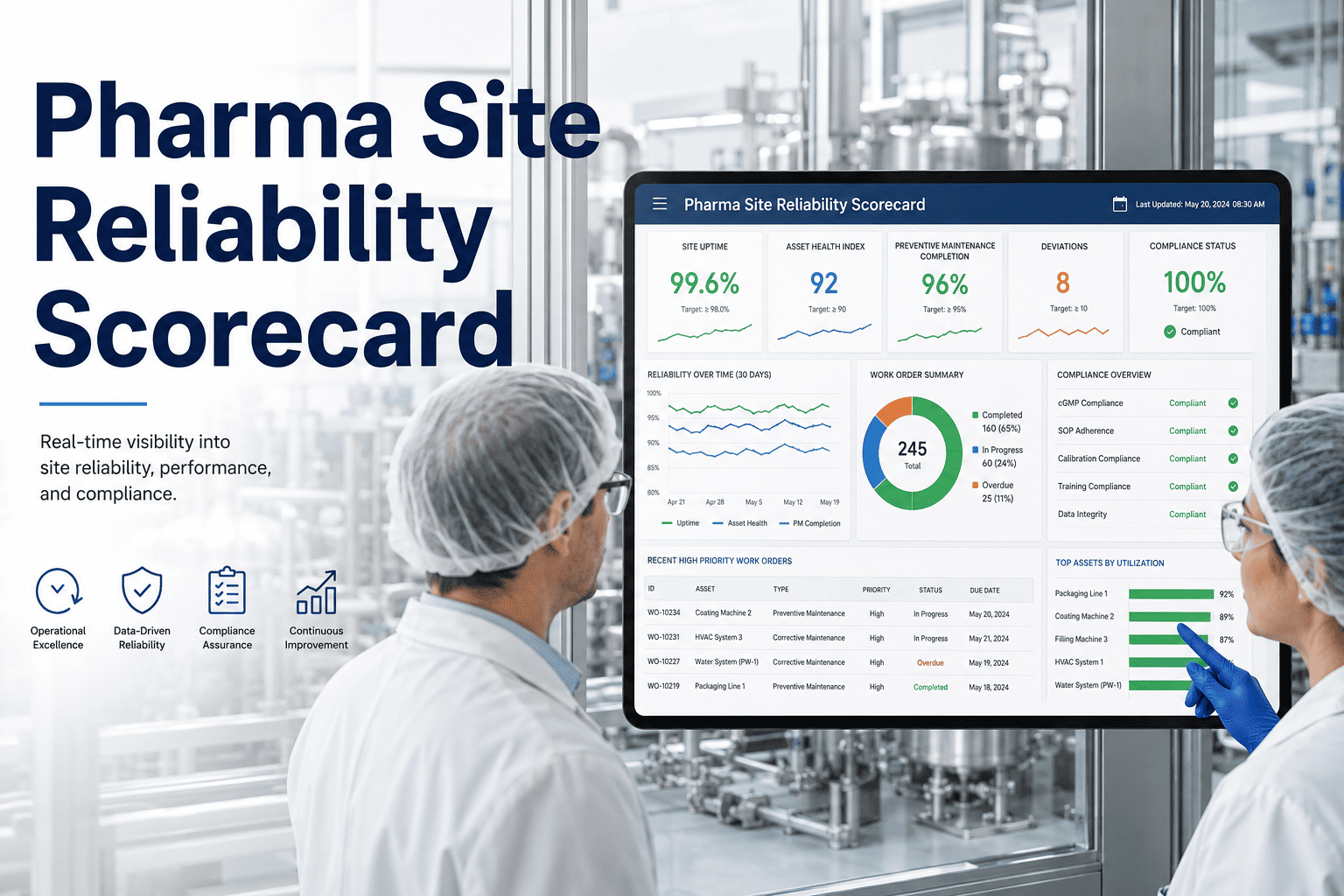
North America pharma manufacturing sites are operating under tighter scrutiny than at any point in the past decade — FDA warning letter volume, EU Annex 1 revisions, and post-pandemic capacity pressure have made site reliability a board-level conversation. Book a demo with OxMaint to see how leading pharma sites across North America are benchmarking their PM compliance, calibration risk, maintenance backlog, and audit readiness against validated CMMS data — and using those scores to prioritize capital and maintenance budget requests before regulators prioritize it for them. This scorecard gives reliability engineers, plant managers, and VP Operations a structured lens for comparing site performance across six critical maintenance dimensions.
North America Pharma · Site Reliability · CMMS Benchmarking
Pharma Site Reliability Scorecard: Are You Inspection-Ready Across All Six Dimensions?
PM compliance, downtime rate, calibration risk, WO backlog, safety work status, and audit record quality — scored and benchmarked against North America pharma peers running validated CMMS platforms.
The Six Dimensions
Site Reliability Scorecard: What Each Dimension Measures
Percentage of scheduled PMs completed on time. Below 90% creates audit observation risk and equipment reliability gaps.
Reactive WO percentage of total maintenance activity. Industry target for GMP sites is below 20% to maintain batch schedule reliability.
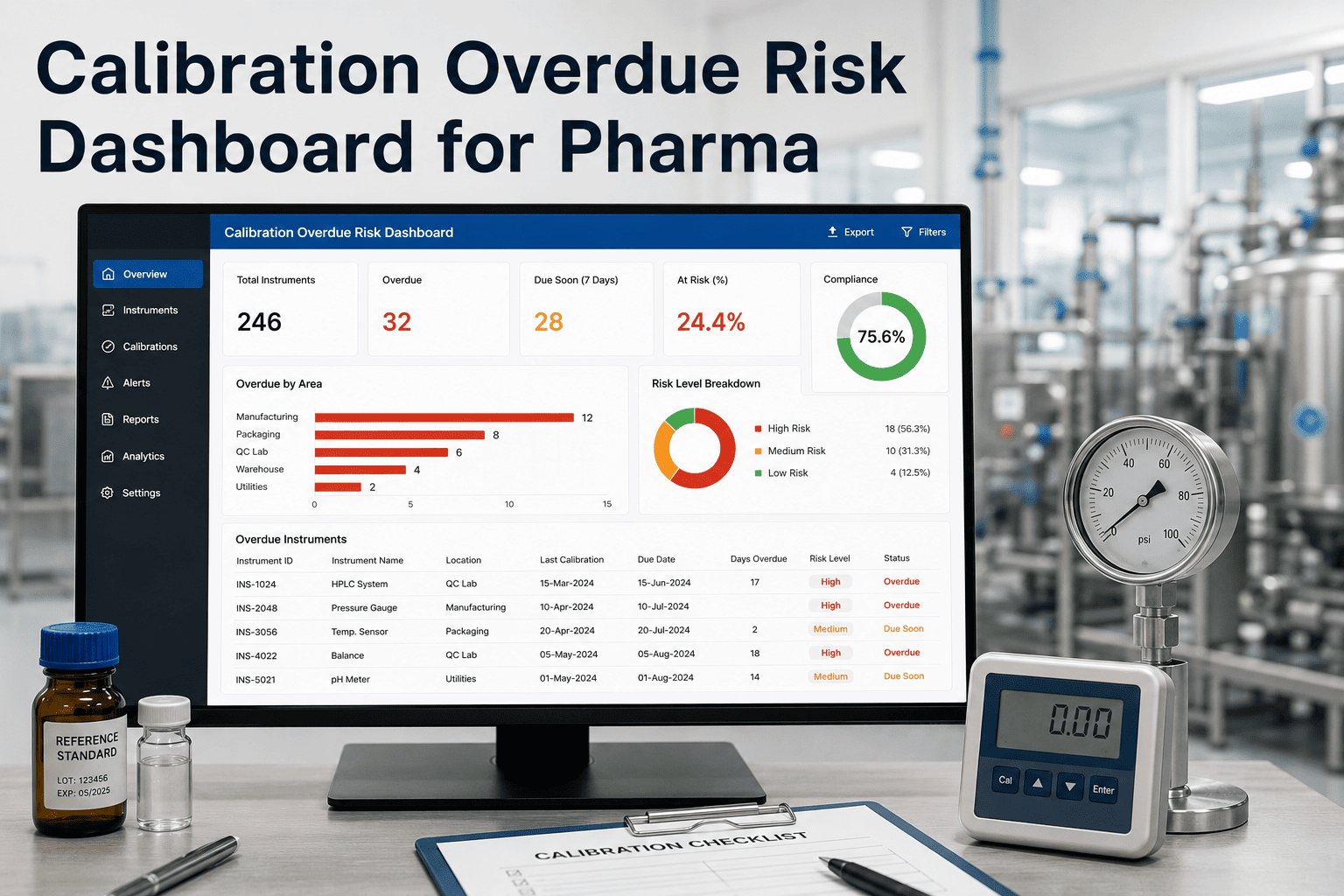
Percentage of calibrated instruments current and certificate-attached. Overdue calibrations are among the top 3 FDA 483 observation categories for pharma manufacturing.
Average age of open corrective WOs. High backlog age signals prioritization failure and is an inspector trigger for deeper records review.
Percentage of safety-flagged work orders completed within required SLA. Any open safety WO at inspection is a critical finding regardless of site overall score.
Percentage of inspector record requests fulfilled within 5 minutes. Slow retrieval creates inspector perception of disorganization and triggers broader records review.
OxMaint · Site Reliability · Live CMMS Dashboard
See Your Site's Reliability Score in a Live OxMaint Demo
OxMaint's reliability dashboard tracks all six scorecard dimensions in real time — so you know your inspection risk posture every day, not just when an audit is announced.
Regional Benchmarks
North America Pharma Site Reliability: Regional Performance Comparison
| Region |
PM Compliance |
Reactive WO % |
Cal. On-Schedule |
Avg Backlog (days) |
Reliability Tier |
| US Northeast Pharma Corridor |
82% |
31% |
79% |
14 days |
Developing |
| US Southeast (Biopharma Clusters) |
79% |
35% |
76% |
17 days |
At Risk |
| US Midwest (Generics Manufacturing) |
76% |
41% |
69% |
22 days |
At Risk |
| Canada (Ontario / Quebec Sites) |
85% |
28% |
83% |
12 days |
Developing |
| OxMaint-Managed Sites (All Regions) |
96% |
19% |
97% |
6 days |
Leading |
Risk Signals
Three Reliability Signals That Predict Audit Findings Before They Happen
High Risk
Calibration Overdue Rate Above 15%
Sites with more than 15% of calibrated instruments overdue are 4.2x more likely to receive a critical instrument-related 483 observation. This is the single highest-correlation predictor of a maintenance-related finding in FDA inspection data (2019–2024).
Medium Risk
WO Backlog Growing for 3 Consecutive Months
A backlog that trends upward for 90 days signals that corrective maintenance demand exceeds team capacity or planning efficiency. Inspectors interpret sustained backlog growth as a site that cannot manage its maintenance obligations — regardless of PM compliance rate.
High Risk
Safety WO Open Beyond 30 Days
Any safety-classified work order open longer than 30 days without documented escalation and justification is a critical finding in virtually every GMP inspection framework. OxMaint escalates safety WOs automatically at 7 days and requires mandatory supervisor acknowledgment at 14 days.
"
The sites that pass inspections without significant maintenance findings are not the ones that scramble before the audit — they are the ones where the reliability scorecard is a standing agenda item in the monthly operations review. PM compliance, calibration status, and backlog age are visible every day, not reconstructed for the inspector. The shift from reactive audit preparation to continuous reliability monitoring is exactly what a validated CMMS enables, and the sites that make that shift stop dreading audits and start using them as validation that the system is working.
Theresa Kwan
VP Quality Operations · 24 years in North America pharma manufacturing · Former FDA Investigator (CDER) · RAPS Fellow, ASQ CQE
FAQ
Site Reliability Scorecard — Questions Plant Managers Ask
How does OxMaint calculate and display these six reliability dimensions in real time?
OxMaint's reliability dashboard pulls live data from the work order, PM schedule, calibration, and asset modules — calculating each dimension score in real time as technicians execute work. The dashboard is configurable by site, department, or asset class, and sends threshold alerts when any dimension drops below the target range. Plant managers can see their site's full scorecard without running a single report.
Book a demo to walk through the reliability dashboard live.
Can we use this scorecard to compare multiple sites within the same organization?
Yes. OxMaint supports multi-site account structures where a central operations or quality team can view normalized reliability scores across all sites on a single screen. Each site's PM compliance, backlog age, calibration status, and safety WO completion are displayed side by side — making it straightforward to identify which sites need resource attention before an inspection cycle. Cross-site comparisons can be exported for executive reporting or board-level quality reviews.
Start a trial to configure your multi-site view.
What is the typical improvement timeline for a site that scores in the "At Risk" tier?
Sites entering OxMaint in the "At Risk" range (PM compliance below 80%, reactive WO above 35%) typically move to "Developing" within 60 days and reach "Leading" tier within 5–7 months. The fastest improvements come in calibration tracking — which is fully current within 30 days of go-live — and PM compliance, which improves within the first scheduling cycle. Backlog reduction takes longer because it requires the team to work through historical open WOs while maintaining current demand, usually a 90–120 day process with OxMaint's backlog prioritization tools.
How does OxMaint handle safety work order escalation to ensure no item ages past 30 days?
OxMaint classifies safety WOs at creation and applies an automatic escalation ladder: supervisor notification at 7 days open, mandatory acknowledgment required at 14 days, and site director alert at 21 days with a documented hold reason required before the system allows the WO to remain open. If no acknowledgment is recorded at 14 days, OxMaint escalates to the next management tier automatically. This creates the documented escalation trail that inspectors need to see when a safety WO has been open longer than the standard SLA.
See the safety WO escalation workflow in a live demo.
OxMaint · Pharma Site Reliability · Real-Time Dashboard
Know Your Site's Reliability Score Before the Inspector Does.
OxMaint tracks all six reliability dimensions continuously — PM compliance, downtime, calibration, backlog, safety work, and audit readiness — so your site is always inspection-ready, not just audit-prepared.