A US hospital in 2026 is subject to the concurrent regulatory authority of at least six separate agencies — The Joint Commission for accreditation, CMS for Medicare and Medicaid conditions of participation, OSHA for workplace safety, state departments of health for licensing, the CDC and public health authorities for infection control, and the local fire marshal for life safety code — plus HIPAA, DEA controlled substance oversight, and FDA medical device recall obligations layered on top. Each agency operates on its own survey cycle, its own citation framework, its own corrective action timeline, and its own escalation ladder. And when a single issue is found — a blocked fire door in a corridor, an expired eyewash inspection tag in a lab, a missing calibration record on a defibrillator — that one physical finding often generates related citations across three or four different regulatory frameworks simultaneously, each requiring its own written response, its own corrective action plan, its own follow-up documentation, and its own tracking to closure. The hospitals that operate this environment successfully are not the ones with the biggest compliance teams. They are the ones that treat compliance as continuous operational discipline captured in a single system, rather than an agency-by-agency scramble organized around survey dates. This 2026 guide walks through the regulatory landscape hospital compliance officers actually manage, the finding-severity cascade that determines response urgency, the cross-agency overlap that turns one finding into many, the corrective action plan windows each agency imposes, and the unified compliance command center that OxMaint's compliance module operationalizes for hospital leadership. Book a free demo to see healthcare compliance audit management inside OxMaint.
The Joint Commission
Accreditation · EC · LS · IC · MM · NPSG
18-39 month unannounced cycle
Loss of accreditation · CMS deemed-status loss
CMS
Conditions of Participation · Medicare · Medicaid
Complaint-driven & validation surveys
Reimbursement termination · Immediate Jeopardy
State DOH
Licensing · state-specific standards
Annual to tri-annual · varies by state
License suspension · operational restrictions
OSHA
Worker safety · bloodborne pathogens · ergonomics
Complaint-driven · programmed inspections
Willful violations up to $161K per instance
Fire Marshal
NFPA 101 Life Safety · NFPA 25 · NFPA 72
Annual (typical)
Operational restrictions · closure orders
HIPAA · OCR
Patient privacy · breach notification · security rule
Complaint & breach-triggered
Civil penalties up to $2M per year per violation
Every agency has its own finding vocabulary · but a single physical issue often creates parallel findings under multiple frameworks · OxMaint holds the cross-reference in one system
6+
separate regulatory authorities exercising concurrent oversight of a typical US hospital · each with its own survey cycle and citation framework
Unannounced
the default posture for major surveys · continuous readiness is the only workable operational stance
45 days
standard Joint Commission window for Evidence of Standards Compliance response · other agencies impose their own CAP timelines in parallel
The Finding Severity Cascade — Response Urgency by Level
Not every citation carries the same operational stakes. Regulatory findings sit on a defined severity cascade — from the most consequential (Immediate Jeopardy, requiring instant corrective action to prevent loss of Medicare certification) down to standard-level findings that can be addressed on the normal CAP timeline. The cascade below reflects how compliance leadership must classify every incoming finding within hours of receipt, because the response protocol, escalation path, and executive notification requirements are all determined by severity level.
Finding Severity Cascade · Response Urgency Increases Upward
Immediate Jeopardy
Situation that has caused or is likely to cause serious injury, harm, impairment, or death · CMS designation
Remove threat within 24 hours · executive team engaged · immediate corrective action
Condition-Level Finding
Non-compliance with a Condition of Participation · CMS reimbursement at risk if not resolved
60-day corrective action plan · validation survey typically follows
Requirement for Improvement
Joint Commission designation for non-compliance with a specific standard
45-day Evidence of Standards Compliance response required
Standard Finding
State DOH or agency finding at standard severity · corrective action tracked to closure
Agency-specific timeline · typically 30-90 days
Observation / Recommendation
Non-citable observation or suggested improvement · documentation retained for trend analysis
Address at next planning cycle · captured in continuous improvement tracker
Every finding classified within hours of receipt · severity drives the response protocol · OxMaint routes each finding to the correct workflow automatically
The Cross-Agency Cascade — One Finding, Many Citations
The single most misunderstood dynamic in healthcare compliance is that a single physical issue rarely generates a single citation. A fire door found propped open during a Joint Commission tracer will very likely also cite under CMS Life Safety Code Conditions of Participation, appear in the state DOH annual report, be flagged by the fire marshal at the next annual inspection, and if it involves an unsafe worker condition, potentially draw OSHA attention. Each citation requires its own written response on its own timeline. Compliance operations that track findings agency-by-agency miss the cascade and end up responding to the same underlying issue four separate times with four separate documents. OxMaint's cross-reference model captures the single underlying issue once and generates the required responses per agency framework automatically.
Single Physical Finding · Multi-Agency Citation Cascade
The Physical Finding
Fire door propped open in patient corridor
Joint Commission
LS.02.01.20 · EP 13
RFI · 45-day ESC response
CMS
§482.41 Life Safety Code
Condition-level potential · CAP required
State DOH
State licensing regulation
Statement of Deficiencies · CAP
Fire Marshal
NFPA 101 · 19.3.7
Violation notice · re-inspection required
One propped fire door · four parallel citation frameworks · four written responses required · one CMMS record eliminates the reconciliation problem
Corrective Action Plan Windows — Each Agency, Its Own Timeline
Every citation triggers a corrective action plan with a defined response window imposed by the citing agency. The windows below reflect the standard CAP timelines compliance officers actually work against — with cascading findings often creating three or four parallel CAP obligations from a single underlying issue, each on its own clock. Missing a CAP deadline typically triggers escalation to the next enforcement tier, so tracking every window against every finding is non-negotiable operational work. OxMaint holds the CAP calendar as tracked deliverables against each open finding, escalating internally before the external deadline is reached.
Corrective Action Plan Response Windows
Immediate Jeopardy · CMS
Threat removed same day · corrective plan follows immediately
Joint Commission · RFI
Evidence of Standards Compliance submitted through TJC portal
CMS · Condition-Level
Written CAP · validation survey typically scheduled to verify
State DOH · Standard
State-specific window · CAP filed with licensing authority
OSHA · Serious Violation
Contest window · abatement dates set at citation
Every window tracked against the specific finding · OxMaint escalates internally before external deadline · nothing slips past a CAP due date
Every Agency, Every Finding, Every Deadline — One Dashboard
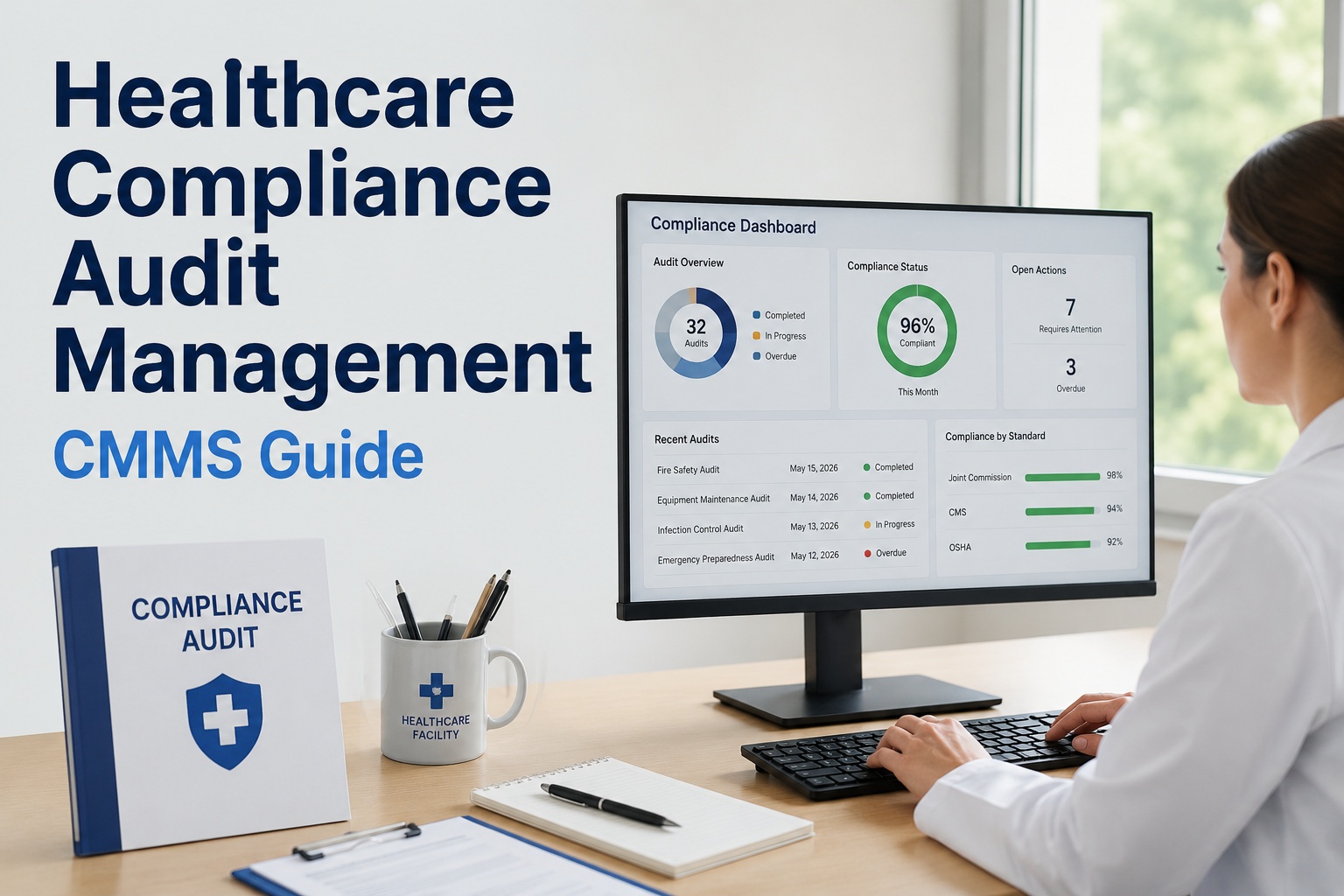
OxMaint's compliance module tracks every open finding against every applicable agency framework · CAP deadlines visible to the compliance team · executive dashboard shows enterprise regulatory posture at a glance.
The Compliance Command Center — What Leadership Actually Sees
The 2026 direction for hospital compliance operations is toward a unified command center view — a single dashboard giving the Chief Compliance Officer, the Director of Quality, and the executive team real-time visibility into regulatory posture across all agencies simultaneously. The mock dashboard below reflects what a mature CMMS compliance dashboard actually displays: agency-by-agency posture, open findings by severity, CAP calendar with days remaining, and readiness indicators for the next expected survey window. This replaces the manual monthly compliance reports that most hospitals still assemble by hand from six or seven separate systems.
Agency Posture · Current Standing
Open Findings by Severity
Upcoming CAP Deadlines
7 days
CMS §482.41 · Life Safety response due
18 days
TJC EC.02.03.05 · Fire equipment ESC
34 days
State DOH · Physical environment CAP
Survey Window Readiness
TJC unannounced windowOpen now · continuous readiness
State DOH annualExpected 60-120 days
Fire marshal annualScheduled Q3 2026
This view is not a monthly report · it is live at every hour · every field updates as work orders close and findings resolve
Executive Perspective · Compliance as Continuous Discipline
Every Chief Compliance Officer eventually understands the same paradox: the hospitals that stress the most about surveys are the ones least ready for them, and the hospitals that seem to barely notice surveys arriving are the ones where compliance is embedded into every operational shift. The difference is not effort or budget. It is whether compliance is an event you prepare for or a discipline you maintain. Preparation-mode hospitals run compliance drills before expected surveys, scramble to close open findings when the window approaches, and treat the tracer methodology as a stressful performance. Continuous-discipline hospitals treat every environmental round, every work order, every PM completion, every incident review as a compliance data point captured to the record, and the survey itself becomes almost administrative — the surveyors see what has been true every day of the year, not what was constructed for the visit. Making that transition operational requires a single system where the compliance program lives — where every finding, every CAP, every response document, every closure verification is tracked against the applicable agency framework with the deadline visible to leadership at all times. When we moved to OxMaint's compliance module, that transition happened almost immediately. Our next Joint Commission survey came in and left without incident. That is the entire operational goal.
One System, Every Agency
OxMaint holds every open finding against every applicable regulatory framework · cross-references cascade findings automatically.
CAP Deadlines Never Slip
Internal escalation before external deadline · executive team notified as findings approach response windows.
Continuous Readiness Posture
Every environmental round captured · every tracer supported by real data · surveys are administrative, not dramatic.
Move to Continuous Compliance Readiness in 2026
If your compliance program still runs on paper CAP files, spreadsheet tracking of finding closure, and monthly manual reports assembled by hand, you are carrying preventable regulatory risk into every survey window. See what OxMaint — a maintenance management platform built for healthcare compliance audit management — looks like against your regulatory portfolio.
Frequently Asked Questions
Which agencies regulate a typical US hospital?
At minimum: The Joint Commission (accreditation), CMS (Medicare/Medicaid Conditions of Participation), state Department of Health (licensing), OSHA (worker safety), local fire marshal (life safety code), and HIPAA/OCR (patient privacy). Additional oversight comes from DEA (controlled substances), FDA (medical device recalls), CDC (infection control), and various state and specialty-specific bodies. Each operates on its own survey cycle and citation framework — OxMaint captures the full portfolio in one system.
What is the difference between Joint Commission RFI and CMS Condition-Level finding?
A Joint Commission Requirement for Improvement (RFI) is a finding of non-compliance with a specific TJC standard, requiring a 45-day Evidence of Standards Compliance response. A CMS Condition-Level finding is non-compliance with a Condition of Participation — an entire regulatory condition rather than an individual standard — that puts Medicare and Medicaid reimbursement at risk if unresolved. Condition-level findings typically trigger a 60-day corrective action plan and often a validation survey to verify remediation.
What is Immediate Jeopardy and how quickly must it be addressed?
Immediate Jeopardy (IJ) is a CMS designation for a situation that has caused or is likely to cause serious injury, harm, impairment, or death to a resident or patient. When IJ is identified, the hospital must remove the threat within a 24-hour window — regardless of any pending appeals or corrective action plan negotiations. Executive leadership is engaged immediately, and follow-up validation surveys typically occur within days. IJ findings carry the highest escalation potential of any regulatory citation.
Why does one physical finding often generate multiple citations?
Because multiple agencies exercise overlapping jurisdiction over the same physical environment. A propped fire door will cite under TJC Life Safety chapter (LS.02.01.20), CMS §482.41 Life Safety Code Conditions of Participation, state DOH licensing regulations, NFPA 101 as enforced by the fire marshal, and potentially OSHA if worker safety is implicated — from a single underlying issue. Each requires its own written response on its own timeline. OxMaint's cross-reference model captures the physical issue once and generates the framework-specific responses automatically.
What is continuous survey readiness?
Continuous survey readiness is the operational posture in which the hospital operates every day as if a surveyor could arrive within the hour — because with unannounced Joint Commission surveys and complaint-driven CMS investigations, that is the operational reality. Continuous readiness means every environmental round is documented, every finding tracked to closure, every CAP visible to leadership, every training current, and every asset inspection captured against the specific piece of equipment. OxMaint operationalizes this posture as tracked routine work rather than pre-survey scramble.
How does a CMMS support cross-agency compliance management?
A modern hospital CMMS captures every finding once against the specific asset, room, or process, then maps it to every applicable agency framework (TJC standard, CMS CoP, state regulation, NFPA reference), generates the required response documents per framework, tracks each CAP deadline separately with internal escalation, and produces the audit-ready evidence package for each agency's specific format. This eliminates the reconciliation problem that arises when compliance data lives across separate departmental systems that do not talk to each other.


.jpg)


