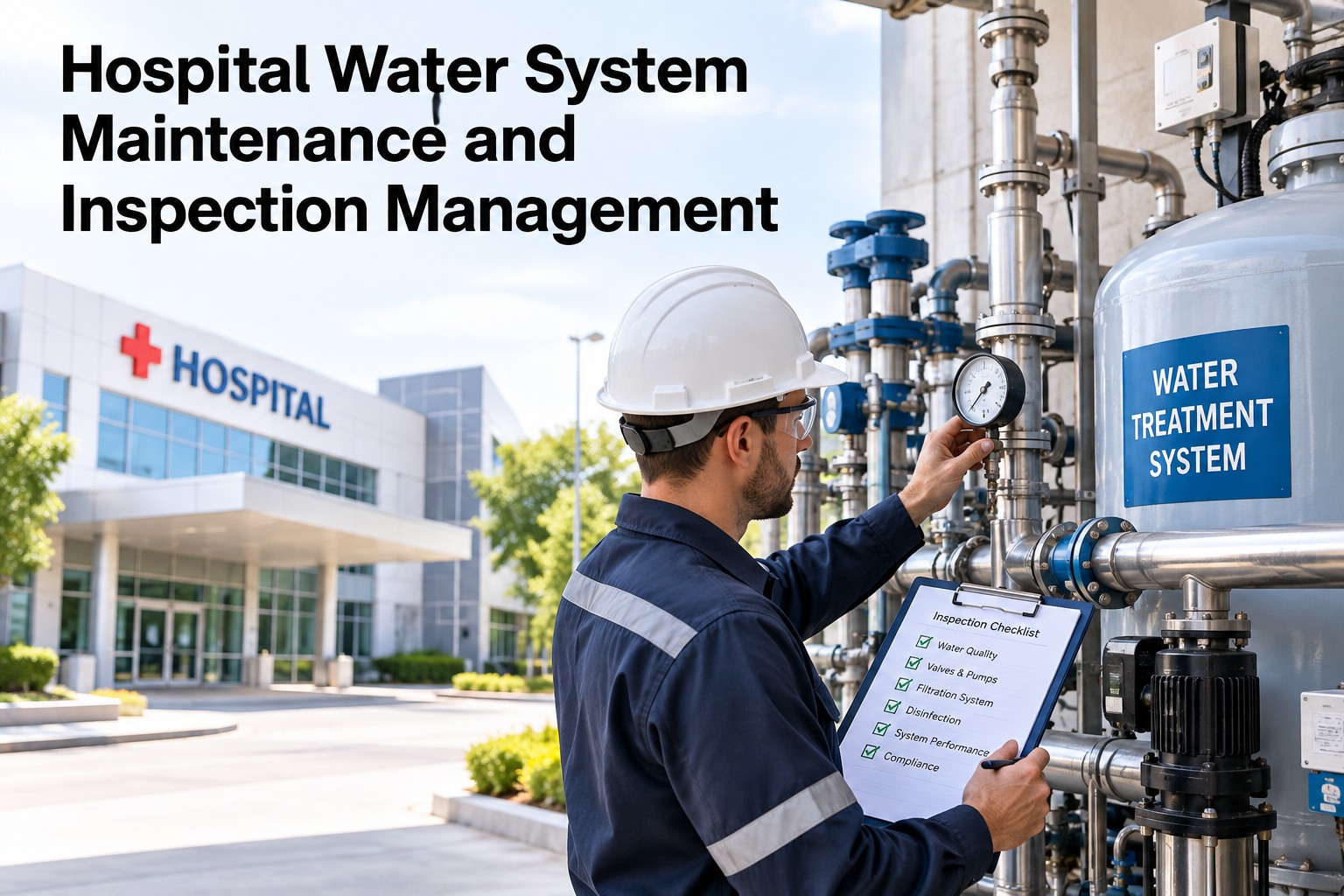
A water system doesn't fail loudly — it fails in a logbook nobody has looked at in three weeks. A cooling tower temperature that's supposed to be checked weekly, a low-use fixture that should have been flushed, a hot water tank running a few degrees below the target range on paper these are small gaps. In a facility with immunocompromised patients, they're exactly how a water management program breaks down. This guide walks through how to structure hospital water system maintenance and inspection — monitoring points, flushing routines, temperature logs and corrective action — using OXMAINT AI, the AI-powered CMMS that keeps every reading, inspection and corrective work order tied to the exact water system asset it came from.
Hospital Water System Maintenance and Inspection Management
A water management program only holds together if every temperature reading, flush log and inspection finding lands somewhere your team actually reviews — not a logbook that gets checked once a month. OXMAINT AI connects the full workflow: routine readings and inspection findings get logged against the exact water asset, a result outside range opens a defect automatically, and that defect converts into a work order with the reading history attached, so corrective action happens before the next scheduled check, not after.
Where Water Management Programs Actually Break Down
Most programs aren't missing a plan — they're missing a reliable way to see whether the plan is actually being followed, day to day, across every monitoring point. A paper logbook can look complete and still hide a gap: a reading skipped during a busy shift, a flush that never happened on a low-use wing, a result written down but never flagged as out of range. Start free and bring your monitoring points into OXMAINT AI.
- Readings recorded by hand, reviewed only when someone remembers to check
- No automatic flag when a reading falls outside the expected range
- Flushing and treatment logs kept separately from temperature records
- A missed check on a low-use wing goes unnoticed until the next full audit
- Corrective action, if it happens, isn't linked back to the reading that caused it
- Every reading logged against its specific monitoring point, timestamped
- An out-of-range result flags automatically and opens a defect
- Flushing, treatment and temperature logs sit on the same asset record
- A missed scheduled check shows up as overdue, not silently skipped
- Corrective work orders carry the reading history that triggered them
The Water Management Workflow
A water program runs on a cycle, not a single checklist — routine monitoring feeds the record, a result outside range triggers review, and confirmed issues become tracked corrective work. OXMAINT AI runs each stage against the same asset record, so nothing has to be reconciled afterward. Book a demo to see this cycle running on your own facility.
Common Monitoring Points
Different water systems carry different risks and need different checks. OXMAINT AI lets each monitoring point carry its own schedule and range, rather than applying one generic rule facility-wide. Sign up free and set up your own monitoring points in OXMAINT AI.
| System | Typical checks | Common corrective action |
|---|---|---|
| Cooling towers | Temperature, treatment residual, visual biofilm check | Treatment dosing adjustment, cleaning, biocide addition |
| Hot water tanks | Storage and delivery temperature at set points | Setpoint adjustment, mixing valve check, tank inspection |
| Ice machines | Visual inspection, cleaning schedule, water quality check | Cleaning cycle, filter replacement, service call |
| Low-use fixtures | Scheduled flushing on unoccupied wings and rooms | Flush logged; escalation if a fixture is repeatedly missed |
A Reading That's Never Reviewed Isn't a Safeguard — It's a Record.
A water management program is only as strong as the gap between a reading being taken and someone acting on it. OXMAINT AI closes that gap by flagging an out-of-range result the moment it's logged, not at the next scheduled review.
One Out-of-Range Reading, Start to Close
Here's how a single flagged reading actually moves through OXMAINT AI. Book a demo to see this on your own water systems.
Paper Logbooks vs. Digital Monitoring
| What matters | Paper logbook | OXMAINT AI digital record |
|---|---|---|
| When an out-of-range result is caught | Whenever someone reviews the log | The moment it's entered |
| Visibility across monitoring points | One binder per building or department | One view across every point, every site |
| Missed scheduled check | Easy to overlook | Shows up as overdue automatically |
| Link between reading and corrective action | Rarely connected | Work order carries the triggering reading |
| Record for internal review | Reassembled from physical logs | Already organized by asset and date |
Frequently Asked Questions
Give Every Monitoring Point One Record, From Reading to Resolution.
Log every reading against the exact system it came from, catch an out-of-range result the moment it's entered, and turn it into a corrective work order automatically — evidence attached, every time.


.jpg)