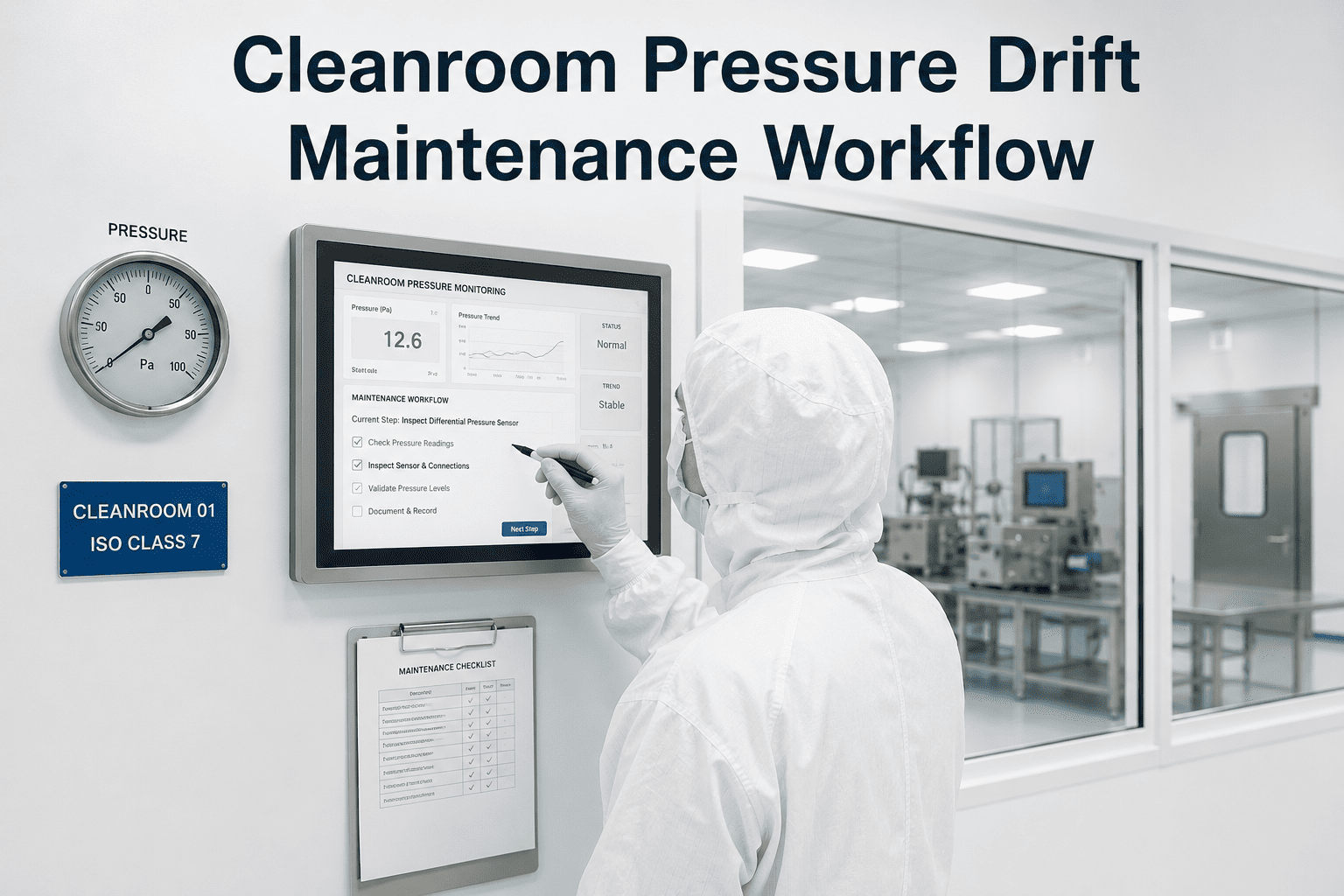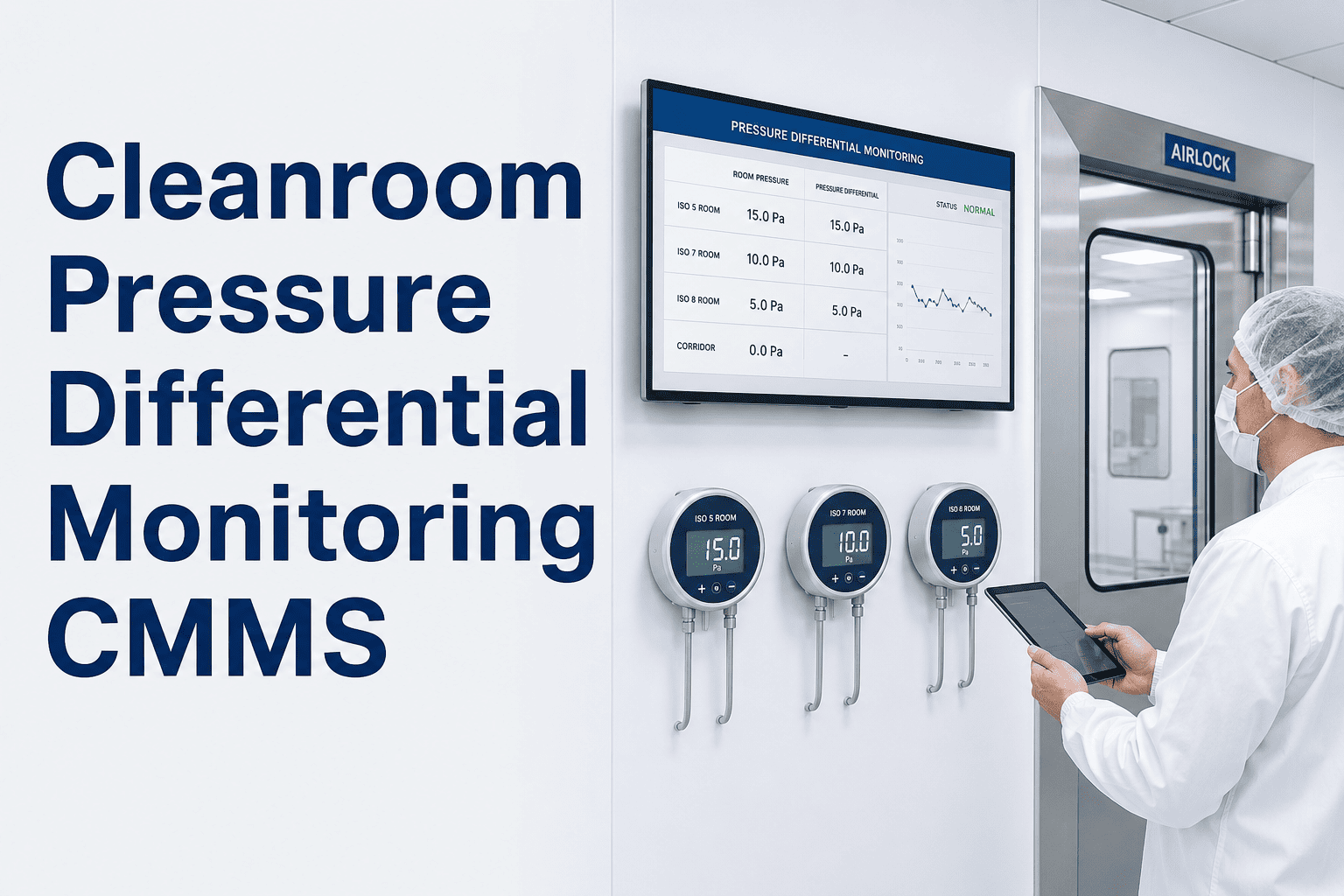
A pressure reversal between two cleanroom zones is invisible. No visible contamination, no immediate alarm in many legacy systems, no warning to the operator transferring materials across the boundary — just contaminated air flowing from a less-controlled corridor into a Grade B filling suite, silently loading the surfaces and settling plates that won't be read until the end of the shift. Unlike a temperature excursion that triggers an alarm and leaves a clear data trail, a pressure differential failure can allow contaminated air to flow into a critical zone without any visible sign, until the consequences surface downstream. OxMaint's CMMS alarm integration converts every pressure excursion into a timestamped, assigned work order before the batch record closes — creating the documented response chain that satisfies FDA, EU GMP Annex 1, and USP 797 reviewers who look for evidence that every pressure alarm was investigated, actioned, and resolved.
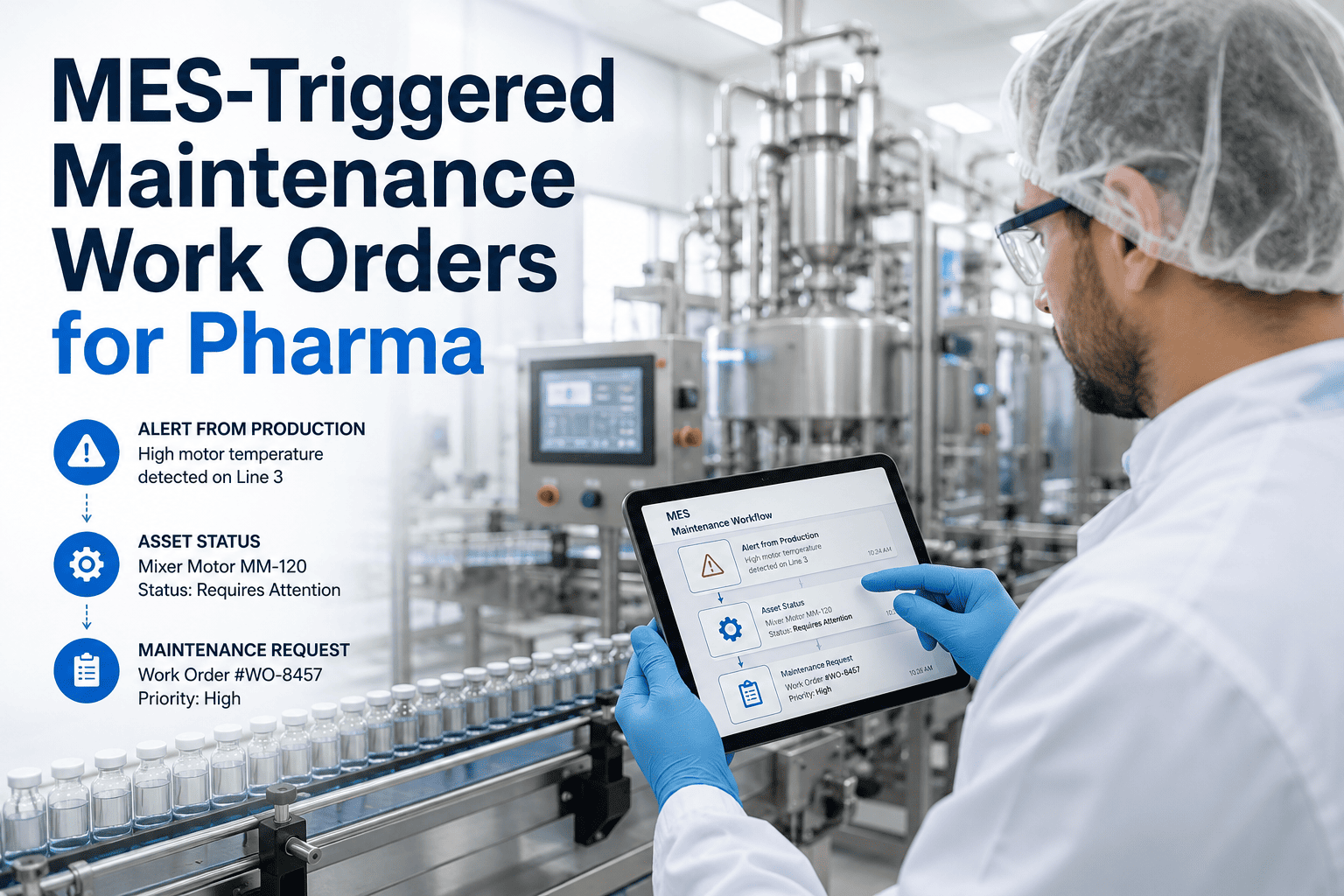
BMS alarm fires → OxMaint work order created → technician dispatched → root cause documented → deviation linked → batch impact assessed. The full excursion response chain, automated from first alarm to CAPA closure — with every step time-stamped and audit-ready.
Every GMP cleanroom parameter can fail. Temperature excursions affect product stability. Particle count spikes indicate contamination events. But pressure differential failures are uniquely dangerous for three compounding reasons that regulators have specifically identified in inspection findings.
OxMaint integrates with your Building Management System or Environmental Monitoring System to convert every pressure differential excursion into a structured maintenance response — automatically, with no manual triage step between the alarm and the work order.
| Root Cause | Excursion Pattern | Detection Method | Maintenance Response | CMMS Trigger in OxMaint |
|---|---|---|---|---|
| HEPA filter loading / blockage | Gradual, sustained pressure drop — worsens over days to weeks | Pressure trending shows progressive decline from baseline | Filter replacement PM — schedule before alert threshold is reached | Trend-triggered PM at 80% of alert threshold; replacement work order before failure |
| Supply air fan speed drift | Gradual change across multiple zones simultaneously — often time-of-day pattern | Multi-zone correlation in OxMaint trend view reveals common cause | VFD calibration check; belt or coupling inspection; motor assessment | Multi-zone excursion pattern triggers HVAC system PM work order |
| Door seal failure / propped door | Sudden, sharp excursion — typically during shift change or material transfer | Time-of-day pattern aligns with personnel activity logs | Door seal replacement PM; SOP reinforcement for airlock procedure | Recurring time-pattern excursion triggers inspection work order for door seals |
| Ductwork seal leak / penetration failure | Persistent baseline shift — lower than expected differential across a specific zone pair | Zone-specific analysis identifies single boundary versus systemic shift | Ductwork inspection and re-sealing; wall penetration audit | Zone-specific persistent deviation from baseline triggers ductwork inspection WO |
| Adjacent construction or facility work | Sudden onset during known construction window — may affect multiple zones | Correlation with scheduled construction activity in facility management records | Temporary pressure monitoring increase; construction isolation verification | Pre-work permit triggers enhanced monitoring mode — alarm thresholds tightened during construction |
| BAS sensor drift / calibration failure | Readings inconsistent with secondary gauges; alarm with no physical cause found | Discrepancy between BAS reading and independent handheld measurement | Sensor calibration or replacement; independent verification procedure | Annual calibration PM work order per sensor; handheld verification checklist step on each investigation |
The pressure differential is the single most important environmental parameter in an aseptic manufacturing cleanroom — more consequential than particle count and more difficult to recover from when it fails, because the contamination exposure happens silently and in real time. I have reviewed batch records from three separate contamination investigations where the root cause trace-back clearly showed that a pressure excursion occurred during the production window, was noted in the BMS log, but was never formally investigated or linked to a deviation. In each case, the batch had been released before QA identified the connection. The regulatory consequences in all three cases — batch recalls, consent agreements, enhanced FDA oversight — could have been entirely avoided if a CMMS had automatically created a work order the moment the BMS alarm fired, required a documented investigation before the work order closed, and linked that investigation to the batch record before it went to QA review. The gap is not monitoring — most facilities monitor continuously. The gap is the automated link between the alarm and the documented, time-stamped, batch-linked response.
How does OxMaint integrate with a Building Management System to receive pressure differential alarms?
OxMaint connects to BMS platforms via BACnet/IP, OPC-UA, Modbus TCP, or REST API — the integration protocols supported by most pharmaceutical-grade BMS vendors including Siemens Desigo, Johnson Controls Metasys, Schneider Electric EcoStruxure, and Honeywell Building Manager. The integration maps specific BMS points (pressure differential readings per zone pair) to OxMaint assets (specific cleanroom zone boundary) with configurable alert and action level thresholds. When a reading crosses a threshold, OxMaint creates the work order automatically. No operator needs to manually transfer the alarm. Start your free trial to review the BMS integration pathway for your specific platform.
How does OxMaint distinguish between alert-level and action-level excursions in its response workflow?
OxMaint supports two-tier alarm classification per zone — alert level (early warning, investigation required, batch not automatically held) and action level (immediate response required, batch conditionally held pending QA review). Each tier triggers a different work order priority, response SLA, and notification recipient list. Alert-level excursions generate P2 work orders with 2-hour response SLA and technician notification. Action-level excursions generate P1 work orders with 30-minute response SLA and simultaneous notification to the HVAC technician, shift supervisor, QA pharmacist, and operations director. The distinction is configured per zone at site setup. Book a demo to configure your two-tier alarm response workflow.
Can OxMaint link a pressure excursion work order directly to the batch record affected during the excursion window?
Yes. When an excursion work order is created, the production schedule in OxMaint identifies which batches were in-process during the excursion window in the affected zone. Those batches are tagged in the system with a conditional review flag, and a batch impact assessment form is automatically generated and assigned to the QA reviewer. The batch cannot be released from OxMaint's conditional hold until the QA reviewer completes and closes the impact assessment — creating an enforced batch review gate. If your batch record system is external (SAP, MasterControl, Veeva), OxMaint provides the excursion package as a PDF attachment to the batch record notification. Start your free trial to configure the batch impact assessment workflow for your production schedule.
How does OxMaint support trend analysis of pressure differential excursions over time?
OxMaint automatically generates excursion trend reports per zone — showing frequency, average duration, time-of-day distribution, and root cause category breakdown over configurable 30/60/90-day windows. The trend report is the primary tool for identifying whether individual excursion events represent isolated incidents or systematic HVAC degradation requiring preventive intervention. OxMaint also flags zones where excursion frequency has increased by more than 50% versus the prior 90-day baseline — triggering a proactive HVAC assessment work order before the pattern becomes an inspection finding. Book a demo to see the pressure differential trend dashboard for cleanroom operations.
OxMaint integrates with your BMS to convert every pressure differential excursion into an automatically assigned, batch-linked, investigation-documented work order — satisfying FDA, EU GMP Annex 1, and USP 797 reviewers who expect to see a closed-loop response to every alarm that fired during a production run.