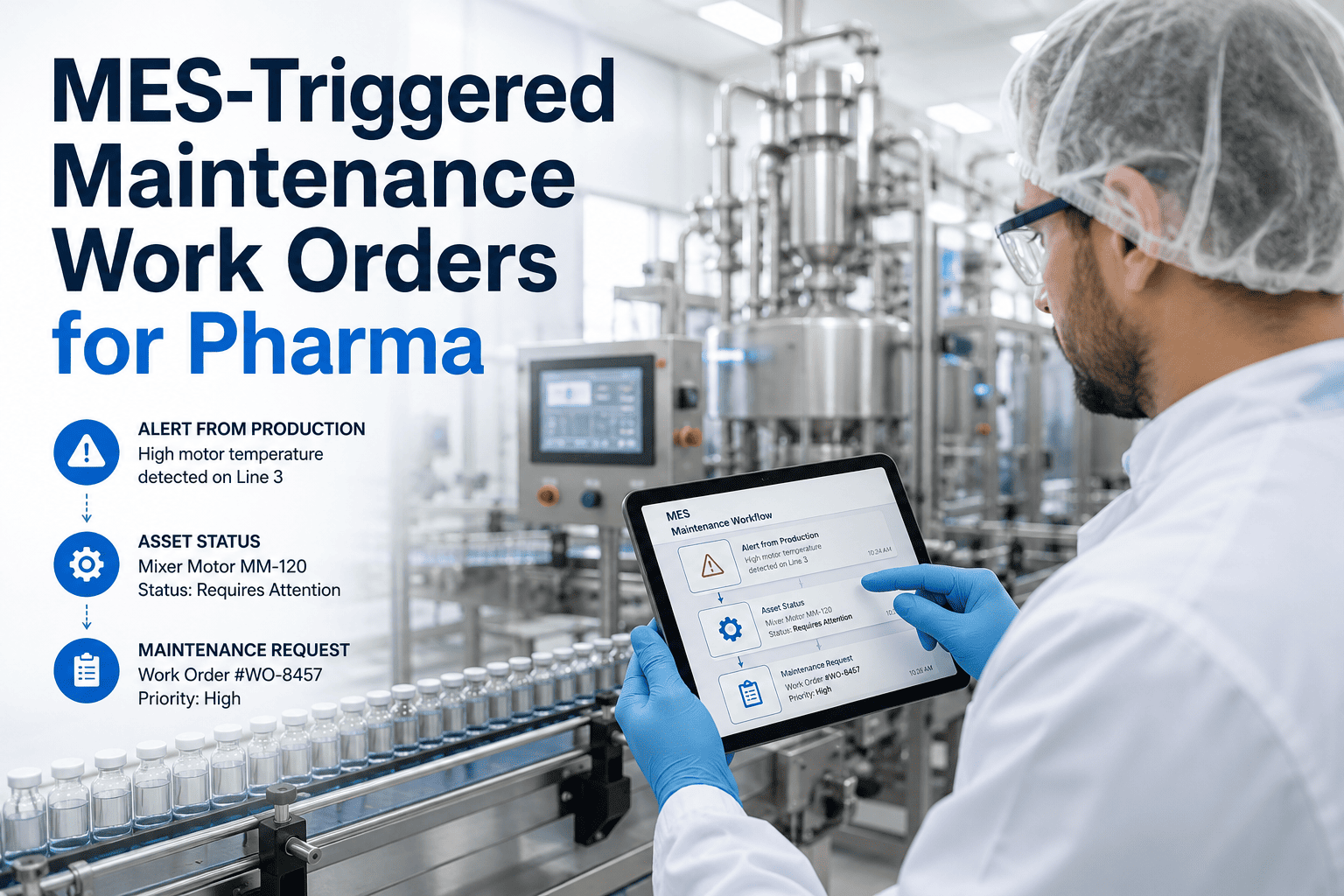
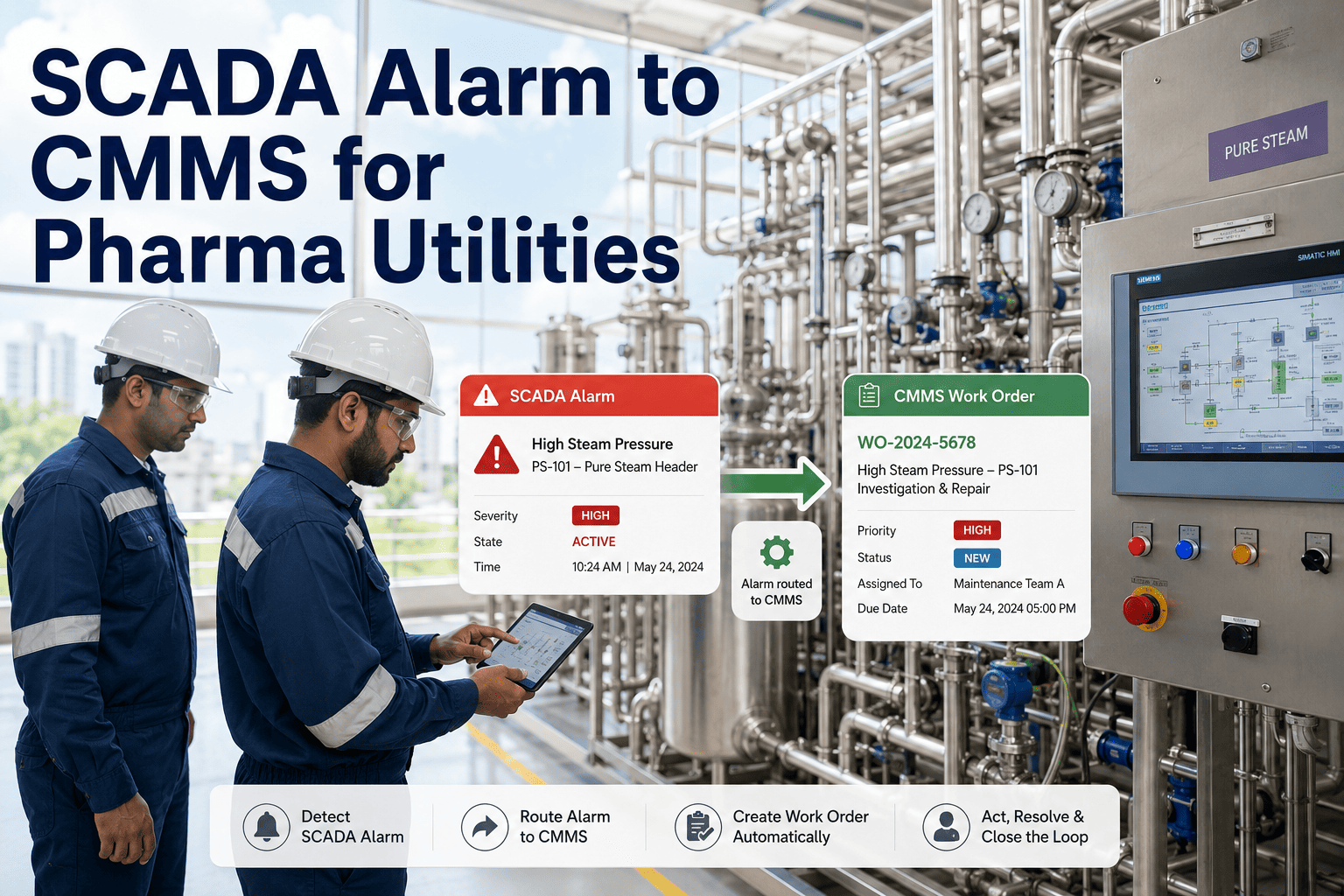
In pharmaceutical manufacturing, the gap between a production event and a maintenance response is where batch failures, regulatory findings, and costly equipment damage accumulate. When a bioreactor stops mid-batch, an alarm fires, a fill line slows unexpectedly, or a CIP cycle runs over time, your Manufacturing Execution System already knows about it — but that information never reaches your maintenance team automatically. Instead, a supervisor notices, calls the maintenance desk, someone opens a work order manually, and 45–90 minutes have passed before a technician is even assigned. MES-triggered maintenance work orders close this gap entirely: production events in your MES automatically generate populated work orders in OxMaint, routing the right technician to the right asset with the right GMP documentation in minutes, not hours. Sign in to OxMaint to configure MES-triggered work order rules, or book a demo to see the MES integration live.
Integrations / Pharma Manufacturing
MES-Triggered Maintenance Work Orders for Pharma Manufacturing
How connecting your Manufacturing Execution System to your CMMS eliminates the manual gap between production alarms and maintenance response — protecting batch integrity, GMP compliance, and equipment uptime in pharmaceutical manufacturing.
MES Event
Equipment stop alarm
CIP cycle overrun
Fill rate deviation
Production exception
Batch parameter breach
Automatic trigger
via API
OxMaint Work Order
Asset ID pre-populated
Fault description from MES
Technician auto-assigned
GMP task steps attached
Batch record linkage
Manual process
45–90 min
alarm to technician assigned
MES-triggered
< 3 min
alarm to work order generated
The Production-Maintenance Gap: What It Costs in Pharma
Every pharmaceutical manufacturer has some version of the same problem: the MES knows what happened to the equipment, but the CMMS doesn't find out until a human makes a phone call. In a GxP environment, that delay isn't just an efficiency problem — it's a data integrity problem, a batch disposition problem, and potentially a regulatory finding.
$320K
Average revenue loss per unscheduled downtime incident in pharma manufacturing
Source: OxMaint pharma industry data — average across batch and continuous manufacturing
3–7 days
Batch release delay when maintenance documentation isn't electronically linked to MES batch records
Manual batch-to-maintenance record assembly introduces error and QA review delay
45–90 min
Typical manual lag from MES alarm to maintenance work order creation in disconnected systems
Every minute of this gap is production loss and potential batch integrity exposure
Zero-Delay Maintenance Response
Every MES Alarm. Automatic Work Order. Technician Responding in Minutes.
OxMaint connects to your MES via API so every equipment stop, alarm threshold breach, and production exception automatically generates a populated, GMP-compliant work order — routed to the right technician before a supervisor even picks up the phone.
MES Event Types That Trigger Maintenance Work Orders
Equipment Stop Events
Unscheduled line stop
Emergency stop activation
Interlock trip
Drive fault
Work order type generated: Corrective maintenance — Priority 1. Technician assigned based on equipment type and shift schedule. Safety clearance steps pre-populated per equipment SOP.
Process Parameter Deviations
Temperature exceedance
Pressure out of range
Speed deviation
Weight variance
Work order type generated: Condition-based inspection. OxMaint links the MES parameter deviation data to the work order so the technician sees exactly what the process value was at the time of trigger — not a second-hand description.
CIP and Cleaning Events
CIP cycle overrun
Conductivity fail
Rinse timeout
Cleaning validation alert
Work order type generated: Equipment inspection with cleaning validation linkage. In pharma, CIP failures have batch disposition implications — OxMaint creates the maintenance record and simultaneously notifies QA with the batch association already populated.
Alarm Threshold Breaches
High-priority alarm
Alarm repeat within window
Alarm escalation level 2+
Suppressed alarm reactivation
Work order type generated: Configurable by alarm priority level. OxMaint rule engine maps MES alarm codes to specific work order templates — so a level-3 bioreactor agitator alarm generates a different work order than a level-1 ambient temperature deviation.
Production Batch Events
Batch hold triggered
In-process check fail
Equipment change required
Format changeover
Work order type generated: Equipment qualification check or changeover verification. OxMaint links the work order to the relevant batch record automatically — building the maintenance-to-batch traceability that QA needs for batch release without manual record assembly.
Predictive Condition Data
Vibration trend alert
Current draw anomaly
Runtime threshold
Cycle count trigger
Work order type generated: Predictive maintenance. MES runtime and cycle-count data feeds OxMaint's predictive engine, triggering PM work orders based on actual equipment usage — not fixed calendar intervals that ignore how hard the equipment has actually run.
Integration Architecture: MES to OxMaint
Layer 1
MES Event Capture
OxMaint connects to your MES platform via REST API, MQTT message broker, or OPC-UA data bridge. Supported MES platforms include Siemens Opcenter, Rockwell Plex, Aveva MES, and SAP ME. Custom MES platforms integrate via standard API configuration without bespoke development in most cases.
Layer 2
Rule Engine Configuration
OxMaint's trigger rule engine maps MES event codes to work order templates. Maintenance engineers configure which events trigger which work order types, what priority level applies, which technician role is assigned, and what task steps are pre-populated — all without coding.
Layer 3
Work Order Generation
When a trigger rule fires, OxMaint generates a fully populated work order: asset ID from the MES equipment identifier, fault description from the event payload, GMP task steps from the linked procedure, and the MES event log attached as supporting evidence for the audit trail.
Layer 4
Batch Record Linkage
OxMaint reads the active batch number from the MES at the time of the trigger event and associates it with the work order record. QA teams see the equipment maintenance event and the batch it occurred during — in one record, with electronic signature evidence, without manual cross-referencing.
Layer 5
GMP Audit Trail
The complete chain from MES event to work order to technician response to QA review is captured in OxMaint's 21 CFR Part 11 audit trail. Every record is timestamped, user-attributed, and tamper-evident — satisfying FDA inspectors and enabling batch release without delays from missing documentation.
Layer 6
Reporting and Analytics
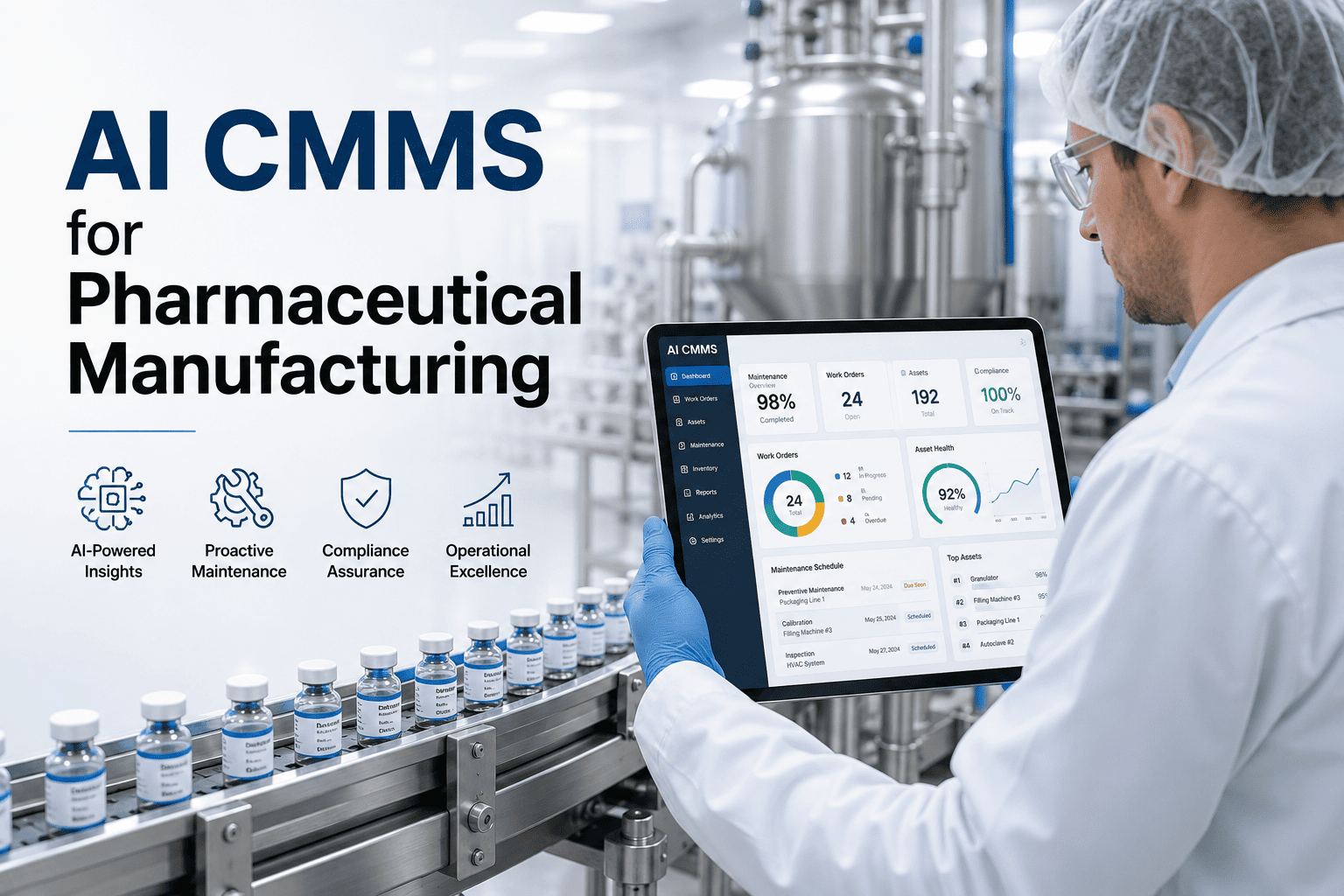
OxMaint reports on MES-triggered work order volume, response time from trigger to technician assignment, resolution time, and repeat event frequency per equipment item. This data identifies chronic equipment problems that drive batch failures — turning reactive maintenance data into proactive reliability improvement.
MES Integration vs Manual Process: What Changes
| Scenario |
Manual Disconnected Process |
MES-Triggered via OxMaint |
| Equipment stop alarm fires |
Supervisor notified verbally, calls maintenance desk |
Work order auto-generated, technician notified on mobile in under 3 minutes |
| Work order creation |
Maintenance coordinator opens WO manually, types in asset, fault description, and priority |
Fully populated WO created automatically from MES event data — no manual entry required |
| Batch record linkage |
QA manually cross-references batch log and maintenance record — 3–7 day delay at batch review |
Batch number associated at trigger time — batch-to-maintenance traceability is automatic and immediate |
| GMP documentation |
Maintenance log updated after the fact — audit trail gaps possible if documentation is delayed |
21 CFR Part 11 audit trail captures every action in real time — no retroactive documentation |
| Repeat alarm analysis |
No systematic tracking — same alarm fires repeatedly with no escalation pattern |
OxMaint reports repeat events per asset — chronic issues escalate to reliability investigation before batch failure |
Frequently Asked Questions
Which MES platforms does OxMaint integrate with for triggered work orders?
OxMaint integrates with major pharma MES platforms including Siemens Opcenter, Rockwell Plex, Aveva MES, SAP Manufacturing Execution, and Werum PAS-X via standard API, MQTT, or OPC-UA connectivity. Custom or legacy MES platforms integrate through OxMaint's configurable API connector layer.
Book a demo to discuss your specific MES platform and integration architecture.
Does MES-triggered work order generation require validation in a GMP environment?
Yes — the integration configuration is a GMP change that requires documented change control and impact assessment. OxMaint provides integration validation support including IQ/OQ protocols for the connected configuration, validation test scripts for trigger rule accuracy, and audit trail verification documentation. The validation scope is typically contained to the integration layer, not a full system revalidation.
How are false positive MES alarms handled to prevent unnecessary work orders?
OxMaint's trigger rule engine includes configurable debounce logic — alarms must persist for a defined duration before triggering a work order, and alarm priority thresholds are configurable per equipment item. Maintenance engineers tune these rules during implementation to match your facility's known alarm patterns, reducing nuisance work orders while ensuring genuine production events always generate a response.
Sign in to OxMaint to explore trigger rule configuration.
Can MES-triggered work orders link to ongoing batch records for GMP traceability?
Yes. This is one of the most significant GMP benefits of the integration. OxMaint reads the active batch number from the MES at trigger time and associates it with the work order — creating automatic, timestamped batch-to-maintenance traceability. QA teams access batch release documentation without manually cross-referencing separate systems, reducing batch release delays from 3–7 days to same-day in most implementations.
What happens to MES-triggered work orders when no technician is available for immediate assignment?
OxMaint's escalation rules handle unassigned work orders automatically. If a Priority 1 work order is not accepted within a defined window, it escalates to the maintenance supervisor and, if required, the on-call technician roster. Every escalation step is timestamped in the audit trail — demonstrating the maintenance response process was followed even when initial assignment was delayed, which matters for FDA inspection documentation.
Close the Production-Maintenance Gap
Your MES Knows. Your Maintenance Team Should Too — Instantly.
OxMaint connects your MES to your maintenance execution layer — so every equipment stop, alarm breach, and production exception generates a GMP-compliant work order automatically, batch traceability is built in from the start, and your FDA audit trail has no gaps from manual documentation delays.