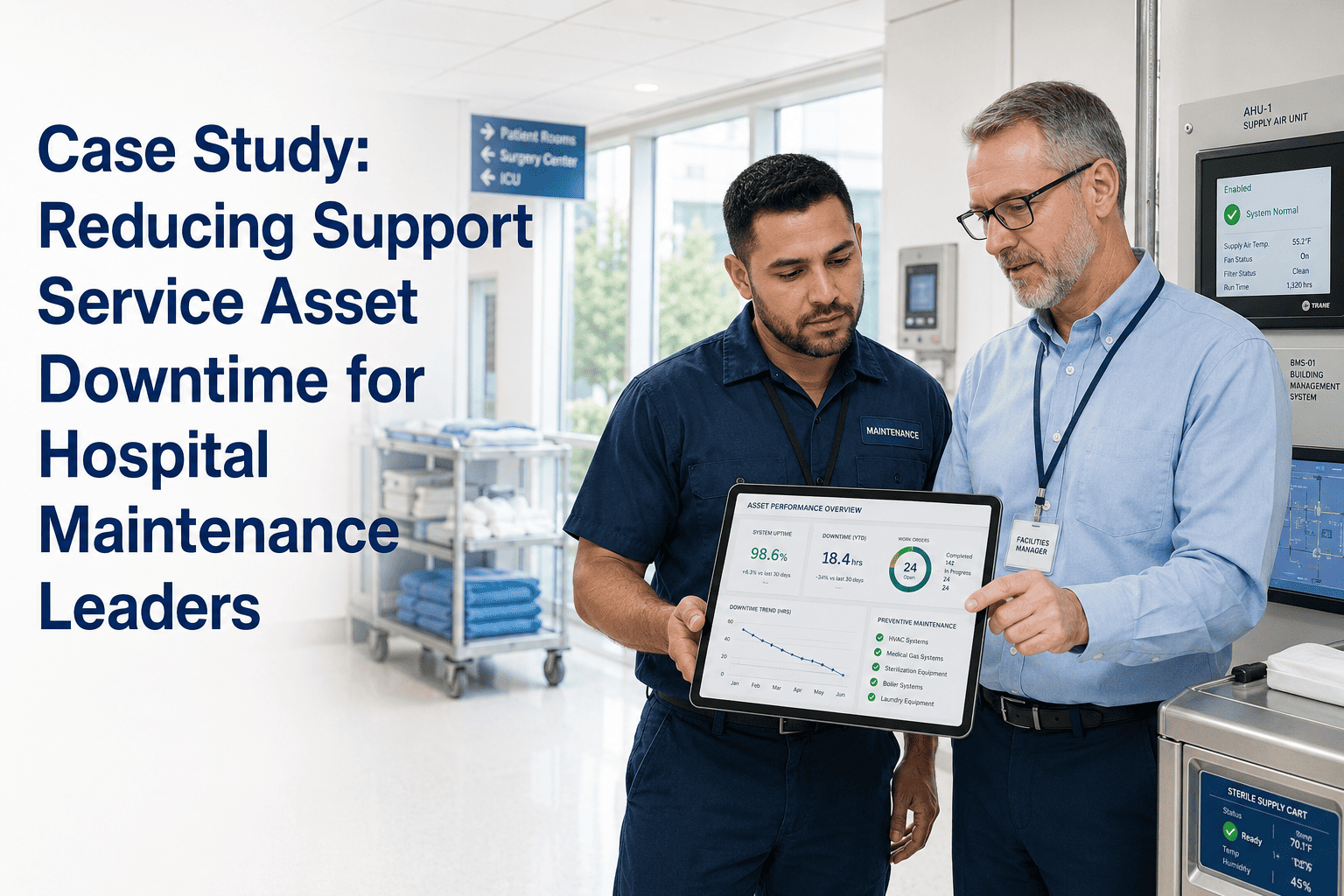
Case Study: Reducing Support Service Asset Downtime for Hospital Maintenance Leaders

By James Smith on June 17, 2026

case-study-reducing-support-service-asset-downtime-for-hospital-maintenance-leaders

When a 420-bed regional medical center in the US Southeast found itself managing 11 open support asset failures simultaneously — with no structured escalation, no service history, and a maintenance backlog that had grown 38% over eight months — the facilities director made a decision that changed how the entire engineering operation ran: they replaced their spreadsheet-and-radio workflow with OxMaint's healthcare CMMS platform. Within 90 days of go-live, unplanned downtime on support service assets had dropped 41%, PM compliance had risen from 67% to 94%, and the engineering team produced their first fully documented Joint Commission Environment of Care evidence package in under two hours. Book a demo with OxMaint to see the platform that made this possible — and understand how hospital maintenance leaders across the US are using structured CMMS workflows to eliminate support asset downtime, build inspection proof, and give leadership the visibility they need to make capital decisions with confidence.

Case Study · Healthcare Facilities · Support Asset Management

How a 420-Bed Regional Hospital Cut Support Asset Downtime by 41% in 90 Days

A hospital maintenance leader's journey from reactive chaos to structured CMMS-driven reliability — with real outcomes, timelines, and lessons learned.

90-Day Outcomes
41%Reduction in unplanned support asset downtime
67→94%PM compliance improvement (first cycle)
2 hrsTime to produce full TJC evidence package
0Critical findings at next JC survey

The Situation Before OxMaint: What Was Breaking Down

The facility managed 340+ support service assets across four buildings — patient transport equipment, pneumatic tube stations, dietary carts, environmental monitoring hardware, waste handling systems, and 60+ access-controlled doors. Maintenance was tracked via a combination of paper logs, individual technician notebooks, and a shared spreadsheet that was updated inconsistently.

The consequences were predictable: inspection cycles were driven by individual memory rather than structured schedules, service history was fragmented across formats that different technicians had invented independently, and when a TJC survey came up, the facilities director spent four days reconstructing maintenance records from paper files — and still couldn't produce complete documentation for 23% of support assets.

The maintenance backlog had grown steadily for eight months. Eleven support asset failures were open simultaneously at the time the facilities director initiated the CMMS evaluation. Three of those failures had been open longer than 45 days with no documented escalation.

Before OxMaint
PM Compliance67%
Open WOs (simultaneous)11
Avg Backlog Age31 days
Audit Record Retrieval4 days
Survey-Ready Assets77%

Is Your Facility in the Same Position This Hospital Was?

If your PM compliance is below 90%, your backlog is growing, or you can't produce inspection records in under 30 minutes — OxMaint was built for exactly this situation.

From Go-Live to Survey-Ready: The 90-Day Transformation


Days 1–5 · Setup & Asset Import
Asset Register Built, PM Schedules Configured
340+ support assets imported from existing spreadsheets into OxMaint. Each asset assigned its PM schedule, compliance category (TJC, NFPA, CMS), and responsible technician. Technician mobile app onboarding completed in a single 30-minute group session. No IT project required — the facility's existing devices were used throughout.


Days 6–30 · First PM Cycle
Backlog Triage, First Digital Inspections Completed
OxMaint prioritized the 11 open WOs by age and asset criticality. Three long-open failures were escalated to external vendors within the first week, each with a documented digital handoff. The first PM cycle under OxMaint ran with 89% on-time completion — already significantly above the pre-CMMS baseline of 67%.


Days 31–60 · Pattern Recognition
Repeat Failures Identified, Preventive Action Taken
OxMaint's asset history reports identified 14 support assets generating disproportionate reactive WOs — the facility's hidden repeat-failure population. Maintenance protocols for these assets were upgraded, two assets were added to the capital replacement queue, and reactive WO volume began declining by week 7. PM compliance reached 92% in the second cycle.


Days 61–90 · Survey Readiness
94% PM Compliance, Full TJC Evidence Package in 2 Hours
By day 90, PM compliance had reached 94% and unplanned downtime had dropped 41% compared to the pre-OxMaint baseline. When the facilities director ran a TJC simulation, the full maintenance evidence package — inspection records, corrective WO history, escalation logs, photographic evidence — was exported in under two hours. At the subsequent actual TJC survey, the facility received zero maintenance-related critical findings for the first time in three survey cycles.

Before vs After: Support Asset Performance Metrics

Metric Before OxMaint After 90 Days Improvement
PM Compliance Rate 67% 94% +27 pts
Unplanned Downtime Baseline -41% 41% reduction
Average Backlog Age 31 days 8 days -74%
Survey Record Retrieval 4 days 2 hours 96% faster
TJC Critical Findings (Maint.) Multiple (prior cycle) 0 Full resolution
Reactive WO Share 44% 21% -52%
"

The hospitals that most consistently achieve clean maintenance findings in TJC surveys are not the ones with the largest engineering staffs — they are the ones where every work order, every inspection, and every escalation creates a record that is retrievable within minutes. The transition from clipboard-and-radio maintenance to a validated CMMS is not a technology upgrade; it is a governance upgrade. When maintenance teams have structured workflows enforced by the system, compliance becomes a byproduct of normal operations rather than a separate effort that consumes weeks before every survey cycle. The 90-day turnaround this case describes is not exceptional — it is exactly what happens when the right structure is applied to a team that already knows how to do the work.

Jonathan Reyes, CHFM, CLSS-HC
Director of Facilities Management · 17 years in acute care hospital maintenance leadership · Certified Life Safety Surveyor · Former TJC Mock Survey Consultant

Support Asset Downtime Reduction — Questions Hospital Maintenance Leaders Ask

Q1
How quickly can a hospital go live with OxMaint if they're starting from spreadsheets?
Most hospital facilities teams are fully operational in OxMaint within 3–7 days of starting setup. If an existing asset register is available in any spreadsheet format, OxMaint's import tool populates the asset database in hours rather than days. PM schedules are configured at the same time, and technician onboarding requires only a single mobile app install and a 30-minute orientation session — no training days, no IT project, no hardware procurement. The initial PM cycle begins generating structured work orders from day one of go-live. Book a demo to walk through the setup process live.
Q2
What does OxMaint's maintenance evidence package look like for a TJC survey?
OxMaint's compliance export produces a structured documentation package that includes the PM completion record for each asset (dates, technician, checklist responses, photos), corrective WO history with escalation logs and resolution timestamps, and a compliance status summary by asset category and regulatory framework. The export is formatted to align with TJC EC chapter requirements and can be filtered by building, department, asset type, or date range. Facilities teams consistently report that this package reduces survey preparation time from days to under two hours — and surveyors receive it as a complete, organized submission rather than a collection of individual records. Start a free trial to generate your first compliance export.
Q3
How does OxMaint identify repeat-failure assets that are driving disproportionate reactive maintenance?
OxMaint's asset history analytics flag assets that generate two or more corrective work orders within a configurable window (default: 90 days) and surface these in the repeat-failure report on the facilities director dashboard. The report shows failure frequency, total maintenance hours consumed, and cost per asset — allowing maintenance leaders to identify the highest-impact problem assets and make data-driven decisions about whether to increase PM frequency, change maintenance protocol, or escalate to capital replacement. This report is updated in real time as new WOs are closed against existing assets.
Q4
Can OxMaint handle support asset maintenance across multiple hospital buildings on the same campus?
Yes. OxMaint supports a full location hierarchy — campus, building, floor, zone — so support assets across multiple buildings are managed in a single platform with location-specific dashboards. Technicians can be assigned primary buildings while retaining cross-campus visibility. The facilities director sees a consolidated campus-wide compliance and downtime view, while building-level managers see their own location's status. Multi-building PM compliance reports, backlog summaries, and survey documentation packages can be generated for the full campus or filtered by individual building. See multi-building configuration in a live OxMaint demo.
Q5
What ROI do hospital facilities teams typically see from implementing OxMaint for support assets?
Hospital facilities teams implementing OxMaint for support asset management typically report three categories of ROI: operational savings from reduced reactive maintenance labor and emergency vendor callouts (average 18–25% reduction in unplanned maintenance spend within six months), compliance cost savings from reduced survey preparation time and elimination of repeat findings (estimated 40–60 hours per survey cycle recovered), and risk cost reduction from better-documented maintenance records that reduce liability exposure in patient safety incidents involving support assets. The 90-day timeline described in this case study represents the fastest improvement trajectory — most facilities reach similar outcomes within 4–5 months.
OxMaint · Hospital Maintenance · Case Study Results

Ready to Write Your Own 90-Day Turnaround Story?

OxMaint gives hospital maintenance leaders the structured workflows, inspection proof, service history, and KPI visibility to reduce support asset downtime, pass surveys clean, and make capital decisions with real data.
Share This Story, Choose Your Platform!