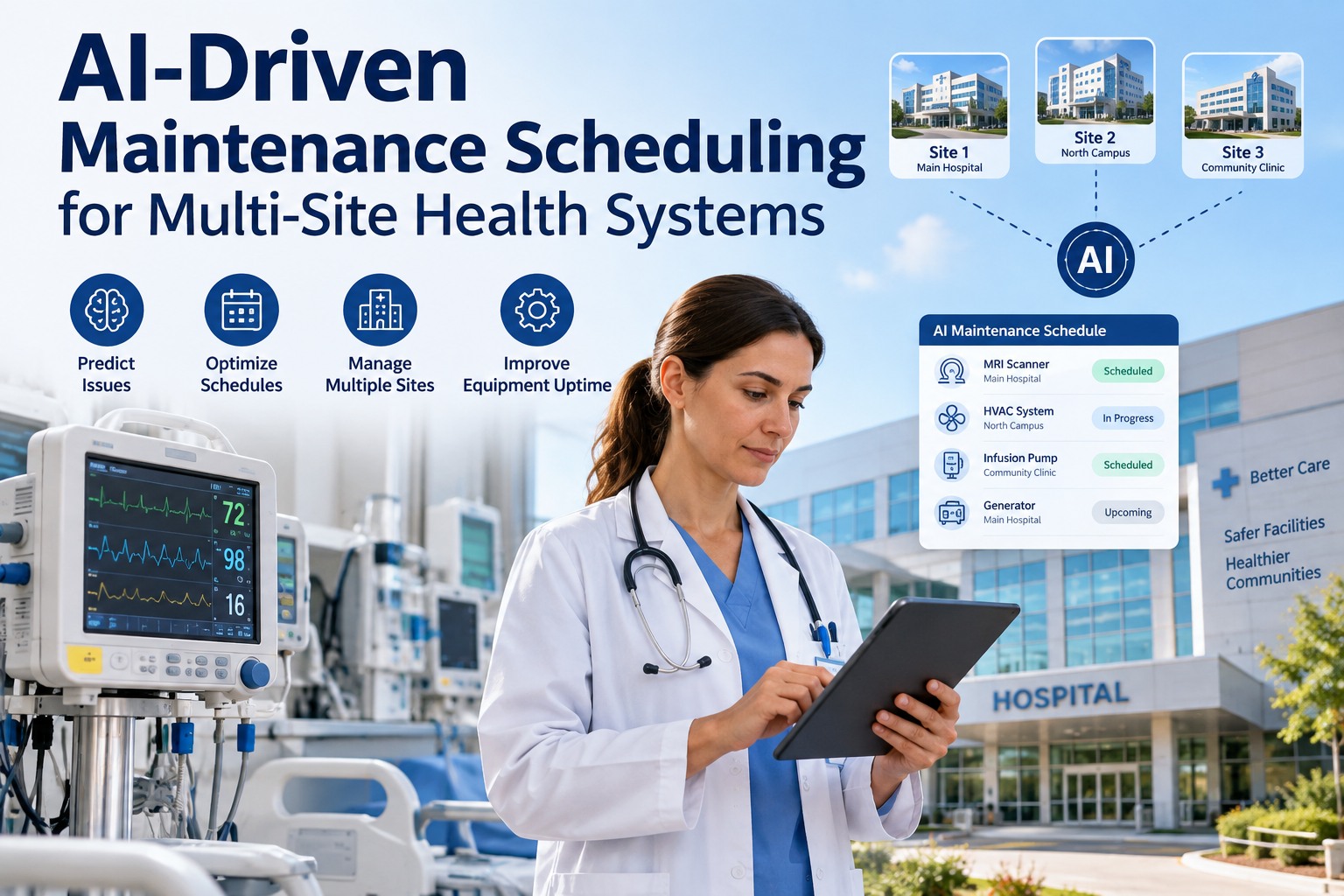
A health system with 14 hospitals and 60+ clinics doesn't have a maintenance problem it has a scheduling problem. Each site runs its own PM calendar, its own biomed roster and its own definition of "critical," so duplicate PMs happen at one campus while another falls weeks behind. Research on AI-driven scheduling across multi-location healthcare shows a 47% downtime drop and 23% first-year cost reduction — because the win isn't better wrenches, it's better scheduling. This guide is a practical field manual for how AI-driven scheduling actually works across a hospital portfolio, using OXMAINT AI, the AI-powered CMMS built for multi-site health systems.
AI-Driven Maintenance Scheduling for Multi-Site Health Systems
Stop scheduling site-by-site. OXMAINT AI, the AI-powered CMMS/maintenance management software, connects the full scheduling workflow across every hospital, clinic and ASC in your system — inspection findings & maintenance requests turn into prioritized defects, defects into scheduled work orders, and every asset gets the right preventive & predictive PM cadence on one portfolio calendar. One brain, one evidence trail, every site.
The Real Scheduling Problem in a Health System
A single hospital already juggles 4,000+ regulated assets — HVAC, medical gas, imaging, biomed, elevators, fire-life-safety. A health system multiplies that across sites that were never designed to share a schedule. The bottleneck isn't a lack of technicians — it's that each site's maintenance requests, inspections and work orders live in their own silo. OXMAINT AI unifies them: every request logged, every inspection finding graded into a defect, every defect converted into a scheduled work order — visible across the whole portfolio. Start free — put every site's maintenance workflow on one platform with OXMAINT AI.
- Duplicate PMs — same OEM cadence run three ways at three sites
- Idle technicians at Site A while Site B is 3 weeks behind on PM
- Repeat failures don't trigger cross-site review — Campus C never learns from Campus B
- Parts inventory bloated at every site because no one trusts the neighbour's stock count
- Compliance evidence lives in 14 different filing cabinets — Joint Commission scramble at every survey
- One PM cadence library — OEM + regulatory rules applied consistently to every asset class
- Technicians balanced across sites by skill, certification and drive-time radius
- Repeat-defect patterns detected fleet-wide — a failure at Site B raises the flag at Sites A/C/D
- Parts pooled across sites with a shared stock ledger — redeploy before reordering
- One evidence trail — every PM, inspection & defect timestamped and instantly retrievable
The 4-Layer AI Scheduling Stack
Portfolio scheduling isn't one algorithm — it's a stack. Each layer feeds the one above it, and none works in isolation. OXMAINT AI runs all four layers on one platform so the handoffs — asset registry → condition signal → risk score → scheduled work order — are automatic. Your team logs maintenance requests and inspections; the software does the routing, prioritizing and PM scheduling. Book a demo to see the full stack live in OXMAINT AI.
Criticality-Weighted PM Cadence — How the AI Decides Who Gets Serviced First
Fixed schedules are a compliance minimum, not a strategy. OXMAINT AI weights every asset on four dimensions and sets the PM cadence & response SLA on each work order to match — an ICU ventilator gets a different maintenance rhythm than a lobby AHU, and the software enforces the difference every day. Your team edits the scoring rubric once; the platform applies it to every site. Sign up free and score your first 100 assets in OXMAINT AI.
| Tier | Score | Asset examples | PM cadence | Response SLA |
|---|---|---|---|---|
| T1 | 85–100 | ICU ventilators, OR anesthesia, medical gas manifold, sole chiller | OEM min + monthly condition check | 4 hours |
| T2 | 60–84 | Imaging (MRI/CT), lab analyzers, AHUs serving patient zones, isolation rooms | OEM min + quarterly review | 24 hours |
| T3 | 35–59 | Non-clinical HVAC, elevators (non-egress), general lighting circuits | OEM standard | 7 days |
| T4 | 0–34 | Furniture, non-critical fixtures, cosmetic items | Annual | 30 days |
A Health System Is Only As Reliable As Its Weakest-Scheduled Site.
When every site schedules alone, the weakest one sets the reliability floor for the whole system. OXMAINT AI lifts every site to the same standard — one criticality library, one scheduling engine, one evidence trail — while giving each campus a view built for how it actually works.
Cross-Site Technician Load Balancing
The second thing OXMAINT AI changes is who does the work. Instead of biomed rosters locked to a single campus, the software sees every certified technician across the system and assigns work orders by skill, certification currency, current load, drive-time and asset criticality — so an idle technician at one site can pick up routine PMs from an overloaded one before either team notices the imbalance. Book a demo to see your own portfolio load-view live in OXMAINT AI.
A Day in the Life of the Scheduling Engine
What actually happens between a sensor reading and a technician tapping "Complete" on a work order? Here's the sequence, timestamped, inside OXMAINT AI. Every step is a handoff most legacy CMMS platforms break — the software runs them all on one event stream, so a maintenance request or sensor signal never gets stuck between systems. Sign up free and trigger your first AI-scheduled work order in OXMAINT AI.
The Portfolio Health Scorecard
OXMAINT AI rolls the whole system into a single report — the number a Chief Operating Officer and VP of Facilities actually want on a Monday morning. Because every maintenance request, inspection, defect and work order lives in the same platform, every KPI on this scorecard is drawn from the software's live records, not a monthly spreadsheet chase across sites. Book a demo to see your own scorecard live in OXMAINT AI.
| Site | PM Compliance | Predictive Alerts Closed | Backlog Ratio | Repeat-Defect % | Composite |
|---|---|---|---|---|---|
| Campus A | 88% | 92% | 11% | 3.4% | B+ |
| Campus B | 76% | 81% | 18% | 7.1% | C |
| Campus C | 96% | 94% | 6% | 2.1% | A |
| Campus D | 94% | 89% | 7% | 2.8% | A- |
| Campus E | 85% | 78% | 12% | 4.6% | B |
| Campus F | 93% | 90% | 8% | 3.0% | A- |
Compliance-Ready by Design
Every task inside OXMAINT AI carries a full evidence chain — who scheduled it, why, who did the work, what they found, what they replaced, when it was signed off. Because the software captures each step at the moment it happens, a Joint Commission or CMS survey becomes a query against live records, not a scramble across filing cabinets and shared drives. Sign up free — put every task on an audit-ready record in OXMAINT AI.
The 90-Day Rollout Plan for a Health System
You don't need a two-year transformation program to run AI-driven scheduling. A pragmatic 90-day rollout moves a health system onto OXMAINT AI in stages — asset registry first, two pilot campuses next, then the rest of the portfolio. The software is production-ready from day one; each stage adds sites, not features. Book a demo to map this rollout to your health system.
What OXMAINT AI Gives a Multi-Site Health System
OXMAINT AI is the AI-powered CMMS/maintenance management software built for the health-system reality — many campuses, many asset classes, many regulators, one platform. Below are the software capabilities that make portfolio scheduling actually run. Sign up free and see the portfolio view on your fleet today.
We ran seven hospitals and eleven ambulatory sites on eleven different maintenance calendars. Nobody could tell me why the same infusion pump model was failing three times a year at one campus and zero at another — because nobody was looking across sites. The first thing the portfolio scheduler did was link identical assets across our whole network. Within a quarter, the flag came up: a batch we thought was current-generation was actually a firmware revision behind at three sites, and that firmware level was tied to the failure signature. We wouldn't have found it in another decade of site-by-site reviews.
Frequently Asked Questions
Schedule Once. Run Every Site Like Your Best One.
Move your whole hospital portfolio to one AI-driven scheduling brain with OXMAINT AI — criticality-weighted PM, cross-site technician load balancing, predictive condition alerts routed to the right biomed at the right campus, and a single evidence chain for every survey.


-(1).jpg)
