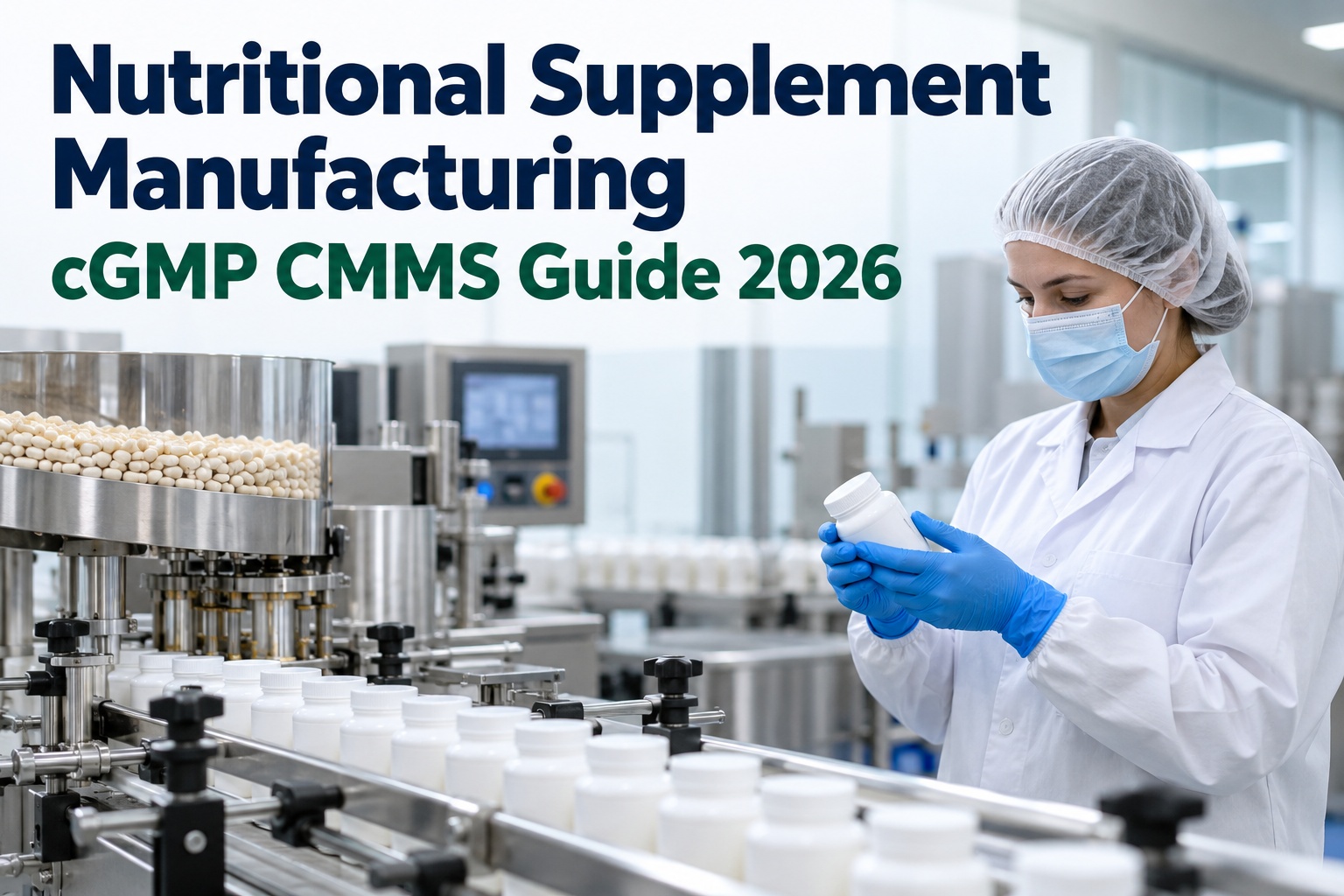
Dietary supplement manufacturing runs under 21 CFR Part 111 — the FDA's current Good Manufacturing Practice rule that turns "we made a supplement" into "we can prove this lot was made under control, met specification, and is backed by defensible records." For a maintenance team, that changes the job entirely. Equipment isn't just kept running; it must be calibrated against a reference standard, taken apart and sanitized to prevent cross-contamination, and documented at every step — because an FDA investigator's Form 483 doesn't ask whether the tablet press works, it asks to see the record proving it was maintained, cleaned, and calibrated. This guide covers maintenance under cGMP for supplement plants: the Part 111 pillars, tablet-press and encapsulation upkeep, calibration discipline, and the CMMS that keeps it all continuously defensible. Start free or book a demo.
Nutritional Supplements · cGMP · 21 CFR Part 111 · CMMS Guide · 2026
Maintenance Under cGMP: Where the Work Isn't Done Until the Record Is
Under 21 CFR Part 111, a maintenance task that happened but wasn't documented didn't happen — as far as an FDA investigator is concerned. This is the maintenance program that treats calibration, sanitation, and equipment upkeep as the compliance controls they legally are, and keeps every record audit-ready by default.
The rule that governs it all
21 CFR
Part 111
FDA cGMP for dietary supplements — equipment, calibration, sanitation, and the records that prove control.
Why Supplement Maintenance Is a Compliance Discipline
Part 111 is not a paperwork regulation bolted onto production — it's the operating model. It requires that equipment be suitable and maintained clean and sanitary, that instruments and controls be calibrated at routine intervals against a reference standard, that anything that can't be adjusted to agree with that standard be repaired or replaced, and that automatic, mechanical, and electronic equipment be routinely inspected and validated. Every one of those is a maintenance activity — and every one produces a record an investigator can demand. The maintenance program and the compliance program are the same program. Sign up free — no credit card and every calibration, PM, and sanitation task lives on the asset with its record attached.
The Four Maintenance Pillars of Part 111
§
Equipment Suitability & Upkeep
Equipment appropriate for its use, maintained in clean and sanitary condition — taken apart as necessary for thorough maintenance, cleaning, and sanitizing.
◎
Calibration Against a Reference
Instruments and controls calibrated at routine intervals against a known reference standard — and repaired or replaced when they can't be brought into agreement.
⬡
Sanitation & Contamination Control
Contact surfaces cleaned and sanitized, low-moisture surfaces kept dry, and written cleaning procedures followed to prevent contamination and cross-contamination.
▤
Validation & Records
Automatic, mechanical, and electronic equipment routinely inspected and validated — with dated, signed records that stand as evidence of control.
The Equipment That Carries the Most Risk
On a supplement line, a handful of machines concentrate both the mechanical wear and the contamination risk — and they're where cGMP maintenance discipline earns its keep. Here's what each demands. Schedule a 30-minute demo to see these built as asset-specific PM and cleaning templates.
Tablet Press
Punch/die tooling
The highest-stakes asset. Punch and die faces are the most critical contact surfaces — inspect after each batch and retire any tooling with pitting, cracking, or dimensional variance beyond ±0.01 mm. High-abrasion formulations wear tooling far faster, so retirement should be cycle-counted per tooling ID, not calendar-based.
Encapsulation Machine
Fill weight & changeover
Dosing accuracy and shell integrity depend on tight tolerances and clean tooling. Cleaning validation at changeover is essential — residue on contact parts is a direct cross-contamination pathway between products and batches.
Blender / Mixer
Blend uniformity
Worn seals and residue in the chamber threaten both blend uniformity and cross-contamination. Take-apart cleaning and seal inspection keep potency consistent and carryover controlled.
Coating Pan
Spray & surface integrity
Inspect for wear and cracks, verify alignment, and service the spray system. Cleaning between products prevents residue transfer onto the finished dosage surface.
Weighing & Instruments
Calibration critical
Balances, force sensors, and temperature controls must be calibrated against reference standards on routine intervals — the direct evidence Part 111 calibration requirements demand.
Dust Collection
Cross-contam. control
Baghouse and dust-extraction upkeep prevents airborne carryover between products and keeps the potent-compound handling environment within spec.
The Punch Was Worn Past Spec. Nobody Could Prove When It Was Last Checked.
That's the Part 111 nightmare: not just a defect, but no defensible record around it. Compression data sat in the press controller, vibration data in one system, cleaning logs on paper — three silos, no correlation, and a Form 483 waiting to happen. OxMaint puts tooling lifecycle, calibration, cleaning, and changeover records on one asset: punch retirement triggers on cycle count, calibration due-dates alert before they lapse, and every task closes with a dated, signed, 21 CFR Part 11-style record ready for the investigator.
Calibration Discipline: The Most-Cited Weak Point
Calibration is where cGMP maintenance programs most often fail an audit — not because instruments aren't calibrated, but because the schedule slips, the reference traceability is unclear, or the record is missing. Part 111 is explicit: calibrate at routine intervals against a reference standard, and repair or replace what won't hold. Here's the discipline that keeps it defensible. Create your free account and let calibration schedule and alert itself.
1
Define Interval & Reference
Set a routine interval per instrument and tie each calibration to a traceable reference standard — so accuracy and precision are provable, not assumed.
2
Schedule & Alert Automatically
Due-dates trigger before they lapse, so no balance, force sensor, or temperature control drifts past its interval unnoticed between production runs.
3
Act on Out-of-Tolerance
When an instrument can't be adjusted to agree with the reference, the rule requires repair or replacement — capture that action and its impact assessment against the asset.
4
Retain the Signed Record
Every calibration dated, attributed, and stored on the instrument's history — the exact evidence an investigator asks for, retrievable in seconds.
Where the CMMS Keeps cGMP Continuously Defensible
The gap between a passing audit and a Form 483 usually isn't the maintenance itself — it's whether the record exists, is complete, and can be produced on demand. A CMMS built for regulated manufacturing makes the record a by-product of the work, so compliance is a state you're always in, not a project you rebuild before each inspection. Schedule a live walkthrough to see the full chain on your equipment.
Tooling Lifecycle Tracking
Every punch and die tracked by ID with a cycle counter that triggers retirement before wear causes defects or cross-contamination — no calendar guesswork.
Calibration Scheduling & Records
Routine-interval calibration against reference standards, auto-alerted before lapse, with dated signed records on each instrument's history.
Cleaning & Changeover Logs
Take-apart cleaning and product-changeover verification logged at the equipment — the documented sanitation trail Part 111 requires between products.
Condition Monitoring on Critical Assets
Vibration and force trends flag bearing or tooling degradation weeks ahead, so replacement lands on a planned changeover — not mid-batch with contamination risk.
Formulation-Linked Intervals
PM and tooling-retirement thresholds tied to formulation abrasiveness and runtime, since high-abrasion products wear equipment several times faster.
Part 11-Style Audit Trail
Timestamped, attributed, tamper-evident records generated as technicians complete tasks — an audit package produced in minutes, not a pre-inspection scramble.
Map every instrument and machine to its Part 111 obligations, let calibration and tooling retirement schedule themselves, log cleaning at the equipment, and the same discipline that protects product quality produces the record that survives an FDA inspection. Sign up free or schedule a demo to see it on your plant.
"
Our maintenance was competent — our documentation was a liability. Calibration certs lived in a binder, tooling wear was tracked in a technician's head, and cleaning logs were paper we hoped were complete. Our last FDA inspection, an investigator asked for the calibration history on a balance and the retirement record for a punch set, and the ten minutes it took to find them felt like an hour. We moved everything into OxMaint: calibration alerts before it lapses, punches retire on cycle count, cleaning is verified at the line. This year's inspection, I answered every equipment question from my phone while we walked the floor. Zero findings on maintenance.
Quality & Engineering Manager · Dietary Supplement Contract Manufacturer
Frequently Asked Questions
What does 21 CFR Part 111 require for equipment maintenance?
Equipment must be suitable, maintained clean and sanitary, and taken apart as needed for thorough cleaning; instruments calibrated at routine intervals against a reference standard; anything that can't be adjusted repaired or replaced; and automatic, mechanical, and electronic equipment routinely inspected and validated — all documented.
Why is calibration the most-cited maintenance weak point?
Usually not because instruments aren't calibrated, but because the interval slips, reference traceability is unclear, or the record is missing. Part 111 requires routine-interval calibration against a reference standard, with defensible records.
How should tablet-press tooling be managed under cGMP?
Inspect punches and dies after each batch, retire any showing pitting, cracking, or variance beyond ±0.01 mm, and track retirement by cycle count per tooling ID — since high-abrasion formulations wear tooling several times faster than calendar intervals assume.
How does maintenance prevent cross-contamination?
Through take-apart cleaning of contact surfaces, cleaning validation at product changeover, seal inspection on blenders, and dust-collection upkeep — all logged, since residue on tooling and in chambers is a direct carryover pathway between products.
What is a Form 483 and how does maintenance trigger one?
It's the observation an FDA investigator issues during inspection. Missing or incomplete maintenance, calibration, or cleaning records are common triggers — and unresolved observations can escalate to warning letters or product action.
How does a CMMS keep cGMP defensible?
It schedules calibration and tooling retirement, logs cleaning at the equipment, and generates timestamped, attributed records as work is completed — so an audit package is a retrieval, not a scramble.
Sign up free to map your equipment.
Make Every Calibration, Cleaning, and PM Its Own Defensible Record.
OxMaint gives supplement manufacturers tooling-lifecycle tracking, auto-scheduled calibration against reference standards, cleaning and changeover logs at the equipment, condition monitoring on critical assets, and a Part 11-style audit trail — so 21 CFR Part 111 compliance is a state you stay in, not a scramble before every FDA inspection. Start free — no credit card, unlimited users, forever. Or book a demo.