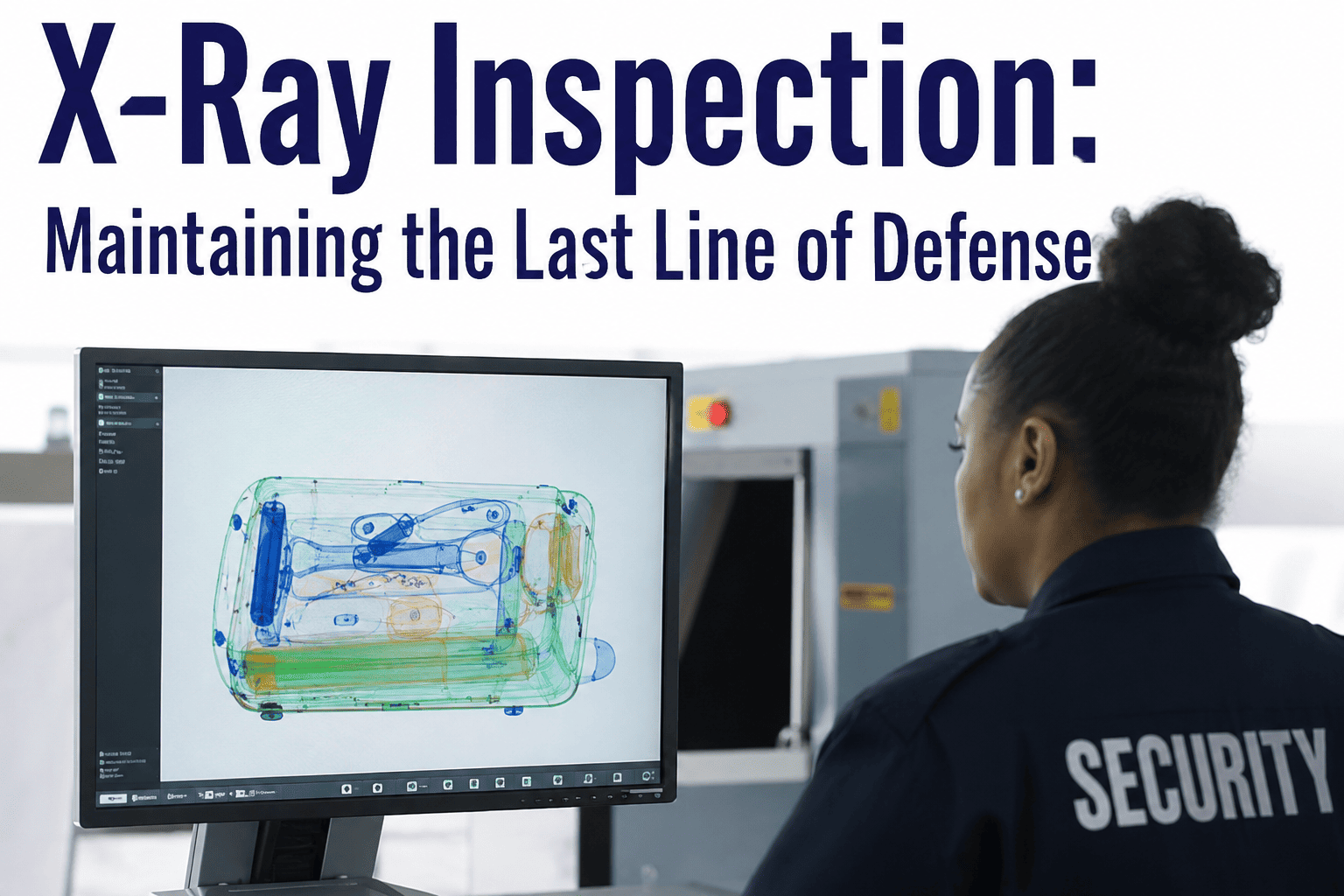
X-ray inspection systems are the last line of defense against foreign material contamination in food manufacturing, catching metal, glass, bone, and dense plastics before products reach consumers. When a food plant xray system fails to detect a contaminant, the result is often a costly Class I recall averaging $10M in direct costs. This xray guide for 2026 walks through sensitivity verification, test piece protocols, reject mechanism checks, and the CMMS documentation required to keep your inspection systems CCP-defensible under FSMA and BRC audits. If your team is still tracking preventive maintenance on paper spreadsheets, Start Free Trial of OxMaint to see how a purpose-built CMMS for food xray inspection eliminates compliance gaps.
Is your last line of defense audit-ready — or a recall waiting to happen?
Every uncaught contaminant is a potential recall event. Most X-ray failures aren't equipment faults — they're PM gaps, missed sensitivity checks, and undocumented calibration drift. OxMaint closes the loop between inspection, maintenance, and compliance.
The true cost of a missed foreign object detection event
FSMA Hazard Analysis and Preventive Controls rules treat foreign material detection as a Critical Control Point (CCP) — meaning every X-ray and metal detector system must have verified, documented, and maintained sensitivity at all times.
A 180-asset food plant running 4 X-ray lines without a CMMS spent $42K annually on manual log reconciliation and still failed a BRC audit — three sensitivity test records were missing for Line 3 over a six-week span. The fix wasn't more inspectors; it was preventive maintenance software that auto-generates and timestamps every check.
X-ray inspection system maintenance checklist for food plants
A defensible xray system maintenance guide breaks PM into three cadences: shift-level verification, weekly calibration, and quarterly deep maintenance. Each task below should be a triggered work order in your CMMS — not a clipboard checklist.
Sensitivity & Test Piece Verification
- Run certified stainless steel, glass, and bone test pieces through each detection zone
- Verify reject mechanism fires and diverts contaminant to locked reject bin
- Confirm reject confirmation sensor registers the diversion
- Document pass/fail with operator ID, timestamp, and product SKU in CMMS
- Escalate any failed test to QA and maintenance instantly via automated alert
Calibration & Conveyor Verification
- Verify X-ray generator voltage and current against manufacturer baseline
- Inspect conveyor belt for wear, tracking deviation, and product buildup
- Run multi-contaminant test kit at three belt speeds to check timing alignment
- Validate image processing algorithms haven't drifted from baseline sensitivity
- Update firmware if patch available; log version in asset history
Deep Maintenance & Compliance Audit
- Full detector array inspection and dark-current calibration
- X-ray tube health diagnostic — output, leakage, cooling system function
- Reject valve solenoid wear test and air pressure rebuild if under spec
- Complete PM record export for FSMA, BRC, and SQF audit readiness
- Review 90 days of sensitivity trend data for drift patterns
CMMS food reject mechanism: why diversion failures cause recalls
An X-ray system that detects a contaminant but fails to reject it is worse than no detection at all — it creates a false sense of security. Reject mechanism verification must be a CMMS-tracked PM event, not an afterthought.
Paper Logbooks & Memory
- Reject checks done "when someone remembers" — gaps of 8+ hours common
- Solenoid wear goes undetected until a contaminant passes into finished goods
- No timestamped proof for FSMA or BRC auditor — CCP documentation rejected
- Maintenance reacts to breakdowns, costing 3–5x more than scheduled PM
Automated PM & Audit Trail
- Shift-level reject test auto-generated as a work order — no task forgotten
- Predictive alerts flag solenoid cycle-count wear before failure occurs
- Every check timestamped, geo-stamped, and attached to the asset record instantly
- Auditor-ready compliance report generated in 30 seconds, not 3 days
Your next audit is closer than you think — is your X-ray PM documentation ready?
See how OxMaint automates sensitivity test tracking, reject verification, and compliance reporting for food plants running X-ray and metal detector CCPs.
How to build a CCP-defensible PM schedule for X-ray systems
A CCP-defensible maintenance schedule links every inspection task to a specific asset, a specific frequency, a specific technician, and a specific compliance standard. Here's the formula that determines your optimal inspection interval based on risk and drift rate.
| PM Task | Frequency | Compliance Standard | CMMS Trigger |
|---|---|---|---|
| Test piece sensitivity verification | Every 2 hours / shift change | FSMA Preventive Controls, BRC 5.6 | Time-based auto work order |
| Reject mechanism functional test | Every shift + after product changeover | SQF 11.2, BRC 5.6.2 | Event + time-based trigger |
| X-ray generator voltage calibration | Weekly | Manufacturer spec, ISO 22000 | Meter-based work order |
| Detector array dark-current test | Monthly | Manufacturer baseline, IFS 5.9 | Time-based auto work order |
| Conveyor belt inspection & replacement | Quarterly or at wear threshold | OEM spec, FSMA Preventive Controls | Condition-based predictive trigger |
| Full system audit & compliance export | Quarterly + pre-audit | FSMA, BRC, SQF, IFS | Manual + scheduled trigger |
CMMS food xray system: what changes when maintenance is automated
OxMaint maps four concrete capabilities to the exact problems food plants face with X-ray inspection maintenance — turning a compliance liability into a defensible, audit-ready process.
Automated Sensitivity Test Work Orders
Every 2-hour shift-level sensitivity check auto-generates as a mobile work order with test piece specs, pass/fail fields, and photo capture. Zero missed checks, zero paper logs.
Predictive Drift Analytics
OxMaint's AI tracks X-ray tube output, detector performance, and reject solenoid cycle counts — predicting failures 2–4 weeks before they happen and auto-creating corrective work orders.
One-Click Compliance Export
Generate a complete FSMA, BRC, or SQF audit packet for any X-ray asset in 30 seconds — every PM, sensitivity test, calibration, and repair record timestamped and technician-attributed.
Spare Parts & Inventory Tracking
Track X-ray tubes, detector modules, reject solenoids, and conveyor belts by serial number with min-max levels and auto-reorder — so critical spares are always in stock when predictive alerts fire.
Common questions about food plant xray inspection maintenance
How often should X-ray inspection sensitivity be verified in a food plant?
FSMA and BRC standards require sensitivity verification at minimum every 2 hours of operation, at every product changeover, and at the start and end of each shift. A CMMS like OxMaint auto-generates these as timed work orders so no check is ever missed or undocumented — turning a manual burden into an automated compliance guarantee.
What is a CCP-defensible X-ray maintenance record?
A CCP-defensible record includes the asset ID, task performed, test piece specifications used, pass/fail result, operator name, timestamp, and any corrective action taken. Paper logs rarely capture all of this consistently. OxMaint structures every work order to capture these fields automatically, so your documentation withstands FSMA, BRC, and SQF scrutiny without manual reconstruction.
Why do X-ray reject mechanisms fail and how can CMMS prevent it?
Reject mechanisms fail most often from solenoid wear, air pressure loss, or mechanical binding — all of which develop gradually. Without CMMS-tracked cycle counting and condition monitoring, the failure is invisible until a contaminant passes into finished product. OxMaint's predictive analytics track reject actuation counts and flag wear before failure, cutting reject-related recall risk dramatically. Book a Demo to see the predictive dashboard on your assets.
Can a CMMS integrate with existing X-ray inspection equipment?
Yes — OxMaint can ingest equipment data through API integrations, manual entry, or mobile work orders completed at the machine. Even without a direct integration, the CMMS enforces the PM schedule, captures results digitally, and provides the audit trail that paper systems cannot. Most food plants see full value within 2–4 weeks of implementation.
How much does a CMMS for food X-ray inspection cost compared to a recall?
A single foreign material recall averages $10M in direct costs — plus brand damage and lost shelf space. OxMaint's CMMS costs a fraction of one percent of that figure while directly preventing the PM gaps that cause detection failures. The ROI is measured not in months but in the cost of the recall it prevents. Start Free Trial to calculate your plant's specific risk exposure.
Stop betting your recall defense on paper logs and memory
Join food plants that cut X-ray downtime 30–50%, eliminated missing PM records, and turned audit prep from a 3-day scramble into a 30-second export. See OxMaint on your assets — book a 30-min demo today.
Free 14-day trial · No credit card