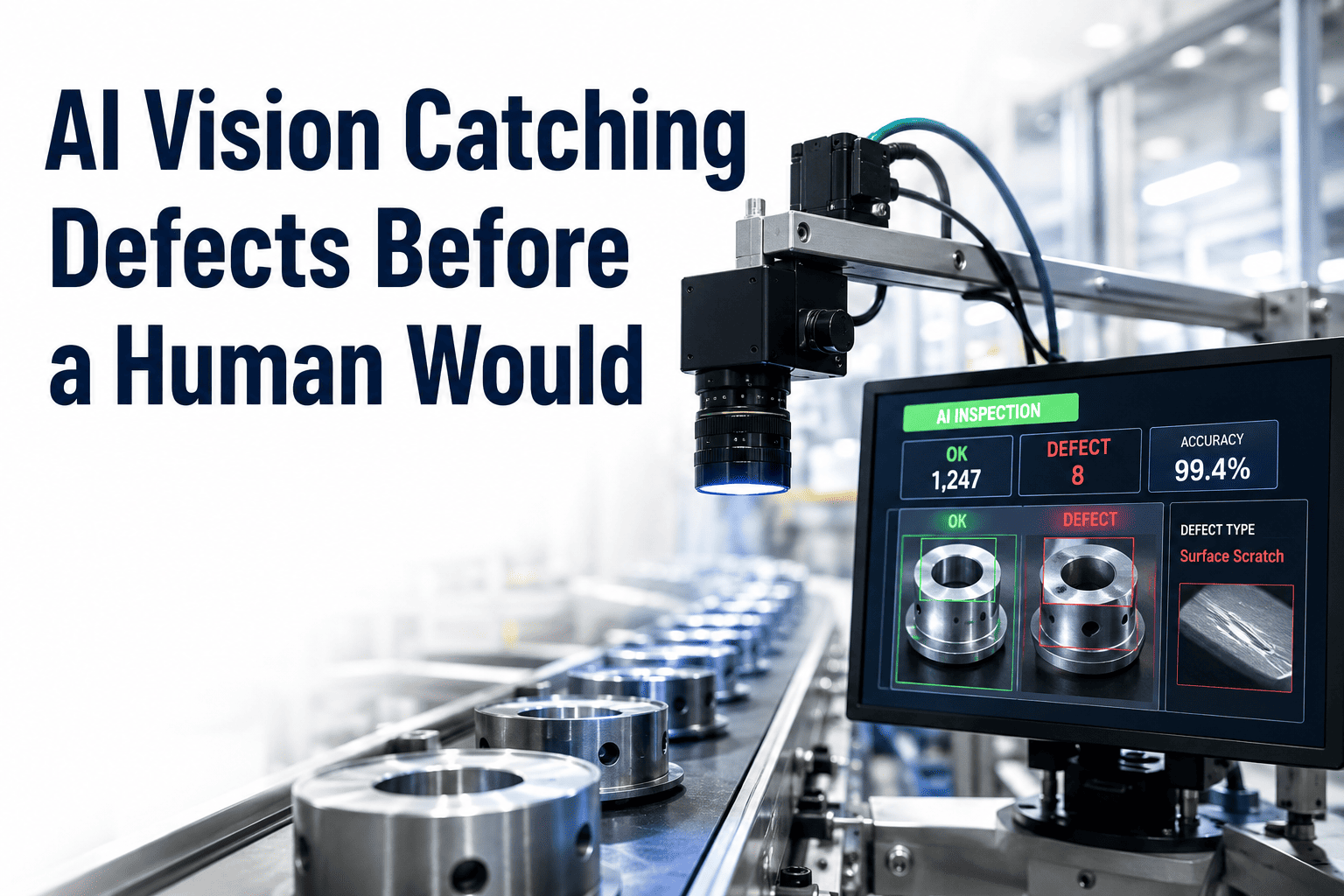
AI vision defect detection in food plants is now catching defects before a human inspector would — and when that camera-detected alert triggers a work order inside your CMMS, quality response drops from hours to seconds. This guide to AI vision for food production covers vision system selection, model training, lighting and camera setup, reject-gate integration, and the CMMS-linked workflow that turns automated visual inspection into scaled defect detection. If your team is still paper-tracking rejects on a line running 300 units per minute, explore how OxMaint closes the loop with a Start Free Trial today.
Can your inspectors catch a hairline crack at 300 units per minute?
AI vision defect detection consistently identifies contamination, mislabeling, and packaging flaws before human inspectors would — and the CMMS-linked approach turns every camera alert into an instant, traceable corrective action across your food plant.
Why food plants are replacing manual visual inspection
Manual visual inspection on high-speed food lines catches roughly 70–80% of defects. Fatigue, lighting glare, and line speed account for the rest — and every missed defect is a recall risk or customer complaint waiting to happen.
FDA data places the average direct cost of a food recall at $10M, excluding brand damage and lost shelf placement.
Human detection accuracy drops by up to 30% after 60 minutes of continuous visual inspection on a fast-moving line.
With a linked CMMS, a camera-detected defect alert can auto-generate a corrective work order in under two seconds.
A mid-size bakery losing $84K/yr to misaligned labels
A 180-asset bakery running two shifts was rejecting 1.4% of output for misaligned labels caught downstream — but only after 400+ defective units had already been packed per shift. By deploying a four-camera AI vision station at the labeler exit and linking alerts to OxMaint, maintenance was notified of labeler drift within seconds. Technicians corrected the feed roller alignment before the next case was packed, cutting packed-defect waste by 92% and recovering an estimated $84,000 annually in scrapped product and rework labor.
How to deploy AI vision defect detection in a food plant: 5 steps
From camera selection to CMMS integration, here is the proven five-step path food and beverage plants use to stand up automated visual inspection that actually scales.
Map defect modes and select camera hardware
Catalog your top defect modes — foreign matter, fill-level, seal integrity, label skew, cap presence. For each, specify resolution and speed: a 5MP global-shutter camera at 60fps covers most packaging lines up to 400 units/min. Budget $4K–$12K per vision station including lens, lighting, and ruggedized enclosure.
Engineer lighting for contrast and repeatability
Lighting is 50% of vision accuracy. Use polarized dome lights for glossy wrappers, structured backlight for fill-level, and UV for foreign-matter detection on certain substrates. Diffusers and shrouds eliminate ambient glare that would otherwise false-trigger your model.
Train and validate the defect-detection model
Collect 2,000–5,000 labeled images per defect class, balanced across good and reject samples. Retrain on edge cases weekly for the first 90 days. Target 95%+ precision before go-live; a false-reject rate above 2% will erode line efficiency and operator trust.
Integrate the reject gate and QMS workflow
Wire the vision controller to the reject diverter via PLC and define the QMS escalation path. Every reject should log a timestamped image, defect class, and line speed into your quality management system for audit traceability and trend analysis.
Link AI vision alerts to your CMMS
This is the step most plants miss. When the vision system detects a recurring defect pattern — say, three seal failures in 60 seconds — it should auto-trigger a corrective work order in your CMMS. That is what turns AI vision from a reject counter into a predictive maintenance signal that prevents the next defect batch.
Manual inspection vs. AI vision with CMMS-linked alerts
The gap between human-only inspection and a CMMS-integrated AI vision system is not incremental — it is structural.
| Capability | Manual Visual Inspection | AI Vision + CMMS (OxMaint) |
|---|---|---|
| Detection rate at 300+ units/min | 70–80% | 95–99.2% |
| Time from defect to corrective action | 5–45 minutes (shift-dependent) | <2 seconds (auto work order) |
| Fatigue-driven miss rate | Up to 30% after 60 min | 0% (no fatigue) |
| Audit traceability | Paper log, manual entry errors | Timestamped image + work order history |
| Predictive maintenance trigger | None — reactive only | Defect-pattern triggers PM work order |
| Cost of missed defect (per incident) | $2K–$10M+ (recall risk) | Contained at the line |
What is the payback period for AI vision defect detection?
A typical mid-size food plant investing in a four-station AI vision system linked to a CMMS sees payback in 8–14 months. Here is the math.
| ROI Driver | Annual Value | How It Is Realized |
|---|---|---|
| Scrap / rework reduction | $80K–$140K | Defects caught at source, not after packing |
| Recall-risk avoidance | $20K–$500K | Contamination and mislabel events contained |
| Inspector labor reallocation | $25K–$45K | Inspectors move to root-cause and PM tasks |
| Unplanned downtime reduction | $15K–$60K | Vision pattern triggers CMMS PM before failure |
See OxMaint close the loop from camera alert to work order
Book a 30-minute demo and we will show you exactly how a camera-detected defect triggers a corrective work order, notifies the right technician, and logs the repair — automatically.
How OxMaint turns AI vision alerts into scaled defect detection
OxMaint is the AI-powered CMMS that sits between your vision system and your maintenance team — translating every camera-detected defect into an instant, traceable, and predictive corrective action.
Auto-generated work orders from vision alerts
When the AI vision system flags a defect pattern, OxMaint instantly creates a corrective work order, assigns it to the right technician by skill and proximity, and pushes it to the mobile app. Outcome: cut defect-to-repair time from 25 minutes to under 2 minutes.
Predictive maintenance from defect trends
OxMaint analyzes vision defect frequency by asset and triggers predictive PM work orders before equipment drift becomes a failure. A labeler showing rising skew defects over 48 hours auto-schedules a roller alignment. Outcome: cut unplanned downtime 30–50%.
Full audit traceability for FSMA and SQF
Every defect image, work order, repair action, and spare part is timestamped and linked to the asset record. When the auditor asks for proof of corrective action on a seal failure, you pull the full chain in one click. Outcome: audit prep time cut by 80%.
Spare-parts inventory pre-staged for vision-linked repairs
When a recurring defect pattern signals an impending part failure, OxMaint checks stock levels and auto-reserves the spare — or flags a reorder if min-stock is breached. Outcome: eliminate 95% of parts-related repair delays on vision-flagged assets.
"We linked our label-vision system to OxMaint and the first week it caught a feed-roller drift that would have cost us a full shift of packed rejects. The work order hit my phone before the operator even knew something was wrong."
AI vision defect detection in food plants: your questions answered
How does AI vision defect detection work in a food plant?
AI vision uses high-speed cameras and trained deep-learning models to inspect every unit on a food line in real time. The model compares each image against labeled defect classes — foreign matter, seal failure, fill-level, label skew — and flags rejects to a diverter. When linked to a CMMS, recurring defect patterns also trigger corrective work orders automatically.
Can AI vision inspection integrate with my existing CMMS?
Yes. Most modern vision controllers expose alerts via REST API or MQTT. OxMaint ingests these signals and converts them into work orders, PM triggers, and asset-history entries. A typical integration takes 2–5 days depending on your vision platform. You can see the exact workflow by booking a demo.
How accurate is AI vision compared to human inspectors?
A well-trained AI vision system achieves 95–99.2% detection rate on known defect classes, versus 70–80% for manual inspection on high-speed lines. AI does not fatigue, can inspect 100% of units instead of a sample, and maintains consistent accuracy across shifts — but it requires ongoing model retraining on new defect modes.
What does an AI vision system cost for a food production line?
A single vision station — camera, lens, lighting, enclosure, and software license — runs $4,000–$12,000. A four-station line with a CMMS integration typically totals $40,000–$70,000. Most mid-size food plants see payback in 8–14 months through scrap reduction, recall-risk avoidance, and inspector labor reallocation.
Is AI vision inspection required for FSMA or SQF compliance?
AI vision is not explicitly mandated by FSMA or SQF, but both require documented, risk-based preventive controls and corrective-action traceability. AI vision with a CMMS link provides the strongest possible evidence: a timestamped image of every defect, the auto-generated work order, the technician who responded, and the resolution — all in one auditable chain. Start your Start Free Trial to see the audit trail in action.
Stop catching defects after they ship. Start preventing them at the source.
OxMaint connects your AI vision system to work orders, predictive maintenance, and full audit traceability — so every camera-detected defect becomes an instant corrective action, not a spreadsheet entry.
Free 14-day trial · No credit card