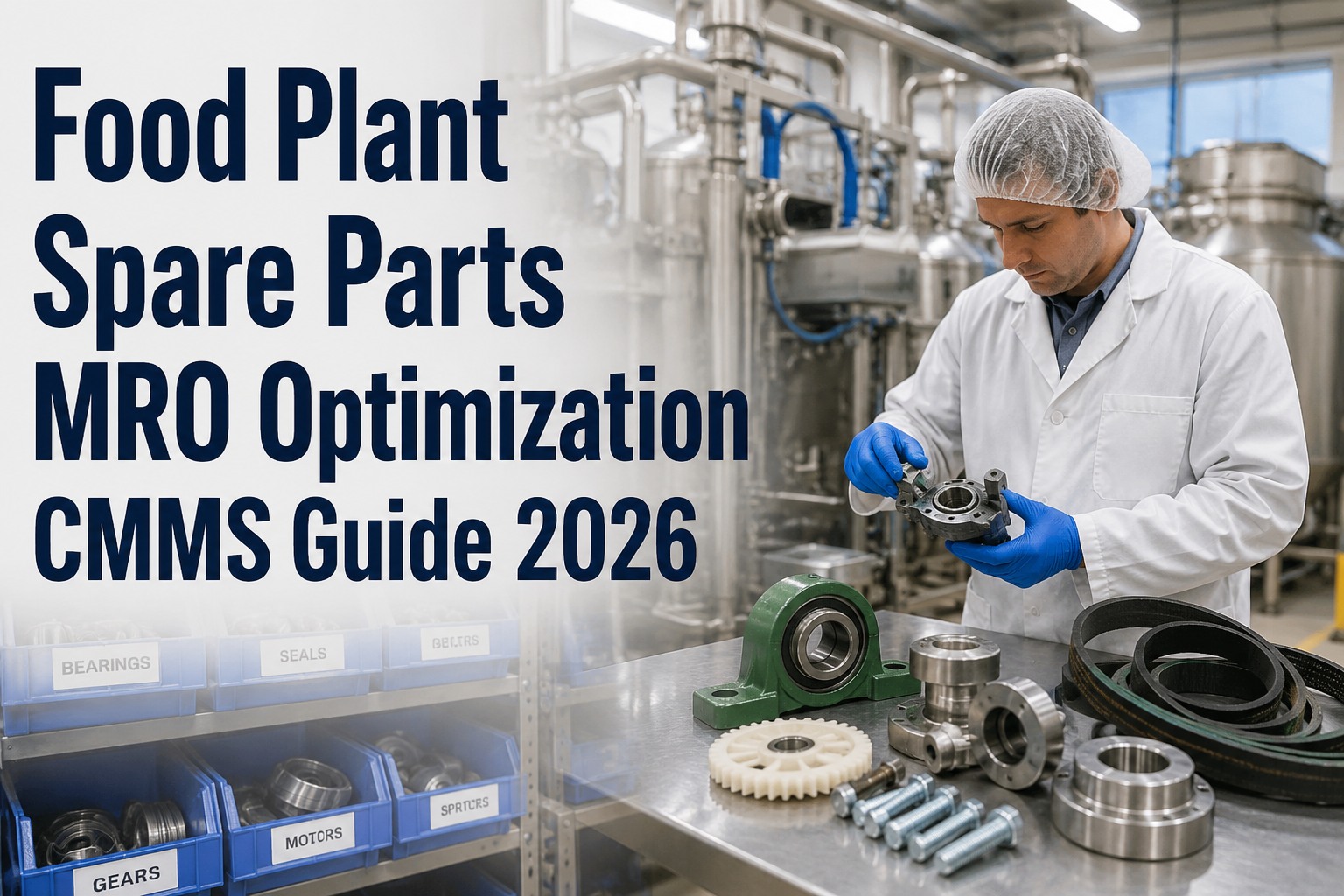
A food plant can have a world-class PM schedule and still bleed money — if the right spare part is not in stock when a critical line goes down. Spare parts strategy in food manufacturing is not a procurement exercise; it is a reliability engineering decision that directly determines your MTTR, your maintenance budget, and your ability to pass a food safety audit. Min/max stocking, vendor-managed inventory (VMI), and criticality scoring are the three levers that transform a parts room from a cost centre into a uptime engine. OxMaint's CMMS platform connects your parts inventory to your asset registry and work order history so every stocking decision is driven by real failure data, not gut feel.
Blog · Food Manufacturing · Spare Parts Strategy
Food Plant Spare Parts Strategy: Min/Max, VMI, and Criticality Scoring
How to build a food-grade parts inventory program that cuts MTTR, eliminates stockouts, and turns every purchase into a data-backed maintenance decision.
68%
of extended downtime caused by parts stockout (Aberdeen Research)
$40K
Average annual carrying cost of overstocked MRO in a mid-size food plant
60%
MTTR reduction when parts are linked to CMMS asset records
3×
ROI on parts-linked CMMS vs. standalone storeroom software
See how much hidden cost lives in your parts room. OxMaint shows you in minutes.
✔ Real-time inventory linked to assets
✔ Criticality-based stocking alerts
✔ Food-grade parts compliance tracking
What Is Spare Parts Strategy in Food Manufacturing
A spare parts strategy is the set of decisions that determines which parts you stock, how many you hold, where you source them, and how you track consumption. In food manufacturing, these decisions are complicated by two factors that do not exist in other industries: food-grade compliance requirements mean many parts must meet FDA, NSF, or EC 1935/2004 standards; and production schedules with zero buffer mean a stockout on a $25 seal can shut a $2M line for half a shift.
The three strategic levers — min/max reorder rules, vendor-managed inventory, and criticality scoring — are not mutually exclusive. Best-practice food plants use all three, applied to different parts of their inventory based on asset criticality, part lead time, and failure frequency. The CMMS is the enabling technology that makes all three work together — without it, you are managing a multi-variable inventory problem with a spreadsheet. Teams that connect parts data to asset records start a free trial with OxMaint to see the difference in the first week, or book a demo for a live walkthrough of the inventory-asset link.
Core Concepts of Food Plant Spare Parts Management
01
Min/Max Reorder Rules
Set a minimum stock level that triggers a reorder and a maximum that caps carrying cost. Min is driven by lead time and failure frequency; max by storage space and part cost.
02
Criticality Scoring
Rank each asset by production impact, safety risk, and lead time for repair. Parts for Criticality A assets are always stocked; parts for C assets may be ordered on demand.
03
Vendor-Managed Inventory (VMI)
The supplier owns and replenishes stock at your site based on consumption data you share. Eliminates stockouts on fast-moving parts while reducing your working capital tied up in inventory.
04
Food-Grade Parts Compliance
Parts in contact with food or food-contact surfaces must carry FDA/NSF certification. CMMS tracks compliance status per part number, flagging non-compliant substitutions automatically.
05
Consumption Tracking
Parts issued from stores are linked to the work order and asset. Over time, this builds a consumption history per part per asset — the foundation of data-driven min/max calculation.
06
Cycle Counting
Rolling physical count of high-velocity parts on a weekly or monthly rotation — preventing the phantom inventory problem where your system shows 3 in stock but the shelf has zero.
07
MRO Spend Analysis
Total spend by vendor, asset, and failure type. Identifies which assets are consuming disproportionate parts cost — a leading indicator of end-of-life and CapEx need.
08
Spare Parts Audit
Annual review of all stocked parts: eliminate obsolete items, update min/max to reflect current failure frequency, and verify food-grade compliance documentation is current.
A $40 seal in the wrong stock level strategy costs $12,000 in downtime. Most plants find this out the hard way.
Industry Pain Points — Where Parts Strategy Breaks Down
⚠
No Link Between Parts and Assets
Parts stored in a standalone system with no connection to the CMMS mean technicians search by memory, not by asset. The right part is in the storeroom but nobody finds it in time.
⚠
Min/Max Set Once, Never Updated
Static reorder rules set during implementation become dangerously wrong within 12 months as production mix, asset age, and failure rates change — leading to simultaneous overstocking and stockouts.
⚠
Food-Grade Compliance Gaps
Non-compliant substitute parts introduced under emergency conditions create food safety risk — and the documentation gap is invisible until an auditor asks for the part specification record.
⚠
Vendor Consolidation Not Tracked
Without spend analysis by vendor and asset, you cannot negotiate VMI agreements, identify single-source risks, or build the purchasing leverage that reduces MRO cost by 15–25%.
⚠
No Criticality Score for Stocking Decisions
Without a formal criticality scoring model, every asset is treated the same — meaning critical processing assets compete for parts budget against low-impact utilities.
⚠
Phantom Inventory in the System
System shows 5 in stock; shelf has 1. No cycle count program, no consumption tracking tied to work orders. The result is MTTR that is always longer than it should be.
These are the exact problems that structured CMMS-linked parts management solves — and starting a free trial with OxMaint means you can see your own inventory gaps in the first session, or book a demo and we will show you the parts-asset link live on your equipment list.
How OxMaint Solves Food Plant Spare Parts Management
Asset-Linked Parts Registry
Every part number is mapped to the assets it serves. When a work order is created for an asset, OxMaint shows available parts, stock level, and last consumption date — instantly.
Consumption-Driven Min/Max
Min/max levels auto-update based on actual work order consumption history. As failure frequency changes, your reorder points change with it — no manual spreadsheet revision required.
Criticality Score Integration
Asset criticality ratings (A/B/C) drive automatic stocking policy recommendations. Critical A assets always have their top-5 failure parts in stock; C assets are managed on-demand.
Food-Grade Compliance Tracking
Each part carries its compliance certification status (FDA, NSF, EC 1935/2004). OxMaint flags non-compliant substitutions at the point of work order issuance — before the part is installed.
Vendor and MRO Spend Dashboard
Total MRO spend by vendor, asset class, and failure type. The data foundation for VMI negotiations, preferred supplier programs, and spend reduction initiatives.
Cycle Count Scheduling
Automated cycle count assignments for high-velocity parts. Discrepancies between physical count and system count trigger an inventory adjustment work order — ending phantom inventory.
Before vs. After — OxMaint Parts Strategy Impact
| Metric |
Before OxMaint |
After OxMaint |
| Parts-caused MTTR extension |
2–6 hours per stockout event |
Under 20 min — part located via asset search |
| Min/max accuracy |
Set at go-live, never updated |
Updated quarterly from consumption history |
| Food-grade compliance gaps |
Discovered at audit — manual doc review |
Zero gap — flagged at work order issuance |
| Inventory accuracy |
72% (Aberdeen benchmark for no-CMMS plants) |
97%+ with cycle count integration |
| MRO spend visibility |
Monthly purchase orders — no asset attribution |
Live spend by asset, vendor, and failure type |
| VMI program readiness |
No consumption data to share with vendors |
Consumption history exportable for VMI setup |
ROI — What a Linked Parts Program Delivers
60%
MTTR reduction
When parts are linked to assets and technicians find the right part in under 5 minutes vs. 30+ minutes searching
25%
MRO cost reduction
Average reduction after VMI implementation and vendor consolidation using OxMaint spend data
97%+
Inventory accuracy
With cycle count integration and work-order-linked consumption tracking
Zero
Food-grade compliance gaps
Part compliance flagged at work order issuance — not discovered at audit
Operations teams managing 10,000+ assets trust OxMaint for their parts strategy — start a free trial and see measurable results within 30 days, or book a demo and we will walk through your current parts program and identify quick wins.
Limited onboarding slots available this quarter. Live in days, not months. No heavy implementation required.
Frequently Asked Questions
How do you set min/max levels for food plant spare parts
Min is calculated as (average daily consumption × supplier lead time in days) plus a safety stock buffer. Safety stock for critical food processing parts is typically 1.5–2× average lead time demand. Max is min plus an economic order quantity based on carrying cost vs. order cost. In practice, the most important step is updating these numbers regularly from actual consumption data — which is why CMMS-linked min/max management outperforms spreadsheet-based approaches.
Start a free trial with OxMaint to see consumption-driven min/max in action on your own parts data.
What is criticality scoring for spare parts in a food plant
Criticality scoring assigns each asset (and therefore the parts that support it) a risk rating based on three factors: production impact (how much output is lost if this asset fails), safety impact (does failure create a food safety or personnel safety risk), and replaceability (how long does it take to source and install a replacement). Assets scoring high on all three are Criticality A — their key parts are always stocked, regardless of cost. C-rated assets can rely on on-demand purchasing. OxMaint builds this scoring into the asset registry so parts stocking policies are automatically aligned with maintenance criticality.
What food-grade standards apply to spare parts in a food plant
Parts in direct food contact or food-contact-surface contact must comply with FDA CFR 21 (USA), EC Regulation 1935/2004 (Europe), or NSF/ANSI 51 (food equipment materials) depending on your region and customer requirements. This covers lubricants (H1 rating for food-safe lubricants), gaskets and seals (silicone or EPDM compounds approved for food contact), and coatings. OxMaint stores compliance certification data per part number and flags non-compliant substitutions at the point of work order creation — before the non-compliant part is installed.
How does VMI work in a food manufacturing parts program
In a VMI arrangement, your supplier takes ownership of maintaining stock levels at your site based on consumption data you share. The supplier replenishes automatically when stock falls below an agreed minimum, and you are billed on consumption rather than purchase order. The prerequisite is reliable consumption data — which comes from CMMS work-order-linked parts issuance. OxMaint generates the consumption reports suppliers need for VMI management, making the transition from traditional purchasing to VMI straightforward for high-velocity parts on critical assets.
Book a demo to see the VMI reporting workflow.
Your Parts Room Is Costing You More Than You Know
Stop Reactive Purchasing. Build a Data-Driven Spare Parts Program with OxMaint.
OxMaint links every part to the assets it serves, tracks consumption through work orders, flags food-grade compliance gaps, and builds the consumption history you need for VMI agreements. The result is fewer stockouts, lower carrying cost, and an MTTR that reflects real response capability — not parts search time.
✔ Real-time inventory linked to assets
✔ Criticality-based stocking recommendations
✔ Food-grade compliance tracked per part
No heavy implementation · Multi-site portfolio ready · Live in days