Every food plant runs thousands of lubrication points across bearings, chains, gearboxes, and conveyors, and a single wrong drum picked off the shelf can turn a routine PM task into a recall. NSF built the H1, H2, H3, and 3H categories to draw a hard line between lubricants allowed near food and lubricants that are not, based on FDA 21 CFR 178.3570. Most plants still track which product goes where on laminated charts or spreadsheets that nobody updates after the first year, which is exactly how a non-food grease ends up on a chain above an open belt. A connected maintenance system removes that guesswork by linking every lubrication point, NSF category, and lot number to a digital record that a technician cannot bypass. Explore how OxMaint builds that record for your plant.
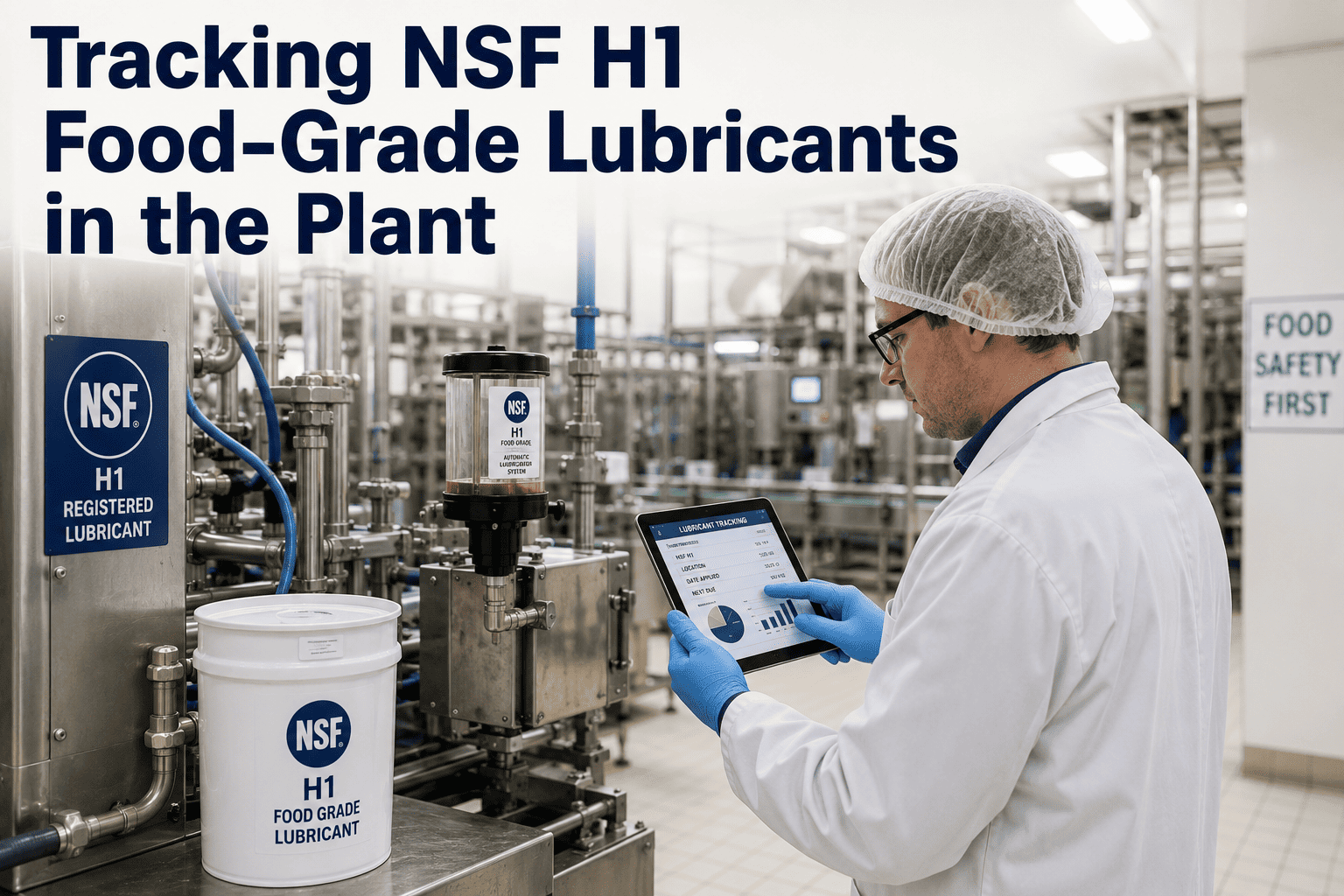
Tracking NSF H1 Food-Grade Lubricants Without Guesswork
Give every lubrication point a registered category, a lot number, and an expiration date — then let the system flag the mismatch before a technician ever picks up the wrong drum.
What Food-Grade Lubricant Tracking Actually Means
Food-grade lubricant tracking is the discipline of matching the correct NSF category to every lubrication point based on its distance from food, then proving that match with a record an auditor can pull on demand. H1 lubricants are approved for incidental contact — tasteless, odorless, and formulated only from ingredients on the FDA's permitted list for trace exposure. H2 lubricants are not food grade at all and belong only on closed systems with zero contact risk, while H3 soluble oils prevent rust on hooks and trolleys but must be fully cleaned off before production resumes. A 3H release agent is the only category cleared for direct, continuous food contact, such as a bread pan coating. Getting this wrong is rarely intentional — it happens when a chart is out of date or a drum gets grabbed from the wrong shelf, and a quick demo shows how a digital point register prevents exactly that.
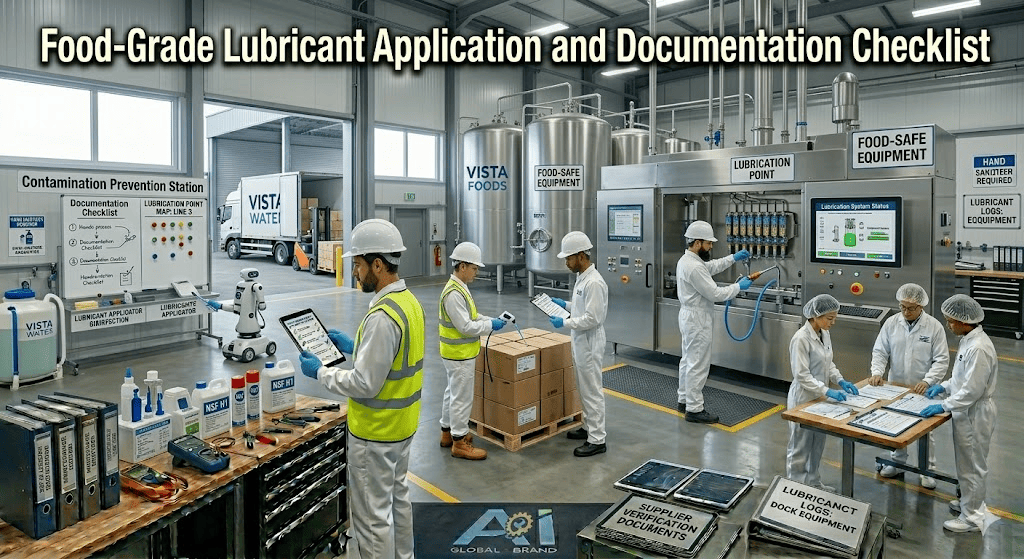
Beyond the category itself, auditors increasingly expect proof of the full chain: the NSF registration number on file, the lot number of the product actually applied, its expiration date, and a signed record of who applied it and where. ISO 21469 certification adds a second layer some plants require, covering not just the formulation but the manufacturing and packaging hygiene behind it. A master lubrication list that matches what is physically on the shelf to what is written in the plan is the single most common gap auditors report, because paper lists drift out of sync within months. Centralising that list inside a CMMS keeps the shelf, the plan, and the audit record permanently aligned — start a free trial and load your first lubrication point register today.
See Your Lubrication Point Register Built in One Sitting
Map every bearing, chain, and gearbox to its correct NSF category, set expiration alerts, and generate your first compliance snapshot — all in under an hour, with no consultant involved.
The Four NSF Categories, In Plain Terms
Where Paper-Based Lubricant Tracking Breaks Down
How OxMaint Keeps Every Lubrication Point Verified
Paper Tracking vs. CMMS Tracking
| Tracking Activity | Paper / Spreadsheet | OxMaint CMMS |
|---|---|---|
| NSF category verification | Relies on memory or a printed chart | Locked to the equipment record, flagged if wrong |
| Lot number recording | Rarely captured at time of use | Logged at every application, searchable instantly |
| Expiration monitoring | Checked only during stock counts | Countdown alerts before shelf life runs out |
| Master list accuracy | Drifts out of date within months | Always matches the live equipment register |
| Audit preparation | Days spent assembling binders | Exportable record compiled in minutes |
Frequently Asked Questions
What does NSF H1 actually allow near food?
NSF H1 lubricants are approved for incidental food contact at trace levels, capped at 10 ppm for most formulations and 1 ppm for silicone-based products. They are used on bearings, chains, and gaskets near open food, but they are not intended for direct or continuous contact. Book a demo to see how these limits map to your equipment.
What is the real difference between H1, H2, and H3?
H1 covers incidental food contact, H2 covers closed systems with no possible contact, and H3 covers soluble oils used on hooks and trolleys that must be cleaned off before production resumes. Only H1 and 3H products are permitted anywhere near open food.
Can OxMaint flag a wrong lubricant before it causes a problem?
Yes. Every lubrication point is locked to its required NSF category in the equipment record. If a technician logs a product outside that category, OxMaint raises a flag on the work order immediately. Start a free trial to set this up on your own point register.
Does OxMaint track lot numbers and expiration dates?
Yes. Lot numbers are captured at the point of application and expiration countdowns run against every stocked product, so an expired or recalled batch can be traced or pulled before it reaches the floor.
What do auditors expect to see for lubrication compliance?
Auditors typically want a master lubrication list that matches the shop floor, NSF registration numbers for products in use, lot and application records, and change control whenever a substitution is made. Book a demo to see a sample audit package.
Every Lubrication Point Categorised. Every Lot Traced. Every Audit Ready.
Lock the right NSF category to every bearing, chain, and gearbox, catch expired stock before it reaches the floor, and hand your auditor a complete record in minutes instead of days.