A pasteurizer running two degrees under its validated setpoint, a metal detector drifting out of sensitivity, a CIP cycle logging a temperature that never actually reached the pipe wall — none of these look like emergencies on the plant floor, but each one is a Critical Control Point failure the moment it happens. HACCP treats CCP equipment differently from every other asset in the plant, because a missed preventive task here does not just risk downtime, it risks an unmonitored food safety hazard reaching a customer. Pasteurizers, metal detectors, cook ovens, and CIP systems carry zero tolerance for calibration drift, deferred maintenance, or undocumented deviations, and auditors know exactly where to look first. This guide breaks down what makes these four equipment categories different, the calibration standards each one demands, and how a CMMS-based CCP registry closes the documentation gap before an inspector finds it. Start a free trial to see how Oxmaint tracks CCP equipment calibration automatically.
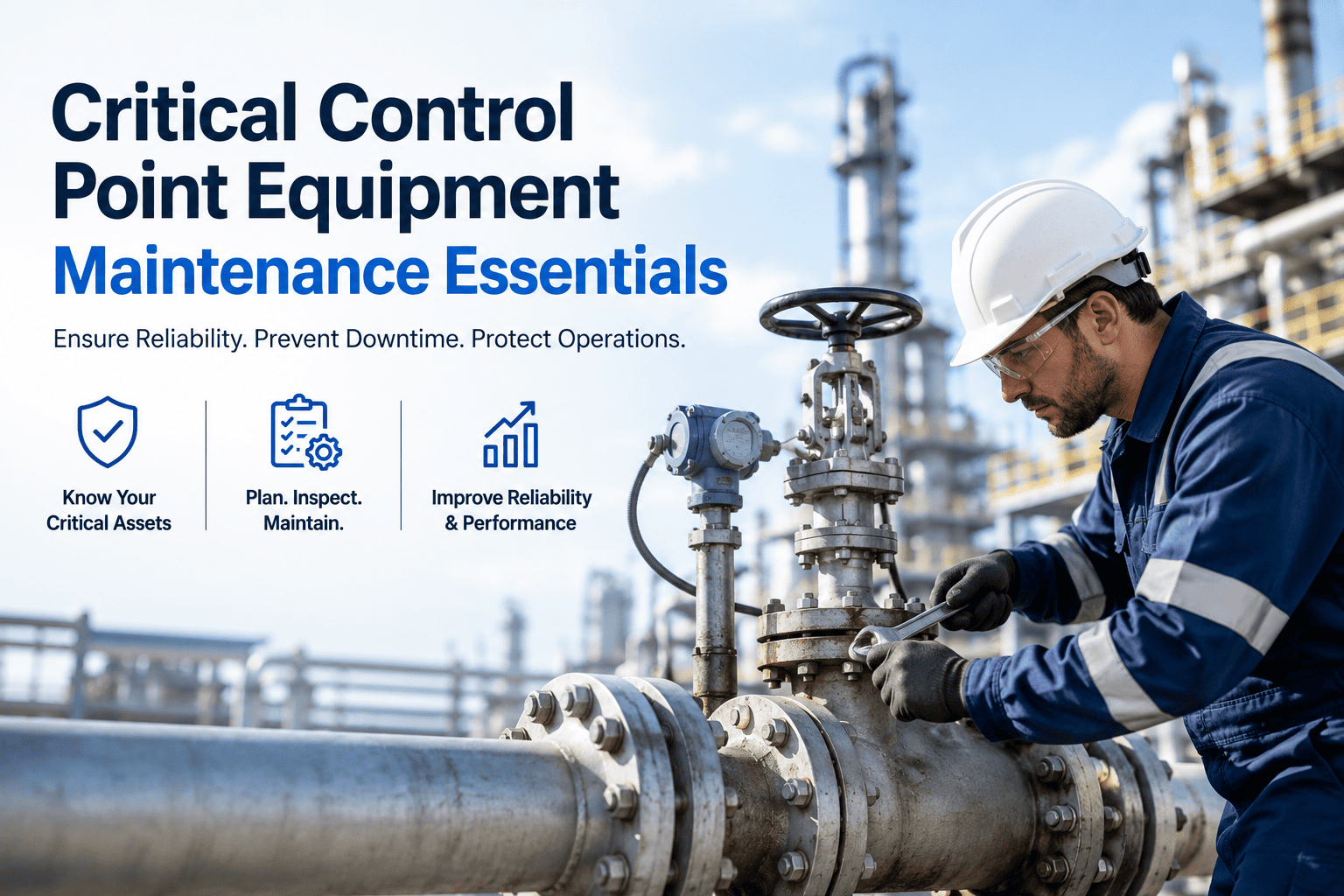
Critical Control Point Equipment Maintenance Essentials
Pasteurizers, metal detectors, cook ovens, and CIP systems don't get a maintenance grace period. A single missed calibration on any of these four systems can invalidate every food safety record generated since the last valid check.
Why CCP Equipment Doesn't Follow Normal Maintenance Rules
Most assets on a production floor follow a simple logic: fix it before it fails, and the cost of a missed PM is downtime. CCP equipment breaks that logic entirely.
A Critical Control Point is a step in the process where a control must be applied to prevent, eliminate, or reduce a food safety hazard to an acceptable level. Pasteurizers control pathogen kill through time and temperature. Metal detectors control physical contamination through sensitivity thresholds. Cook ovens control thermal lethality. CIP systems control microbial residue through validated chemical, temperature, and contact-time combinations. When the equipment enforcing a critical limit drifts out of calibration, the hazard it was supposed to control is no longer actually controlled — even if every reading on the screen still looks normal.
That is the distinction auditors are trained to find. A worn conveyor belt is a maintenance issue. A pasteurizer temperature recorder with an expired calibration certificate means every batch it monitored since that expiry is now an open food safety question. The equipment condition and the compliance record are the same thing at a CCP — which is exactly why these four systems need a maintenance program built around calibration proof, not just uptime.
The 4 CCP Equipment Categories That Carry Zero Tolerance
Every food plant has dozens of CCPs on paper, but in practice, four equipment categories generate the overwhelming majority of CCP-related audit findings and recalls.
Time and temperature are the critical limits. RTD probes, flow diversion valves, and plate heat exchangers all degrade in ways that quietly shift the actual kill temperature below the validated setpoint while the display still reads correct.
Sensitivity is the critical limit, typically down to a few millimeters of ferrous, non-ferrous, or stainless contaminant. Daily challenge tests must run with an unbroken record — a single gap raises the question of what passed through undetected.
Thermal lethality depends on uniform temperature across every zone of the oven. Deviations exceeding roughly two degrees against the validated cook curve must be documented and evaluated, not silently averaged out across the batch.
Chemical concentration, temperature, flow velocity, and contact time all have to hit validated targets on every single cycle. A clogged spray ball or a drifting conductivity sensor can let a cycle complete on the PLC while leaving residue behind.
4 Reasons These Systems Turn Small Gaps Into Major Non-Conformances
A missed PM on a conveyor motor costs you a repair bill. A missed PM on a CCP asset costs you the validity of every food safety record it produced in between.
An out-of-calibration probe or sensor doesn't just risk the next reading — it retroactively puts every reading since the last valid calibration in question.
Recording "product held, reprocessed" without a documented root cause linking the deviation to equipment condition reads as an incomplete corrective action to most auditors.
When a CCP procedure is revised without a matching re-training and sign-off, the version mismatch between the SOP and the training record becomes its own separate finding.
A sensitivity drift or temperature fix that isn't linked to the production window it affected leaves that batch with unknown CCP coverage — treated as at-risk regardless of how it looks.
Reactive CCP Maintenance vs. a CMMS-Managed CCP Registry
The gap between a clean audit and a major non-conformance usually isn't the equipment itself — it's whether the maintenance program can prove the equipment was in control the whole time.
| Compliance Requirement | Paper Logs / Spreadsheets | Oxmaint CCP Registry |
|---|---|---|
| Calibration due-date tracking | Manual tracker; overdue instruments often missed until an audit | Automated alerts before due date; overdue assets flagged out-of-service |
| Challenge test / verification logs | Paper sheets; gaps across shift changes are common | Digital log required at shift start; gaps flagged in real time |
| Deviation root cause linkage | Fix logged separately from the deviation; link often missing | Corrective action work order auto-links equipment history to the deviation |
| Training and SOP version sync | Manual re-training reminders; version mismatches slip through | SOP revision auto-flags technicians who need re-sign-off |
| Audit record retrieval | Hours or days pulling records across binders and shared drives | Complete CCP history by asset or date range in seconds |
How Oxmaint Keeps CCP Equipment Inside Its Validated Limits
A CCP registry only works if it's built into the daily workflow, not maintained as a side task. Here's how Oxmaint structures it.
Pasteurizers, metal detectors, cook ovens, and CIP skids are tagged as CCP-critical in the asset registry, each carrying its validated critical limit, calibration frequency, and tolerance range.
RTD probes, conductivity sensors, and flow meters are scheduled against their validated frequency, with the asset flagged out-of-service the moment a calibration lapses.
A sensitivity drift or temperature deviation generates a corrective action work order automatically, with the affected production window and equipment history attached.
When a CCP procedure is revised, technicians assigned to that equipment are flagged for re-training before they can be scheduled on the related work order type.
Calibration certificates, challenge test logs, deviation records, and sign-offs for any CCP asset are retrievable by date range in seconds when an inspector asks.
What Changes When CCP Maintenance Is Tracked Systematically
The value of a structured CCP registry shows up in fewer findings, faster audits, and equipment that stays inside its validated limits between checks.
Frequently Asked Questions: CCP Equipment Maintenance
What equipment is typically classified as a Critical Control Point?
How often should CCP instruments like metal detectors be calibrated?
What happens if a CCP instrument's calibration lapses?
How does a CMMS support HACCP compliance for CCP equipment?
What documentation do auditors expect for CIP systems as CCPs?
Give Your CCP Equipment a Registry, Not a Spreadsheet
Pasteurizers, metal detectors, cook ovens, and CIP systems don't get a maintenance grace period. Oxmaint tracks every calibration, deviation, and sign-off against its validated limit — so the next audit finds a complete record, not a scramble.
- Automated calibration scheduling for every CCP-critical instrument
- Deviations linked automatically to corrective action work orders
- Full CCP history retrievable by asset or date range in seconds