Compressed Air Quality in Food Plants: ISO 8573 and Maintenance Requirements
By OxMaint Team on June 16, 2026
Compressed air quality ISO 8573 compliance is one of the most overlooked food safety requirements in production facilities — yet compressed air contacts food directly in filling, packaging, blowing, and conveying operations. A single contaminated air stream can introduce oil, moisture, particulates, or microbial contamination into product at scale. ISO 8573 defines the purity classifications your system must meet; the question is whether your maintenance program is actually delivering them.
Food Safety · ISO 8573 · Compressed Air
Compressed Air Quality in Food Plants: ISO 8573 and Maintenance Requirements
Compressed air is the invisible ingredient in every food production line. ISO 8573 sets the purity standard — but only a structured maintenance programme keeps you there, every shift, every audit.
Class 1
ISO 8573-1 purity required for direct food contact air — the strictest classification
0.003
mg/m³ — maximum total oil content for Class 1 food-grade compressed air
3 axes
ISO 8573 rates purity separately: solid particles, water, and oil — all three must be managed
62%
reduction in unplanned downtime achieved by food plants using Oxmaint predictive maintenance
See how Oxmaint tracks compressed air system maintenance to keep your ISO 8573 purity targets on record — every filter change, every dew point test, every audit.
✓ Automated compressed air PM scheduling and records✓ Filter change tracking with expiry alerts✓ Instant audit-ready documentation for FDA and SQF
1,000+ food manufacturing and facility clients · Live in days, not months
What Is ISO 8573 Compressed Air Quality for Food Plants?
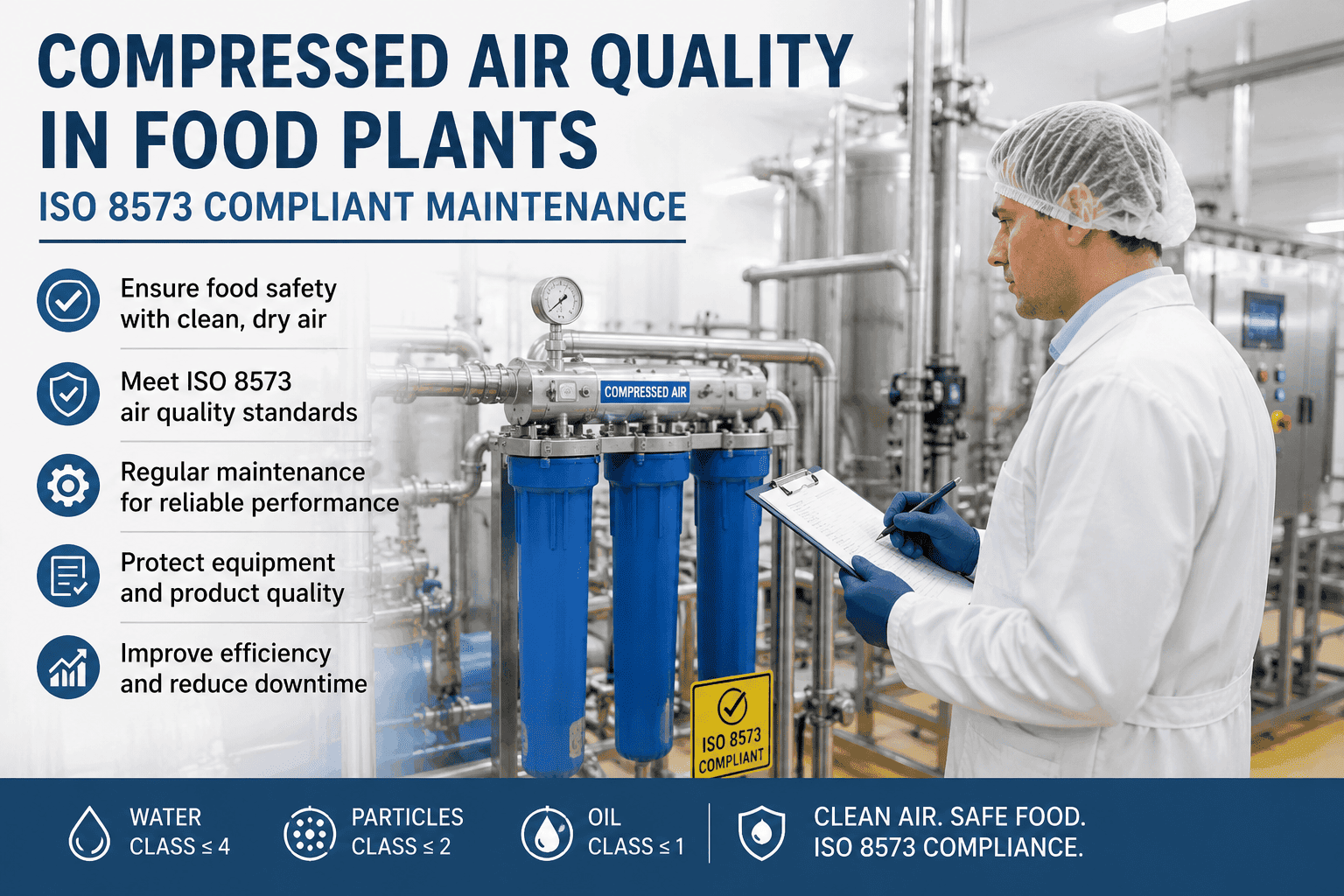
ISO 8573 is the international standard that defines compressed air purity classifications across three contamination axes: solid particulates, water (measured as pressure dew point), and oil content (aerosol, vapor, and liquid). In food manufacturing, compressed air that contacts product or food-contact surfaces must meet the most stringent classifications — typically Class 1 for oil and Class 1 or 2 for particulates — to prevent contamination that could cause product recalls or regulatory action.
The standard defines nine purity classes for each axis. Class 1 represents the highest purity; each subsequent class permits progressively higher contamination levels. For food plants, the relevant classifications depend on the application: direct product contact (filling, blowing, conveying) requires the strictest classes, while indirect applications (actuators, pneumatic tools not near open product) may permit Class 2 or 3 oil content. The key compliance requirement is that every compressed air application in your facility is classified, tested, and documented against the appropriate ISO 8573 class.
Critically, ISO 8573 compliance is not achieved at installation — it must be maintained through disciplined servicing of compressors, dryers, filters, and distribution piping. Contamination levels drift as filters load, desiccant saturates, and compressor oil carry-over increases. Without a structured maintenance program backed by periodic air quality testing, a food plant can move from compliant to non-compliant between certification audits without any visible warning. Oxmaint's preventive maintenance scheduling tracks every compressed air system component on a defined service cycle, so purity classification is a live operational fact rather than an annual sampling event.
ISO 8573 Class 1 oil limit is 0.003 mg/m³ — a single degraded coalescing filter can push oil content 10× above this threshold without triggering any visible alarm.
ISO 8573 Purity Classes: What Food Plants Must Know
Solid Particles
Class
Particle Size
Food Application
Class 1
≤0.1 µm & ≤10,000/m³
Direct food contact
Class 2
≤1 µm & ≤400,000/m³
Near-product indirect contact
Class 3
≤5 µm & ≤90,000,000/m³
Non-product pneumatics
Water / Dew Point
Class
Pressure Dew Point
Food Application
Class 1
≤−70°C PDP
Critical food-contact
Class 2
≤−40°C PDP
Standard food-grade
Class 3
≤−20°C PDP
General pneumatic
Oil Content (Aerosol + Vapor)
Class
Total Oil
Food Application
Class 1
≤0.003 mg/m³
Direct food contact (required)
Class 2
≤0.1 mg/m³
Near-product applications
Class 3
≤1 mg/m³
Non-product zone
Maintaining Class 1 across all three axes requires documented filter changes, dew point monitoring, and compressor service records. Oxmaint's inspection management captures every test result and maintenance action with timestamps — ready for your next SQF or BRC audit.
6 Compressed Air Maintenance Gaps That Put Food Safety at Risk
Overdue Coalescing Filter Changes
Coalescing filters are the primary barrier against oil aerosol in compressed air. As they load, differential pressure rises and separation efficiency falls — eventually allowing oil carry-over that exceeds Class 1 limits. Most facilities change filters on calendar intervals rather than actual differential pressure readings, missing real-world loading patterns.
Desiccant Dryer Saturation
Desiccant dryers maintain low pressure dew points required for Class 1 or 2 water classification. When desiccant beads saturate — through aging or high-humidity ambient conditions — dew point rises above specification without triggering an alarm in many installations. Periodic dew point measurement and scheduled desiccant replacement are the only defences.
No Air Quality Testing Schedule
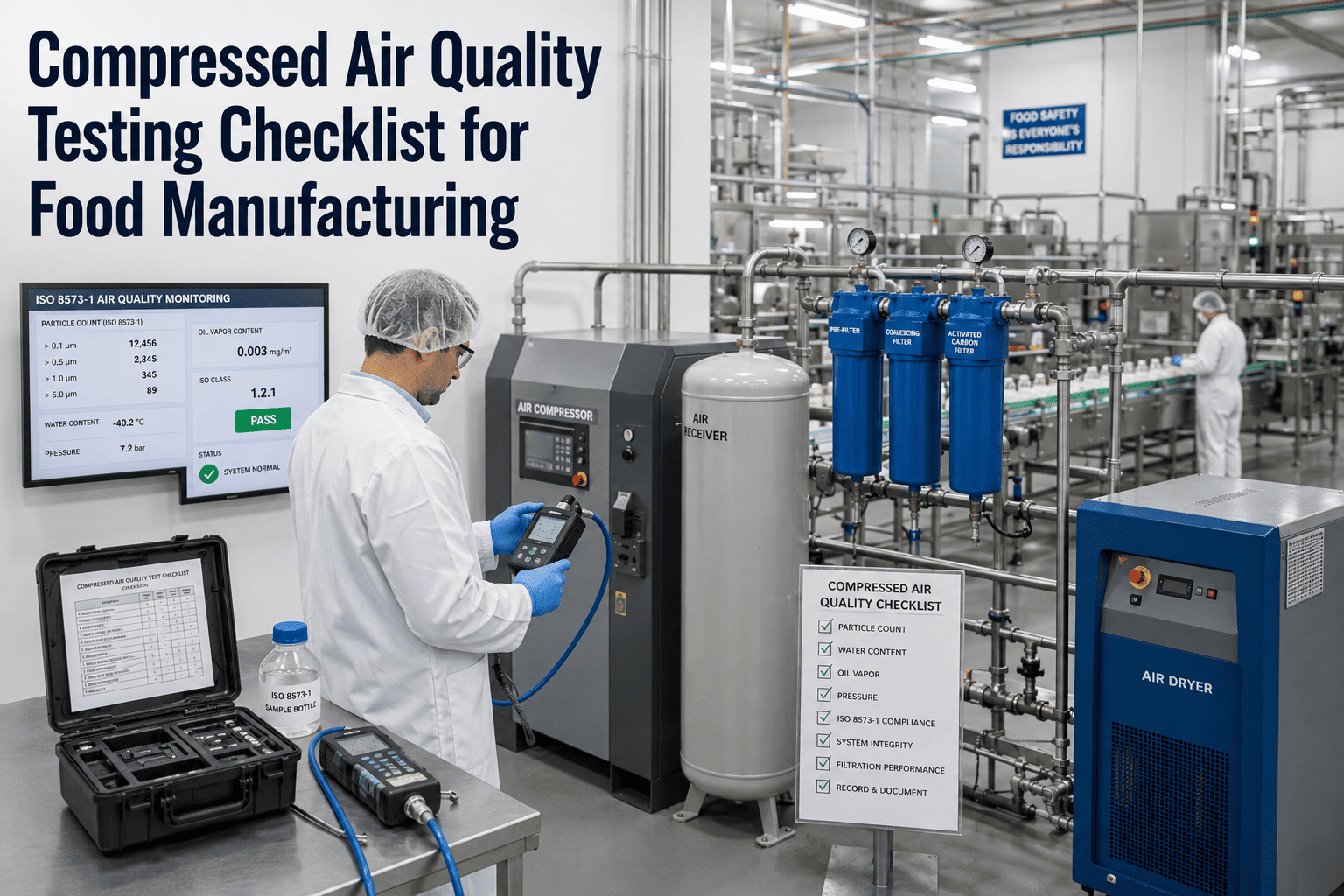
ISO 8573-2 specifies measurement methods; food safety standards (SQF, BRC, IFS) require periodic air quality verification with documented results. Facilities that only test during GFSI certification audits may operate outside classification limits for months between tests. A scheduled testing programme with recorded results is a mandatory evidence requirement.
Distribution System Contamination
Clean air leaving the compressor room can pick up contamination in corroded pipework, condensate that pools in low points, or improperly maintained point-of-use filters. The distribution system requires its own inspection regime — condensate drain checks, piping condition surveys, and point-of-use filter servicing — separate from the central plant.
Incomplete Maintenance Records
During GFSI, BRC, or FDA inspections, auditors request evidence that compressed air maintenance was actually performed — not just scheduled. Verbal confirmation and calendar entries are not accepted. Every filter change, oil analysis, dew point measurement, and drain service must be documented with date, technician, and result.
Compressor Oil Service Neglect
Oil-lubricated compressors with degraded lubricant produce significantly higher oil carry-over into the air stream — overwhelming downstream filtration designed for normal carry-over rates. Compressor oil analysis and scheduled changes are a first-line defence for ISO 8573 oil class compliance, especially as compressors age and ring wear increases.
All six failures share a root cause: no structured, digital maintenance system. Oxmaint's food manufacturing module schedules and documents every compressed air maintenance task automatically — book a demo to see how it works.
How Oxmaint Maintains ISO 8573 Compliance Between Audits
01
Asset-Level Compressed Air Tracking
Every compressed air system component — compressors, dryers, coalescing filters, activated carbon filters, condensate drains, point-of-use filters — registered as an individual asset in Oxmaint with its own service history, replacement schedule, and test record log. No component is invisible to the maintenance programme. Integrates with Oxmaint asset management.
02
Automated PM Schedules by Component
Filter change intervals, desiccant replacement cycles, compressor oil services, and condensate drain checks — all scheduled automatically with work orders assigned to the responsible technician. Completion is captured with photo evidence and digital sign-off. Preventive maintenance automation ensures no service interval is missed.
03
Air Quality Test Result Logging
Periodic ISO 8573 air quality test results — particle counts, dew point measurements, oil content analyses — recorded directly in the asset record for each test point in the distribution system. Auditors get a continuous test history at every point of use, not just the compressor room outlet.
04
Corrective Action Workflows
When a dew point test exceeds specification or a differential pressure reading indicates a loaded filter, a corrective action work order is automatically generated, assigned, and tracked to resolution. The full chain — trigger, response, verification — is documented automatically, providing the evidence trail required by SQF, BRC, and FDA.
"A food plant with 200 compressed air use points managing filter and test records manually generates 2,400+ individual maintenance events per year — impossible to track reliably without a CMMS."
Reactive vs. Managed: Compressed Air Programme Comparison
Annual audit only; exceedances missed between audits
Scheduled periodic testing; results logged; auto corrective action
Oil Content Verification
Tested at certification; not between audits
Documented test programme; continuous test point history
Audit Record Production
Manual paper assembly; gaps common; takes days
Instant export; complete history per asset; under 2 minutes
Non-Conformance Response
Discovered at audit; emergency remediation
Detected during routine testing; corrective action auto-triggered
ISO 8573 Classification Status
Unknown between test events; compliance assumed
Live maintenance status per component; test history always current
Compressed Air Quality ROI: The Business Case for ISO 8573 Compliance
Unmanaged Programme
85% of contamination events undetected before audit
Structured Oxmaint Programme
~18% escape detection — caught by corrective action workflow
62%
Less unplanned downtime with AI-driven maintenance — compressed air failures included
94%
Oxmaint predictive maintenance accuracy — flag compressed air system issues before they cause contamination events
Days
Time to go live in a food facility — Oxmaint is operational before your next audit cycle
See what ISO 8573 maintenance automation saves your facility — try the Oxmaint ROI Calculator or book a demo with our food manufacturing team.
Frequently Asked Questions: ISO 8573 Compressed Air in Food Plants
What ISO 8573 class is required for direct food contact compressed air?
For compressed air that contacts open food product, food-contact surfaces, or primary packaging materials, ISO 8573-1 Class 1 is the required standard for oil content (maximum 0.003 mg/m³ total oil) and typically Class 1 or 2 for solid particulates and water. Food safety standards including SQF Edition 9, BRC Issue 9, and IFS Food Version 8 all reference these requirements. Your food safety plan should identify every compressed air application, assign the appropriate ISO 8573 class for each, and document the maintenance and testing programme that maintains that classification.
How often should compressed air quality be tested in a food manufacturing facility?
Testing frequency depends on the risk level of the application and the requirements of your food safety certification scheme. For direct food-contact air, SQF and BRC typically require at minimum annual third-party testing, with internal verification testing more frequently — quarterly is common for high-risk applications. Testing should also be triggered after any maintenance event that could affect purity (filter changes, compressor rebuilds, desiccant replacement) and after any process deviation or corrective action. All test results must be documented with the test method used, the point of use tested, and the result against the target classification.
Can a CMMS help with ISO 8573 compressed air compliance documentation for GFSI audits?
A CMMS is the most efficient way to maintain the documentation trail that GFSI scheme auditors expect for compressed air systems. Oxmaint tracks every compressed air system component as an asset with its own maintenance schedule and test record history. When an SQF or BRC auditor asks for evidence of filter changes, dew point test results, and corrective actions over the past 12 months, Oxmaint produces a complete, timestamped report for each asset in minutes. This is far more reliable than spreadsheets or paper logs, which typically have gaps that become non-conformances. Oxmaint's compliance module is specifically designed for this kind of multi-standard documentation requirement.
What is the difference between oil-free and oil-lubricated compressors for food plant compressed air?
Oil-free compressors eliminate lubricant from the compression mechanism entirely, removing the primary source of oil carry-over in compressed air systems. This simplifies achieving ISO 8573 Class 1 oil content but does not eliminate the need for filtration — atmospheric contaminants, water, and particulates still require downstream treatment. Oil-lubricated compressors can achieve Class 1 classification with properly maintained and correctly specified coalescing and activated carbon filtration, but require more intensive maintenance management to sustain that classification over time. Regardless of compressor type, ISO 8573 compliance requires a documented maintenance programme — the type of compressor determines the complexity, not whether maintenance documentation is required.
Compressed Air Quality ISO 8573 · Food Manufacturing · CMMS
Keep Your Compressed Air System Audit-Ready, Every Day
Oxmaint tracks every filter, dryer, test result, and corrective action in your compressed air system — so ISO 8573 compliance isn't an event you prepare for, it's a status you maintain. See how it works in a 30-minute demo built around your food facility.
✓ Automated PM scheduling for every compressed air component✓ Air quality test result logging with instant audit export✓ AI-powered predictive alerts before contamination events occur
Trusted by 1,000+ food manufacturing and industrial clients · Live in days