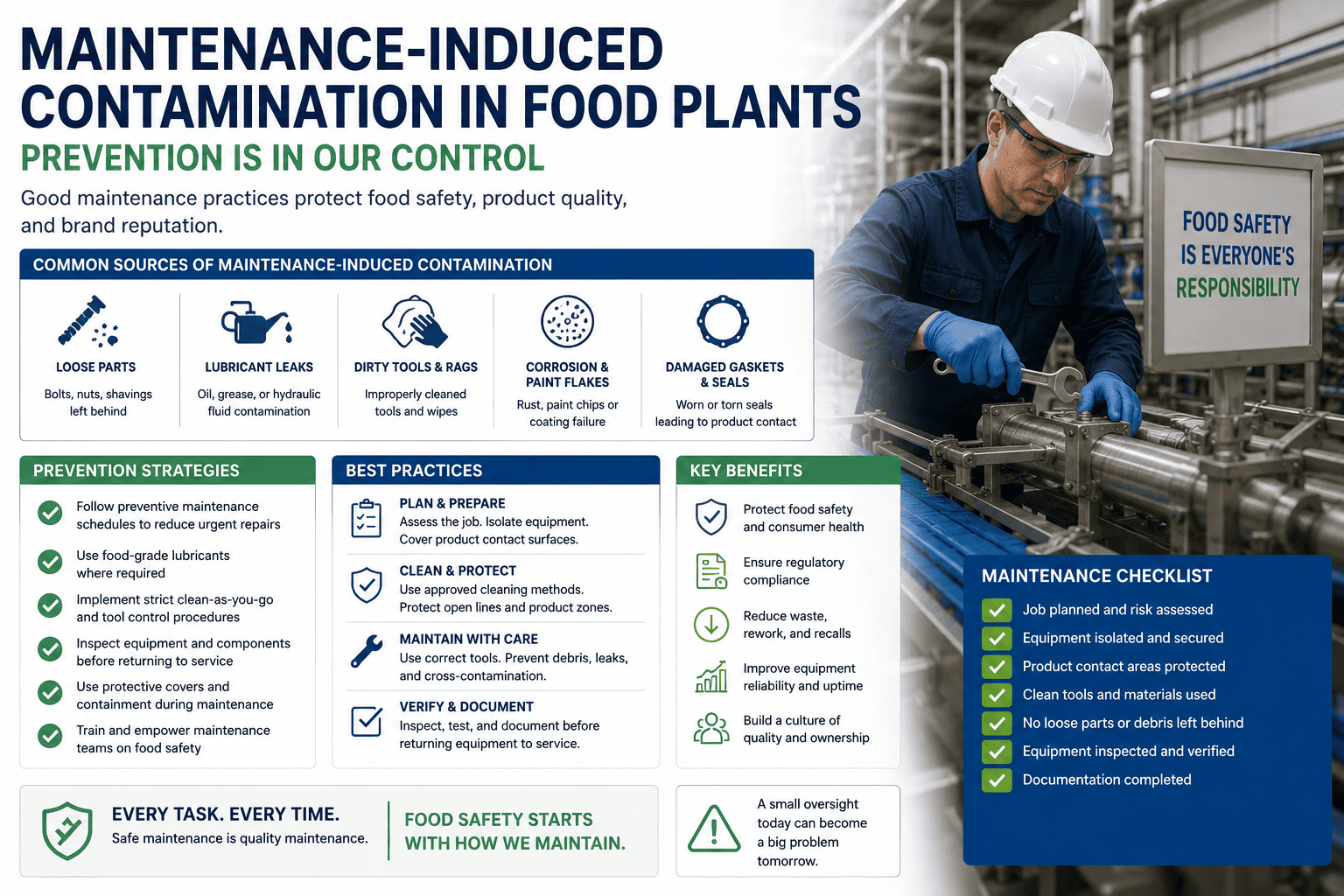
Maintenance-induced contamination in food plants happens when a repair, lubrication task, or PM activity itself becomes the contamination source — metal shavings from a weld, grease on a conveyor, a dropped bolt near open product. It's one of the most preventable yet recurring causes of food safety incidents, and most plants don't realize how often their own maintenance work order practices are the root cause until a recall traces back to it.
See how AI-tracked work orders close the contamination gap maintenance creates — in a 30-minute walkthrough.
Trusted by teams managing 10,000+ assets · Live in days, not months.
What Is Maintenance-Induced Contamination?
Maintenance-induced contamination occurs when repair, lubrication, or inspection activity introduces a physical, chemical, or microbial hazard into food-contact areas. Common sources include metal fragments from worn parts, non-food-grade lubricant overspray, and tools or fasteners left behind after a job — all traceable directly back to how the maintenance task was performed and documented.
of physical contamination recalls trace to maintenance or foreign-object sources
AI detection accuracy on equipment-related contamination risk with OxMaint
less unplanned downtime when PM is automated instead of reactive
A single undocumented "quick fix" near open product is one of the most common root causes cited in physical contamination investigations.
Root Causes of Maintenance-Induced Contamination
Worn gears, blades, and bearings shed metal particles into the product stream before failure is visually obvious.
Using standard grease instead of NSF H1-rated lubricant near food-contact surfaces introduces a chemical hazard.
Bolts, washers, and hand tools forgotten inside guards or hoppers after a repair are a leading foreign-body source.
Equipment restarted without a hygiene clearance check can carry residue from the repair directly into production.
Flaking paint, degraded gaskets, or cracked plastic guards shed material gradually until a failure event occurs.
Tape, wire, or improvised repairs left in place indefinitely become a permanent and growing contamination risk.
How the Risk Builds: A Maintenance Timeline
Most maintenance-induced contamination events aren't a single mistake — they're a sequence of small gaps that compound over weeks or months without a system to catch them.
A technician completes a fix but the work order is logged informally or not at all.
Equipment is restarted without a documented check that the area is free of debris.
Without a tracked PM schedule, the same component degrades further on the next cycle.
A fragment, residue, or tool enters the product line — often discovered downstream or by a customer.
Without records, tracing the cause back to a specific repair or part takes days instead of minutes.
Food plants without digital work order tracking spend significantly longer on root-cause investigations after a contamination event.
How OxMaint Prevents Maintenance-Induced Contamination
The AI Vision Camera detects cracks, corrosion, and leaks 24/7, flagging wear points before they shed material into the product.
Every repair is logged via work order management with parts, lubricant, and technician tied to a timestamped record.
Preventive maintenance auto-schedules wear-point replacement before degradation reaches contamination risk.
Inspection management enforces hygiene clearance sign-off before any asset returns to production.
Reactive vs Planned: Contamination Risk Comparison
| Risk Factor | Reactive Maintenance | Planned + AI-Tracked Maintenance |
|---|---|---|
| Wear-point detection | Found after visible failure | Flagged before failure via AI Vision |
| Lubricant compliance | Inconsistent, untracked | Logged per work order automatically |
| Tool accountability | Manual, easily missed | Checked in/out per job |
| Post-repair clearance | Often skipped under time pressure | Required before asset restart |
| Root-cause investigation time | Days, paper-trail dependent | Minutes, full digital history |
Switching from reactive to AI-tracked maintenance is one of the fastest ways to close contamination gaps — start a free trial to see it mapped to your lines, or book a demo for a guided walkthrough.
Results: Prevention in Practice
Frequently Asked Questions
What causes maintenance-induced contamination in food plants?
It's typically caused by metal fragments from worn parts, non-food-grade lubricant use, tools left in equipment, or restarting machinery without a documented hygiene clearance check.
How can food plants prevent contamination from maintenance work?
By enforcing food-grade lubricant standards, requiring tool check-in/check-out logs, scheduling preventive maintenance before parts degrade, and documenting hygiene clearance before equipment restarts.
What is a hygiene clearance check after equipment repair?
It's a documented inspection confirming the repair area is free of debris, tools, and contaminants before the equipment is approved to resume production.
Can a CMMS reduce maintenance-related food safety incidents?
Yes. A CMMS that tracks parts, lubricants, tool accountability, and clearance sign-offs per work order creates the traceable record needed to prevent and investigate contamination events.
Stop Letting Maintenance Be the Contamination Risk
Every untracked repair, unlogged lubricant, or skipped clearance check is a contamination event waiting to happen. OxMaint makes prevention automatic, not aspirational.
Trusted by teams managing 10,000+ assets · Live in days, not months.