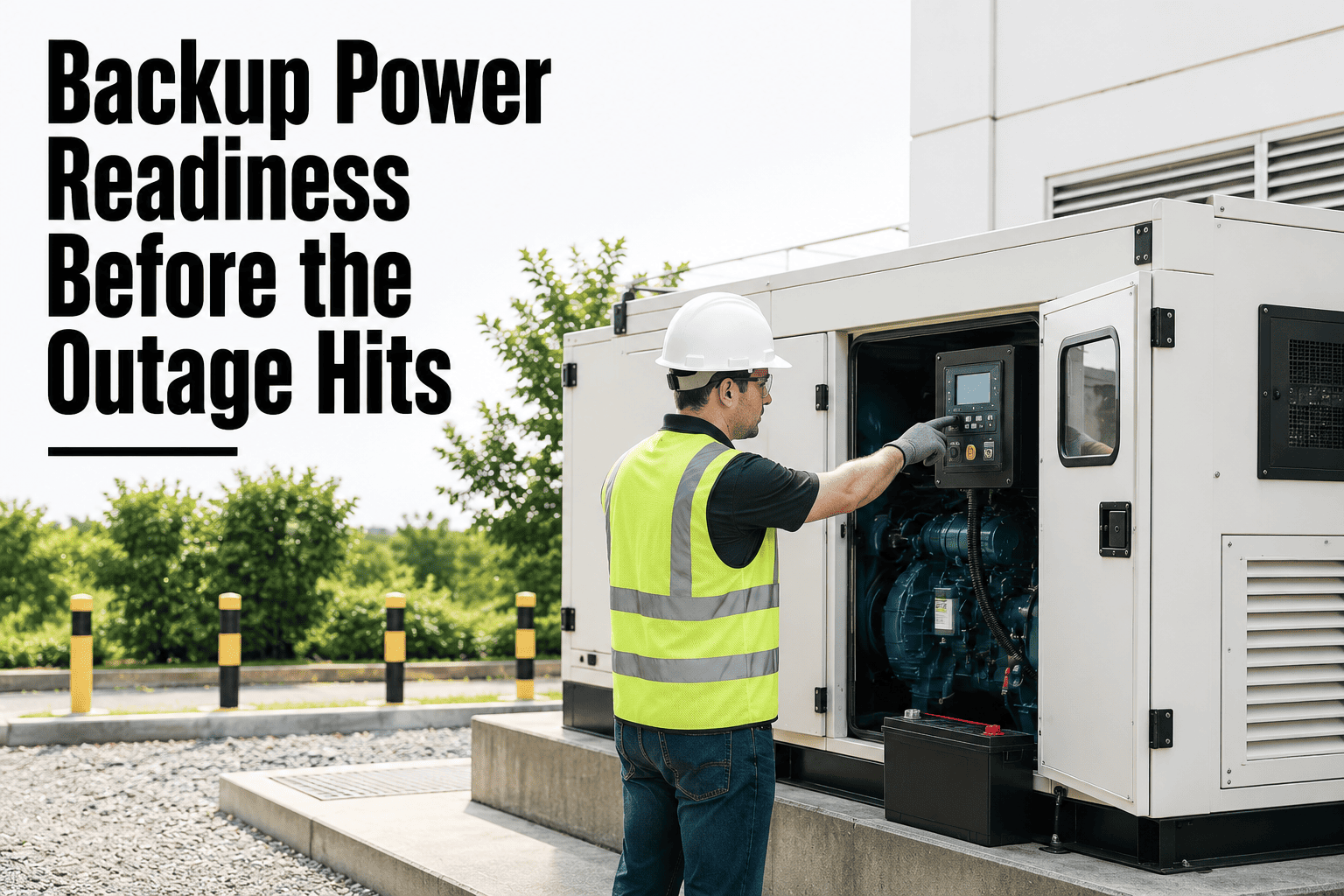
Cold storage emergency backup power readiness is the single variable that determines whether a facility rides through a utility outage or loses a six-figure product load to temperature excursion. When the grid fails, a 10,000-square-foot freezer room can breach its critical threshold in under four hours — and once product temperature crosses the line, there is no undoing it. This backup power guide walks maintenance and reliability teams through the CMMS-driven practices — NFPA 110 generator testing, load bank verification, transfer switch servicing, and fuel quality management — that keep emergency power genuinely ready. Skip the guesswork: start your Start Free Trial and turn your backup power program into a verifiable, audit-ready system.
Is your generator ready to carry full load the second utility power drops?
In cold storage, backup power readiness is measured in minutes — not in the hope that the engine starts. NFPA 110 load tests, transfer switch cycles, and fuel polishing schedules must be verified, logged, and triggered automatically before the outage hits. A CMMS cold storage backup power program is what separates a routine event from a total product loss.
Why cold storage backup power failure is a CMMS problem, not just an electrical one
A 2022 industry analysis estimated that U.S. cold chain facilities lose over $50 billion annually to temperature-related spoilage — and power outages rank among the top three root causes. The failure rarely starts with a broken generator; it starts with a missed load-bank test, an unlogged fuel-polishing cycle, or a transfer switch that last exercised six months ago. Backup power failure is, at its core, a maintenance execution problem — which is exactly what a CMMS is built to solve.
CMMS cold storage backup power checklist: NFPA 110, fuel, ATS & load bank
Every item below must be scheduled, assigned, and verified with a digital signature. When these tasks live in a CMMS, an auditor can pull a complete readiness dossier in seconds — and a facility manager can sleep through a storm.
Generator Testing & Inspection
- Weekly no-load start & 30-min run (Level 1, Type 10)
- Monthly load-bank test at ≥30% nameplate capacity
- Annual full-load test for 4 continuous hours
- Coolant, oil, and battery specific gravity logged each test
Diesel Fuel Quality & Polishing
- Monthly water-bottom check via tank sight glass
- Quarterly fuel sampling for microbial contamination (ASTM D975)
- Biocide treatment & fuel polishing every 6 months
- 72-hour minimum on-site fuel supply verified
Transfer Switch Servicing
- Weekly no-load utility-to-gen transfer exercise
- Quarterly contact cleaning & torque verification
- Time-delay relay settings validated annually
- Retransfer to utility confirmed stable after cooldown
| Test / Task | Frequency | Standard | What a CMMS Verifies |
|---|---|---|---|
| No-load generator exercise | Weekly | NFPA 110 §8.4.1 | Run time, start sequence, oil pressure log |
| Transfer switch operation | Weekly | NFPA 110 §8.4.3 | Transfer & retransfer success, elapsed time |
| Load-bank test | Monthly | NFPA 110 §8.4.1.3 | Load %, exhaust temp, duration, fuel consumed |
| Fuel quality analysis | Quarterly | ASTM D975 / D7464 | Lab report attached, water & microbes flagged |
| Full-load endurance run | Annually | NFPA 110 §8.4.1.2 | 4-hour continuous log, cooling system performance |
What a backup power failure costs a cold storage facility
When backup power fails in a cold storage environment, the bill arrives in three envelopes: lost product, regulatory exposure, and reputational damage. Quantifying the risk turns "we should probably test the generator" into a funded maintenance initiative.
Product loss & emergency disposal
A single excursion event in a mid-sized freezer typically destroys $50K–$500K of inventory. If USDA or FDA inspectors determine the product entered commerce after a temperature breach, the facility faces mandatory recall costs that can exceed $2M.
Compliance & audit exposure
FSMA, HACCP, and SQF auditors demand documented evidence of backup power readiness. Without timestamped work orders and test logs, a facility risks a major non-conformance — which can suspend certifications and trigger customer-driven facility holds.
Insurance & premium impact
Cargo insurers increasingly require proof of NFPA 110 compliance before paying spoilage claims. Facilities without a documented maintenance record may face claim denials or premium hikes of 15–25% at renewal.
Don't wait for the next storm to find out your generator won't start.
Book a 30-minute demo and see how OxMaint automates every NFPA 110 test, fuel check, and ATS cycle — with audit-proof records.
How OxMaint keeps cold storage backup power actually ready
OxMaint turns backup power readiness from a binder of hope into a live, AI-driven maintenance program. Every generator, transfer switch, and fuel tank becomes a tracked asset with automated PM triggers, condition-based alerts, and a full digital trail.
Automated NFPA 110 PM Schedules
OxMaint auto-generates weekly, monthly, and annual generator test work orders — assigned to the right technician with checklists, pass/fail criteria, and mandatory photo upload. No test is ever skipped or forgotten.
Condition-Based Fuel Monitoring
Track fuel tank levels, water-bottom percentages, and polishing cycles in real time. OxMaint's AI predicts fuel degradation timelines and triggers biocide treatment before microbial growth reaches critical.
Audit-Ready Digital Records
Every work order, test result, meter reading, and signature is stored against the asset record. Generate a complete NFPA 110 readiness dossier for any inspector or insurer in under 60 seconds.
Predictive Failure Alerts
OxMaint's AI analyzes trend data — battery voltage decay, crank-time drift, exhaust temperature deviation — to flag developing failures weeks before an outage exposes them.
"Before OxMaint our generator test logs were paper in a binder. After a near-miss excursion during an ice storm, we switched. Now every weekly NFPA test auto-triggers, the tech gets a checklist on their phone, and I can pull a full readiness report for our SQF auditor in one click. We passed our last audit with zero non-conformances for the first time in facility history."
Backup power readiness FAQ for cold storage facilities
How often should cold storage generators be load-bank tested?
NFPA 110 requires Level 1 emergency power supply systems to undergo a load-bank test at least once every 36 months at 30% of nameplate rating for 30 minutes — but most cold storage operators test monthly at 30% capacity to catch fuel and cooling issues early. Annual full-load endurance runs of 4 hours are standard for critical facilities. OxMaint automates these schedules and logs every parameter. Start Free Trial to configure them in minutes.
What is the biggest cause of backup power failure in cold storage?
Fuel degradation accounts for approximately 38% of generator failures in standby applications. Water accumulation, microbial growth, and fuel aging cause filters to clog and engines to stall under load — usually at the worst possible moment. A CMMS-driven fuel management program with quarterly sampling and bi-annual polishing virtually eliminates this failure mode.
Can a CMMS prevent temperature excursions during a power outage?
Yes — indirectly but powerfully. A CMMS like OxMaint ensures the generator, ATS, and fuel system are tested, serviced, and verified on schedule so that when utility power fails, backup power engages within seconds and sustains load. It also tracks cold room door seals, refrigeration PMs, and alarm systems so the thermal envelope is intact before the outage even begins.
What NFPA 110 records do FSMA and SQF auditors expect to see?
Auditors expect timestamped logs of weekly no-load exercises, monthly load-bank tests, annual full-load runs, fuel quality reports, and ATS transfer cycles — all with technician signatures and any deficiencies noted and resolved. OxMaint stores every record against the asset and generates a compliance-ready report instantly. Book a Demo to see the audit module in action.
How long does it take to implement a CMMS for backup power in a cold storage facility?
Most cold storage teams are live on OxMaint within 2–4 weeks. Generator, ATS, and fuel tank assets are imported, NFPA 110 PM templates are applied, and technicians receive mobile access on day one. Because the platform is AI-powered and cloud-hosted, there is no server installation — you can begin scheduling backup power work orders the same day you start your trial.
Make backup power readiness automatic, verifiable, and audit-proof.
Join the cold chain operators who trust OxMaint to keep their generators, transfer switches, and fuel systems ready — before the outage hits.
Free 14-day trial · No credit card