Vision Inspection System Maintenance for FMCG Lines: Cameras, Lighting, and Lens
By Jack Edwards on May 16, 2026
Vision inspection systems fail silently. A camera lens fogged by condensation, an LED illumination bank at 60% intensity, or a calibration target drifting by 0.3mm — none of these trigger an alarm. The system continues running, accepting or rejecting products based on degraded image data, while the inspection accuracy that was validated at 99.8% during commissioning quietly drops toward 97%, then 95%, then below the threshold where label errors, seal defects, and fill shortfalls reach consumers. Start a free OxMaint trial and build a vision inspection PM program that holds accuracy above 99.5% — or book a demo to walk through a machine vision maintenance workflow.
FMCG Quality Systems · Machine Vision
Vision Inspection System Maintenance for FMCG Lines: Cameras, Lighting, and Lens PM
Vision inspection systems fail silently through dust, lighting decay, and calibration drift. Learn the preventive maintenance routine that keeps FMCG inspection accuracy above 99.5%.
Minimum inspection accuracy target for FMCG vision systems under BRCGS Issue 9 statistical process control requirements
3,000 hrs
Typical LED illumination half-life — beyond this, intensity drops and inspection accuracy degrades without triggering alarms
$180K
Average cost of a label error recall on a single FMCG SKU — the defect vision systems exist to catch before products leave the line
Weekly
Minimum lens cleaning frequency in high-humidity or spray-wash FMCG environments to maintain image sharpness
What Is Vision Inspection System Maintenance and Why Silent Failure Is the Defining Risk
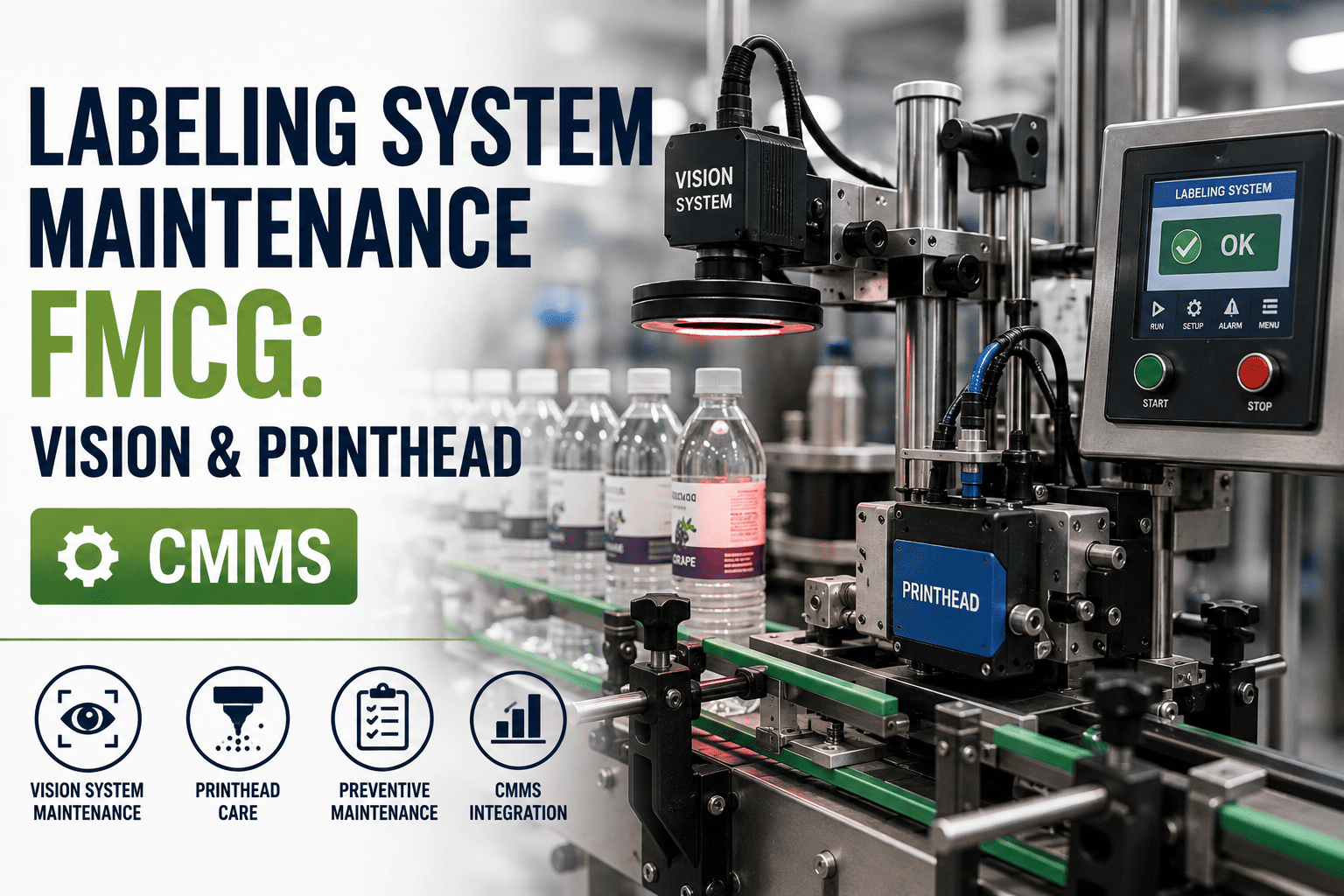
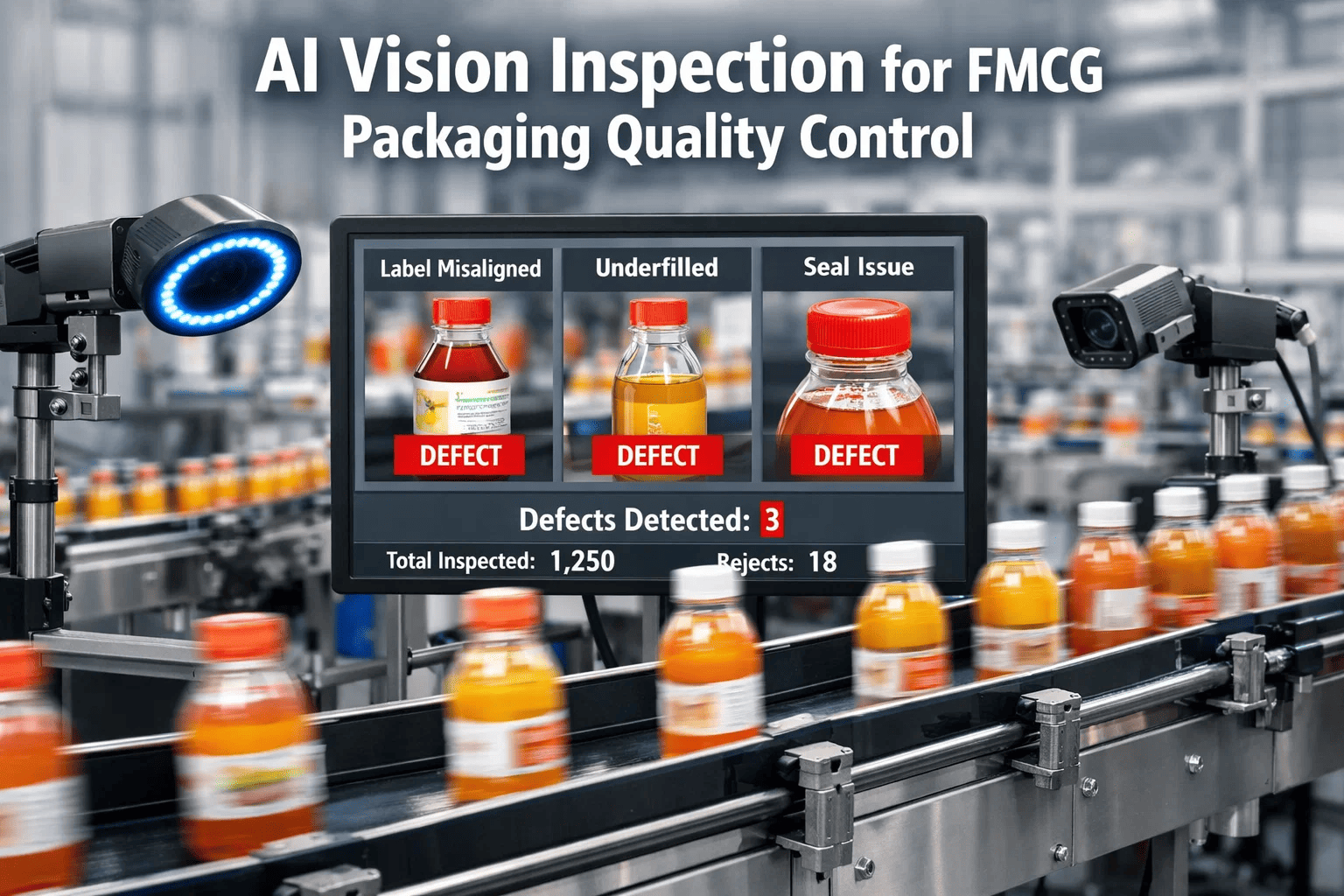
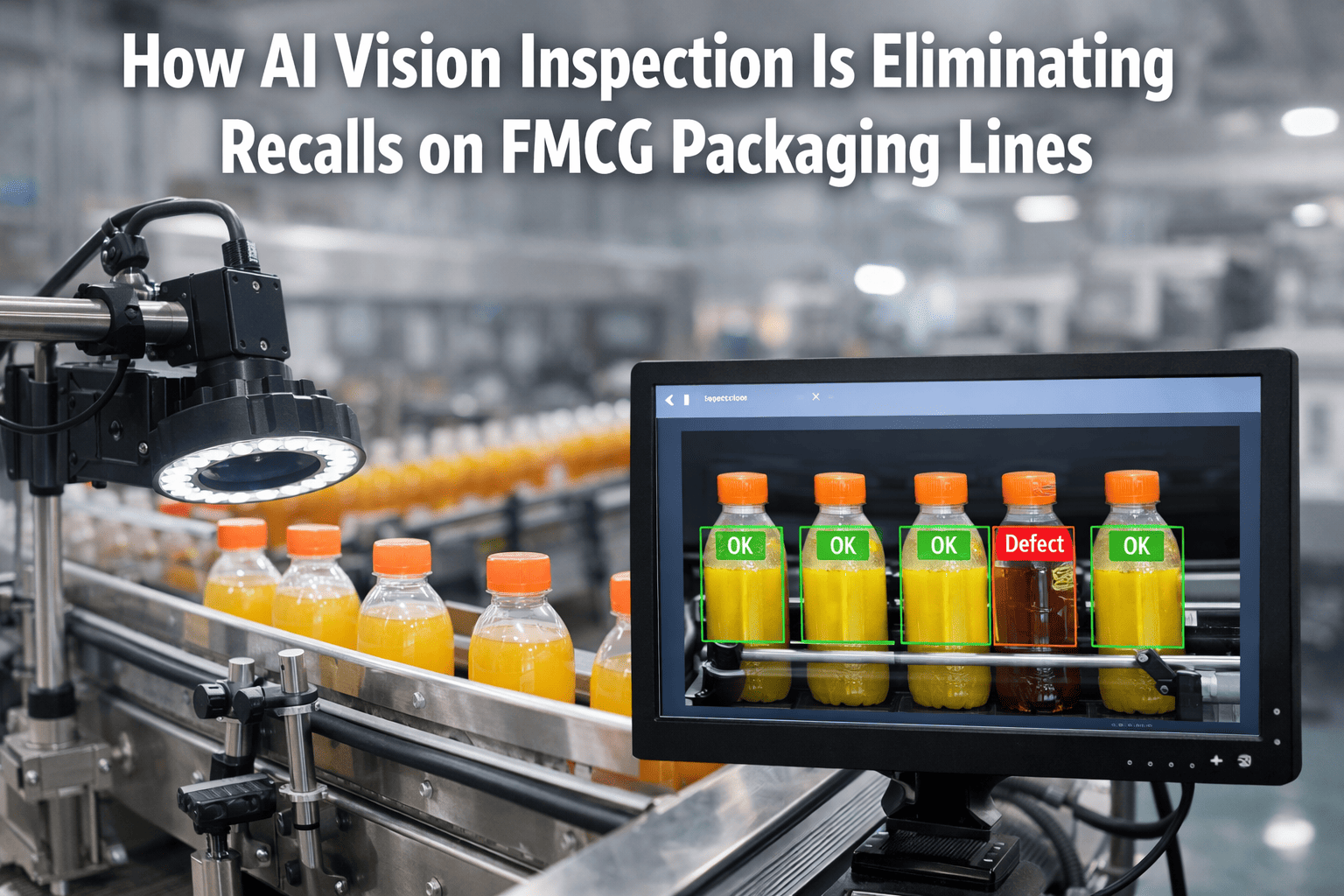
Machine vision inspection systems use industrial cameras, structured lighting, and image processing algorithms to inspect every product on a production line for defects — missing labels, incorrect labels, seal defects, underfill, overcap, date code errors, and foreign objects — at line speeds that make human inspection impossible. In FMCG manufacturing, vision systems are deployed as the final quality gate before primary packaging, secondary packaging, or despatch, and their performance directly determines how many defective products reach the consumer.
The defining maintenance challenge for vision inspection systems is that performance degradation is invisible to operational staff. Unlike a conveyor that stops running or a pump that makes noise when failing, a vision system running with a dusty lens, degraded LED illumination, or miscalibrated reference target continues to produce inspection results — they are simply less accurate. The gap between apparent performance and actual performance widens silently until a retailer audit, a consumer complaint, or a label error recall forces the investigation that should have been prevented by preventive maintenance.
Eight Core Concepts in Vision Inspection System Maintenance
Effective vision inspection PM requires understanding these eight technical domains that govern system accuracy and the maintenance actions that maintain it across the equipment lifecycle.
01
LED Illumination Life Management
LED illumination systems degrade gradually — intensity drops approximately 20% in the first 1,000 hours and continues declining. At 50% intensity, the image contrast that algorithms depend on is insufficient for reliable defect detection. LED half-life tracking in a CMMS enables planned replacement before intensity drops below the calibration threshold.
02
Lens Cleaning Protocol
Dust, spray, product residue, and condensation accumulate on camera lenses in FMCG production environments. A 0.1mm film of dust reduces image contrast by 15–20% — sufficient to drop a 99.8% accuracy system below 99.5%. Weekly cleaning with appropriate optics-grade materials is minimum frequency; daily cleaning is best practice in wet or dusty lines.
03
Calibration Reference Targets
Vision systems calibrate image scale and reference dimensions against a physical target of known size and pattern. Calibration targets degrade through contamination, physical damage, and UV exposure. A worn or dirty calibration target produces incorrect scale references that cause dimensional inspection errors — defects accepted, conforming products rejected.
04
Camera Alignment Verification
Camera position relative to the inspection zone is set during commissioning and must be maintained. Vibration from adjacent equipment, maintenance activities, and belt changes can shift camera alignment by fractions of a millimeter — sufficient to move inspection windows outside their validated positions and miss defects that fall outside the misaligned field of view.
05
Algorithm Validation on Product Change
Vision inspection algorithms are trained and validated against specific product images — label design, fill level, pack geometry, and date code position. When any of these change — label redesign, packaging change, fill weight adjustment — the algorithm must be re-trained and re-validated before production resumes or the system inspects against outdated reference images.
06
Reject System Integration Testing
Vision system defect detection is only valuable if the reject mechanism physically removes the detected defect from the product stream. Air blast timing, pusher stroke, and diverter position must be verified at each shift start using known defect samples. A detection event without physical rejection produces a false compliance record — the defect is logged as detected but reaches the consumer.
07
Statistical Accuracy Trending
Inspection accuracy — the ratio of correctly classified products to total products inspected — should be trended continuously. A declining accuracy trend, increasing false reject rate, or narrowing statistical process control window are early warning indicators of LED degradation, lens fouling, or algorithm drift. Trending enables proactive intervention rather than reactive investigation after a customer complaint.
08
Environmental Condition Control
Temperature fluctuations cause camera sensor thermal drift that affects pixel sensitivity. Relative humidity above 80% accelerates lens condensation and connector corrosion. Vision systems in wet environments require IP65 or IP69K enclosures with sealed connectors, and environmental monitoring should be part of the periodic PM to confirm operating conditions remain within the system's validated range.
The Vision Inspection Pain Points That Cost FMCG Facilities Their Certifications
Vision inspection failures in FMCG follow a predictable progression from silent degradation to expensive discovery. These four pain points are the most common root causes behind label error recalls, retailer audit failures, and production quality escapes in facilities without structured vision inspection PM programs.
LED Illumination Decay Degrading Inspection Accuracy
LED illumination intensity decay is the single largest contributor to silent vision inspection failure in FMCG operations. Systems commissioned at 100% LED intensity operate without issue for 1,000–1,500 hours, then begin to show increasing false accept rates as image contrast declines. Most facilities discover the problem only when a consumer complaint or retailer audit traces a defect escape back to a period of degraded illumination performance.
Algorithm Not Updated After Label Redesign
Label redesigns — changed font, repositioned date code, updated artwork — require full vision algorithm re-training and re-validation before production runs with the new label. When a label change is treated as a design task rather than a maintenance event, vision systems continue inspecting new labels against old reference images. Conforming new labels are rejected as defects; defective prints pass inspection because the reference tolerances no longer apply to the new design.
Lens Fouling Creating Inspection Windows Without Alerts
In FMCG production environments with spray wash operations, steam cleaning, or high-humidity zones, camera lenses foul within hours of a cleaning event. A fouled lens degrades image sharpness and reduces effective resolution — but the system produces no alarm, continues generating inspection pass records, and logs a 100% inspection completion rate against what is effectively a blurred image field.
Paper PM Records Failing BRCGS Verification Activities
BRCGS Issue 9 requires documented verification that vision inspection systems are operating at validated performance levels — including cleaning records, accuracy statistics, and calibration verification. Paper records for vision inspection PM are among the most commonly incomplete set in FMCG quality systems, because cleaning activities are perceived as minor tasks not worth recording. An auditor requesting six months of lens cleaning and calibration verification records from a paper system typically receives a partial, illegible, or missing record that generates a non-conformance.
Vision systems failing silently are the most expensive quality problem in FMCG — they produce compliance records while accuracy degrades below validated thresholds.
How OxMaint Manages Vision Inspection System PM
OxMaint connects LED life tracking, lens cleaning schedules, calibration verification, algorithm re-validation events, and accuracy trending to a single maintenance record — eliminating the silent failure gap that costs FMCG facilities their inspection accuracy and their certifications.
LED Hour Tracking and Replacement Planning
Each illumination bank is tracked as a component asset with accumulated operating hours logged against rated half-life. OxMaint generates a planned replacement work order at 70% of rated LED life — giving the maintenance team time to source and schedule replacement before intensity drops below the calibration threshold, rather than discovering performance loss after product has shipped.
Daily and Weekly Lens Cleaning Schedules
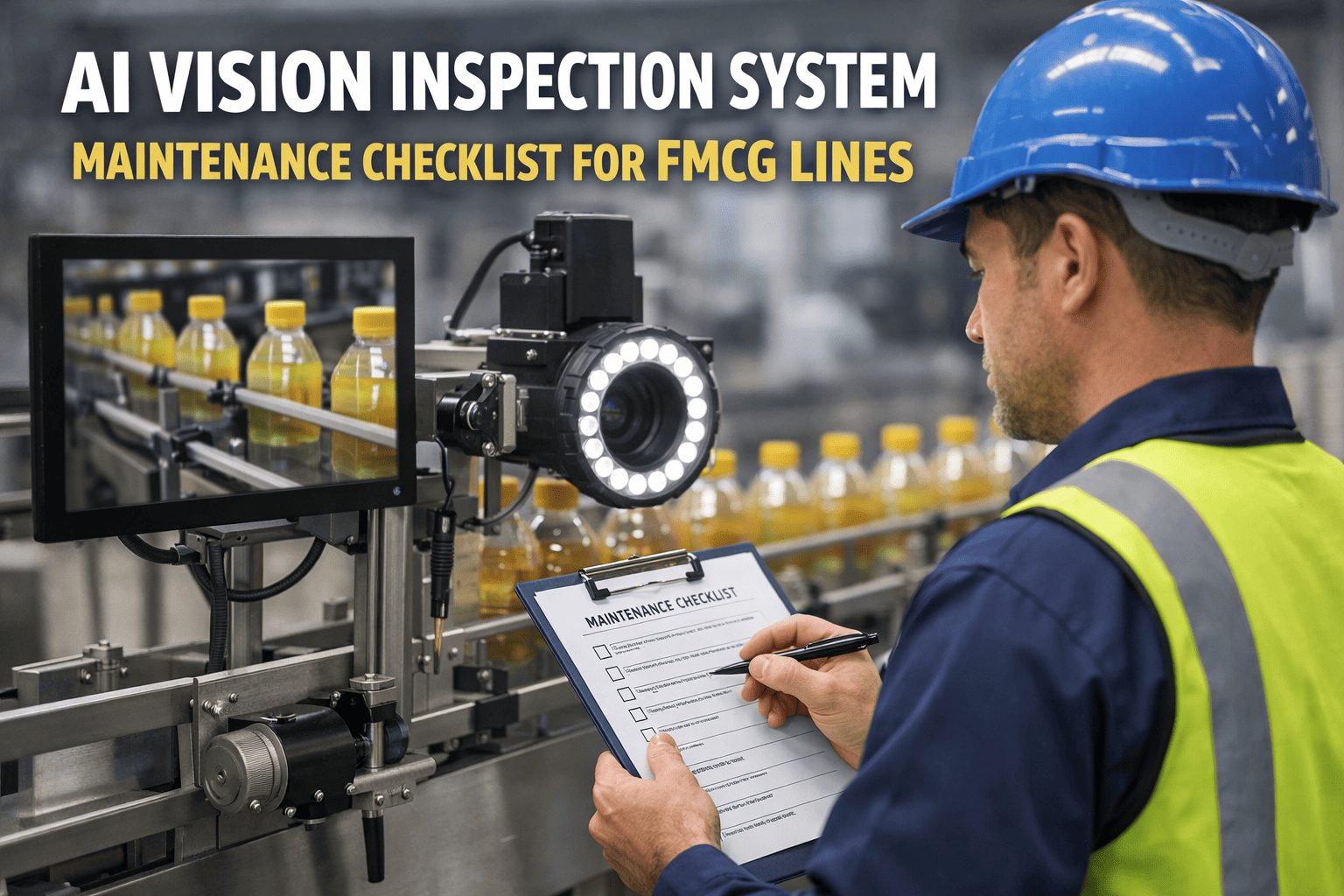
Lens cleaning tasks are scheduled as daily PM activities in wet or dusty production environments, with weekly tasks in dry ambient conditions. Operators complete the cleaning task on mobile, capturing the pre-clean and post-clean image clarity check result. Every cleaning event is timestamped and stored — creating the six-month verification record that BRCGS auditors request and paper systems fail to provide.
Calibration Reference Target Inspection
Monthly PM work orders include calibration target inspection — checking for contamination, surface damage, and dimensional accuracy using a reference measurement. When a target fails inspection, a corrective work order triggers replacement procurement and re-calibration before the system returns to production. Calibration records link to target inspection records in the same asset history.
Label Change Algorithm Re-Validation Trigger
When a product specification change is logged in OxMaint — new label design, packaging material change, or fill weight adjustment — a conditional work order is generated for vision algorithm re-validation before the product runs. Re-validation records capture test image results, acceptance criteria, technician sign-off, and the date the new algorithm was activated — preventing the HACCP gap created by running old algorithms on changed products.
Accuracy Trend Dashboard
OxMaint aggregates inspection accuracy statistics from each vision system — by shift, day, product, and camera — and surfaces trending data on the quality dashboard. Declining accuracy trends trigger a maintenance alert before they breach the validated threshold. Quality managers see early warning indicators rather than investigating retroactively after a defect escape reaches the market.
BRCGS and SQF Audit Export
When a BRCGS or SQF auditor requests vision inspection maintenance records — cleaning logs, calibration verifications, accuracy statistics, algorithm validation records — the filtered export covers all systems across the audit period in minutes. Every PM activity, accuracy check, and corrective action is included with timestamps and technician identification — the complete verification package auditors require.
Reactive vs. Planned: Vision Inspection PM Comparison
PM Requirement
Reactive Approach
OxMaint Planned Program
LED life tracking
Replaced only after visible brightness failure
Hour-tracked — replacement planned at 70% of rated life
Lens cleaning frequency
Cleaned when operators notice blurred images
Daily or weekly scheduled task — timestamped, signed
Calibration target inspection
Assumed current — replaced after calibration failure
Monthly PM inspection — dimensional check recorded
Algorithm re-validation on label change
Not triggered — label change managed by design team
Spec change triggers algorithm validation work order
Camera alignment verification
Checked only after false reject complaints
Quarterly PM alignment check — position recorded
Accuracy trend monitoring
No trending — discovered at retailer audit or complaint
Continuous dashboard — alert fires on declining trend
Reject system integration test
Assumed functional — tested before audits only
Shift-start defect sample test — result logged
Audit record completeness
Paper cleaning logs — incomplete, illegible, or missing
Digital records — 6-month export in 5 minutes
Scroll right to view full table on mobile
ROI from a Structured Vision Inspection PM Program
vs. 96–98% accuracy on FMCG lines managing vision PM reactively without LED life tracking or cleaning schedules
$180K
Average label error recall cost prevented
Each prevented label defect escape justifies the entire annual CMMS cost across the facility — often many times over
40%
Reduction in false reject rate
Maintained LED intensity and calibration accuracy reduces over-rejection of conforming products — recovered directly as production yield
5 min
BRCGS verification record export
vs. hours assembling paper cleaning logs, calibration certificates, and accuracy reports before each scheme audit
Frequently Asked Questions
How often should FMCG vision inspection cameras and lenses be cleaned?
Cleaning frequency depends on the production environment. In wet environments — wash-down zones, steam-intensive lines, or high-humidity areas — daily lens cleaning is best practice and should be a mandatory pre-shift task. In dry ambient FMCG environments, weekly lens cleaning is the minimum frequency. Cleaning must use optics-grade lens wipes or cloths with an appropriate optical cleaning solution — standard production cloths leave residues that accelerate fouling. After cleaning, a visual clarity check using the system's live image should confirm the lens is clear before production resumes. All cleaning events should be logged in a CMMS with the pre-clean clarity rating, cleaning method, and post-clean confirmation to build the verification record auditors require.
What triggers a full vision algorithm re-validation in FMCG production?
A full vision algorithm re-training and re-validation is required whenever any parameter that the algorithm was trained on changes. This includes label design changes — new fonts, repositioned date codes, updated artwork, or changed color profiles. It also includes packaging changes — new material, changed gloss level, different geometry — and product changes that affect the visual profile of the pack. Fill weight changes that alter the visible product level in transparent packs require re-validation. Line speed changes that alter the pixel resolution per unit length require re-validation of algorithms dependent on dimensional measurements. Algorithm re-validation must use representative samples of the new product, cover all defect categories in the inspection specification, and be signed off by a qualified quality authority before production resumes.
What does BRCGS Issue 9 require for vision inspection system PM records?
BRCGS Issue 9 Clause 6.4 requires that inspection equipment used to ensure product safety and quality is maintained to prevent inaccurate results. For vision inspection systems, auditors typically request evidence of: defined cleaning frequency with records of completion; calibration verification activities at defined intervals with pass/fail results; accuracy statistics demonstrating the system is operating within validated performance parameters; records of algorithm re-validation after product or label changes; and corrective action records for any identified performance deviations. Records must be available for the full audit cycle — typically 12 months — and must be attributable to a named technician. Paper records frequently fail on the completeness and legibility requirements; digital CMMS records satisfy all elements automatically.
How does OxMaint track LED illumination life for vision inspection systems?
In OxMaint, the LED illumination assembly for each vision system is registered as a component asset with the manufacturer's rated half-life in hours and the installation date recorded. Operating hours are logged during each PM visit from the system's hour meter or operating log. When accumulated hours approach 70% of rated half-life, OxMaint generates a replacement planning work order — assigned to the maintenance team with the LED assembly specification and approved supplier details attached. This approach ensures illumination intensity is maintained within the validated range without waiting for visible performance degradation, which in a production environment typically occurs after inspection accuracy has already dropped below the acceptable threshold.
Hold Accuracy Above 99.5%. Every Shift.
Stop Losing Inspection Accuracy to Silent LED Decay and Lens Fouling — Build a Vision PM Program with OxMaint
LED life tracking and planned replacement. Daily and weekly lens cleaning schedules. Calibration reference target inspection. Algorithm re-validation on product change. Accuracy trend dashboard. BRCGS and SQF audit export in minutes. OxMaint connects every vision inspection PM task to a complete, traceable record that holds accuracy above validated thresholds and keeps your quality certifications secure.
LED intensity tracked — replacement before silent accuracy loss
Algorithm re-validation triggered automatically on product change
6-month BRCGS verification record export ready in 5 minutes
Used by FMCG quality teams managing machine vision inspection across multi-line, multi-site portfolios. Live in days, not months.