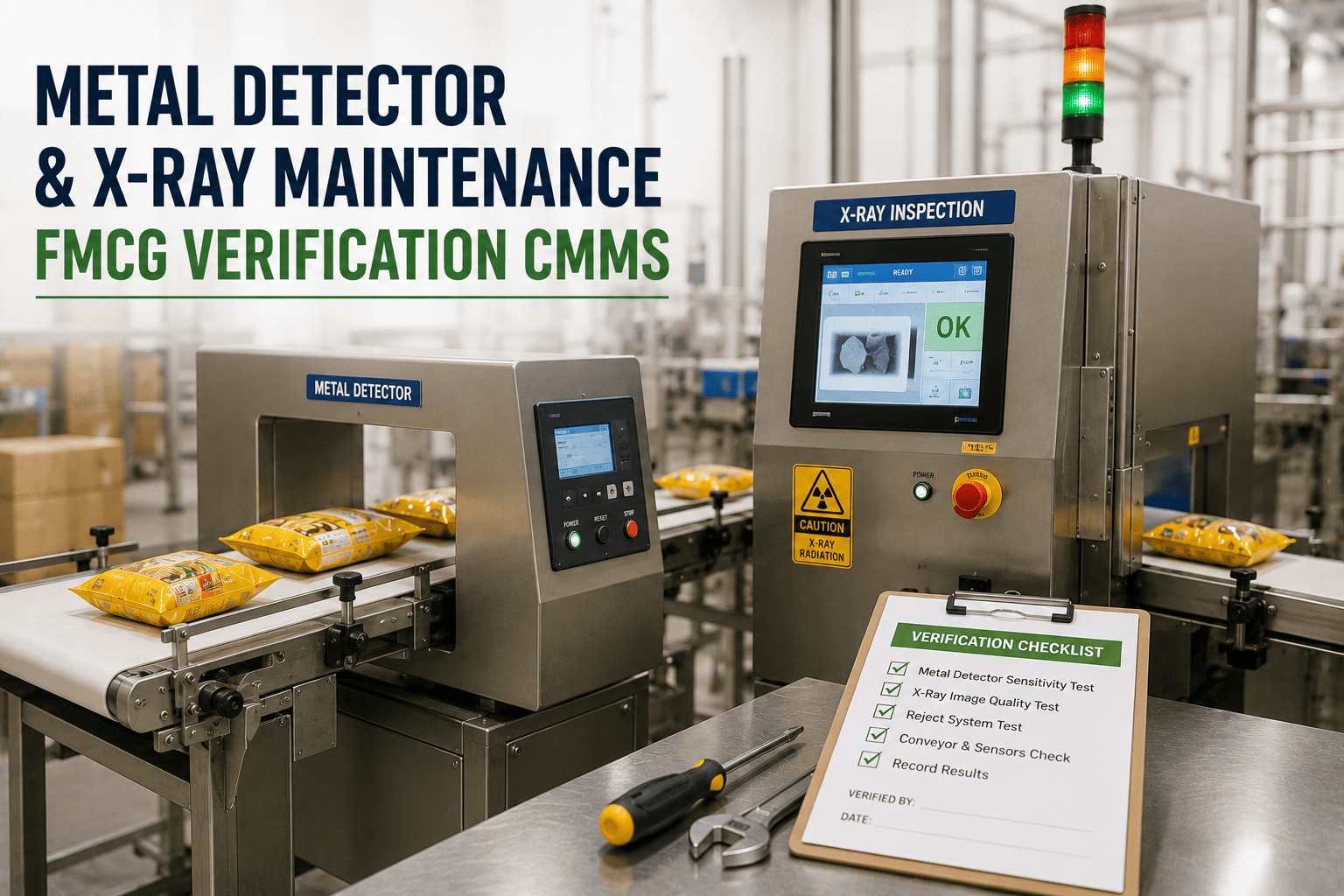
Metal Detector Maintenance for FMCG: Sensitivity Tests, Phase Setup, and CCP Logs
By Jack Edwards on May 16, 2026
A metal detector that fails to reject a contaminated pack during production is not just a food safety failure — it is an unreported Critical Control Point deviation that, when discovered during a HACCP audit, can trigger immediate line shutdown, product recall, and in the USA, an FDA enforcement action. For FMCG manufacturers, the metal detector is not a convenience device. It is a CCP, legally required to perform at validated sensitivity settings every operational period. Start a free OxMaint trial and build a digital metal detector CCP program from day one — or book a demo to see a metal detector HACCP maintenance workflow.
FMCG Food Safety · HACCP Critical Control Points
Metal Detector Maintenance for FMCG: Sensitivity Tests, Phase Setup, and CCP Logs
Avoid costly recalls with a metal detector CCP maintenance program auditors can verify quickly. Learn sensitivity testing, phase setup, and HACCP logging best practices for FMCG lines.
Average cost of a major FMCG metal contamination recall including logistics and brand damage (USDA data)
1.5mm
Ferrous detection sensitivity target for dry FMCG products under BRCGS Issue 9 CCP validation standards
Every 30 min
Minimum CCP test card verification frequency required on active FMCG production lines under HACCP plans
No. 1
Metal detection is the most common CCP deficiency finding in GFSI scheme audits across food manufacturing
What Is Metal Detector Maintenance and Why CCP Status Changes Everything
An industrial metal detector detects ferrous, non-ferrous, and stainless steel contaminants in food products by generating an electromagnetic field and sensing disruptions caused by metallic particles. In FMCG manufacturing, this device is almost always designated a Critical Control Point under HACCP — meaning it is the last identified control measure before a product reaches the consumer. Failure of this control point means contaminated product reaches the market.
CCP designation changes the maintenance obligation fundamentally. A metal detector is not maintained to keep a production aid running — it is maintained to demonstrate continuous, validated performance at defined sensitivity thresholds. Every operational period, the detector must be tested with certified test pieces at the validated sensitivity level, and every test must be recorded. If a test fails, all product since the last passing test must be put on hold and investigated. This is not optional protocol — it is HACCP plan compliance.
Eight Core Concepts in Metal Detector Maintenance for FMCG
Effective metal detector CCP management requires technical literacy across eight domains. These concepts define a program that satisfies BRCGS, SQF, FSSC 22000, and FDA FSMA requirements simultaneously.
01
CCP vs. Control Measure
A CCP is a step at which control is essential to prevent or reduce a food safety hazard to acceptable levels. Metal detection designated as a CCP requires validated sensitivity limits, defined monitoring frequency, corrective action procedures, verification activities, and complete records — all mandated elements of HACCP Principle 6 (record keeping).
02
Sensitivity and Detection Limits
Sensitivity is defined as the smallest test piece the detector reliably rejects under worst-case conditions — product in the most challenging orientation, at maximum line speed. BRCGS Issue 9 defines minimum detection limits: 1.5mm ferrous, 2.0mm non-ferrous, 2.5mm stainless steel for dry products. Wet products require product-specific validation due to product effect.
03
Phase Angle Setup
Phase angle compensates for the electromagnetic signal generated by the product itself — known as product effect. High moisture, salt, and conductive ingredients create strong product signals that can mask contaminants. Correct phase angle setup separates the product signal from a metallic contaminant signal. Phase must be set per product and verified after every product changeover.
04
Test Card Validation
Test cards are HACCP-validated test pieces containing spheres of ferrous metal, non-ferrous metal, and stainless steel at the validated detection limit. Test cards must be passed through the detector in the product stream at the defined frequency — typically every 30 minutes — and the result recorded. Test cards themselves must be calibration-certified and replaced when worn or damaged.
05
Reject System Confirmation
A metal detector that detects but does not reject is no better than one that misses contamination entirely. Reject mechanism testing — air blast, pusher, or flap diverter — must be part of every CCP check to confirm the full detection-to-rejection chain functions correctly. Reject bin full-detection sensors must also be verified to prevent bypass accumulation.
06
Coil Condition and Alignment
The transmitter and receiver coils must be mechanically aligned and free of physical interference from adjacent metallic structures. Vibration from conveyors, frame distortion, and coil contamination progressively degrade sensitivity. Quarterly coil inspection and alignment verification is standard PM practice for high-throughput FMCG metal detectors.
07
Sensitivity Drift Monitoring
Metal detectors do not typically fail catastrophically — they drift. Monthly trending of sensitivity test results against the validated limit provides early warning of degrading performance before the instrument produces a formal CCP failure. A CMMS that trends calibration data across operational periods allows maintenance teams to see drift before it becomes a non-conformance.
08
Corrective Action Documentation
When a CCP check fails, HACCP Principle 5 requires defined corrective actions: isolate and evaluate product, identify and correct the cause, and record all actions taken. Corrective action records must link directly to the failed CCP check record and include product disposition decisions, investigation findings, and sign-off by a qualified authority. This linkage is what auditors verify.
The FMCG Metal Detector Pain Points That Trigger Recalls and Audit Failures
The consequences of metal detector program failures are immediate and expensive. These four scenarios are the most common root causes behind FMCG metal contamination recalls and GFSI audit non-conformances — and each one is preventable with a structured CMMS-tracked CCP maintenance program.
Phase Setup Not Updated After Product Changeover
When phase angle is not reconfigured between products with different moisture or conductivity profiles, the detector's product-effect compensation is mismatched. The result is a high false-reject rate — or worse, a reduced effective sensitivity that allows contaminants to pass undetected. Phase setup errors are the leading cause of metal detector CCP failures in multi-SKU FMCG operations.
CCP Test Records Incomplete During Audit
GFSI scheme auditors require every CCP test to be recorded with time, result, and technician identification. Paper CCP logs regularly present with gaps — missed tests during busy production periods, illegible handwriting, or shifts where the log was never retrieved. A single gap in a CCP log during an audit is a major non-conformance that can trigger suspension of certification.
Reject System Failure Allowing Contaminated Product Through
An air blast reject that has lost pressure, a flap diverter with a mechanical fault, or a pusher with timing drift will fail to physically remove a detected contaminant from the product stream. If reject system function is not tested at each CCP check, the detection event creates a record of apparent control while the contaminated product continues downstream.
Sensitivity Drift Discovered Only at Annual Service
Without monthly sensitivity trending, a metal detector can drift from 1.5mm to 2.2mm ferrous detection sensitivity over six months of coil wear, vibration-induced misalignment, and electronic component aging — all while passing daily test card checks at the original setting. Annual service discovers the drift after 180 days of product have shipped at reduced protection.
FMCG facilities without CMMS-tracked CCP logs face a 3x higher rate of audit major non-conformances on metal detection than those with digital records.
How OxMaint Manages Metal Detector CCP Programs
OxMaint connects every metal detector CCP test, phase setup record, sensitivity verification, and corrective action to a single digital audit trail — eliminating the paper gaps that cost FMCG facilities their GFSI certification.
30-Minute CCP Test Checklists
Configure digital CCP test checklists that trigger every 30 minutes during production. Operators confirm ferrous, non-ferrous, and stainless test card pass results, reject system function, and any alarms — timestamped and signed on mobile device. No paper log gaps. Every test is on record the moment it is completed.
Product Changeover Phase Setup Records
Work orders triggered by product changeover include a phase setup verification step — confirming the phase angle has been reconfigured for the incoming product and the sensitivity test has been passed at the new setting. Phase setup records are stored against the product-detector combination and retrievable for HACCP verification audits.
CCP Failure and Corrective Action Workflow
When a CCP test fails, OxMaint immediately generates a corrective action work order — product hold decision, investigation assignment, and required sign-off all tracked in the system. The failed test record links directly to the corrective action record. When an auditor requests the corrective action history for a specific CCP failure, the complete linked record is available in seconds.
Monthly Sensitivity Trending
OxMaint stores every sensitivity verification result over time. Quality managers can view sensitivity trends by detector, product, and shift — identifying gradual drift before it reaches a non-conformance threshold. Trend alerts fire when sensitivity readings approach the validated limit, allowing planned maintenance before a CCP failure occurs.
Test Card Asset Tracking
Each test card set is an asset in OxMaint with its calibration certificate, expiry date, and sphere sizes documented. Alerts fire when test cards approach replacement or recertification dates — ensuring CCP tests are never performed with an expired or worn test piece, which would invalidate the verification record in an audit.
HACCP Audit Export by Line and Date
When a BRCGS or SQF auditor requests six months of CCP records for a specific production line, the filtered export is generated in minutes. Records include test times, results, technician IDs, phase settings, corrective actions, and test card certificate references — the complete HACCP documentation package in one export.
Reactive vs. Planned: Metal Detector CCP Program Comparison
CCP Requirement
Reactive Approach
OxMaint Planned Program
30-minute test card check
Paper log — gaps during busy periods
Digital checklist — timestamped, mandatory every 30 min
Phase angle setup at changeover
Done from memory — often skipped on fast changeovers
Changeover work order includes phase verification step
Reject system test
Tested at start of shift — forgotten during production
Included in every 30-minute CCP checklist
CCP failure corrective action
Verbal decision — product hold not documented
Corrective action work order auto-generated on failure
Sensitivity trend monitoring
No trending — drift discovered at annual service
Monthly trend report — alert fires before limit breach
Test card certification
Unknown expiry — often used beyond certification date
Asset record with expiry alert — never test with expired card
Coil alignment inspection
Inspected only after sensitivity complaints
Quarterly PM inspection — condition scored and recorded
Audit record retrieval
Hours searching paper CCP logs by date
Filtered export by line, date, product in under 5 minutes
vs. 58% for FMCG facilities using paper-based metal detector CCP logs during GFSI scheme audits
$10M+
Average recall cost prevented
Each prevented metal contamination recall justifies years of CMMS investment across the entire facility
Zero
CCP log gaps in digital records
Digital timestamped checklists eliminate the incomplete records that cause GFSI major non-conformances
5 min
To export 6 months of CCP records
vs. hours manually assembling paper CCP logs before each BRCGS, SQF, or customer audit
One metal contamination recall costs more than a decade of CMMS investment. The math makes a structured CCP program non-negotiable.
Frequently Asked Questions
How often must metal detector CCP checks be performed on a FMCG production line?
HACCP plans for FMCG metal detection CCPs typically require test card verification every 30 minutes during production, at the start of each shift, after any production stoppage of more than 15 minutes, after any maintenance activity on the detector, and after every product changeover. The 30-minute frequency is the industry standard for high-risk products. Some retailer codes of practice — particularly for baby food, ready-to-eat, or high-risk products — require more frequent verification. The frequency should be defined in your HACCP plan and validated with your scheme certification body.
What is product effect and how does it affect metal detector sensitivity?
Product effect is the electromagnetic signal generated by the food product itself as it passes through the metal detector aperture. Wet products, products with high salt content, and products containing conductive ingredients generate strong product signals that can partially or fully mask the signal from a metallic contaminant. Phase angle compensation is the technique used to separate the product signal from a contaminant signal. When phase is incorrectly set — which happens when phase settings from one product are applied to a different product without reconfiguration — effective sensitivity is reduced and the validated detection limit is no longer achievable. Phase setup must be verified with a sensitivity test after every product changeover.
What happens if a metal detector CCP check fails during production?
When a CCP test card check fails, immediate corrective action is required. Production must be stopped, all product produced since the last passing CCP check must be placed on hold and physically segregated, and an investigation must be initiated to determine the cause of the failure. Once the cause is identified and corrected, the detector must be re-verified at the validated sensitivity before production resumes. Product on hold must be evaluated — typically re-inspected through a verified detector or destroyed. All actions taken must be documented in the corrective action record linked to the failed CCP check. This documentation is a legal requirement under HACCP Principle 5 and a mandatory GFSI audit record.
How does OxMaint handle metal detector records for multi-line, multi-shift FMCG operations?
Each metal detector is registered as an asset in OxMaint under the production line hierarchy. CCP checklists are configured per detector with the validated frequency, test piece sizes, and phase settings for each product run. Operators complete checks on mobile devices — no paper — and records are stored with shift, operator ID, line, and product identification. Quality managers view CCP compliance across all lines on a single dashboard. When an auditor requests records for a specific line, shift, or product, the filtered export includes all CCP tests, corrective actions, phase setup records, and test card certificates for the requested period — assembled automatically rather than manually.
Protect Every Pack. Document Every Check.
Stop Leaving Metal Detection CCP Compliance to Paper — Build an Audit-Ready Program with OxMaint
30-minute CCP checklists. Phase setup records per product changeover. Corrective action workflows. Sensitivity trend monitoring. Test card certificate tracking. Audit-ready export in minutes. OxMaint connects every metal detector CCP event to a complete, traceable, timestamped record that keeps your FMCG lines compliant and your GFSI certification secure.
Zero CCP log gaps — digital timestamped records on every check
Corrective action linked to failed CCP record automatically
6-month HACCP export ready in under 5 minutes for any auditor
Used by FMCG operations teams managing metal detector CCPs across multi-line, multi-site portfolios. Live in days, not months.