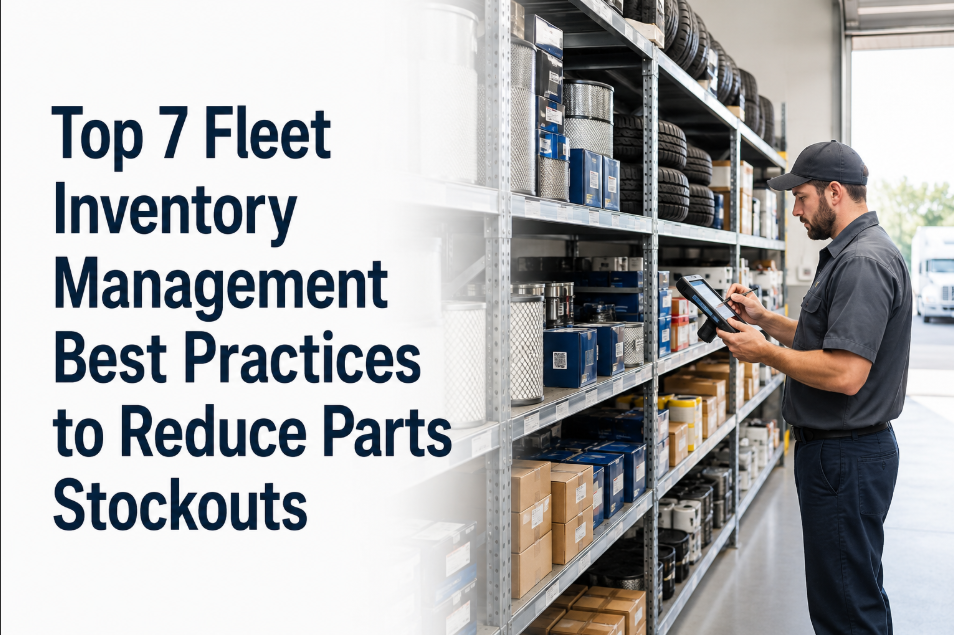
Stockouts are the silent budget killer in fleet maintenance. When a technician opens a work order and the required part is not on the shelf, the repair stops. The vehicle sits. Downtime accumulates. And someone pays a premium freight charge to get the part delivered overnight — if it can be sourced at all. Across commercial fleets in North America and the UK, parts stockouts cause 34% of all repair delays. That is not a supply chain problem. It is an inventory management problem — and it is largely preventable with the right systems and practices. The seven practices in this guide are drawn from fleet operations that have eliminated chronic stockouts while simultaneously reducing inventory carrying costs by 18–25%. The core insight is that the two goals are not in conflict: fewer stockouts and lower carrying costs are achieved together by replacing guesswork inventory management with data-driven reorder automation. If you want to see how Oxmaint's CMMS handles fleet inventory management end to end, start a free trial and explore the inventory module, or book a demo with our fleet team to walk through your specific storeroom setup.
Top 7 Fleet Inventory Management Best Practices to Reduce Parts Stockouts
Stockouts cause 34% of fleet repair delays. These seven practices eliminate them — without inflating your inventory carrying costs.
Why Fleet Parts Stockouts Keep Happening
Most fleet stockouts are not caused by unpredictable demand. They are caused by predictable demand that no one tracked. The same brake pads, filters, and belts that failed last quarter will fail again — the timing is different but the pattern is measurable. The root causes below drive the majority of fleet stockout events across commercial, municipal, and industrial fleets.
The 7 Best Practices That Eliminate Stockouts
Reorder point = (Average daily usage × Lead time in days) + Safety stock. Average daily usage should be calculated from 12 months of actual consumption history in your CMMS, not estimated. Lead time should be the actual delivery time from your primary supplier for each part number, not a generic assumption. Safety stock should account for usage variability — high-variability parts need more buffer than predictable consumables. In practice, fleets that migrate from intuition-based to calculation-based reorder points reduce stockout frequency by 60% within 90 days. Oxmaint calculates and updates reorder points automatically from work order consumption history — no spreadsheet required.
The storeroom team should see upcoming PM work orders 2–4 weeks in advance so they can verify parts availability and initiate procurement before work begins. A CMMS that connects PM schedules to inventory records allows the system to automatically flag when a scheduled PM requires parts that are below reorder point. Fleets using this integration report a 45% reduction in technician wait time for parts on scheduled maintenance events. The principle is simple: scheduled maintenance is predictable demand — treat it that way. Oxmaint's PM scheduling module links directly to inventory records, and parts shortfalls for upcoming work orders surface automatically in the storeroom dashboard. Start a free trial to see this workflow in action, or book a demo for a guided walkthrough.
Not all parts deserve equal attention. ABC classification divides inventory into three tiers based on usage value (annual usage × unit cost): A-class items (typically 20% of SKUs representing 80% of inventory value) require tight control and frequent review. B-class items (30% of SKUs, 15% of value) need regular monitoring. C-class items (50% of SKUs, 5% of value) can run on simple automatic reorder. Applying this framework prevents the common failure mode where storeroom staff spend equal time on $2 filters and $400 alternators. Fleet storerooms that implement ABC classification report 30% improvement in cycle count accuracy and 18% reduction in overall carrying cost because C-class items are managed on bulk auto-reorder rather than manual tracking.
Inventory accuracy collapses when parts are pulled from the storeroom without being logged against a work order. This happens constantly in fleets that rely on verbal requests, honor systems, or unlocked storerooms. The result is a steadily growing gap between system on-hand quantities and physical stock — until someone discovers the brake pads the system says are there are not actually on the shelf. The practice is simple: every part issued from the storeroom must be linked to a specific work order in the CMMS before the part leaves the shelf. Mobile work orders with parts assignment functionality make this frictionless — the technician selects the part from the work order screen rather than pulling it manually. Fleets that enforce this process restore inventory accuracy from a typical 65–75% to 94–98% within 60 days.
Every fleet has seasonal demand patterns — winter tire changovers, summer AC system work, spring brake inspections before DOT roadcheck week, and pre-winter heating system preventive maintenance. These demand spikes are entirely predictable from 2–3 years of consumption history in a CMMS. Yet most fleet storerooms experience the same stockouts at the same seasonal peaks every year because no one built the seasonal forecast into procurement planning. The fix is to generate a seasonal demand report from your CMMS 8 weeks before each peak period, identify the top 10 parts by projected volume, and pre-stage inventory 30 days in advance. Fleets that implement this practice report zero seasonal stockouts after the first full year of operation, reducing seasonal premium freight costs by an average of $34,000 annually for mid-size commercial fleets.
Annual physical inventory counts are disruptive, time-intensive, and only correct inventory accuracy for a brief window after the count. Errors accumulate again immediately. The superior practice is rolling cycle counts — counting a subset of SKUs daily or weekly so that every item in the storeroom is counted 4–12 times per year. Using ABC classification, A-class items are counted weekly or bi-weekly, B-class monthly, and C-class quarterly. CMMS-generated cycle count lists make this frictionless — the storeroom manager receives a daily list of which SKUs to count, logs the physical count on mobile, and the system flags any discrepancy for immediate investigation. Fleets using rolling cycle counts maintain 95%+ inventory accuracy year-round versus the 65–70% that typically prevails between annual counts.
Even fleets with perfect internal inventory management will experience stockouts if a primary supplier goes out of stock, raises prices above procurement threshold, or experiences logistics disruption. For every part category that is critical to fleet operations — brakes, filters, belts, batteries, lighting — qualify at least two approved suppliers in your CMMS with current pricing and lead times. When the primary supplier cannot fulfill a reorder, the system automatically escalates to the secondary supplier without requiring manual intervention. Fleets that implemented dual-supplier qualification during the supply chain disruptions of 2022–2024 reported 40% fewer supply-related stockouts compared to single-supplier dependent operations. Keep secondary supplier lead times updated in the CMMS quarterly to ensure the safety stock calculation accounts for any lead time difference.
Before and After: Stockout Rate Comparison
How Oxmaint Automates Fleet Inventory Management
Every practice in this guide can be implemented manually — but manual implementation is time-intensive and error-prone. Oxmaint automates the data-intensive elements so your storeroom team focuses on exceptions rather than administration.
Frequently Asked Questions
How much consumption history do we need before setting data-driven reorder points?
What is the right safety stock level for fleet parts?
Should we centralize parts inventory or distribute stock across multiple depots?
How do we handle emergency parts purchases that bypass the normal procurement process?
Stop Losing Revenue to Parts Stockouts
Every stockout is preventable. Oxmaint's fleet CMMS automates the inventory management practices in this guide — from data-driven reorder point calculation to PM-integrated parts availability checks and mobile work order issuance. Most fleets see measurable stockout reduction within 60 days of deployment. Start a free trial and test the inventory module on your actual storeroom data, or book a demo and we will walk through your specific parts categories and reorder challenges.




.png)