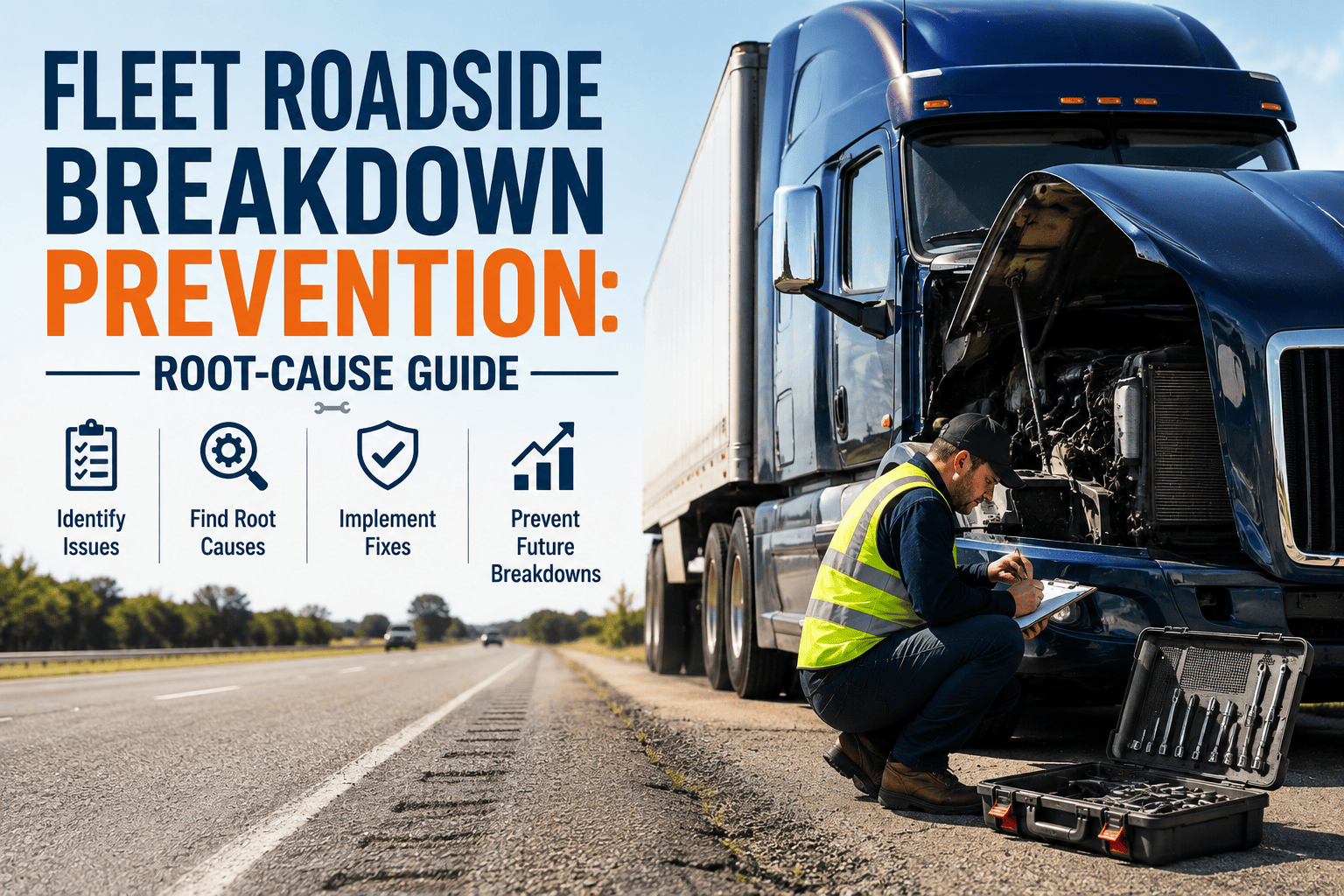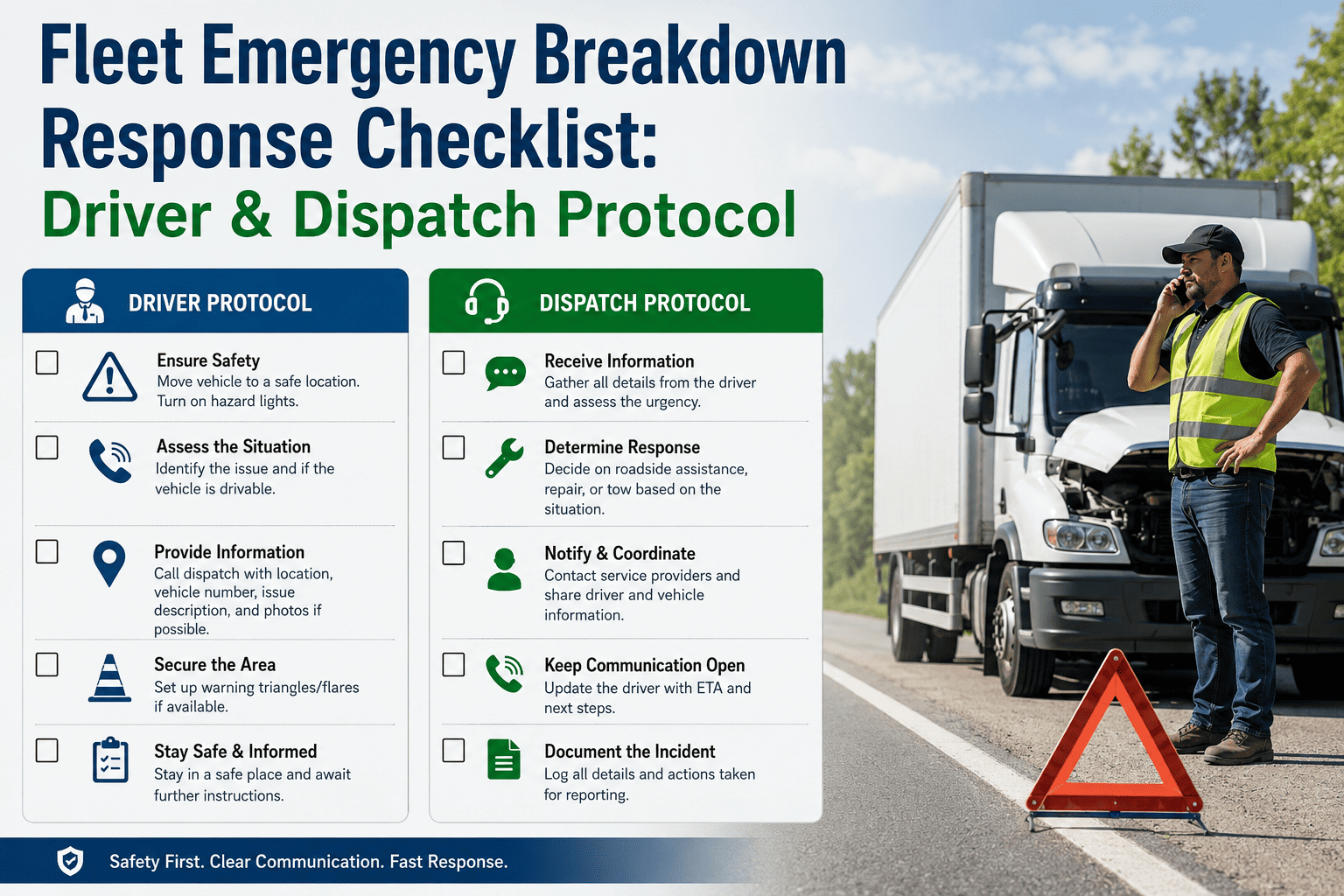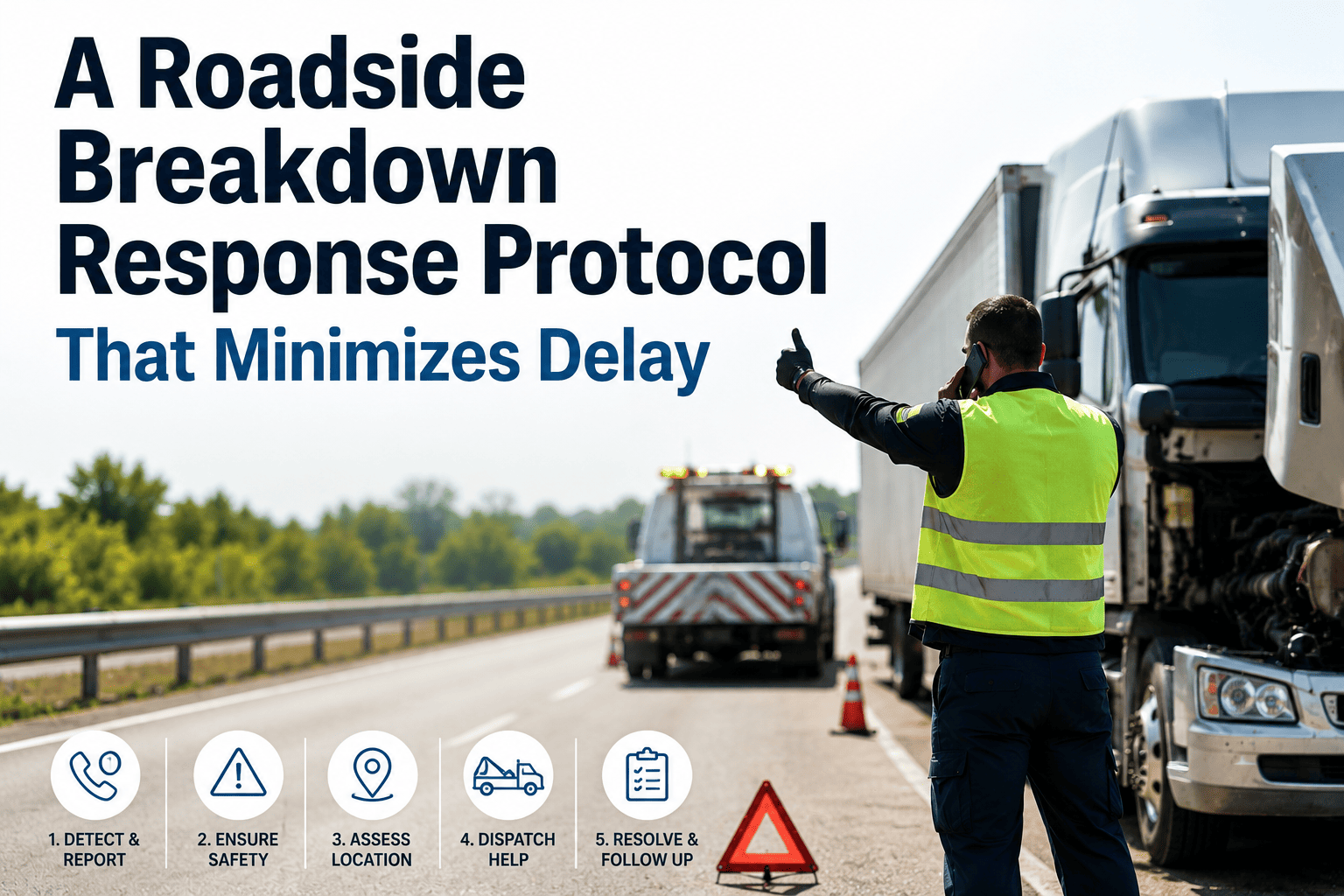
A roadside breakdown response protocol can cut the time a loaded truck sits idle on the shoulder by 30–50% compared to ad-hoc, call-around react. Every minute a tractor or trailer is stranded costs money — driver detention, tow bills, late-delivery penalties, and cargo exposure — and a structured breakdown protocol for fleet operations is what separates a 90-minute recovery from a six-hour ordeal. Whether you're operating 12 power units or 1,200, standardizing your fleet roadside breakdown response into a repeatable six-step workflow minimizes downtime, protects driver safety, and preserves customer commitments. This 2026 roadside response guide breaks down each phase of the protocol and shows how an AI-powered CMMS like OxMaint can automate dispatch, document root cause, and help you Start Free Trial to experience the difference firsthand.
Is a single roadside breakdown quietly costing you $1,200+ per hour in delay, towing, and late-delivery penalties?
Without a structured roadside protocol, fleet maintenance teams lose hours to phone tag, unvetted tow operators, and disjointed communication. A documented fleet roadside protocol — initiated from the driver's phone and dispatched through a managed service network — slashes MTTR and keeps drivers, customers, and dispatchers aligned in real time.
From Driver Call to Dispatched Repair in Under 15 Minutes
A breakdown handled by protocol takes roughly half the time of one managed ad-hoc. The fleet breakdown protocol below is the structured workflow used by high-performing maintenance and reliability teams to minimize the hours a loaded truck sits idle on the highway.
The driver reports the breakdown through a mobile CMMS app — not a voicemail — capturing GPS coordinates, a symptom description, and photo evidence of the fault (tire, coolant leak, dash code). This eliminates the 20-minute game of "where exactly are you?" and gives the maintenance dispatcher actionable data on screen one.
The dispatcher assesses three variables simultaneously: Is the truck safe where it is? Is repair-in-place possible (e.g., roadside tire, DEF system reset)? Or is recovery required? A structured triage checklist ensures the decision is made in minutes — not after three callbacks — and that hazmat or traffic-exposure risks are flagged immediately.
A pre-arranged towing or mobile repair partner is contacted with the exact location and problem details. For managed fleets, this typically routes through a truck stop network partner (TA Petro, Love's, Pilot Flying J) or a national roadside program (FleetNet America, NationaLease Roadside) with pre-negotiated rates and response-time commitments — protecting the fleet from opportunistic $2,500 tows.
Driver, customer, and internal stakeholders receive automated ETA updates as the situation develops. A driver stranded on the highway wants clear communication and a timeline more than anything else — and a customer waiting on a loaded trailer needs to know whether to rebook or hold. Structured cadence eliminates the anxiety of silence.
If repair-in-place isn't possible, the vehicle is towed to the nearest qualified shop with vehicle-class capability — matching shop capacity and repair type to the asset. Sending a Class 8 tractor to a light-duty shop wastes two hours; the protocol prevents it by filtering partners by capability before dispatch.
The vehicle is returned to service, the work order is fully documented, the root cause is captured for predictive analysis, and the total downtime cost is calculated against the asset's history. This is where reactive fleets lose institutional knowledge — without closure data, the same breakdown repeats next quarter.
What a Single Unmanaged Roadside Breakdown Actually Costs
Consider a 180-asset regional fleet running on spreadsheets and speed-dial. A loaded reefer breaks down on I-95 with a suspected EGR cooler failure. The driver calls dispatch, who calls three tow companies, finds one available 90 minutes out, and the truck is dragged to an unvetted shop. The total event takes 9.5 hours.
Now apply the same scenario with a structured roadside protocol: driver taps "Breakdown" in the OxMaint mobile app, the dispatcher sees GPS + photo in 30 seconds, triage flags repair-in-place as viable, a Love's mobile tech is dispatched at pre-negotiated rates, and the EGR cooler is replaced on the shoulder in 3.2 hours. The event cost drops to approximately $2,340 — a 71% reduction driven entirely by protocol, not by luck.
Structured Roadside Protocol vs. Ad-Hoc Phone-and-Pray
The performance gap between fleets with a documented breakdown response guide and those improvising each event is not marginal. Below is a side-by-side of what changes when the six-step protocol replaces unstructured response.
| Dimension | Ad-Hoc Response | Structured Protocol |
|---|---|---|
| Time to First Dispatcher Action | 15–45 minutes (voicemail, callbacks) | Under 2 minutes (automated alert) |
| Tow Cost Control | Spot rates, $800–$2,500 unvetted | Pre-negotiated, $350–$900 managed |
| Driver Communication | Sporadic, driver-initiated | Automated ETA cadence every 15 min |
| Average MTTR (Roadside Event) | 6–10 hours | 2.5–5 hours |
| Root Cause Documentation | Paper invoice, lost or filed late | Digital work order, tagged to asset |
| Repeat Failure Rate | High — no trend data captured | Low — feeds predictive maintenance |
| Customer Notification Speed | Hours later, often by the broker | Within 10 minutes of driver alert |
OxMaint Turns the 6-Step Protocol Into an Automated Workflow
OxMaint is an AI-powered CMMS and EAM platform built for maintenance and reliability teams that can no longer afford reactive, spreadsheet-driven breakdown management. Roadside events initiate through the driver mobile app, trigger automated dispatcher notification, and integrate third-party service network dispatch — all documented in a single closed-loop work order. Here is how specific OxMaint capabilities map directly to the roadside breakdown response protocol.
Drivers tap one button to report a roadside event with auto-captured GPS, symptom tags, and photo evidence — arriving on the dispatcher's screen in under 30 seconds. Outcome: eliminates 15–45 minutes of phone tag and location confusion at step one of the protocol.
OxMaint routes service requests to pre-vetted partners — FleetNet America, NationaLease, TA Petro, Love's, Pilot Flying J — with location and problem details attached. Outcome: secures pre-negotiated tow and repair rates, cutting per-event towing cost by 40–60%.
ETA updates fire automatically to driver, customer, and internal stakeholders on a configurable schedule (every 15 or 30 minutes). Outcome: reduces dispatcher call volume by 70% and keeps the driver calm and informed — the single biggest driver-experience factor.
Every roadside event closes as a fully documented work order with root-cause tagging, downtime cost calculation, and asset-history linkage. Outcome: feeds OxMaint's predictive maintenance engine to flag at-risk components before the next breakdown — cutting repeat roadside events by 25–35%.
See OxMaint's Roadside Response Workflow on Your Assets
Book a 30-minute demo and we'll walk you through a live roadside breakdown — from driver app initiation through partner dispatch, ETA cadence, and root-cause closure.
Roadside Breakdown Response Protocol — What Fleet Managers Ask
A roadside breakdown response protocol is a structured, repeatable six-step workflow — driver notification, triage, service dispatch, communication cadence, transport decision, and recovery closure — that governs how a fleet responds when a vehicle fails on the road. Fleets running a documented protocol typically cut roadside event MTTR by 30–50% compared to ad-hoc phone-based response, because every role, decision, and communication is pre-defined rather than improvised under pressure.
A loaded commercial truck stranded on the roadside typically costs $800–$1,500 per hour in combined driver detention, tow premiums, late-delivery penalties, and cargo risk. Unmanaged events frequently total $5,000–$10,000 per occurrence. A structured protocol with pre-negotiated service rates and faster triage can reduce per-event cost by 50–70%, which is why fleets evaluating maintenance software should book a demo to see the ROI math on their own asset count.
The driver's first action is to secure the vehicle safely — pull as far off the road as possible, activate hazard lights, set triangles or flares, and assess personal safety. Once safe, the driver reports the breakdown through the fleet's mobile CMMS app with GPS location, symptom description, and photo evidence. If the fleet uses OxMaint, this single tap triggers automated dispatcher notification and initiates the six-step protocol — no phone tag required.
Fleets with a structured protocol rely on pre-vetted national networks — FleetNet America, NationaLease Roadside, TA Petro, Love's, and Pilot Flying J — that offer pre-negotiated rates and response-time commitments. The dispatcher selects the provider based on proximity, vehicle-class capability, and repair type. This prevents the costly default of calling the first available tow operator, which often results in unvetted shops charging premium spot rates for a 45-mile tow.
An AI-powered CMMS like OxMaint compresses roadside response time by automating the first three steps of the protocol — driver notification arrives with GPS and photos in under 30 seconds, triage checklists standardize the repair-or-tow decision, and integrated service-network dispatch eliminates manual provider searches. Additionally, every event closes as a documented work order with root-cause data, feeding predictive analytics that reduce future breakdowns by 25–35%.
Stop Losing Hours to Unmanaged Roadside Breakdowns
Deploy a structured roadside breakdown response protocol powered by OxMaint's AI-driven CMMS — driver mobile app, automated dispatch, integrated service networks, and root-cause analytics in one platform.
Free 14-day trial · No credit card