A breakdown does not cost money the moment a vehicle fails — it costs money for every minute that follows while the driver waits, dispatch scrambles to find a tow, and the delivery or route sits unfinished. Most fleets can tell you their average repair cost, but very few can tell you their average minutes-to-recovery, which is usually the bigger number on the balance sheet. Cutting response and recovery time is one of the highest-leverage, lowest-cost improvements a fleet can make, because it needs a better workflow more than it needs new equipment. OxMaint's breakdown workflow gives dispatch a structured process the moment a driver reports a failure.
$750–$1,200
Estimated cost per hour of unplanned downtime for a commercial vehicle, including lost revenue and labor
2.5 hrs
Average time to tow dispatch for fleets without a pre-negotiated vendor network
35–45%
Typical reduction in recovery time after implementing a structured breakdown workflow
18–22%
Share of unplanned breakdowns that trace back to a defect visible during a prior inspection
Every Minute of Downtime Has a Price Tag
See how a structured breakdown workflow cuts recovery time in half
How Downtime Cost Compounds by the Hour
0–30 min
Driver Reports the Failure
Cost is still limited to the missed schedule — but every unstructured minute here adds directly to total downtime with no recovery action yet underway.
30 min–2 hrs
Vendor Search Begins
Without a pre-approved vendor list, dispatch spends this window calling around for tow or roadside availability — the single largest source of avoidable delay.
2–24 hrs
Route & Load Disruption
Freight or route reassignment costs stack on top of the repair bill, and customer-facing delays start generating their own downstream cost.
24 hrs+
Extended Vehicle Loss
Parts availability and shop backlog now dominate the timeline — the stage every fast-response workflow is designed to prevent from being reached at all.
Post-repair
Return to Service & Review
The vehicle is inspected before redeployment, and the full event — dispatch time, vendor, repair cause — is logged so the same failure pattern can be caught earlier next time.
What a Fast Response Workflow Requires
Pre-Approved Vendor Network
A ranked list of tow, tire, and mobile repair vendors by region removes the search-and-call delay entirely — dispatch calls the first name on the list.
GPS-Based Nearest Match
Matching the breakdown location to the closest available vendor, rather than the most familiar one, shortens arrival time on every single call.
Standard Dispatch Checklist
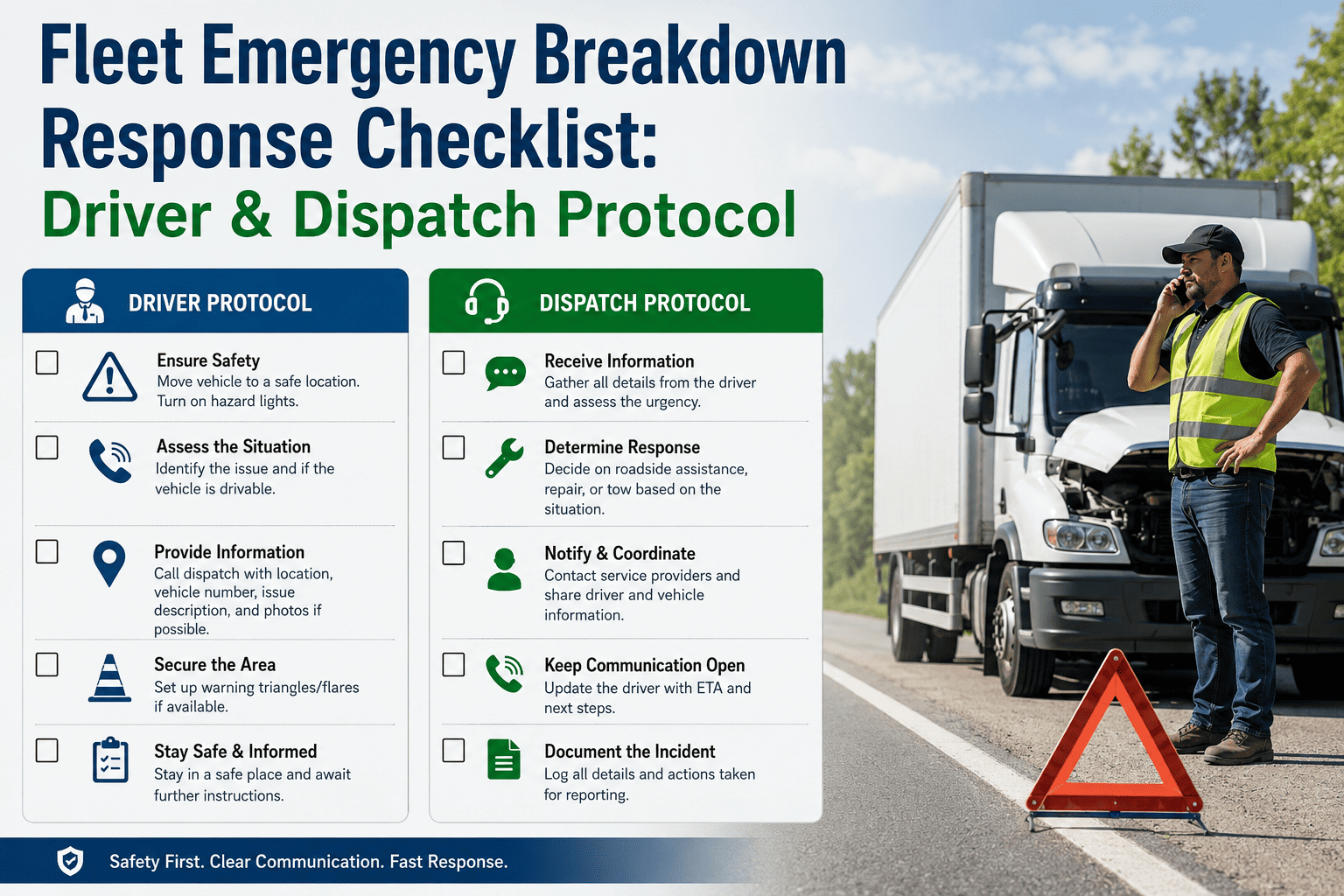
A fixed sequence — location, hazard status, vendor call, driver safety, load reassignment — keeps response consistent regardless of who is on shift.
Recovery Time Tracking
Logging minutes-to-dispatch and minutes-to-recovery on every event turns downtime into a measurable KPI instead of an anecdote.
Driver Safety Protocol
A fixed hazard-response step — warning triangles, safe positioning, check-in timing — protects the driver while dispatch works the recovery in parallel.
Root Cause Tagging
Every event is tagged with a failure cause so recurring problems on a specific vehicle or component surface in the data instead of staying anecdotal.
Replace the Scramble With a Workflow
OxMaint logs every breakdown, routes it to the right vendor, and tracks recovery time automatically from first report to vehicle back in service.
Reactive Response vs. Managed Recovery Workflow
35–45%
reduction in average recovery time
<15 min
target dispatch time with a ranked vendor list
100%
of breakdown events logged for review
18–22%
of failures traceable to a missed prior defect
We used to lose the first hour of every breakdown just figuring out who to call. Once we had a ranked vendor list tied to GPS location, our average recovery time dropped from almost five hours to under three — and we finally had the data to prove it to ownership.
— Fleet Manager, 130-vehicle regional carrier
Building a Vendor Network That Actually Gets Used
A vendor list only helps if dispatch trusts it enough to skip the phone search. Three things make that trust possible: coverage across every region the fleet actually runs, a clear ranking based on past response time rather than familiarity, and a review cycle that removes vendors who consistently underperform. Fleets that revisit their ranked list quarterly see the largest sustained gains, since vendor reliability shifts as businesses grow, change staff, or expand coverage areas.
Frequently Asked Questions
What is the single biggest source of delay in breakdown recovery?
The vendor search phase — calling around to find an available tow or repair provider — consumes more time than the actual repair in most reactive fleets.
Do we need to build our own vendor network from scratch?
No, most fleets start with existing relationships and formalize them into a ranked list inside their workflow.
OxMaint helps structure that list by region and vehicle type.
How is recovery time actually measured?
From the moment a driver reports the failure to the moment the vehicle is confirmed back in service, split into dispatch time and repair time segments so each stage can be improved on its own.
Does this replace our existing roadside assistance provider?
No, it sits on top of your existing providers, ranking and routing calls to them faster rather than replacing the relationships you already have with trusted vendors.
How quickly can we see results after implementing a workflow?
Most fleets see measurable dispatch time improvement within the first month.
Book a demo to see how the workflow fits your regions.
Cut Recovery Time Before the Next Breakdown
Structure your dispatch process now, before the next roadside call starts the clock.



-(1).png)