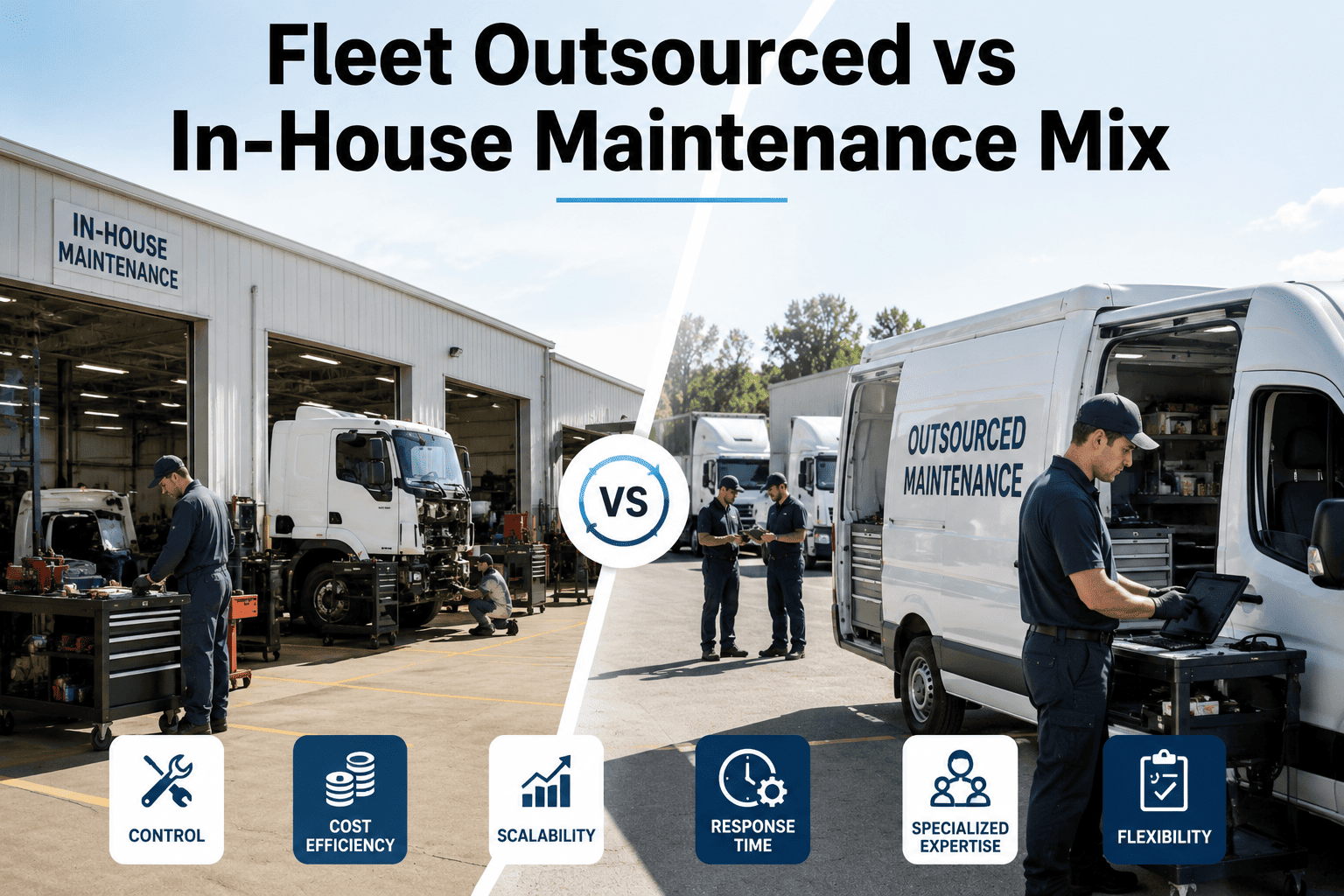
Fleet Outsourced vs In-House Maintenance Mix

By Corin Hale on August 17, 2026

fleet-outsourced-vs-in-house-maintenance-mix

A 20-truck fleet spending $316,800 a year on repairs is not deciding between "outsource" or "in-house" — it is deciding how to split labor across two rate tiers that can differ by more than double, $45-$75 an hour in-house versus $125-$175 an hour outsourced. Most fleets never run that split deliberately; they inherited it. The fleets that outperform their peers on cost per mile are the ones that treat sourcing as a mix to optimize, not a single company-wide policy. See how Oxmaint tracks that mix across a live fleet.

Fleet Operations / Maintenance Sourcing / 2026 Guide

Outsourced vs In-House Maintenance Mix: Finding the Split That Actually Lowers Cost Per Mile

Neither all-outsourced nor all-in-house wins for most fleets. The right answer is a mix that shifts by fleet size, vehicle complexity, and geography — and the fleets getting it right are the ones measuring the mix, not guessing at it.

$45-$175
Per-hour labor rate range, from in-house technician to outsourced shop
25-30
Trucks — the typical break-even point where an in-house shop starts paying for itself
62.4%
Share of maintenance done in-house by fleets over 1,000 vehicles
7x
Cost gap between planned and unplanned repair events — bigger than the sourcing gap itself

The Real Decision Is Bigger Than Rate Per Hour

Most sourcing comparisons stop at labor rate: in-house technicians cost less per hour than an outside shop. That is true, but it ignores the fixed cost of running your own shop and the flexibility an outside network provides when demand spikes. A full comparison has to weigh both sides against each other.

In-House
Lower unit cost, higher fixed cost
Lower Per-Repair Labor Cost
$45-$75 per hour versus $125-$175 outsourced
Full Schedule Control
Preventive maintenance run on your own timeline
Upfront Capital Requirement
Bays, lifts, and diagnostic equipment before a wrench turns
Technician Recruitment Risk
Diesel and EV technician shortages hit owned shops hardest
Outsourced
Higher unit cost, lower fixed cost
No Facility Investment
Zero capital tied up in bays or equipment
Access to Specialized Work
Engine rebuilds and EV battery work without in-house expertise
Scheduling Dependency
Bay availability and parts wait time outside your control
Higher Per-Repair Cost
Shop rate premium adds up fast at scale

The Cost Categories Most Sourcing Comparisons Leave Out

Building an owned shop typically requires $50,000-$150,000 in diagnostic equipment per workstation plus a leased bay running $2,000-$4,500 a month, and in-house overhead usually adds 40-60% on top of direct labor once benefits and supervision are counted. None of that shows up in a simple hourly-rate comparison, and skipping it is why so many sourcing decisions get revisited within a year.

$50K-$150K
Diagnostic equipment cost per in-house workstation
$2K-$4.5K
Monthly lease rate for a commercial repair bay
40-60%
Overhead added to direct labor cost in owned shops
$90-$120/hr
Estimated cost of a sidelined commercial vehicle, either model

Where the Break-Even Point Actually Sits by Fleet Size

Fixed shop costs only make sense once they are spread across enough vehicles. Below the threshold, outsourcing almost always wins on cost; above it, the math flips.

Under 20 Vehicles
Fixed shop costs don't spread efficiently
Outsourcing usually wins
25-30 Vehicles
The commonly cited break-even threshold
Decision point
50+ Vehicles
In-house shops start capturing real savings
In-house usually wins
1,000+ Vehicles
Large fleets running majority in-house
62.4% in-house average
Maintenance Sourcing Analytics

Stop Choosing a Sourcing Model Once and Never Revisiting It

Oxmaint's CMMS coordinates in-house technicians and outsourced vendors through the same work order system — so you can see the true cost of each path and adjust the mix every quarter instead of guessing once and living with it.

What Actually Belongs in a Fully-Loaded Sourcing Comparison

A rate-per-hour comparison alone is misleading in both directions. These are the categories a real comparison has to include.

01
Direct Labor Rate
The headline number, but only one input among several.
02
Facility Overhead
Bay lease, utilities, and diagnostic equipment amortized per repair.
03
Parts Sourcing Premium
Markup differences between vendor-supplied and self-sourced parts.
04
Scheduling Disruption
Bay wait time and appointment availability at outside shops.
05
Downtime Cost
Every hour a vehicle sits idle carries a real revenue cost, regardless of who does the repair.
06
Planning Discipline
The gap between planned and reactive repair cost dwarfs the sourcing gap itself.

Signs Your Current Sourcing Mix Needs Rebalancing

A sourcing decision made two or three years ago rarely still fits today's fleet size, vehicle mix, or technician market. These are the signals worth checking on a quarterly basis.

1
Fleet Size Crossed 25-30
Growth past the common break-even point without revisiting the in-house case.
2
Rising Vendor Wait Times
Outsourced bay scheduling delays are quietly adding downtime cost.
3
Technician Vacancy Rate Climbing
An owned shop losing techs faster than it can hire needs a hybrid safety net.
4
New Vehicle Complexity
EV or specialized equipment arriving faster than in-house training can keep up.
5
Unplanned Repair Share Rising
A growing reactive-repair share often signals a planning gap larger than any sourcing gap.

Split-Service Model — A Common 2026 Approach

Rather than choosing one model fleet-wide, many mid-sized operators now split work by frequency and complexity, keeping high-frequency jobs in-house and routing rare, specialized jobs out.

Work TypeRecommended ModelWhy
Oil Changes, Tires, Inspections In-house High frequency, low complexity, best return on owned equipment
Brake Pads, Routine PM In-house Predictable schedule, low specialized tooling need
Engine Rebuilds Outsourced Low frequency, high specialization, not worth owning the tooling
EV Battery Remediation Outsourced Emerging specialty, technician shortage makes in-house impractical for most fleets
Major Collision Work Outsourced Rare event, requires body-shop-grade facility

What Oxmaint Automates for Sourcing Decisions

The sourcing decision is only as good as the data behind it. Oxmaint keeps that data live instead of buried in separate spreadsheets for shop payroll and vendor invoices.

Unified Work Order System
In-house technicians and outside vendors log to the same work order record, so cost comparison is automatic.
True Cost Per Repair Tracking
Labor, parts, downtime, and scheduling delay roll up into one per-event cost, by vehicle and by vendor.
Planned vs Reactive Split Reporting
See exactly how much of your spend is preventable, regardless of which model performed the repair.
Quarterly Mix Review Reports
Revisit the sourcing split on a schedule instead of leaving a decision made once to run unquestioned for years.

Frequently Asked Questions

Is in-house maintenance always cheaper than outsourcing?+
No. In-house wins mainly once fleet size is large enough to spread fixed shop costs, typically above roughly 25-30 vehicles. Start a free trial to model your own break-even point.
What matters more, the sourcing model or the planning model?+
The planning model. The cost gap between planned and unplanned repair events is far larger than the gap between in-house and outsourced labor rates.
Can a fleet use both models at the same time?+
Yes, this hybrid split-service approach is increasingly common — high-frequency work stays in-house while rare, specialized repairs go to outside vendors.
How often should a fleet revisit its sourcing mix?+
Quarterly is a reasonable cadence, since fleet size, vehicle mix, and technician availability all shift over time. Book a demo to see quarterly mix reporting.
Does outsourcing eliminate downtime risk?+
No. Downtime cost applies regardless of who performs the repair — bay wait time at an outside shop can add as much delay as an internal queue.
Fleet Maintenance Intelligence — Powered by Oxmaint

Make Your Sourcing Mix a Data Decision, Not a Legacy Habit

One work order system for in-house technicians and outside vendors, true cost-per-repair tracking, and quarterly mix reporting that keeps the decision current as your fleet changes.

Share This Story, Choose Your Platform!