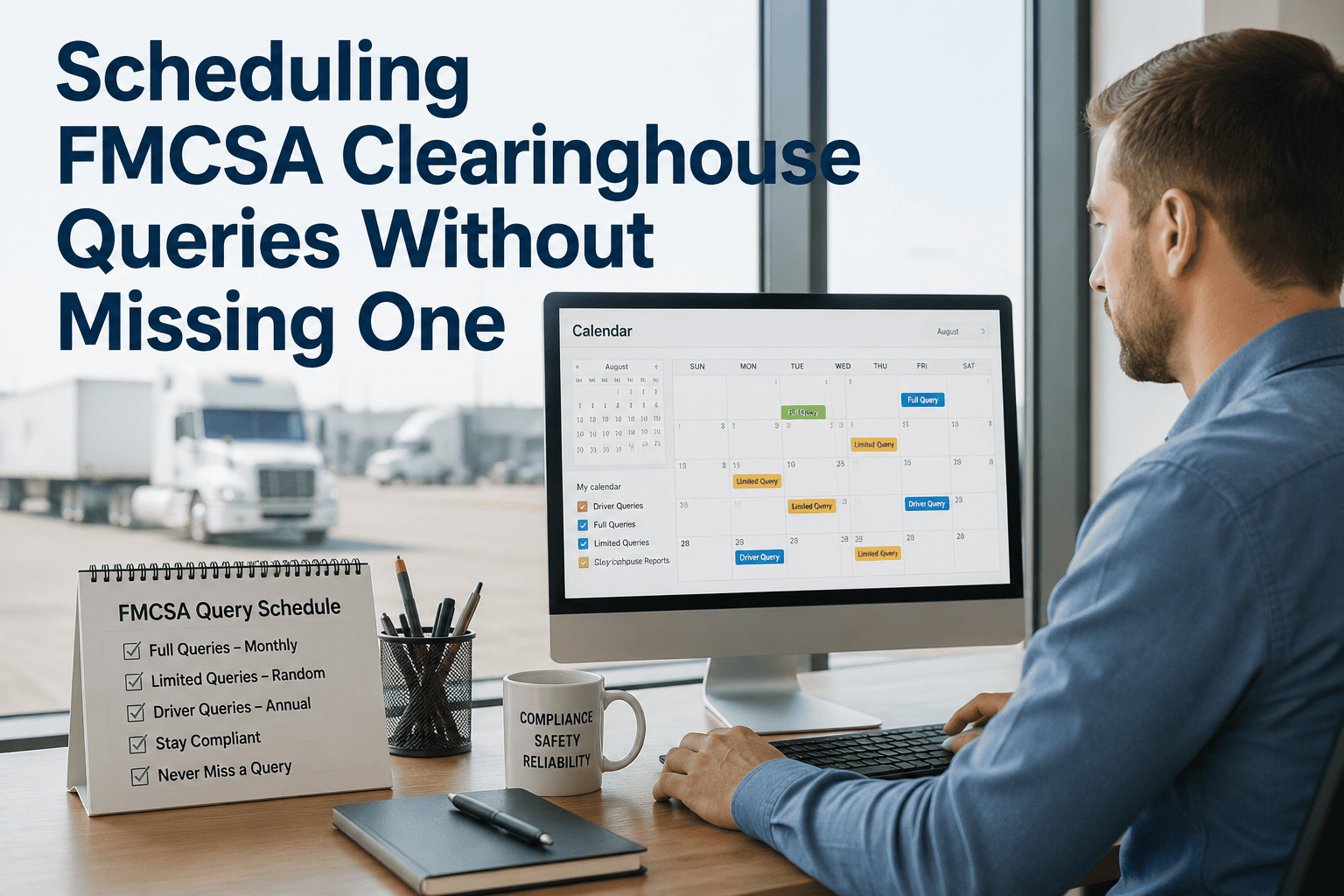
FMCSA clearinghouse fleet compliance hinges on executing two types of queries — a full pre-employment query before a CDL driver operates a commercial motor vehicle, and a limited annual query at least once every 12 months — yet thousands of carriers miss these deadlines annually and face costly citations. Under 49 CFR 382 Subpart G, the drug and alcohol clearinghouse tracks positive tests, refusals, and return-to-duty (RTD) completions, making it illegal to hire or retain a prohibited driver. Structured scheduling prevents the 12-month window from drifting, ensuring your clearinghouse query fleet requirements are met without relying on error-prone spreadsheets. By automating alerts and batch-processing due dates, maintenance and reliability teams eliminate compliance gaps — see how OxMaint streamlines this workflow when you Start Free Trial or book a personalized walkthrough.
FLEET CLEARINGHOUSE 2026 GUIDE
Is a single missed annual query putting your entire fleet out of compliance?
Under 49 CFR 382, a 30-day drift on a driver's annual limited query window triggers a citable violation. Structuring your clearinghouse query fleet schedule with automated 60/30-day alerts eliminates the risk of prohibited drivers operating your CMVs.
CLEARINGHOUSE QUERY GUIDE
Understanding FMCSA Drug and Alcohol Clearinghouse Fleet Requirements
The FMCSA Drug and Alcohol Clearinghouse is a secure online database that tracks commercial driver's license (CDL) holders' drug and alcohol program violations. For any FMCSA clearinghouse fleet, the database is the central source of truth for positive drug tests, alcohol violations, refusals to test, and completed return-to-duty (RTD) processes. A driver with an unresolved positive test is legally prohibited from operating a commercial motor vehicle (CMV) until they complete the RTD protocol. Hiring or continuing to employ a prohibited driver is a citable violation that directly impacts your carrier safety score. Managing this requires a disciplined clearinghouse query fleet schedule to ensure no driver slips through the cracks.
Full Pre-Employment Query
Required under 49 CFR 382.701 before a newly hired driver is allowed to operate a CMV. The carrier must conduct a full query in the Clearinghouse, which requires the driver's specific electronic consent. This reveals all unresolved violations.
Annual Limited Query
Mandatory for every employed CDL driver at least once every 12 months. A limited query only checks if the driver's record has changed since the last query. If a result comes back positive, a full query must be triggered immediately.
Perpetual Consent Tracking
For limited queries, carriers can obtain a driver's standing consent once at hire, covering all future annual limited queries in perpetuity. This dramatically simplifies the fleet clearinghouse 2026 workflow, but the consent must be documented and auditable.
Follow-Up Full Queries
If an annual limited query returns a positive result, the carrier's designated employer representative (DER) must immediately initiate a full query and remove the driver from safety-sensitive duties, including driving, until the RTD process is complete.
WORKED EXAMPLE & VIOLATION COST
The Hidden Risk of 12-Month Window Drift in Fleet Clearinghouse Compliance
Missing the annual query schedule is one of the most common FMCSA clearinghouse guide violations. The 12-month window is strict: if a driver was hired and queried in October, their next annual limited query must be completed by the following October. Missing it by even 30 days puts the carrier in direct violation of 49 CFR 382 Subpart G. Consider a 180-driver fleet: relying on spreadsheets or manual calendar reminders practically guarantees that at least 5-10% of drivers will have expired query windows at any given time. If audited, a carrier with 15 expired queries faces thousands in cumulative civil penalties — not to mention the risk of a prohibited driver causing a recordable accident while unknowingly unresolved in the RTD process.
OxMaint identifies drivers with annual queries due in 60 days, giving the DER ample time to process batch limited queries before the 12-month window closes.
A second alert escalates to the compliance manager. Any unprocessed drivers are flagged in red on the dashboard, ensuring no clearinghouse query fleet requirement is overlooked.
The limited query is processed using the driver's perpetual consent. OxMaint automatically logs the query result, date, and DER review signature into an audit-ready record.
CLEARINGHOUSE 2026 FLEET WORKFLOW
How to Batch-Process Fleet Clearinghouse Queries by Month
Carriers managing 100 or more drivers rarely track individual query dates. Instead, best practice dictates batching queries by month. Drivers are grouped by their initial hire or previous query month. When October arrives, the CMMS identifies all drivers whose annual window closes that month and processes them together. This approach standardizes the workload, reduces administrative overhead by up to 70%, and ensures the designated employer representative reviews all results in a single sitting. OxMaint transforms this fleet clearinghouse 2026 guide into an automated reality by attaching Clearinghouse query schedules directly to driver and asset records.
| Query Type | Frequency | Consent Required | Action on Positive Result |
|---|---|---|---|
| Full Pre-Employment | Once before operating a CMV | Yes (per-query e-consent) | Do not hire / Remove from safety-sensitive duties |
| Annual Limited | Every 12 months (min) | Standing consent at hire | Trigger immediate Full Query |
| Follow-Up Full | As triggered by limited query | Yes (per-query e-consent) | Immediate removal from CMV operation |
HOW OXMAINT HELPS
Automate Fleet Drug Alcohol Compliance with OxMaint
OxMaint is an AI-powered CMMS and EAM platform that centralizes maintenance, asset tracking, and compliance operations. For fleet managers, integrating clearinghouse compliance into the same system that manages vehicle preventive maintenance means driver eligibility and truck readiness are tracked in one unified ecosystem — eliminating siloed spreadsheets and disconnected calendars.
Automated Query Scheduling
Attach required full and limited query dates directly to driver records. OxMaint generates automated 60-day and 30-day alerts, eliminating manual calendar tracking and reducing compliance drift to zero.
Batch Identification by Month
For large fleets, OxMaint instantly filters and surfaces all drivers due for their annual limited query in a given month, allowing the DER to process them simultaneously and review results in a single dashboard view.
Audit-Ready History Retention
Every query executed, its result, the DER review, and the driver's perpetual consent are permanently logged. If the DOT audits your fleet drug alcohol program, you can export a fully compliant trail in seconds.
Unified Driver & Asset Tracking
If a driver's query returns positive, OxMaint immediately flags their profile, preventing work orders from assigning them to safety-sensitive vehicle maintenance tasks or driving assignments until RTD completion is logged.
Stop risking FMCSA citations over missed queries
See how OxMaint automates your clearinghouse query schedule and secures your compliance posture in minutes.
FREQUENTLY ASKED QUESTIONS
FMCSA Clearinghouse Fleet Compliance FAQ
What is the difference between a full and limited Clearinghouse query?
A full query requires the driver's specific electronic consent and reveals detailed violation information, typically used for pre-employment. A limited query only checks if new information has been added to the driver's record since the last query and can be run using a standing consent obtained at hire. If a limited query returns a positive result, the carrier must immediately initiate a full query.
How often must a fleet run Clearinghouse queries on employed drivers?
Under 49 CFR 382 Subpart G, carriers must run a limited query at least once every 12 months for every employed CDL driver. Missing this 12-month window is a citable violation. Using an automated CMMS like OxMaint ensures these dates are tracked and processed on time — book a demo to see the scheduling workflow.
Can a driver consent to all future annual queries at once?
Yes. For limited queries, carriers can obtain a driver's electronic consent once at the time of hiring that covers all future annual limited queries in perpetuity. This simplifies the clearinghouse query fleet workflow significantly, though the carrier must still track the 12-month cadence for each driver.
What happens if an annual limited query returns a positive result?
The carrier's designated employer representative (DER) must immediately remove the driver from safety-sensitive functions, including operating a CMV, and initiate a full query to obtain the specific violation details. The driver cannot return to duty until they complete the return-to-duty (RTD) process with a qualified substance abuse professional.
How do large fleets manage batch Clearinghouse queries efficiently?
Fleets with 100 or more drivers typically group query dates by month rather than tracking individual deadlines. By identifying all drivers due in a specific month and processing their limited queries together, the DER can review results in a single batch. OxMaint automates this grouping and reporting — start your free trial to test the batch processing dashboard.
Secure your fleet clearinghouse 2026 compliance today
Join the maintenance and reliability teams using OxMaint to automate queries, track assets, and eliminate compliance gaps.
Free 14-day trial · No credit card