Fleet Maintenance Outsourcing vs In-House: Making the Right Decision
By Alex Jordan on March 28, 2026
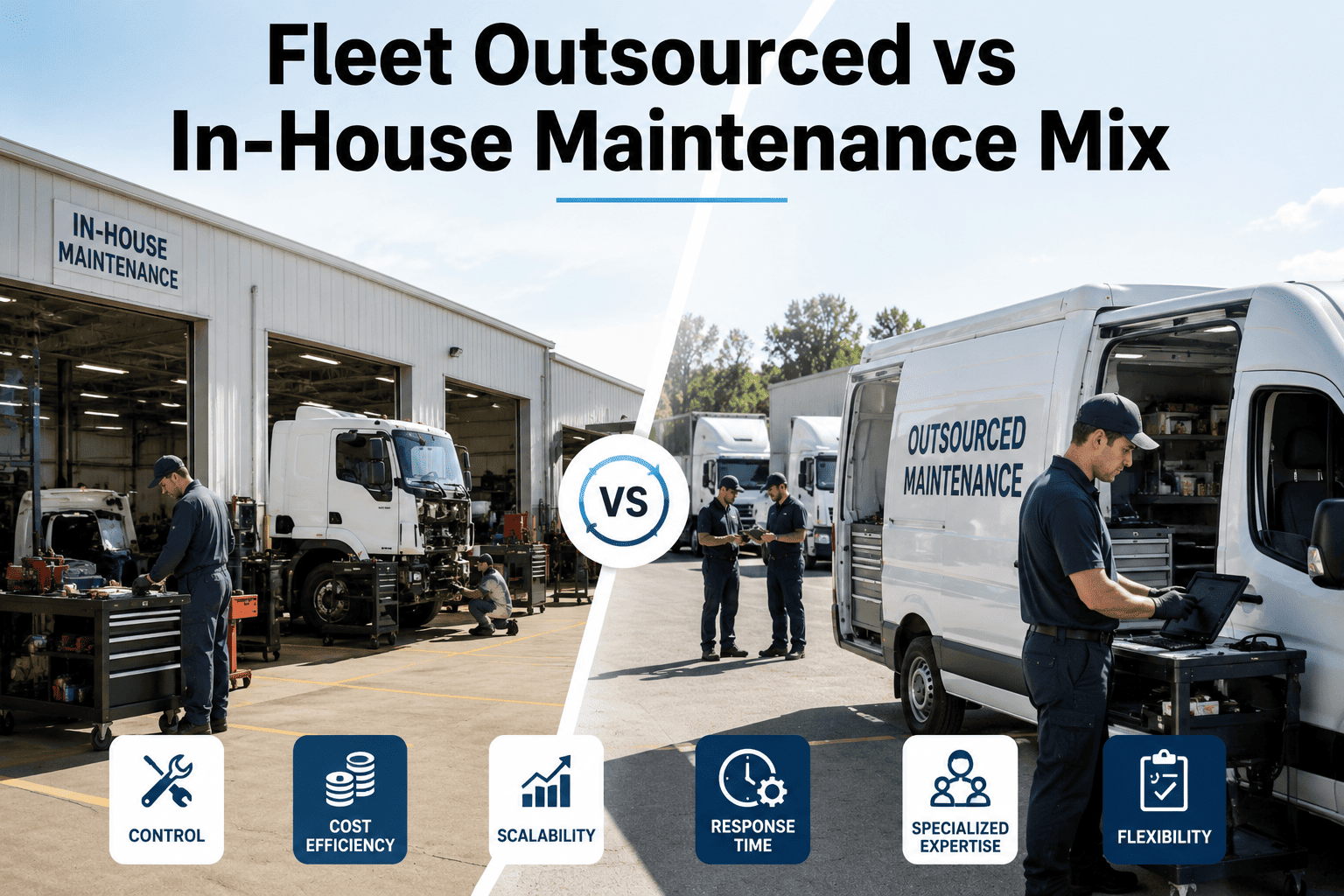
The outsource-vs-in-house decision is one of the most financially consequential choices a fleet director makes — and most organisations make it once, based on intuition, and never revisit it with data. The correct answer is not universal: it depends on fleet size, vehicle mix, geographic distribution, available capital, and the PM compliance discipline the organisation can actually sustain. What research consistently shows is that the maintenance model matters less than the planning model — a well-run outsourced program outperforms a poorly-run in-house shop, and the reverse is equally true. OxMaint's CMMS coordinates both in-house technicians and external vendors through the same work order system — giving fleet directors the data to make, revisit, and optimise this decision on a quarterly basis rather than treating it as permanent.
Fleet Operations · Blog ·
Fleet Maintenance Outsourcing vs In-House: Making the Right Decision
A structured decision framework covering cost analysis, quality control, compliance, workforce factors, and hybrid models — with CMMS-based coordination that works whether you outsource, run in-house, or do both.
7×Cost gap — unplanned outsourced vs. planned in-house repair event
30Vehicles — the typical threshold where in-house starts to outperform
34%Of hybrid fleets save more than pure outsource or pure in-house
Q1Typical CMMS payback period regardless of maintenance model chosen
The 5-Factor Decision Framework — Evaluate Before You Choose
The outsource vs. in-house decision cannot be reduced to a cost-per-event comparison — it requires evaluating five distinct factors that interact with each other. Fleet volume and PM frequency set the baseline economics. Cost structure determines whether fixed investment makes financial sense. Workforce capability defines what you can realistically sustain in-house. Compliance exposure defines the risk of quality gaps. And CMMS integration defines how well you can track performance regardless of which model you choose. The framework below moves from the most foundational factor (fleet volume) to the most strategic (performance measurement). OxMaint supports all five factors in a single platform — whether you run in-house, outsourced, or a hybrid.
Factor
5
Performance Measurement & CMMS Integration
Your ability to track cost per event, PM compliance, vendor quality, and downtime hours determines whether your model is improving or drifting. A model without measurement cannot be optimised.
Measure
Factor
4
Compliance, Risk & Quality Assurance
DOT, FMCSA, and insurance requirements follow the vehicle, not the service provider. Poor vendor quality carries the same CSA consequence as poor in-house quality — but is harder to audit in real time.
Comply
Factor
3
Workforce Capability & Availability
Technician recruitment, retention, training, and certification costs are the primary hidden cost of in-house shops. A facility without a qualified technician pipeline has a single-point-of-failure risk.
Staff
Factor
2
Cost Structure & Capital Requirements
In-house requires capital investment in facility, tools, and lift equipment. Outsource converts capital cost to operating cost — improving cash flow flexibility but reducing per-event margin at scale.
Analyse
Factor
1
Fleet Volume & Service Frequency
Fewer than 30 vehicles: outsource typically wins on economics. 30–80 vehicles: hybrid is usually optimal. Over 80 vehicles: in-house PM with outsourced specialty work delivers the best cost profile at scale.
Audit
True Cost Per Repair Event: The Number That Changes the Decision
Most outsource-vs-in-house cost comparisons compare contract rate against technician hourly rate and stop there. The analysis that actually changes decisions compares the fully-loaded cost per repair event — including parts sourcing premium, scheduling disruption, parts wait time, and downstream downtime cost. The gradient chart below shows what each service model and planning discipline actually costs per event for a 50-vehicle commercial fleet. The critical insight: the planned-vs-unplanned gap (7×) dwarfs the in-house-vs-outsource gap (1.5×). Choosing your planning model matters more than choosing your service provider. OxMaint's planned PM scheduling eliminates the unplanned emergency cost category entirely — regardless of whether you use in-house technicians or external vendors.
True Cost Per Repair Event — By Model & Planning Discipline (50-Vehicle Fleet)
Outsource · Unplanned emergency
$1,800
In-house · Unplanned (parts delay)
$1,200
Outsource · Emergency same-day
$980
In-house · Emergency breakdown
$640
Outsource · Planned PM
$420
In-house · Planned PM
$280
Quality, Control & Compliance — Scoring Your Risk Exposure
Every maintenance model carries a distinct quality and compliance risk profile. An in-house shop with a certified technician and CMMS-tracked work orders gives a fleet director complete audit trail and real-time visibility. An outsourced shop with a service level agreement and CMMS integration can deliver equivalent quality — but requires more rigorous vendor management. An outsourced arrangement with no CMMS integration, no SLA, and no defect tracking is the highest-risk configuration regardless of vendor reputation. The scoring framework below rates each model across five compliance and quality dimensions — the framework that DOT auditors and insurance underwriters actually use to assess fleet maintenance risk.
Maintenance Model — Compliance & Quality Scoring
Score 5 = best outcome · Score 1 = highest risk · Assess your current model against each dimension
5
In-House + CMMS
Full work order history per vehicle, real-time PM compliance, technician accountability, instant defect-to-repair tracking.
Profile: Best for 80+ vehicle fleets. High capital cost, highest control. DOT audit-ready by default.
4
Hybrid + CMMS
In-house handles PM, outsource handles specialty and overflow — all routed through unified CMMS work orders.
Profile: Best for 30–80 vehicles. Balanced capital, near-full visibility. Most common high-performer model.
3
Outsource + CMMS
External vendors, internal work order tracking. Vendor SLA enforced by CMMS data — quality auditable.
Profile: Best for <30 vehicles or specialist assets. No capital outlay. SLA management is critical.
2
Outsource, No CMMS
External vendor invoices only. No work order history, no defect tracking, no PM compliance reporting.
Repairs triggered by breakdown. No PM schedule, no vendor management, no compliance history maintained.
Risk: Highest CSA exposure. 3–5× true cost vs. planned alternatives. Unsustainable at fleet scale.
The Hybrid Model: Four Configurations That Actually Work
The hybrid model — in-house capability for some work, external vendors for others — is the highest-performing maintenance approach for fleets between 30 and 150 vehicles. The key to a hybrid model is not the split of work between channels: it is the unified CMMS layer that tracks both. When every in-house and outsourced work order flows through the same system, cost per event, PM compliance, and vendor quality are all visible in a single dashboard. OxMaint routes in-house and vendor work orders through the same PM calendar and cost tracking system — giving fleet directors a single performance view regardless of who does the work.
Model A: Routine PM In-House / Major Repairs Outsourced
Most Common
Best fleet sizeMixed fleet with 20%+ specialist vehicles · high consequence equipment requiring OEM-certified service
CMMS roleAsset-level routing rules direct work by vehicle type — automated, no dispatcher decision required
Technology Integration: OBD, Digital Twin, AI Camera, and SAP
Modern maintenance technology reduces the performance gap between in-house and outsourced models — because it provides the data layer that makes both models accountable. OBD-II and J1939 telematics generate vehicle health data that can be acted on by either an in-house technician or an outsource vendor with equal effectiveness, as long as the CMMS routes the alert correctly. AI Digital Twin models predict component failure per vehicle — enabling outsource vendors to pre-position parts before service visits, eliminating the parts wait that makes outsource emergency response expensive. AI Camera Vision enables quality assurance on outsourced work — depot cameras can verify tyre condition and brake dust patterns after a vendor service event, without relying on vendor self-reporting. SAP, ERP, and PLC integration provides the financial visibility that makes vendor contract performance auditable at CFO level.
OBD-II / J1939
PM trigger accuracy
94%
Unplanned event reduction
−41%
Vendor accountability
86%
Real-time fault data enables outsource vendors to diagnose remotely and arrive with the right part — eliminating return visits and emergency markups.
Depot cameras verify outsource service quality after vendor visits — independent of vendor self-reporting and before vehicle dispatch.
Fleet AI vision deployment data · US/EU 2025
SAP / ERP Integration
Vendor invoice match
96%
Contract compliance audit
94%
CFO cost visibility
89%
CMMS-to-SAP integration makes outsource vendor spend auditable at board level — three-way invoice matching eliminates billing disputes automatically.
SAP fleet maintenance integration case studies · 2024–2025
"
We were fully outsourced and spending $680,000 a year across 58 vehicles — no visibility into what we were paying for. We moved to a hybrid model with OxMaint tracking both our in-house tech and our outsource vendors. Total maintenance spend dropped to $490,000 in year one. We kept outsource for specialist work and covered everything else in-house.
Director of Fleet Operations — National logistics company, 58 vehicles, UK
Run In-House, Outsourced, or Hybrid — OxMaint Tracks All Three
One CMMS for every maintenance model. In-house work orders, vendor work orders, and PM schedules — all in a single compliance and cost dashboard. Free to start.
Implementing Your Chosen Model — 5 Steps That Stick
Most fleet maintenance model transitions fail not because the model is wrong — but because they are implemented without a structured process. The most common failure mode is switching from outsource to in-house without first establishing the CMMS cost baseline that will be used to measure improvement. The second most common is building the in-house shop capacity before establishing the PM schedule discipline that justifies the investment. The five steps below work for any model choice — in-house, outsourced, or hybrid.
1
Establish Current Cost-Per-Event Baseline
Pull 12 months of repair invoices. Calculate average cost per repair event by category: planned PM, unplanned repair, emergency callout. This is the baseline your new model must beat — and without it, you cannot prove the transition delivered value.
Step 1
2
Deploy CMMS Before the Model Switch
CMMS deployment must precede — not follow — the transition. Whether you move to in-house or outsource, the system that tracks work orders, PM compliance, and cost-per-event must be live from day one of the new model. Data from week one is the evidence your stakeholders will ask for in month six.
Step 2
3
Define the Scope Split Precisely
For hybrid models: document exactly which work stays in-house and which routes to vendors — by vehicle type, work type, and cost threshold. A written scope document prevents scope creep in both directions and gives vendors and in-house technicians clear work assignment boundaries.
Step 3
4
Negotiate SLAs With Measurable KPIs
Outsource vendor SLAs must specify: response time, first-time fix rate, parts availability guarantee, and PM compliance rate — each with a financial consequence for non-performance. A vendor contract without measurable KPIs is a maintenance budget without control.
Step 4
5
Review Model Performance Quarterly
Fleet size, vehicle mix, and service geography change. What was the right model at 35 vehicles may be the wrong model at 70. Set a quarterly review of cost-per-event, PM compliance, and unplanned event frequency — and use the data to adjust scope, not to confirm assumptions.
Step 5
7×
Cost gap between best and worst maintenance model configurations
Planned in-house: $280/event. Unplanned outsource: $1,800/event. Planning discipline, not provider choice, drives the gap.
30
Vehicle threshold — where in-house PM typically becomes more cost-effective than outsourced PM
Below 30: outsource wins. 30–80: hybrid. Above 80: in-house PM delivers the best cost-per-event profile.
34%
Of hybrid model fleets outperform both pure alternatives — the right split matters
The winning hybrid always uses CMMS to track both channels. Without data, there is no hybrid — just uncoordinated spending.
Q1
CMMS payback period regardless of maintenance model — in-house, outsource, or hybrid
One prevented emergency repair event typically covers the first year of CMMS subscription for a 20-vehicle fleet.
Frequently Asked Questions
At what fleet size does in-house maintenance make financial sense?
Generally 30+ vehicles with consistent PM volume justify a full-time in-house technician. Below 30 vehicles, outsourcing or a part-time arrangement typically has a lower total cost. OxMaint's cost tracking gives you the data to make this call with actual numbers, not estimates.
Can OxMaint manage outsourced vendor work orders alongside in-house work orders?
Yes — vendors are assigned as technicians in OxMaint. Work orders route to them exactly as they route to in-house staff. All costs, completion times, and defect rates are tracked in the same dashboard regardless of provider.
What is the biggest hidden cost in outsourced fleet maintenance?
Emergency call-out premiums — typically 35–55% above the base labour rate. Planned outsourced PM is cost-competitive. Unplanned outsourced repair is not. The CMMS that eliminates unplanned events is more valuable than the vendor contract negotiation.
How does SAP integration help with outsourced maintenance cost control?
CMMS-to-SAP integration enables three-way invoice matching — every vendor invoice is matched against the CMMS work order and the PO before payment. This eliminates overbilling and makes vendor contract performance auditable at CFO level automatically.
One CMMS. Every Maintenance Model.
OxMaint runs in-house, outsourced, and hybrid fleets from the same dashboard. Free to start, no hardware required.