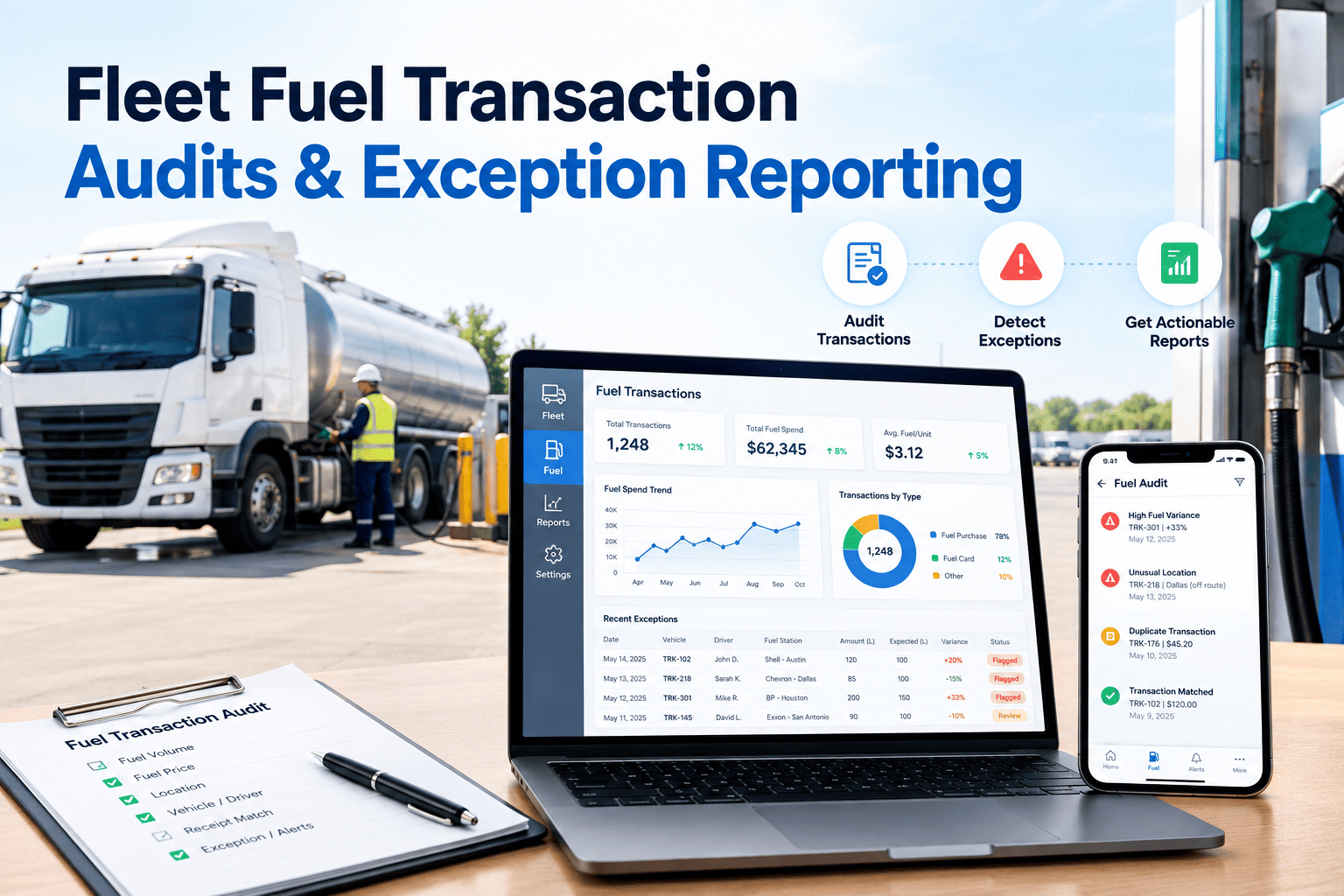
A mid-sized fleet running 75 trucks generates roughly 18,000 fuel card transactions a year — and buried inside that volume, at an average fraud rate of 1 to 3 percent of fuel spend, are the transactions nobody has time to review one at a time. Manual monthly reconciliation catches the obvious cases weeks after the money is gone, by which point the same pattern has usually repeated three or four more times. Exception reporting flips the review order: instead of scanning every transaction for the few that matter, the system does the scanning and hands the fleet manager only the ones that broke a rule — wrong fuel type, impossible location, a tank-busting gallon count. Fleets that move from monthly spreadsheet audits to continuous exception-based review typically recover 4 to 8 percent of fuel spend in the first audit cycle. Book a demo to see how OxMaint builds that exception layer directly into your fleet's maintenance and fuel data.
Fleet Fuel Management · Transaction Auditing
Fleet Fuel Transaction Audits & Exception Reporting
Stop reading every fuel receipt. Set the rules once, let every transaction test itself against them, and only look at the ones that fail.
1–3%
of fuel spend lost to unchecked transactions, industry-wide
4–8%
of fuel spend recovered in a fleet's first exception-based audit cycle
Weeks
the typical delay before month-end reconciliation catches a fraud pattern
Why Reviewing Every Transaction By Hand Doesn't Work
A fleet manager scanning a monthly fuel statement is looking at hundreds or thousands of line items that all look nearly identical — a gallon count, a price per gallon, a station name, a card number. Fraud and waste don't announce themselves in that format. A driver fueling a personal vehicle on the company card looks exactly like a legitimate fill-up unless someone cross-references the vehicle's actual location at that moment. The problem isn't effort — it's that the human eye is not built to catch a five percent deviation buried inside a thousand rows of numbers that all follow the same format. And because most fuel programs still run reconciliation as a monthly, end-of-cycle exercise, the review happens long after the transaction — and long after any chance to stop a repeat purchase the same week.
01
Volume outpaces review capacity
A 100-vehicle fleet fueling twice a week generates over 10,000 transactions a year. No manager reviews that volume line by line every month and still gets their other work done, so review quietly becomes a spot check instead of a full pass.
02
Reviews happen weeks after the fact
Monthly reconciliation means a fraud pattern that started on day one isn't caught until the statement closes — by which time it has often repeated four or five times, and each repeat is money that was recoverable the day it happened but isn't now.
03
Context lives in a different system
The fuel statement shows a transaction. It doesn't show where the vehicle's GPS placed it at that moment, or what its tank capacity is, or when it last fueled — the context that turns a normal-looking purchase into a red flag, and pulling that context by hand for every transaction isn't realistic at scale.
04
Investigation has no starting point
Without a flagged transaction to start from, an investigation is a fishing expedition through thousands of records — most fleets simply don't start one until a variance shows up on the P&L, and by then the trail is cold and the driver has moved on to a different vehicle.
The Six Exception Rules That Catch Almost Everything
Exception reporting works by testing every transaction against a small set of rules the moment it posts. A transaction that passes all six moves on without anyone looking at it. A transaction that fails even one gets flagged for review, with the specific rule it broke attached, so the reviewer knows immediately what to check rather than starting from a blank transaction line. Most fuel fraud and waste falls into one of the six categories below, and together they cover the overwhelming majority of misuse patterns fleet programs actually encounter.
Volume
Capacity exceptions
A purchase larger than the vehicle's tank can physically hold. A 100-gallon tank buying 180 gallons in one transaction is not a fill-up — it's two vehicles, a container, or a resale, and the size of the overage is usually a strong clue to which one.
Location
Geo-location mismatch
The transaction's station location doesn't match the vehicle's GPS position at the time of purchase. This is the single most reliable signal for a card used on a vehicle that wasn't there, because a legitimate fill-up can't happen somewhere the truck never was.
Timing
Time-of-day violations
Fuel purchased at 2 a.m. on a vehicle assigned to a day route, or on a day the vehicle wasn't scheduled to run, flags for review regardless of the amount, since off-hours purchases correlate strongly with personal use.
Fuel type
Product mismatch
Diesel purchased on a gasoline-only vehicle, or premium fuel on a fleet standardized to regular — a mismatch that either damages the engine or signals the card was used elsewhere, so it routes to maintenance as well as accounting.
Price
Price-per-gallon anomalies
A price meaningfully above the regional average at the time of purchase, which can point to a non-network station, a skimmed card, or a data entry error worth correcting before it repeats across the statement.
Frequency
Velocity checks
Two fuel purchases on the same card within an implausibly short window, or a fill-up on a vehicle that fueled to full less than a day earlier — a pattern almost always tied to a second vehicle or a card shared beyond its assigned driver.
Fleet Fuel Program · OxMaint
Rules Only Work If Something Is Checking Every Transaction
OxMaint tests every fuel card transaction against your exception rules the moment it posts, matches it against vehicle GPS and tank capacity, and puts only the transactions that failed a rule in front of your team — with the audit trail already attached.
Manual Reconciliation vs. Exception-Based Auditing
The shift from manual reconciliation to exception-based auditing isn't a bigger version of the same process — it changes what the fleet manager's day actually looks like. The comparison below lays out the practical difference between the two approaches at each stage of the fuel review cycle.
Manual reconciliation
Review cadenceMonthly, at statement close
What's reviewedEvery transaction, or a small random sample if volume is too high
Context availableWhatever the fuel statement itself shows — no GPS or tank data cross-check
Detection lagDays to weeks after the transaction posted
Audit trailNotes in a spreadsheet, if kept consistently at all
Exception-based auditing
Review cadenceContinuous — every transaction tested within minutes of posting
What's reviewedOnly transactions that failed a rule — a small fraction of total volume
Context availableGPS position, tank capacity, fuel type, and recent history attached automatically
Detection lagSame day, usually within the hour
Audit trailEvery flag, decision, and resolution logged permanently against the transaction
From Flag to Resolution: The Investigation Workflow
A flagged transaction is only useful if someone acts on it before the pattern repeats. A structured workflow moves a flagged transaction from alert to resolved decision within days, not at the next statement cycle.
1
Transaction posts and is tested
Every fuel card transaction is checked against the full rule set within minutes of posting — not at month-end when the trail has already gone cold and the pattern has had weeks to repeat.
2
Failed rule generates a flag with context attached
The alert includes which rule failed, the vehicle's GPS position, its assigned driver, and its recent fueling history — so the reviewer isn't starting from zero and doesn't need to pull four separate reports before forming a judgment.
3
Flag is assigned and investigated
A fleet manager or fuel program owner reviews the flagged transaction against the attached context and either clears it as a legitimate edge case or opens a formal investigation with the driver involved.
4
Resolution and driver action are logged
Whether the outcome is a cleared false positive, a policy reminder, or a card suspension, the decision and the reasoning behind it are recorded against that transaction permanently, not left in an email thread that gets deleted next quarter.
5
Pattern tracked across future transactions
Repeat flags on the same card or vehicle are surfaced together, so a driver who trips the same rule three times in a quarter is visible as a pattern, not three unrelated incidents that each look minor on their own.
Setting Rule Thresholds by Vehicle Class
A single gallon threshold across an entire fleet produces bad results — a threshold sized for a light-duty pickup will never trigger on a Class 8 tractor, and one sized for the tractor will flag every legitimate light-duty fill-up. Thresholds need to be set per vehicle class before the rule library is switched on, and the same logic applies to geo-radius and velocity rules: a long-haul tractor legitimately fuels hundreds of miles from the depot, while a local delivery van rarely should.
Light-duty vehicles (pickups, vans, sedans) — capacity threshold set at 15 to 30 gallons per tank, tightest velocity window
Medium-duty vehicles (box trucks, service trucks) — capacity threshold set at 30 to 60 gallons, moderate geo-radius allowance for wider service areas
Class 8 tractors — capacity threshold set at 100 to 300 gallons depending on dual-tank configuration, wider geo-radius for long-haul routes
Off-road and yard equipment — time-of-day rules relaxed for overnight or shift-based operating patterns, capacity thresholds tied to equipment specification sheets
Reefer and auxiliary-power units — fuel type and volume tracked separately from the main tank so reefer fuel doesn't get flagged against the tractor's threshold
Exception Type, Signal, and Typical Response
The table below maps each exception category to the data signal that triggers it and the response a fleet program typically takes once it's confirmed.
| Exception type |
Primary signal |
Typical threshold |
Standard response |
| Capacity exception |
Gallons purchased vs. tank size on record |
Purchase exceeds rated tank capacity |
Immediate flag; review before next card use is authorized |
| Geo-location mismatch |
Station location vs. vehicle GPS at time of sale |
Distance beyond a set radius, commonly 1–2 miles |
Flag for same-day review; highest-priority fraud signal |
| Time-of-day violation |
Purchase timestamp vs. vehicle's scheduled operating hours |
Outside assigned shift or route window |
Flag; cross-check against driver schedule |
| Fuel type mismatch |
Fuel grade purchased vs. vehicle's specified fuel type |
Any mismatch on grade or diesel/gasoline |
Flag; engine-damage risk escalates to maintenance team |
| Price anomaly |
Price per gallon vs. regional average at time of sale |
Meaningfully above local network pricing |
Flag for accounting review; check station network status |
| Velocity check |
Time elapsed since the card's last transaction |
Second full fill-up within an implausible window |
Flag; compare against odometer and route distance |
These six rules are a starting point, not a ceiling — most fleet programs refine their thresholds over the first two or three audit cycles as they learn which patterns are genuinely unusual for their operation and which are just how a particular route or vehicle class normally behaves. A rule set that's too loose lets real misuse through; one that's too tight buries the team in false positives and trains reviewers to click past flags without reading them. The right balance is usually found by starting conservative, tracking how many flags clear as legitimate versus how many turn into confirmed findings, and tightening or loosening individual rules based on that ratio rather than guessing at the outset.
A Flagged Transaction, Start to Finish
The value of exception reporting is easiest to see in a single example. Consider a 60-vehicle regional delivery fleet running standard box trucks, each with a 40-gallon tank and an assigned route within a 30-mile radius of the depot.
9:14 AM
A fuel card assigned to Truck 118 posts a 52-gallon transaction — 12 gallons above the vehicle's rated tank capacity. The capacity rule fails automatically and a flag is created within the minute, no month-end wait involved.
9:15 AM
The flag arrives with Truck 118's GPS position at the time of sale, the driver's name, the vehicle's last three fueling events, and the specific rule that failed — a capacity exception — already attached.
Same day
The fleet manager reviews the context: GPS confirms the truck was at the station, but the mileage between this fill-up and the last one is far shorter than 40 gallons would explain, suggesting the tank wasn't empty when it was topped off, or a second container was filled alongside it.
Next day
The driver is asked directly, confirms a fuel can was filled for a generator on-site, and the policy on non-vehicle fuel purchases is reinforced. The resolution — cleared, with a policy reminder — is logged permanently against the transaction.
Under a monthly reconciliation process, that same transaction would have sat unreviewed for up to four weeks, during which the same pattern could easily have repeated on multiple fill-ups without anyone connecting the events together as a single recurring issue.
What a Structured Audit Program Actually Recovers
Fuel is typically a fleet's second-largest operating cost, behind labor and ahead of maintenance parts — yet it is often the least scrutinized line item, because reviewing it by hand doesn't scale. A structured, rule-based audit program changes the economics without adding headcount, and the gains tend to show up in more than one place at once.
Recovered fuel spend
Fleets moving from periodic manual review to continuous exception monitoring commonly uncover 4 to 8 percent of annual fuel spend as recoverable waste or fraud in the first cycle alone — money that was already leaving the budget, just unnoticed.
Hours returned to the team
Manual reconciliation of a mid-size fleet's fuel statement typically consumes 8 to 12 hours a week. Reviewing only flagged exceptions cuts that time to a fraction, freeing the fuel program owner for higher-value work.
Audit-ready documentation
Every flag, investigation note, and resolution is timestamped and attached to the transaction — the same record set that supports FMCSA and IFTA compliance reviews without a separate documentation scramble.
Earlier detection, smaller losses
Catching a misuse pattern within days instead of at month-end typically means the pattern is stopped after one or two occurrences instead of running for a full billing cycle before anyone notices.
Frequently Asked Questions
What is exception reporting in fleet fuel management?
It's a review method that tests every fuel transaction against a set of rules automatically and surfaces only the ones that fail — instead of requiring someone to review every transaction by hand.
Start free to see how the rule library is configured for your fleet.
How much fuel fraud does a typical fleet actually have?
Industry estimates put unchecked fuel misuse at roughly 1 to 3 percent of total fuel spend across an average fleet, though fleets with weak card controls or no exception monitoring often run higher.
Which exception rule catches the most fraud?
Geo-location mismatch — comparing the fuel station's location against the vehicle's GPS position at the time of sale — is generally considered the single most reliable signal, since a legitimate fill-up can't happen somewhere the vehicle wasn't.
Does exception reporting replace fuel card controls like PINs?
No — card-level controls and exception reporting work together. PINs and purchase restrictions prevent some misuse at the pump; exception reporting catches what still slips through and gets flagged after the fact.
How quickly can a fleet start catching flagged transactions?
Once vehicle, tank capacity, and GPS data are connected, rule-based flagging can run from the first new transaction onward.
Book a demo to see typical setup timelines for a fleet your size.
Fleet Fuel Transaction Auditing · OxMaint
Stop Reading Every Receipt. Start Reviewing the Ones That Matter.
OxMaint connects your fuel card feed to vehicle GPS, tank capacity, and maintenance records, tests every transaction against your exception rules the moment it posts, and gives your team a single queue of flagged transactions with the context already attached — so your review time goes toward the handful of transactions that actually need a decision, not the thousands that don't.