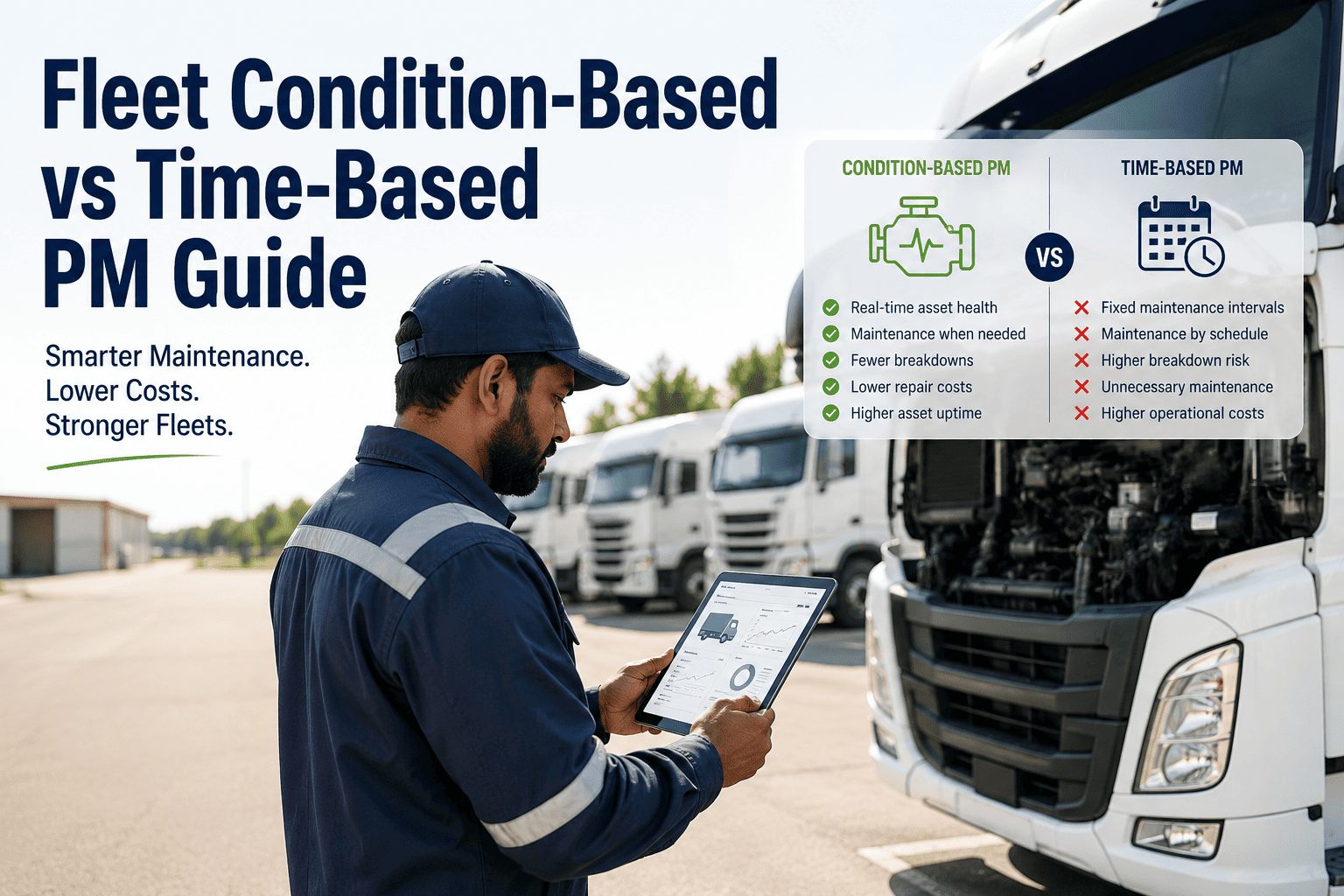
Most fleets still service every vehicle on the same calendar — oil every 90 days, brakes every 12,000 miles — no matter how hard that vehicle actually worked between visits. A school bus running 500 miles a week and a backup unit running 80 miles a week land on identical service dates, which means one gets over-maintained while the other gets serviced too late to catch developing wear. Data pulled across hundreds of U.S. fleets shows this fixed-interval habit lets roughly one in four scheduled PMs run late or get skipped outright, while burning technician hours on components that were nowhere near failure. Condition-based maintenance flips the trigger from a date on a calendar to the actual health of the part, and fleets that make the switch typically see unplanned downtime fall by close to a third and total maintenance spend drop 20 to 40 percent. The real question isn't which strategy wins outright — it's which assets belong on which strategy, a decision OxMaint's fleet maintenance platform helps reliability teams make component by component.
Fleet PM Strategy
Condition-Based vs Time-Based PM — Which One Should Actually Run Your Fleet?
Calendar-driven PM treats every vehicle the same regardless of how it's actually used. Condition-based PM lets real component data decide when service happens — cutting wasted labor while catching the failures a fixed interval walks right past.
22%
less waste
unnecessary maintenance cut by usage-based triggers
32%
downtime
average drop in unplanned breakdowns with CBM
20-40%
cost range
total maintenance spend reduction reported by fleets
70-75%
industry avg
PM completion rate under calendar-only scheduling
The Hidden Cost of Running a Fleet by the Calendar
Time-based PM is easy to explain and easy to budget, which is exactly why most fleets started there. A fixed interval doesn't ask what a vehicle went through last month — it just fires on schedule. That simplicity is also its weakness. A component that's still healthy gets pulled apart anyway, and a component that's degrading faster than expected keeps running until the next scheduled stop, sometimes past the point of safe operation. Neither outcome is intentional; both are baked into a strategy that can't see inside the machine between visits.
Over-Maintenance
Healthy components get pulled apart on schedule simply because the date arrived, burning technician hours and consuming parts inventory that never needed replacing in the first place.
Under-Protection
A high-utilization vehicle accumulates wear faster than the calendar assumes, so the fixed interval arrives after the failure risk has already climbed past a safe threshold.
Missed Windows
Roughly a quarter of scheduled PM tasks across surveyed fleets run late or get skipped, closing the gap between what the plan says and what actually happens on the shop floor.
Two Trigger Philosophies — What Time-Based and Condition-Based PM Actually Mean
Both strategies aim at the same goal — keep the vehicle running and avoid a roadside failure — but they answer a different question. Time-based PM asks "has enough time or mileage passed?" Condition-based PM asks "what is the component's actual health right now?" Neither question is wrong, and most well-run fleets end up asking both, just for different parts of the vehicle.
Time-Based PM
Service triggers on a fixed calendar or odometer interval — every 90 days, every 5,000 miles — set in advance and applied uniformly regardless of how the vehicle was actually used between stops.
Simple to plan, budget, and staff around
Required for safety and regulatory inspection items
Creates a predictable documentation trail
Ignores actual usage intensity between visits
Condition-Based PM
Service triggers on measured evidence — oil analysis results, vibration signatures, fault codes, telematics wear data — so a component is touched only when data shows it actually needs attention.
Labor and parts spend scale to real need
Catches accelerated wear a fixed date would miss
Extends usable component life on average
Depends on sensor coverage and data quality
See Which of Your Assets Are Over-Maintained Right Now
OxMaint maps every vehicle and component in your fleet against actual usage and condition data, flags where time-based intervals are wasting labor, and builds the hybrid PM plan that fits each asset — not a one-size schedule.
Which Assets Belong on Which Strategy — A Tiering Framework
The transition from time-based to condition-based PM is not an all-or-nothing switch. The fleets that get the most value sort their assets into tiers first, then apply the strategy that fits each tier's risk profile, cost, and how much usage data is actually available for it.
Safety and Compliance Items
Brakes, steering linkage, lighting, and DOT-inspected systems stay on a fixed interval by regulation, regardless of what condition data shows. This tier is not a candidate for full CBM conversion.
Strategy: Time-Based, Fixed Interval
High-Cost Rotating Components
Engines, transmissions, and turbochargers justify the sensor investment because a single unplanned failure costs far more than the oil analysis or vibration monitoring needed to predict it.
Strategy: Condition-Based
High-Utilization, Harsh-Duty Units
Vehicles running heavy loads, stop-and-go routes, or extreme climates accumulate wear far faster than a standard interval assumes, making them strong candidates for condition monitoring.
Strategy: Condition-Based
Low-Utilization or Backup Assets
Seasonal and backup vehicles generate too little usage data for condition triggers to be reliable, and inactivity itself causes degradation a calendar interval is better positioned to catch.
Strategy: Time-Based, Extended Interval
Time-Based vs Condition-Based PM — Side by Side
Laid out against the same metrics, the operational gap between the two strategies becomes easier to see — and easier to explain to a fleet director deciding where to put next year's maintenance budget.
Time-Based PM
Condition-Based PM
PM completion rate
70-75% industry average
Higher, driven by automated condition alerts
Labor on healthy components
Significant — service happens on schedule regardless of need
Minimal — labor follows measured evidence only
Unplanned breakdown impact
Higher — faults between intervals go unseen
Reduced roughly 32% in reported fleet programs
Total maintenance cost trend
Stable but includes unnecessary spend
20-40% lower once the program matures
Component visibility
Only at the scheduled stop
Continuous, between stops included
Sensor or data requirement
None beyond a calendar or odometer
Telematics, fault codes, or fluid analysis
Best fit
Safety-critical and regulated items
High-cost, high-utilization components
Making the Transition — Five Steps From Calendar to Condition
Fleets that move successfully from time-based to condition-based PM don't rip out their existing schedule overnight. They layer condition triggers on top of the tiers that benefit most, keep the calendar running underneath as a safety net, and let the CMMS reconcile both.
1
Inventory and Tier Assets
List every vehicle and major component, then sort into safety-critical, high-cost, high-utilization, and low-utilization tiers before touching a single schedule.
2
Instrument for Data
Connect telematics, fault code streams, and fluid analysis for the tiers marked condition-based, starting with the highest-cost components first.
3
Set Hybrid Thresholds
Define the condition thresholds that trigger service, while keeping a mileage or calendar backstop so nothing runs indefinitely on missing data.
4
Automate the Work Order
Route both condition alerts and calendar triggers into the same CMMS so technicians see one prioritized work queue instead of two competing systems.
5
Track and Rebalance
Review completion rates, breakdown trends, and labor spend by tier every quarter, then move assets between strategies as real data builds up.
Frequently Asked Questions
What's the real difference between condition-based and time-based PM for fleets?
Time-based PM triggers service on a fixed date or mileage figure set in advance. Condition-based PM triggers service on measured evidence — oil analysis, fault codes, vibration data — so work happens only when a component's actual condition calls for it.
Should every vehicle in a fleet move to condition-based maintenance?
No. Safety and regulatory items should stay on fixed intervals, and low-utilization backup vehicles rarely generate enough data for condition triggers to be reliable.
Sign in to OxMaint to see a tier-by-tier recommendation for your own fleet.
What data do you need to run condition-based PM on a fleet?
Most fleets start with telematics and diagnostic trouble codes already available through the vehicle's onboard systems, then expand to oil analysis and vibration sensors for the highest-cost components as the program matures.
Does condition-based PM replace DOT-mandated inspections?
No. Federally required inspection items remain time-based regardless of condition data. Condition-based PM is layered on top of, not in place of, safety and compliance schedules.
How long does it take to transition a fleet from time-based to condition-based PM?
Most fleets phase it in over two to four quarters, tier by tier, rather than switching all at once.
Book a demo to map a transition timeline against your own asset mix.
Stop Servicing Every Vehicle on the Same Date
OxMaint tiers your fleet, layers condition data on the components that justify it, and keeps a calendar safety net underneath — one CMMS, one work queue, one PM strategy built around how each asset is actually used.