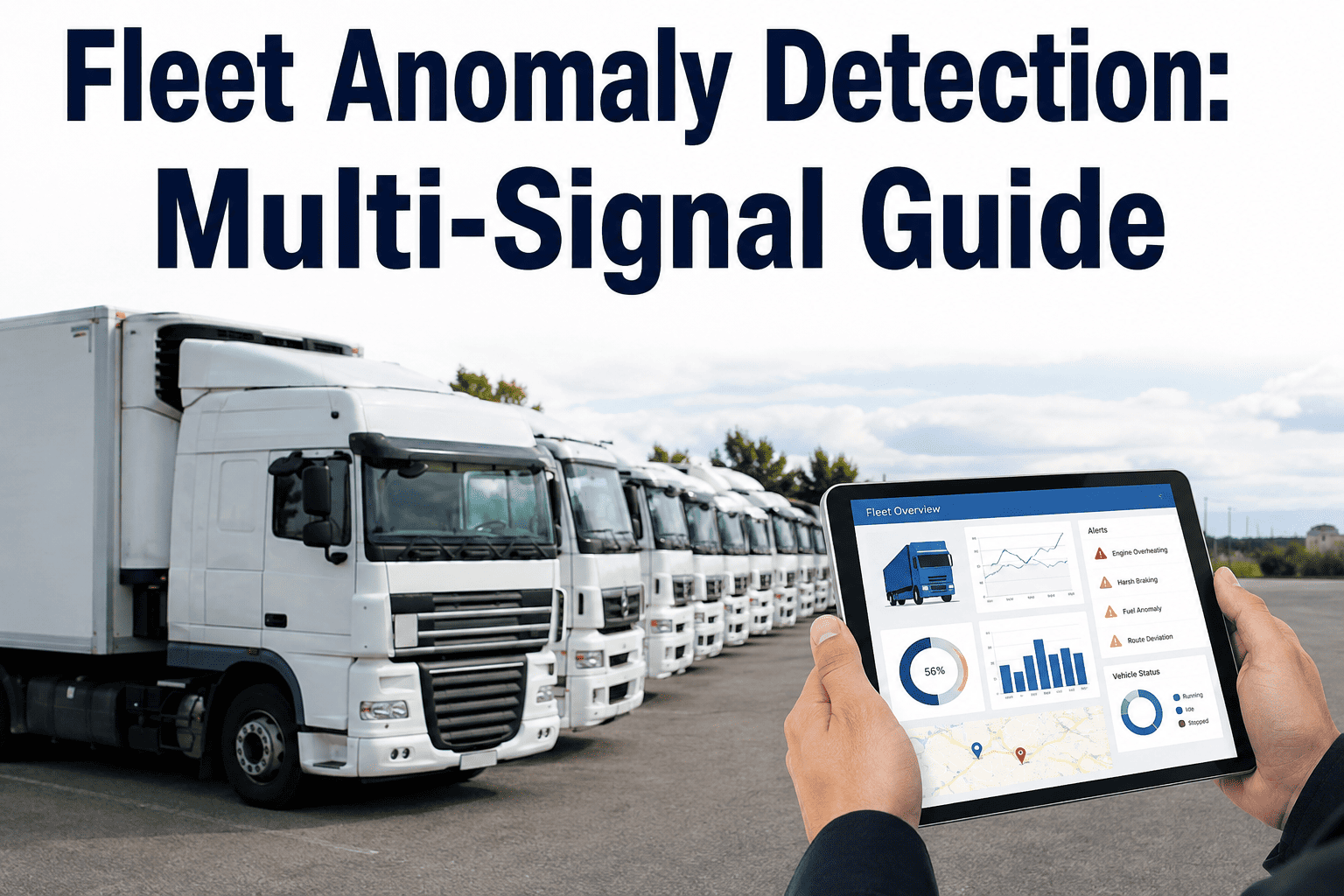
Fleet anomaly detection using multi-signal analysis catches the failures that single-sensor alarms consistently miss — because real breakdowns almost never announce themselves through one channel. A bearing that is starting to fail might raise vibration only 8%, nudge motor current up 4%, and add 3°C to casing temperature: every signal stays "in range," yet the correlation of all three is a clear early warning. This guide explains how multi-signal fleet anomaly detection works, how to build the sensor-fusion architecture and alert workflow behind it, and how to turn correlated anomalies into scheduled maintenance instead of roadside breakdowns. If you want to see this running on your own fleet data, Start Free Trial and connect your first assets in under an hour.
What if your next breakdown is already visible — just not in any single sensor?
One signal says "fine." Four correlated signals say "act now." Multi-signal anomaly detection fuses vibration, temperature, current and process data so your fleet flags problems weeks earlier — with a fraction of the false alarms.
- Fuse 4+ signal types per asset into one anomaly score
- Cut false alarms 60–80% with cross-signal correlation
- Auto-convert confirmed anomalies into CMMS work orders
- Prioritize the 5% of alerts that actually need a wrench
Why single-signal fleet monitoring misses the failures that matter
Threshold alarms on individual sensors catch roughly 30–40% of developing failures — the loud, late-stage ones. The rest hide in the space between signals.
The "everything looks normal" failure
A delivery truck's wheel-end bearing begins to spall. Vibration rises 9% — still under the alarm limit. Hub temperature climbs 4°C — within spec. Driver reports nothing. Three weeks later the bearing seizes at highway speed, taking the brake assembly with it: $9,400 in repairs, a tow, a missed delivery window, and an FMCSA reportable event. Every individual signal was "fine." The correlation was screaming.
The false-alarm tax
Single-threshold systems also cry wolf — constantly. Fleets running per-sensor alarms report that up to 85% of alerts are false or non-actionable. Technicians learn to ignore the dashboard within months, and the one real alert gets buried under forty noise events. Alert fatigue isn't a people problem; it's an architecture problem that multi-signal correlation is designed to solve.
"A single sensor tells you a value. Correlated signals tell you a story — and the story is what lets you act early, order the part, and schedule the repair instead of surviving the breakdown."
The 4 signal streams every fleet anomaly detection system should correlate
Effective multi-signal anomaly detection for fleets starts by instrumenting four complementary channels — each one weak alone, decisive together.
Vibration
Accelerometers on wheel ends, engines, transmissions and PTO-driven equipment. Catches imbalance, misalignment, bearing wear and looseness 4–8 weeks before failure. The earliest mechanical warning channel — but noisy on rough roads, which is exactly why it needs corroboration.
Temperature
Hub, coolant, oil, exhaust and brake temperatures. Slow-moving but highly specific: a hub running 10–15°C hotter than its axle-mates under identical load is a near-certain friction event. Correlating temperature delta-vs-peers — not absolute values — is what makes this channel powerful.
Current & electrical
Motor current signature analysis on electric drivetrains, liftgates, compressors and auxiliary motors. A 3–5% current rise at constant load flags rising mechanical resistance days before vibration sensors agree. Also catches failing alternators, parasitic drains and weak batteries — the #1 cause of fleet no-starts.
Process & operating context
Telematics, load, speed, duty cycle, fuel rate and fault codes from the CAN bus. Context is what separates anomaly from artifact: high vibration at 65 mph on fresh asphalt means something very different than the same reading on a gravel lot. Without this stream, every other channel generates false alarms.
How fleet signal correlation turns weak warnings into one confident alert
A worked example: one Class-8 tractor in a 120-vehicle fleet, instrumented across all four channels over a 5-week window.
| Week | Vibration | Hub Temp vs Peers | Current Draw | Single-Signal Verdict | Correlated Score |
|---|---|---|---|---|---|
| 1 | +4% | +2°C | +1% | All normal | Low — watch |
| 2 | +7% | +4°C | +3% | All normal | Medium — inspect at next PM |
| 3 | +11% | +7°C | +4% | All normal | High — schedule repair |
| 4 | Work order auto-created · bearing replaced during planned stop · 3.5 hrs labor | Resolved: $1,150 | |||
| — | What single-signal monitoring would have delivered: roadside seizure ~week 5–6 | Avoided: $9,400 + tow + downtime | |||
The pattern that matters: no channel ever crossed its individual alarm threshold. Only the correlation of three weak, co-moving signals — rising together, week over week, under comparable duty cycles — revealed the failure. That is the entire case for multi-signal fleet anomaly detection in one table.
A 90-day rollout plan for multi-signal anomaly detection on your fleet
Most fleets reach production-grade correlated alerting in one quarter — if they sequence it right. Here is the timeline OxMaint customers follow.
Instrument & baseline
Pick your 10–20 highest-cost-of-failure assets. Fit vibration and temperature sensors, tap CAN/telematics feeds, and stream everything into OxMaint. The platform builds per-asset baselines automatically — 2–3 weeks of normal operation is enough to learn what "healthy" looks like for each unit and route profile.
Train & tune correlation rules
Define which signal combinations matter per asset class: vibration + temperature for wheel ends, current + vibration for motors, fault-code clusters + fuel rate for engine health. Tune sensitivity against historical failures. Target: fewer than 3 alerts per asset per month — a volume technicians will actually trust and act on.
Automate the response loop
Wire confirmed anomalies straight into work orders: the alert arrives with the asset history, the correlated evidence, the likely failure mode, and the required parts already checked against inventory. Scale from the pilot group to the full fleet, and start tracking the KPI that pays for everything — unplanned roadside events per 100,000 miles.
How OxMaint turns fleet anomaly correlation into scheduled maintenance
Detection without action is just a prettier dashboard. OxMaint closes the loop from correlated signal to completed repair inside one AI-powered CMMS + EAM platform.
Multi-signal ingestion & fusion
OxMaint ingests vibration, temperature, current and telematics feeds into a single per-asset anomaly score — no data-science team required. Fleets typically cut false alerts 60–80% in the first month while catching failures 2–6 weeks earlier than threshold alarms.
Anomaly-to-work-order automation
When a correlated anomaly crosses your confidence threshold, OxMaint auto-generates a prioritized work order with evidence attached and assigns it to the right technician. Result: 30–50% less unplanned downtime and zero alerts dying in an inbox.
Asset history & spare-parts linkage
Every anomaly is logged against the asset's full lifecycle record, and the parts it implies are checked against live inventory. No more discovering a $60 bearing is out of stock while a $40,000 truck sits idle — parts availability is confirmed before the work order is even dispatched.
Reliability analytics that prove ROI
Dashboards track avoided breakdowns, cost-per-mile trends, MTBF by asset class and alert-to-repair cycle time. When leadership asks what the program is worth, you show them: most fleets document payback inside 6 months from avoided roadside events alone.
See your fleet's weak signals — before they become breakdowns
Book a 30-minute demo and we'll walk through multi-signal anomaly detection on asset classes that match your fleet — vibration, temperature, current and telematics, fused into work orders your team actually trusts.
Fleet anomaly detection: your questions answered
What is multi-signal anomaly detection for fleets?
It is the practice of monitoring several sensor channels per asset — vibration, temperature, current, telematics — and flagging problems only when multiple signals deviate together. Because real failures produce weak, correlated changes across channels, this approach catches issues 2–6 weeks earlier than single-sensor alarms while eliminating most false alerts.
Why does single-sensor monitoring miss so many fleet failures?
Because thresholds are set conservatively to avoid alarm storms, early-stage failures rarely breach any one limit. A bearing can raise vibration 9%, temperature 4°C and current 3% — all "normal" individually, unambiguous together. Fleets relying on single-signal alarms typically catch only 30–40% of developing failures before breakdown.
How many sensors do I need per vehicle to start?
Fewer than you think. Most fleets start with vibration plus temperature on wheel ends and existing CAN-bus/telematics data — often hardware they already have. A pilot on 10–20 high-criticality assets is enough to prove value. Start Free Trial and OxMaint will baseline your first assets within weeks.
How does anomaly correlation reduce false alarms?
A single-channel spike might be a pothole, a heavy load or a hot day — context explains it away. But when vibration, temperature and current all drift upward together over days, coincidence becomes statistically implausible. Requiring cross-signal agreement before alerting typically cuts false alarms 60–80%, which is what keeps technicians trusting the system.
What ROI should a fleet expect from multi-signal anomaly detection?
The math is driven by avoided roadside events: a single prevented seizure saves $5,000–$15,000 in repairs, towing and lost revenue. Fleets running correlated detection through a CMMS report 30–50% less unplanned downtime and documented payback within 6 months. Book a Demo and we'll model the ROI against your own breakdown history.
Stop waiting for the loud failure. Catch the quiet one.
OxMaint fuses your fleet's vibration, temperature, current and telematics signals into early, trustworthy alerts — and turns every confirmed anomaly into a scheduled, parts-ready work order.
Free 14-day trial · No credit card · Connect your first assets in under an hour