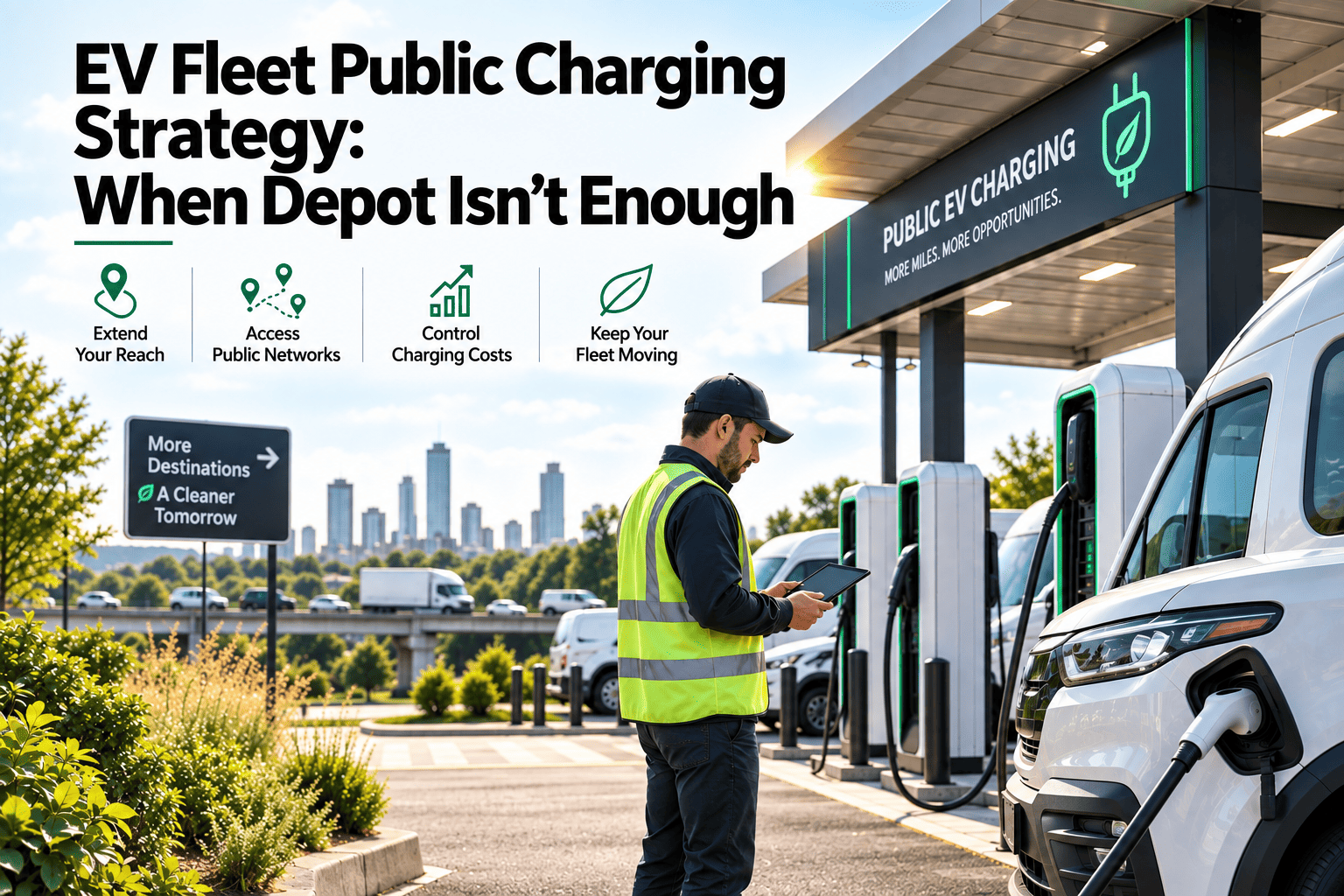
Depot charging is the backbone of most commercial EV fleets, and for good reason — it is cheaper per mile, happens overnight, and keeps vehicles under your own roof. But no depot plan survives contact with a missed route, a driver who needs an extra 80 miles before shift end, or a delivery van stuck two towns over with 12% battery. That is the exact moment a fleet finds out whether it has a real public charging strategy, or just a backup plan nobody ever tested.
Commercial EV Fleet Operations
When depot charging isn't enough, is your fleet actually covered?
Public DC fast charging is meant to be the safety net under your depot plan — but only if network coverage, pricing, and dispatch integration are built in before a driver needs them, not after.
The Trigger Points
Four moments where depot-only charging quietly fails a fleet
Route overruns depot range
A last-minute reroute or extra stop pushes a vehicle past the range depot charging alone can guarantee for the next shift.
Depot charger is down
A faulted port or a utility outage takes a bay offline overnight, and the vehicle scheduled for it still has a route in the morning.
Fleet is scaling faster than infrastructure
New vehicles arrive before permitting, panel upgrades, or utility interconnection for added depot capacity is finished.
Driver operates outside depot radius
Sales, service, or long-haul delivery routes regularly put a vehicle too far from home base to return on the remaining charge.
The Real Numbers
What public charging actually costs a fleet in 2026
Public charging is not free insurance. It carries its own price structure, and knowing that structure before a driver is stranded is what separates a strategy from a scramble.
Depot vs. Public
Where each option actually wins
| Factor | Depot Charging | Public Network |
|---|---|---|
| Cost per kWh | Lower, but demand charges can add 30–50% to the bill during heavy DCFC use | Higher per kWh, no demand-charge exposure to the fleet |
| Upfront investment | $40,000–$250,000+ per DC fast port, plus utility interconnection timelines | No infrastructure capital required |
| Availability | Guaranteed, if the port is working and the vehicle is on-site | Dependent on network uptime and nearby station density |
| Best fit | Predictable overnight or midday routes returning to base | Range overruns, off-route stops, and fleet growth ahead of depot buildout |
Most fleets running mixed routes end up needing both — depot for the predictable base load, and a qualified public network as the pressure valve for everything that doesn't fit the plan.
Know exactly when a vehicle needs a public charge
See how OxMaint connects vehicle and charger status to dispatch, so a low-range alert becomes a routed stop, not a stranded driver.
Building The Fallback
What a real public charging strategy actually needs
Network coverage mapped to your routes
Qualify DCFC stations along every regular route corridor, not just near the depot, and confirm uptime history before relying on a site.
Fleet pricing and access set up in advance
Network memberships and fleet billing accounts are active before the first emergency stop, not signed up for on the roadside.
Live vehicle range visible to dispatch
Dispatch can see remaining range against the planned route in real time, catching a shortfall before it becomes a stranded vehicle.
Automatic fallback trigger
When projected range drops below a safe threshold, the nearest qualified public station is surfaced to the driver automatically.
Spend and usage tracked against depot cost
Public charging spend is logged per vehicle and route, so fleet managers can see exactly when the fallback is being overused.
Where OxMaint Fits
Keeping depot chargers reliable is what reduces public charging costs
The single biggest driver of unplanned public charging spend is a depot charger going down without warning. OxMaint keeps depot infrastructure running so the public network stays the exception, not the default.
Charger asset management
Every depot port is tracked as a maintained asset, with fault history, service records, and warranty data in one place.
Preventive maintenance scheduling
Scheduled inspections on connectors, cabling, and cooling systems catch failures before a port goes down overnight.
Mobile fault reporting
Drivers and technicians log a faulted port from a mobile device the moment it happens, triggering a work order instead of a discovery the next morning.
Reporting dashboards
Depot uptime, work order history, and public charging spend roll up into one dashboard, showing exactly where the fallback plan is being used and why.
FAQ
Frequently asked questions about EV fleet public charging
How much public charging should a fleet plan for?
Most depot-based fleets plan for public charging to cover 5–15% of total charging volume, reserved for range overruns, off-route stops, and depot downtime rather than routine use.
Is public DC fast charging reliable enough for fleet operations?
Major public networks are reporting uptime in the 90–95% range in 2026, a meaningful improvement from prior years, but fleets should still qualify specific stations along their routes rather than assuming network-wide reliability.
Why is public charging so much more expensive than depot?
Public DCFC pricing reflects the network operator's own infrastructure and demand-charge costs, typically landing at $0.35–$0.80 per kWh versus a lower effective depot rate — though depot demand charges narrow that gap more than most operators expect.
Can public charging replace depot infrastructure entirely?
For most commercial fleets, no — the per-kWh cost and dwell time make public charging a poor substitute for predictable, high-volume base charging, which is better handled overnight at the depot.
How does OxMaint help reduce reliance on public charging?
OxMaint keeps depot chargers maintained and monitored so unplanned downtime — the most common reason fleets fall back on the public network — happens far less often. Book a demo at calendly.com/oxmaintapp/30min to see it on your fleet.
Turn public charging into a real fallback, not a gamble
Keep depot chargers running, catch faults before they strand a driver, and see exactly when your fleet needs the public network.
Free 14-day trial · No credit card