A commercial EV fleet is only as reliable as its charging infrastructure — and depot chargers are assets that fail silently. Unlike a vehicle with a dashboard warning light, a charger that degrades gradually gives no obvious signal until a driver arrives at 5 AM to find a vehicle at 30% charge after 8 hours on the plug. For fleet operators transitioning to or scaling electric vehicles, charger uptime is as operationally critical as fuel pump availability was for diesel fleets. Yet most EV depot maintenance programs treat chargers as set-and-forget infrastructure rather than maintained assets with predictable service intervals. Faulty connectors, thermal management failures, firmware drift, and degraded cable insulation are all detectable in advance — with the right inspection program and a CMMS tracking every charger as a registered asset. OxMaint's AI Predictive Maintenance module manages charger assets alongside vehicles — scheduling inspections, logging faults, and predicting failures before they strand a vehicle on a critical delivery day. Register your chargers as maintained assets in OxMaint.
No More Silent Charger Failures
OxMaint tracks every charger as a maintained asset — scheduled inspections, fault logs, and AI-predicted failure warnings before your vehicles are stranded at empty charge.
What Fails in EV Depot Chargers — and When
EV chargers are complex power electronics operating in demanding conditions — temperature extremes, high-cycle connector wear, and continuous software dependency. Understanding the failure modes helps prioritise your inspection effort correctly. Connector wear is the highest-frequency failure in high-utilisation depot chargers — every plug-in cycle degrades the contact surfaces fractionally. Cable insulation cracking accelerates in climates with temperature extremes above 45°C or below -15°C. Thermal management systems in DC fast chargers require periodic coolant checks. Power module faults show early warning signatures in charging session logs — sessions that terminate early, output power that drops below rated capacity, or error codes that appear and self-clear without intervention.
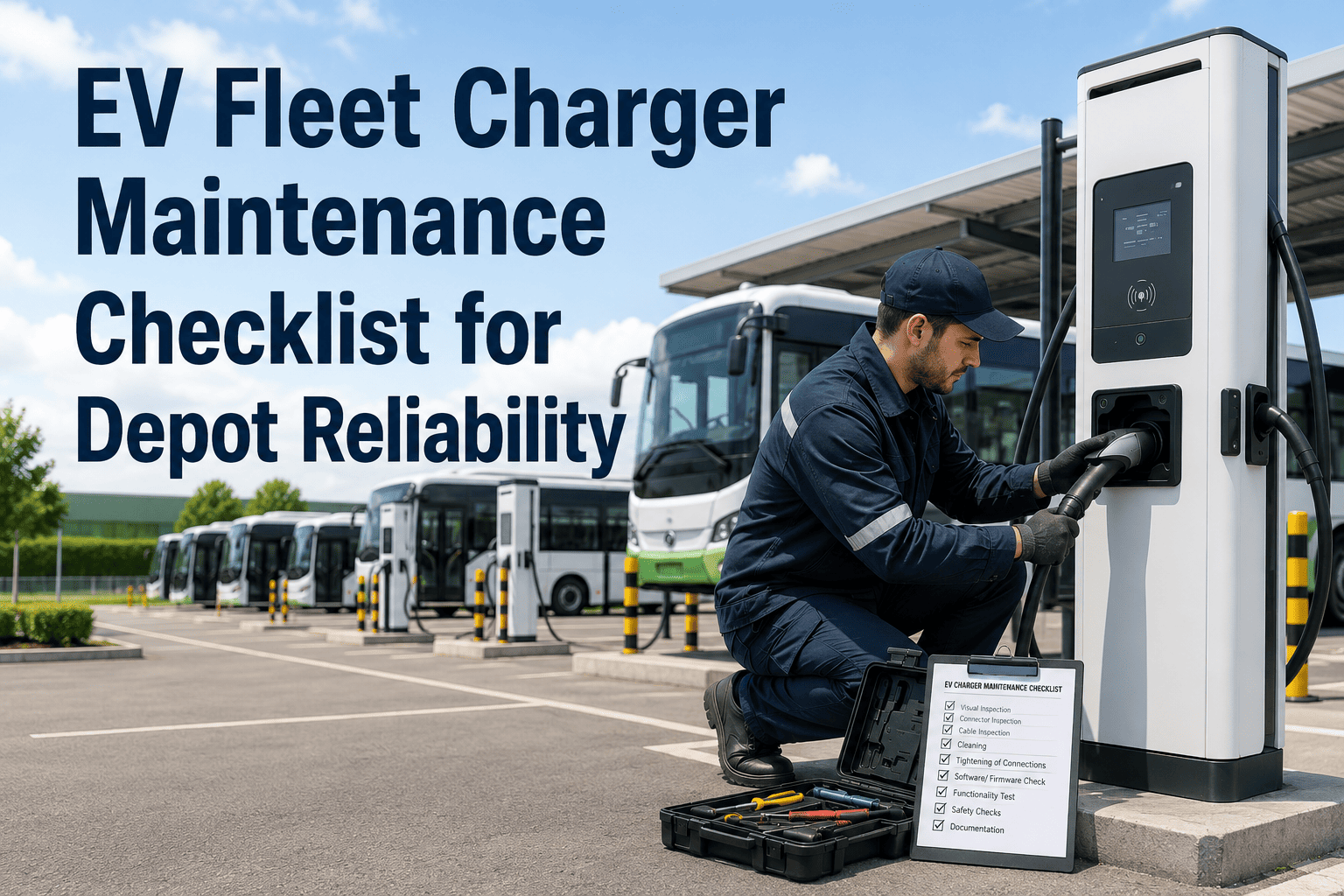
EV Charger Maintenance Checklist — By Interval
Every item below should be logged as a completed inspection record in OxMaint against the charger's asset profile. Undocumented inspections provide no protection during an insurance claim, warranty dispute, or electrical safety audit.
Inspect the charging cable full length for kinks, cuts, abrasion, and insulation cracking. Check the connector for bent pins, corrosion, or discolouration indicating arc damage. Tag any damaged cable as out-of-service immediately — cable insulation failure is a shock hazard. Safety — critical
Export or review the past month's session logs for each charger unit. Flag any unit with more than 3% early session terminations, output power below 90% of rated capacity, or recurring error codes that self-clear. These patterns precede hardware failure by 4–8 weeks. Monthly log review
Check for impact damage, graffiti, forced entry, and seal integrity on all enclosure panels. A compromised enclosure seal allows moisture ingress into control electronics — the leading cause of complete unit failure in outdoor installations. Monthly check
Use a contact resistance meter to measure the resistance across charging connector pins. Resistance above 0.5 milliohms indicates surface oxidation or mechanical wear that will progress to intermittent faults and eventual connector failure. Log readings per OxMaint charger profile. Quarterly measurement
Compare installed firmware against the latest manufacturer release. Outdated firmware causes OCPP protocol errors, charging session timeouts, and incompatibility with new vehicle BMS versions. Schedule firmware updates as CMMS work orders to ensure they are completed and documented. Quarterly audit
Test the residual current device and ground fault protection circuit for each charge point using a certified test instrument. A failed RCD is both a shock hazard and a code violation. Record test results and device serial numbers in OxMaint. Safety — required
Use a thermal camera to scan all internal electrical connections, busbars, and cable terminations for hot spots. A connection running 15°C above ambient indicates loosening or increased resistance — tighten or replace before it becomes an arc fault. Quarterly thermal scan
For liquid-cooled DC fast chargers, check coolant level, colour, and pH. Replace coolant per manufacturer interval (typically 2 years). Any coolant leakage near electronics is an immediate shutdown event — leak inspection should accompany every coolant check. Every 6 months
Annual full electrical inspection by a certified electrician — covering installation integrity, protective earth continuity, overcurrent protection, and insulation resistance. Required for insurance compliance and site safety certification. Certificate uploaded to OxMaint charger asset record. Annual — certification required
High-utilisation chargers (8+ sessions per day) should have cable replacement assessed annually based on cycle count and condition data. Proactive cable replacement at 18–24 months for heavy-use units avoids the emergency downtime of a cable failure mid-shift. Annual review
We had three DC chargers go down in the same week because nobody was tracking them as maintained assets. After setting them up in OxMaint with inspection schedules, we have not had an unplanned charger outage in seven months. The quarterly connector resistance checks catch degradation before sessions start dropping.
Charger Uptime KPIs for Depot Operations
A depot charging program without KPIs has no feedback loop — you will not know your charger uptime is deteriorating until your vehicles start arriving at shift start undercharged. These are the metrics OxMaint tracks automatically from charger session data and inspection records.
| KPI | Formula | Target | Action Trigger |
|---|---|---|---|
| Charger Availability Rate | Uptime hours / Total scheduled hours | ≥ 98% | < 95% — maintenance audit |
| Session Completion Rate | Completed sessions / Initiated sessions | ≥ 99% | < 97% — charger flagged for inspection |
| Mean Time Between Failures | Operating hours / Number of faults | > 8,760 hrs | < 4,380 hrs — PM review |
| PM Compliance Rate | Completed PM tasks / Scheduled PM tasks | 100% | < 90% — schedule review in OxMaint |
| Average Charge Throughput | kWh delivered / kWh session target | ≥ 95% | < 90% — power module inspection |
Track Every Charger Like a Critical Fleet Asset
OxMaint registers each charge point as a maintained asset — with its own inspection schedule, fault history, and AI-predicted failure warnings. Your depot stays reliable, your vehicles stay charged.
How OxMaint AI Predictive Maintenance Works for EV Chargers
Traditional charger maintenance is reactive — something fails, a technician is dispatched, and the vehicle waiting for charge is stranded. OxMaint changes the sequence. The platform ingests charger session data and inspection records continuously, running pattern analysis across each unit's performance history. When a charger's session completion rate drops below its rolling average, or its error code frequency increases, or its scheduled inspection is 14 days overdue, OxMaint raises a predictive work order before the unit fails. The result is fewer emergency callouts, higher depot uptime, and maintenance labour spent on scheduled inspections rather than emergency diagnostics.
Frequently Asked Questions
Questions fleet operators commonly ask when setting up their first EV charger maintenance program.
Build a Depot That Never Lets Your EVs Down
OxMaint turns your charger infrastructure into a maintained, monitored, audit-ready asset fleet. Start your free trial and register your first charger today.