A tire ten PSI under spec does not set off an alarm a shop can act on — it just runs hotter, wears faster, and burns more fuel for weeks until someone notices. Most fleets already have the sensors that would catch this the moment it happens. What they are missing is the wiring between the sensor and the work order, and that gap is where the savings disappear start a free trial.
Fleet Maintenance · TPMS-CMMS Integration
A Pressure Alert Should Never Just Sit on a Dashboard. It Should Become a Work Order.
The integration architecture that connects PressurePro, Doran, and telematics-based TPMS sensors directly to scheduled service — no dispatcher relaying alerts by phone.
The Cost of a Pressure Alert Nobody Acts On
Tire pressure monitoring has been standard equipment on most commercial fleets for years. The sensors are reliable and the data is accurate. The failure point is almost never the hardware — it is what happens between the moment a sensor detects underinflation and the moment a technician actually puts a wrench on the tire.
1%
fuel efficiency lost for every 10 PSI a commercial tire runs under spec
10%
of usable tread life surrendered at that same 10 PSI deficit
$70K–$140K
annual recovery for a 100-truck fleet from a 5 PSI average improvement
0
manual steps between alert and work order when TPMS is fully integrated
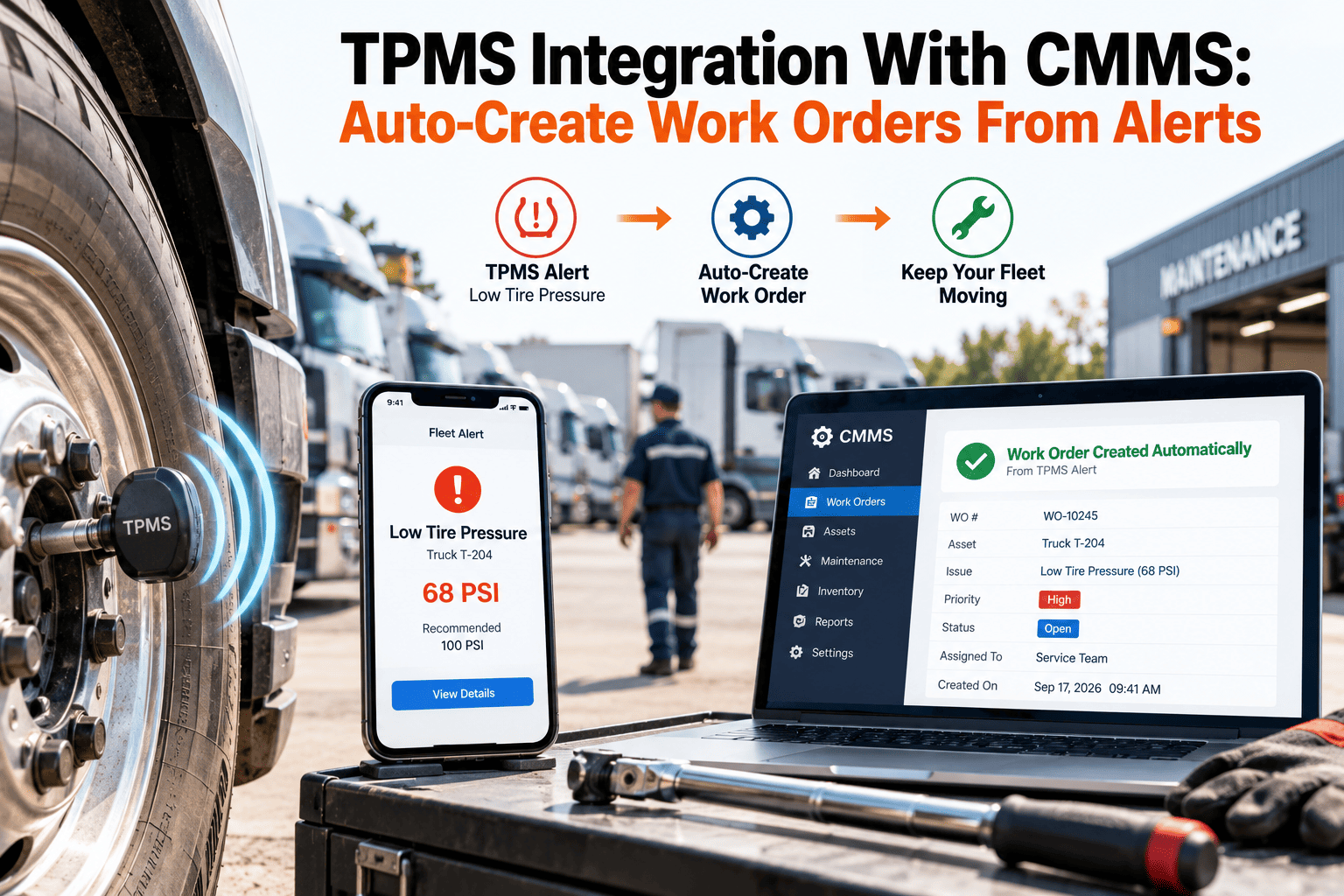
Without integration, a pressure alert reaches a driver's dash or a dispatcher's inbox and then depends on a person remembering to act on it before the next dispatch, the next shift change, or the next distraction. Full integration removes that dependency by writing the alert directly into the maintenance system as a scheduled work order the moment it crosses a threshold.
Three Levels of TPMS Deployment — Only One Closes the Loop
Level 1
Driver-Only Alerts
Sensors warn the driver in-cab. Resolution depends entirely on the driver noticing, remembering, and reporting it once the truck is back at the yard.
Telematics-Integrated
Level 2
Pressure and temperature stream to the telematics platform. Dispatch and the shop see the breach in real time, even if the driver never reports it — but someone still has to open a ticket.
Level 3
Full CMMS Integration
The alert writes directly into the maintenance system. A tire below threshold generates an automatic work order, and the event is logged to that tire's lifecycle record without anyone touching a keyboard.
How the Alert-to-Work-Order Pipeline Actually Works
TPMS Sensor to Scheduled Service — Five Stages
01
Sensor Reads Pressure
Valve-cap or internal sensors from PressurePro, Doran, or a comparable provider stream live pressure and temperature per tire to a receiver on the vehicle.
→
02
Threshold Evaluated
Configured per axle position and vehicle type, the threshold triggers when a reading crosses the defined underinflation or overheat limit — not on every minor fluctuation.
→
03
Data Reaches the API
The telematics or TPMS platform pushes the breach event through an API or middleware connection into the CMMS, carrying vehicle ID, tire position, and severity.
→
04
Work Order Generated
The CMMS creates a work order automatically, assigned by priority and routed to the shop or the nearest approved service point, with the tire position pre-filled.
→
05
Lifecycle Record Updated
Once resolved, the event and the pressure trend write back to that specific tire's history — feeding replacement forecasting instead of disappearing after the ticket closes.
Every stage after sensor reading runs without a person manually opening a ticket — the integration is what turns a data feed into scheduled labor
OxMaint · TPMS Integration
Connect Your TPMS Feed to Work Orders That Actually Get Scheduled
OxMaint ingests pressure and temperature alerts from PressurePro, Doran, and telematics platforms, and turns a threshold breach into a work order automatically.
What the Integration Architecture Actually Requires
Connecting a TPMS feed to a CMMS is not a single plug-and-play toggle. It depends on how the sensor data reaches the fleet's existing systems, and most deployments fall into one of two patterns.
A
Direct API connection — the TPMS or telematics provider exposes an API that the CMMS polls or subscribes to, pushing alerts as they occur
B
Middleware bridge — a connector layer translates the TPMS provider's data format into the CMMS's work order schema when no native API exists
C
Threshold configuration — pressure and temperature limits are set per vehicle class and axle position, not as a single fleet-wide number
D
Routing rules — work orders route to the correct shop, mobile technician, or approved third-party vendor based on the vehicle's current location
E
Lifecycle write-back — resolved events feed a per-tire history so pressure trends inform replacement timing, not just single incidents
Manual Alert Handling vs Automated Work Order Generation
Fleet Size Changes How the Integration Pays Off
Small Fleet · Under 50 Units
One Person Cannot Watch Every Dashboard
Small fleets rarely have a dedicated person monitoring a telematics dashboard all day. Integration matters most here because it replaces constant manual watching with an alert that only surfaces when action is actually needed.
Mid-Size Fleet · 50–250 Units
Alert Volume Outpaces Manual Triage
At this scale, enough pressure events occur daily that manual triage becomes a full-time job on its own. Automated routing keeps the shop working from a prioritized queue instead of a scrolling alert feed.
Large Fleet · 250+ Units, Multiple Terminals
Consistency Across Terminals Is the Hard Part
Large fleets need the same threshold logic and routing rules applied identically at every terminal, so a pressure event in one location gets the same response as the same event anywhere else in the network.
What Happens When Integration Is Missing
Picture a driver's dash lighting up on a Tuesday morning during a delivery run. Most fleets have no formal process at that moment — the driver either remembers to mention it at the end of the shift, radios dispatch mid-route, or, more often, simply keeps driving because the truck still moves fine and the deadline matters more than a dashboard icon.
The sensor did its job. The gap was never data quality — it was the missing link between a reading and a scheduled action.
Two weeks later, that same tire is pulled for inspection because it is visibly worn on one shoulder. By then it has already cost the fleet fuel efficiency for every mile driven underinflated, and the technician replacing it has no pressure history to explain why the wear pattern looks the way it does. The sensor did its job the entire time — the gap was never data quality, it was the missing link between a reading and a scheduled action.
Integration does not require better sensors. It requires the alert to travel automatically, without depending on human memory.
This is the exact failure mode that integration removes. It does not require better sensors or a different TPMS vendor. It requires the alert to travel automatically from the sensor to a work order, without depending on a driver's memory or a dispatcher's spare attention during a busy shift.
Why Threshold Configuration Matters More Than People Expect
A poorly configured threshold undermines an otherwise well-integrated system just as effectively as no integration at all. Set the threshold too sensitive, and the shop drowns in work orders for pressure variations that are normal for the season and the load. Set it too loose, and the system misses the underinflation that is actually costing fuel and tread life.
A
Vary thresholds by axle position — steer, drive, and trailer axles carry different loads and tolerate different pressure ranges before a reading becomes a real concern
B
Adjust for seasonal temperature swings — ambient temperature changes baseline pressure readings, and a threshold set in summer can trigger unnecessary alerts once winter arrives
C
Separate warning from critical — a moderate deviation can route to the next scheduled service window, while a severe one should generate an immediate work order
D
Review false-positive rates monthly — a threshold that generates work orders technicians routinely close as "no issue found" needs recalibration before it erodes trust in the whole system
The Data an Integrated System Builds Over Time
A single pressure alert is useful in the moment. A year of pressure alerts, tied to a specific tire position on a specific vehicle, becomes something more valuable — a trend line that predicts replacement timing before a tire fails on the road.
A single alert is useful in the moment. A year of alerts tied to one tire position becomes a prediction.
Fleets that have run full CMMS integration for a season or more typically notice the pattern before it becomes obvious on a walkaround inspection: a specific position on a specific vehicle starts requiring more frequent pressure corrections weeks before the tread wear becomes visible. That early signal is only available because every prior event was written to the same tire record instead of disappearing after each ticket closed.
Reactive tire management replaces on the tire's schedule. Lifecycle management replaces on the fleet's schedule.
This is the difference between reactive tire management and a lifecycle approach. Reactive management replaces a tire when it fails or when a routine inspection flags visible wear. Lifecycle management uses the accumulated pressure and service history to schedule the replacement on the fleet's terms, during planned downtime, rather than on the tire's terms, on the side of a highway.
Choosing Between API and Middleware — A Practical Decision
Fleets planning an integration often assume they need to pick a single "best" technical approach, when the right answer usually depends on what the existing TPMS provider already supports rather than a general preference. A direct API connection is simpler to maintain long-term, but it only works when the provider actually exposes one with the data fields a CMMS needs — vehicle ID, tire position, pressure reading, and timestamp at minimum.
The right integration path depends on what the existing provider supports, not on a general technical preference.
Middleware becomes necessary when the TPMS or telematics platform predates modern API standards, or when a fleet runs multiple sensor brands across different parts of its operation and needs one translation layer to normalize the data before it reaches the maintenance system. This is common in fleets that have acquired other operations over time and inherited whatever TPMS hardware came with each one.
Neither path requires replacing existing TPMS hardware. The integration layer sits between what the sensors already collect and what the maintenance system already does with work orders — it is connective work, not a hardware replacement project.
Frequently Asked Questions
Which TPMS providers integrate with a CMMS?
PressurePro, Doran, and most telematics platforms with tire pressure modules expose an API or support a middleware connection, which is what a CMMS uses to receive threshold-breach events as work orders rather than raw sensor data.
Does every pressure fluctuation create a work order?
No — thresholds are configured per axle position and vehicle type so only breaches that actually require service generate a ticket, which keeps the shop working from a real priority list instead of noise.
Can OxMaint connect to our existing TPMS hardware?
Yes — OxMaint connects to PressurePro, Doran, and telematics-based TPMS feeds through API or middleware, converting threshold breaches into scheduled work orders automatically.
Start a free trial to see it against your current sensor data.
What happens to the tire's history after the work order closes?
The pressure event and resolution write back to that specific tire's lifecycle record, building the trend data that feeds replacement forecasting instead of ending at ticket closure.
How long does the integration take to set up?
Most fleets connect an existing TPMS provider within a few days once API credentials and threshold values are confirmed —
book a demo to review your specific sensor setup.
Every Pressure Alert Your Fleet Already Generates Can Become a Work Order. Today It Probably Doesn't.
Threshold detection, automatic routing, and per-tire lifecycle tracking — connected in one platform.